Houston's top startups by valuation range from e-commerce startups to a geothermal pioneer. Photo via Getty Images

The Greater Houston Partnership has released its list of the 10 most valuable startups that are fueling the city’s growth and entrepreneurial energy, including industry giants like Axiom Space and Fervo Energy.

Currently, Houston hosts more than 1,300 startups in industries such as energy, life sciences, manufacturing and aerospace, according to the GHP. The list ranks its top 10 startups by valuation based on the company’s last private funding round, reflected in Pitchbook data, as of Oct. 20 of this year.

The top 10 list includes:

10. NXTClean Fuels

Valuation: $530 million

NXTClean Fuels builds biofuel refineries that produce renewable fuel by using feedstocks like cooking oil and recycled organic materials.

9. Homebase

Valuation: $660 million

HR tech company Homebase provides employee management software that helps manage and optimize timesheets, payroll and more, with over over 100,000 small businesses and 2 million hourly workers using its product.

8. Zolve

Valuation: $800 million

Zolve is a banking platform that provides customers with access to financial products that aim to be accessible, flexible, and affordable than other financial platforms.

7. Stramsen Biotech

Valuation: $807 million

Stramsen Biotech develops plant-based drug therapies that target both infectious and noninfectious diseases, which include cancer, diabetes, HIV, kidney disease and neurological issues.

6. Octagos

Valuation: $843 million

Healthtech company Octagos has developed a remote cardiac monitoring software driven by AI that helps consolidate patient data in real-time, assisting healthcare professionals in providing quicker, easier and more accurate care.

5. Fervo Energy

Valuation: $1.4 billion

Pioneering geothermal company Fervo Energy combines horizontal drilling and fiber-optic sensing to produce electricity. The company is developing its flagship Cape Station geothermal power project in Utah. The first phase of the project will supply 100 megawatts of power beginning in 2026

4.Cart.com

Valuation: $1.7 billion

Cart.com is an e-commerce giant and logistics solutions provider that was founded in 2020 and obtained unicorn status within just three years.

3. Axiom Space

Valuation: $2.1 billion

Axiom Space is one of the anchor tenants at the Houston Spaceport, and has completed four missions of sending commercial astronauts to the ISS since 2022. In 2027, the company expects to see the first section of its private space station, Axiom Station, launched into low-earth orbit.

2. Solugen

Valuation: $2.175 billion

Solugen replaces petroleum-based products with plant-derived substitutes through its Bioforge manufacturing platform.

1. HighRadius

Valuation: $3.2 billion

HighRadius uses advanced technology to automate and manage accounts receivable processes for businesses worldwide.

The GHP also released its State of Houston’s Tech and Innovation Landscape, which mapped Houston’s digital and innovation sectors. Read the full report here.

Sage Geosystems is the No. 3 most innovative startup in Texas. Photo via sagegeosystems.com

3 Houston startups named most innovative in Texas by LexisNexis

report card

Three Houston companies claimed spots on LexisNexis's 10 Most Innovative Startups in Texas report, with two working in the geothermal energy space.

Sage Geosystems claimed the No. 3 spot on the list, and Fervo Energy followed closely behind at No. 5. Fintech unicorn HighRadius rounded out the list of Houston companies at No. 8.

LexisNexis Intellectual Property Solutions compiled the report. It was based on each company's Patent Asset Index, a proprietary metric from LexisNexis that identifies the strength and value of each company’s patent assets based on factors such as patent quality, geographic scope and size of the portfolio.

Houston tied with Austin, each with three companies represented on the list. Caris Life Sciences, a biotechnology company based in Dallas, claimed the top spot with a Patent Asset Index more than 5 times that of its next competitor, Apptronik, an Austin-based AI-powered humanoid robotics company.

“Texas has always been fertile ground for bold entrepreneurs, and these innovative startups carry that tradition forward with strong businesses based on outstanding patent assets,” Marco Richter, senior director of IP analytics and strategy for LexisNexis Intellectual Property Solutions, said in a release. “These companies have proven their innovation by creating the most valuable patent portfolios in a state that’s known for game-changing inventions and cutting-edge technologies.We are pleased to recognize Texas’ most innovative startups for turning their ideas into patented innovations and look forward to watching them scale, disrupt, and thrive on the foundation they’ve laid today.”

This year's list reflects a range in location and industry. Here's the full list of LexisNexis' 10 Most Innovative Startups in Texas, ranked by patent portfolios.

  1. Caris (Dallas)
  2. Apptronik (Austin)
  3. Sage Geosystems (Houston)
  4. HiddenLayer (Austin)
  5. Fervo Energy (Houston)
  6. Plus One Robotics (San Antonio)
  7. Diligent Robotics (Austin)
  8. HighRadius (Houston)
  9. LTK (Dallas)
  10. Eagle Eye Networks (Austin)

Sage Geosystems has partnered on major geothermal projects with the United States Department of Defense's Defense Innovation Unit, the U.S. Air Force and Meta Platforms. Sage's 3-megawatt commercial EarthStore geothermal energy storage facility in Christine, Texas, was expected to be completed by the end of last year.

Fervo Energy fully contracted its flagship 500 MW geothermal development, Cape Station, this spring. Cape Station is currently one of the world’s largest enhanced geothermal systems (EGS) developments, and the station will begin to deliver electricity to the grid in 2026. The company was recently named North American Company of the Year by research and consulting firm Cleantech Group and came in at No. 6 on Time magazine and Statista’s list of America’s Top GreenTech Companies of 2025. It's now considered a unicorn, meaning its valuation as a private company has surpassed $1 billion.

Meanwhile, HighRadius announced earlier this year that it plans to release a fully autonomous finance platform for the "office of the CFO" by 2027. The company reached unicorn status in 2020.

---

This article originally appeared on Energy Capital HTX.

In the latest round up of Houston innovation news you may have missed, a health tech startup has grown its team, a coworking company opens its latest location, and more. Shobeir Ansar/Getty Images

Houston named a top market for remote tech workers, startup doubles its staff, and more innovation news

short stories

Houston is starting 2022 strong in terms of innovation news, and there might be some headlines you may have missed.

In this roundup of short stories within Houston startups and tech, the Bayou City is ranked based on its ability to employ remote tech talent, a coworking company opens a new location, a med device startup doubles its staff, and more.

New report finds Houston a top market for remote tech talent

Houston is a top city for employing remote tech workers. Graphic via Karat

In a new report, Karat — a Seattle-based human resources company — looked at which metros were best for attracting remote tech talent. The company first completed the report based on 2020 due to a changing workforce spurred by the pandemic.

"Last year we took our first look at the rapidly expanding remote software engineer hiring landscape. As more organizations shifted to remote or hybrid working models we had started to see significantly improving candidate performance outside of the more-established tech hubs," writes Patrick Wu, data analyst at Karat, in a blog post. "Today, as even more top tech companies commit to hiring remote software engineers, we’re taking a look at how this landscape has continued to evolve."

Houston ranked No. 6 this year in the list of 10 metros just ahead of No. 7 Austin. Last year, Houston ranked as No. 2 and Dallas at No. 9, but that North Texas metro fell off the top 10 for 2021. Pittsburgh maintained its top spot on this list year over year.

Houston artificial heart company makes strategic hires

This med device company has eight new team members. Photo via bivacor.com

BiVACOR, a Houston-based cardiatric medical device company, announced that it has doubled the size of its team with the addition of eight team members. The growth comes following its series B raise last year.

“The diversity of skills and experience throughout the company is something we are very proud of, and I am pleased to welcome this all-star group of individuals to the team,” says Daniel Timms, BiVACOR founder and CEO, in a December news release. “They will each play an integral role in the overall accomplishments of BiVACOR, specifically as we undertake benchtop and preclinical verification activities so that we can commence our First in Human early feasibility study in the near future.”

Here's who recently joined the company at both its United States and Australia-based operations:

  • Nathan Kong, purchasing administrator
  • Farhad Akhavan, systems engineer
  • David Duarte, verification and validation engineer
  • Paul Chiver, manufacturing technician
  • Lindsey Brede, financial controller
  • Dawnel Scott, director QA/RA
  • Mairi Maclean, director of product development
  • Nicole Bartnikowski, scientific manager (Australia)

“Having the ability to attract and hire individuals with the industry knowledge and pedigrees of this world-class team is a testament to how BiVACOR is perceived in the industry," Timms continues. "Each of them brings a unique perspective and skillset to BiVACOR and will play an important role in furthering our technology.”

BiVACOR is developing its Total Artificial Heart, or TAH. The device, billed as the first long-term therapy for patients with severe heart failure, is an implantable artificial heart based on rotary blood-pump technology. Similar in size to an adult fist, it is small enough to be implanted in many women and some children yet capable of delivering enough cardiac power to a man who's exercising. Unlike the two-chamber human heart, BiVACOR's device features a single chamber.

Coworking company opens new Houston location

Common Desk has a new West Houston location. Photo via Common Desk

Dallas-based Common Desk has announced the opening of its newest location in Westchase District. The flexible workspace company opened its first location in Houston in October 2020 and unveiled four more locations since then. The company shares in a news release that two more spots will be opening in 2022.

Common Desk - Westchase (2500 CityWest Blvd) ha 20,000 square feet of coworking space with 54 private offices, four office suites, six conference rooms, and shared space. Tenants will have access to an outdoor space, reserved and unreserved garage parking, a fitness center, and Common Desk's coffee brand, Fiction Coffee.

"When thinking about expanding our reach in the city, we knew we wanted to be somewhere in West Houston,” says Bobby Spoden, community sales manager at Common Desk, in the release. “Community comes first at Common Desk, and we love that the Westchase District shares the same value. We couldn't be more excited and honored to become part of the rich community in the West Houston area, and we're looking forward to the new additions to our vibrant member base."

Houston fintech unicorn expands on partnership with software company

HighRadius has deepened its partnership with Genpact. Photo via highradius.com

New York-based Genpact and Houston-based HighRadius announced the expansion of their strategic partnership. The expanded partnerships means the merging HighRadius's Autonomous Software platform with Genpact’s global accounts receivables and digital process and delivery expertise to enhance client experience across the board.

“Now more than ever, the finance function plays a vital role in leading businesses through crises, providing agility and insight that lead to greater resilience. To thrive, organizations must connect, predict and adapt at speed, placing data at their core and embracing digital technologies,” says Tiger Tyagarajan, CEO at Genpact, in a news release. “Bringing our two companies together in even deeper partnership will allow a new level of predictive intelligence that can derive meaningful insights and lead to impactful action for our clients.”

The duo originally teamed up in February of 2020 to bring together their expertise — digital automation solutions and advanced machine learning and artificial intelligence.

“If we paint the picture of the future of finance, and therefore the future of the CFO and the CFO organization, we think about the world of the CFO as one where technologies will basically allow them to make decisions every minute,” says Sashi Narahari, founder and CEO at HighRadius, in the release. “Prediction is what the machine will do. Decision, judgment and experience are never going to go away from human beings. So, humans are going to spend more time than they do today on decisions and examining business outcomes. That’s where the HighRadius and Genpact partnership can make a big difference.”

3 deadlines approach for Houston startup opportunities

Don't miss these three founder opportunities. Photo via Rice

Three different entrepreneurial opportunities have deadlines quick approaching.

  • The Rice Business Plan Competition, which is planned for April 7-9 this year, has its applications open until January 31. Any graduate-student startup, in a broad range of industries, from any university, in any degree program, in any country, can apply to the RBPC. Learn more about the competition and how to apply online at https://rbpc.rice.edu/compete.
  • Applications are open for the Black Girl Ventures Change Agent Fellowship, a nine-month leadership skills development program for Black and Brown women entrepreneurs and ecosystem builders. Selected applicants, who must be based in Los Angeles, New York, Chicago, Miami, Houston or Detroit, will each receive a $10,000 stipend. The time commitment is about 8 hours/month. The deadline to apply is January 31, 2022, and decisions will be made by mid-February. Learn more and apply at https://www.blackgirlventures.org/fellowship.
  • The 2022 HCC Business Plan Competition has applications open through January 28. The BPC will begin in late February and run through early June, with six free, virtual, 1.5 hour training  sessions. To learn more about the program and eligibility, click here.

Nuro, which has several pilot programs on Houston roads, has raised fresh funding — plus a few other short stories of Houston innovation. Photo courtesy of Kroger

Nuro scores $600M, Houston e-commerce startup launches ESG tool, and more local innovation news

short stories

The Houston innovation ecosystem has been bursting at the seams with news from innovative tech companies and disruptive Houston startups as we fly through the final quarter of 2021.

In this roundup of short stories within Houston innovation, a California tech company with a large presence in Houston has raised hundreds of millions in investment funding, a logistics startup has been ranked among the most innovative companies, the city of Houston has named its new sustainability leader, and more.

California tech company with huge presence in Houston raises $600M

Nuro has fresh funding to deploy its tech in Houston and beyond. Photo courtesy of Nuro

California-based Nuro, which has a large presence in Houston, announced the closing of its $600 million series D round led by Tiger Global Management with participation from Baillie Gifford, Fidelity Management & Research Company, LLC, Gaorong Capital, Google, Kroger, SoftBank Vision Fund 1, funds and accounts advised by T. Rowe Price Associates, Inc., Woven Capital, and other existing investors, per a news release. The new funding will support the development and deployment of Nuro's autonomous delivery service in communities across the country.

"We're thrilled to have the backing of these prominent investors and world class companies, and honored that they support our vision of improving communities and revitalizing local commerce," says Dave Ferguson, Nuro co-founder and president, in the release. "We believe this investment will allow us to accelerate our commercialization strategy and better everyday life with Nuro's technology."

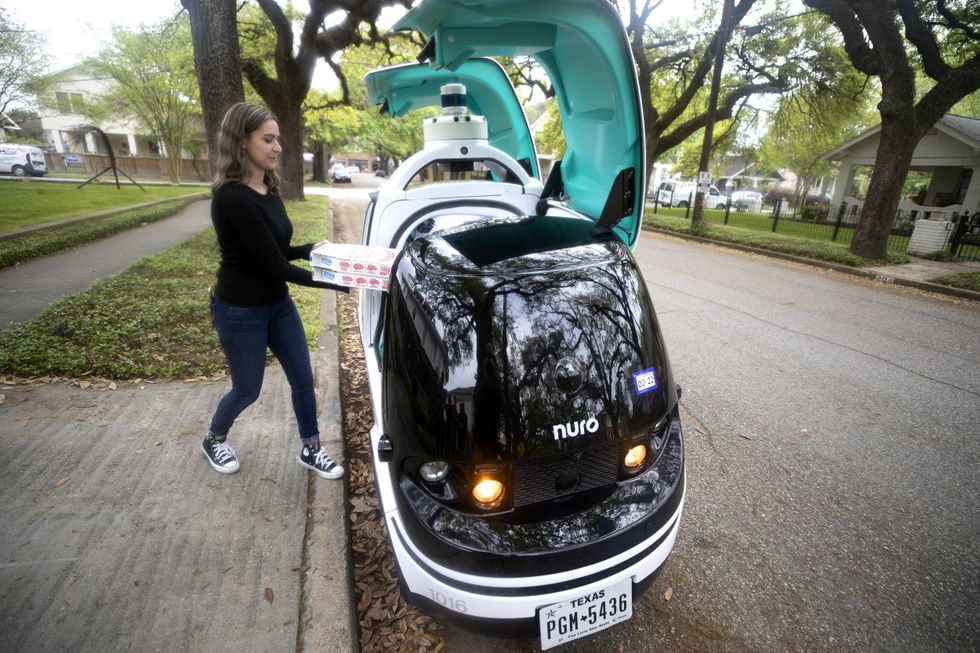
Nuro has launched a few delivery pilots in Houston over the past few years, including the first Nuro pilot program with Kroger in March 2019, grocery delivery from Walmart that was revealed in December 2019, pharmacy delivery that launched in 2020, and pizza delivery with Domino's that went live in Woodland Heights earlier this year. Most recently, Nuro partnered with FedEx for last-mile delivery.

"Kroger launched its partnership with Nuro in 2018 to explore grocery delivery through autonomous vehicles," said Yael Cosset, senior vice president and chief information officer for Kroger, in the release. "Since then, Kroger and Nuro completed thousands of deliveries to our customers -- driving innovation that supports our expanding seamless ecosystem by creating consistent and rewarding customer experiences with scalable, sustainable, and profitable solutions."

Nuro has also signed a five year strategic partnership with Google Cloud that support the tech needed to run self-driving simulation workloads, machine learning to improve model accuracy, and storage to manage important data from the vehicles, according to the release.

Houston-based digital supply chain company launches ESG tool

Houston industrial e-commerce startup expands into the construction industry
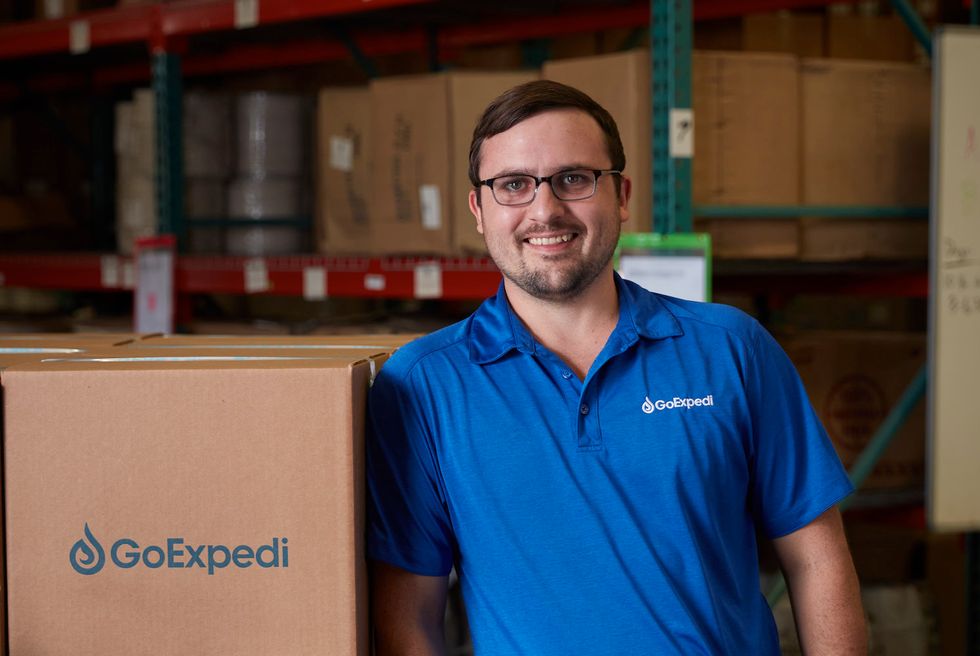
Houston-based GoExpedi has created a new tool. Photo by Colt Melrose for GoExpedi

GoExpedi, an innovative end-to-end digital supply chain and data analytics solutions company, the launch of ESG Command. The new tool is designed to drive environmental, social and governance (ESG) initiatives. Users on GoExpedi's platform can identify environmentally-friendly products and certified veteran, minority and women-owned businesses.

"Led by some of the world's largest industrial companies, our clients are driving for more sustainable business practices and more equitable workplaces," says Yang Tang, CTO at GoExpedi, in a news release. "In support of these lofty goals and a more prosperous and environmentally-friendly global community, we grew GoExpedi's digital ecosystem to benefit our clients and suppliers. Our goal is to use technical advances in the supply chain to build a brighter future for all."

Last fall, GoExpedi raised $25 million in its series C in order to grow and scale operations. The company is growing its warehouse presence, most recently in Pittsburgh, Pennsylvania.

Houston logistics company ranks among the most innovative companies

Sugar Land-based CommtrexPhoto via commtrex.com

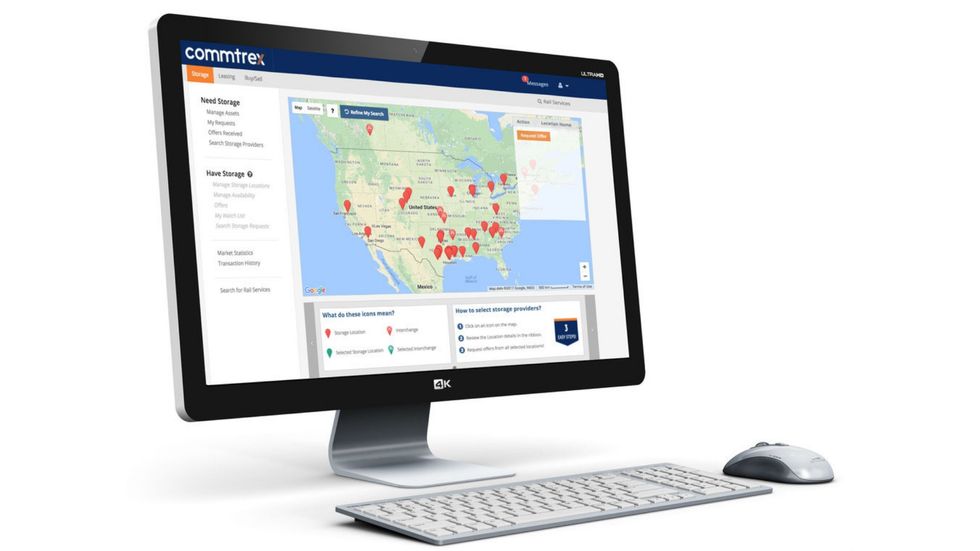
Commtrex, based in the Houston area, has been presented the FreightWaves 2022 FreightTech 100 award. The startup's platform connects professionals in the rail industry. The award also honored other innovative and disruptive companies in the freight industry, including Amazon Freight, DHL Supply Chain, FedEx, Flexport, Phillips Connect, Tesla, Uber Freight, Waymo, and Waze.

"Commtrex is honored and excited to be a part of the FreightWaves FreightTech 100," says Commtrex CEO Martin Lew in a news release. "Our mission at Commtrex is to simplify the movement of freight by rail. We are doing this by creating one centralized platform for shippers to efficiently connect with rail-served transloaders, storage providers, terminals, ports, warehouses, and many other resources that support the global supply chain ecosystem. As the largest rail platform in North America, we will continue to provide best-in-class service for all of our members."

Commtrex will also be eligible to be named to the FreightTech 25, which will be announced at the F3 Virtual Experience, November 9-11.

Houston fintech unicorn opens an office in Paris

HighRadius expands to Amsterdam

HighRadius has opened its newest European office. Photo via highradius.com

Continuing its expansion in Europe, HighRadius opened its new Paris office, which will have local staff for all customer facing operations including consulting, sales and marketing. The Houston-headquartered fintech unicorn also has offices in Germany, Amsterdam, the United Kingdom, India and the United States.

"The new Paris office is a sign of cementing our growing leadership in Europe and will bring the HighRadius Autonomous Software platform even closer to French companies," says Jon Keating, vice president and general manager of HighRadius in EMEA. "Our data-driven, AI software is helping global enterprises rethink and transform their finance and accounting processes. Our aim will be to deliver improvements in Days Sales Outstanding and working capital optimization, accelerate the financial close, and improve productivity in under six months for our new clients in France."

Over the past year, HighRadius has deployed over 300 transformation projects, across 37 out of 44 European countries.The HighRadius Autonomous Software platform has processed in excess of €475 billion in finance transactions in the European region alone, per a news release.

City of Houston names new sustainability leader

Priya Zachariah was named chief resilience and sustainability officer. Photo courtesy of the city of Houston

Mayor Sylvester Turner announced the appointment of Priya Zachariah as chief resilience and sustainability officer for the city of Houston. She will oversee the city's new Office of Resilience and Sustainability. The position is new and combines previously separate but similar roles, providing for more streamlined efforts to implement the Resilient Houston Plan and the Houston Climate Action Plan, according to a news release from the city.

"Sustainability and Resilience are intrinsically tied to each other. We created our resilience and climate plans to forge a path towards a stronger, more equitable city that not only faces and overcomes disaster scenarios, but builds forward to a better Houston tomorrow," says Mayor Turner in the release. "I am confident Priya will help us meet the goals we have established."

Zachariah was previously the senior program manager for Regional and Long-Range Planning at Houston METRO. While at METRO, Zachariah led the team that successfully delivered the METRONext 2040 transit plan for the Houston Region.

"This is a critical juncture for all of us. We now have the opportunity as a community to turn our focus from resilience and climate planning, to implementation and a realization of the benefits of those plans," says Zachariah in the release. "I am grateful for this opportunity and look forward to working with Mayor Turner and all stakeholders to move us toward a more resilient and equitable future."

Here are three of the latest updates on new execs and advisory appointments from Houston startups. Photo via Getty Images

3 Houston startups announce strategic appointments across health tech, materials, and software

short stories

Three Houston tech startups have new hires they're excited about this summer. From new board members to c-level execs, here's who's moving and shaking in Houston innovation.

Former Memorial Hermann CEO joins board of ZIBRIO

This Houston medical device startup has added a big name to its board. Photo courtesy of ZIBRIO

Dan Wolterman, who served as president and CEO of Memorial Hermann Health System for 15 years, has been named to the board of directors of Houston-based ZIBRIO. The health tech company, which was founded based on NASA technology, has developed a device that measures balance.

"We're delighted to have Dan on the team," says Katharine Forth, ZIBRIO CEO and co-founder, in a news release. "He understands ZIBRIO's vision to work across the full continuum of care, empowering older patients and clinicians with quantifiable fall prevention. His experience and enthusiasm will be invaluable in helping us to achieve it."

Falling is the top cause of trauma injury and trauma death across all age groups, according to ZIBRIO's release, and the current cost of falls in people over 65 is $50 billion – which is expected to double.

"ZIBRIO is coming to market at a time when population health and prevention are key for Healthcare systems to generate outcomes. They have a strong team and an elegant solution to a complex problem that will help millions," Wolterman says in the release.

Inhance adds to its C-suite

Inhance Technologies has added an integral member to its leadership. Photo via inhancetechnologies.com

Inhance Technologies, an international provider of polymer material science solutions based in Houston, has named its new CFO. Andrew Leeser, previously at Cimarron Energy, has joined the company to lead global finance, accounting and treasury functions, as well as human resources and information technology.

"I'm delighted to welcome Andrew to the Inhance Technologies family. He has an excellent track record in organizations spanning a range of industries, and I'm sure that his experience will help us continue on our upward trajectory," says Andrew Thompson, president and CEO of Inhance Technologies, in a news release. "We look forward to working with him to build a bright future for the company and our customers as we help them make a conscious choice towards more sustainable plastics."

The company just recently announced its expansion, including another new C-level exec and a new 75,000-square-foot site in St. Louis.

"I'm very pleased to have joined Inhance Technologies and I look forward to helping the organization achieve its goals over the next few years. With the significant growth in demand for our fully recyclable barrier technology Enkaseä, as well as our global expansion, there is no doubt I'm joining the company at an exciting time," says Leeser in the release.

Houston fintech unicorn names new council

Meet the new council dedicated to supporting HighRadius's new platform. Photo via LinkedIn

HighRadius, a Houston-based fintech company that reached unicorn status last year, has announced the members of its advisory council for its new microlearning and community platform Highako Academy.

Bob Shultz, managing partner of Quote-to-Cash Consulting, will serve as chairman of the council.

Other council members include:

  • John LaRocca, Sr. Director of Global Credit, Hitachi Vantara
  • Roger Torneden, Director of Business, Management and Legal Programs for UCLA Extension
  • R. Britt Hastey, Chair, Business Administration Department, Los Angeles City College
  • Bruce Lynn, Managing Partner, the FENG LLC
  • Scott Blakeley, Partner, Blakeley LLP

The council "will identify and improve courseware, certification programs and the methods of delivery based on current and future industry and professional trends," according to an email from the company. Highako Academy is aimed at helping teams and customers develop critical industry skills.

"Our customers have asked us for an online self-service learning platform, and that led us to launch highako.com as a beta platform last year," says Urvish Vashi of HighRadius in a recent release. "With 10,000+ users on the platform and a vibrant partner ecosystem consisting of credit groups, collection agencies, attorneys and industry associations, we see this echoing a larger trend of millennials and Gen Z gravitating towards microlearning platforms."

In the latest round up of Houston innovation news you may have missed, Houston has been deemed an affordable city for tech careers, HighRadius has a new product, and more. Photo via Getty Images

Houston named an affordable tech city, startup hires CFO, and more local innovation news

short stories

It's been a busy summer for the Houston innovation ecosystem, and for this reason, local startup and tech news may have fallen through some of the cracks.

In this roundup of short stories within Houston innovation, a software company has a new game-changing product, Houston was named an affordable city for a tech career, a health tech startup has a new C-suite leader, and more.

Houston ranks as affordable tech city

Houston is an affordable city to start off your career in tech, per this new report. Image courtesy of CodingDojo

While the coasts have some of the most booming tech hubs, Coding Dojo set off to identify the hubs with affordability for young professionals just starting off. The coding bootcamp started off by identifying the fastest growing cities in America using data from the Census, and factored in Apartment List's housing price data and the number of engineering jobs available in each city.

"The purpose of the report is to highlight cities that may be overlooked but have affordable living costs, plenty of open developer jobs in the vicinity and thus, are viable options to start or continue a career in tech," reads the report.

Houston ranks as No. 6 on the list, following Dallas at No. 1 and Austin suburb Leander as No. 2.

"With major campuses or headquarters in town for companies like FlightAware, Microsoft, Halliburton, and many others, you won't have a problem with Houston as your tech career destination," the report writes.

Houston data in the report:

  • Median Rent: $1,141
  • Entry-Level Developer Jobs: 81
  • Mid-Level Developer Jobs: 278

HighRadius announces new product

HighRadius has a new game-changing software update. Photo via highradius.com

Houston unicorn fintech SaaS company HighRadius has a new product that hit a milestone. The RadiusOne AR achieved "Built for NetSuite" status, according to a news release from the company.

"With RadiusOne AR, we can help NetSuite customers automate their AR processes, manage their operational costs, and increase efficiency," says Sayid Shabeer, chief product officer at HighRadius, in the release. "The RadiusOne AR SuiteApp will allow our joint customers to have stronger cash-flow using AI-based technology to automate their electronic invoicing, collections, cash reconciliation, and credit risk."

The product is aimed at streamlining invoicing and collections, cash reconciliation and credit risk services. The software is affordable and easy to deploy, potentially delivering value in as little as four weeks, per the release.

"Businesses continue to look for ways to bring automation and intelligence to their AR processes to better manage their working capital," says Guido Haarmans of Oracle NetSuite in the release. "This new SuiteApp extends our robust solution for receivables management and helps NetSuite customers further optimize their cash flow management."

Ignite Healthcare's pitch application deadline looms

Now's the time to apply for Ignite's annual accelerator. Photo courtesy of Ignite

Ignite Healthcare Network has opened applications for its annual mini accelerator programs for women-led digital health and med tech companies. The deadline to apply online is July 19.

The program "provides women-led healthcare startups the unique opportunity to engage with potential customers and investors who will assess and advise on the strengths and weaknesses of their companies," according to the website.

Following the mentorship and acceleration, Ignite's Pitch Competition Event allows finalists a chance to compete for several hundred thousand dollars in cash and investment prizes from health care executives and investors. This year, the audience will include parties interested in social impact investing, in search of companies that have solutions to the needs of underserved populations, reads the website.

Pulmotect names new CFO

Bill Noss joined Houston-based Pulmotect's C-suite in June. Photo courtesy of Pulmotect

Houston-based Pulmotect Inc., a clinical-stage biotechnology company, announced a new CFO late last month. William J. Noss III joined the company's team.

"I am delighted to welcome Bill to Pulmotect at such an important time for the company," says Dr. Colin Broom, CEO of Pulmotect, in the news release. "His expertise and experience will help build our infrastructure as we continue the clinical development of PUL-042. It is an exciting time to join Pulmotect, with two Phase 2 clinical trials for the prevention and treatment of COVID-19 that have been supported with funding from the Department of Defense and our planned clinical trials for the prevention of respiratory complications in cancer patients."

Noss has over 15 years of experience in the life science industry, formerly at Harmony Biosciences, where he helped lead the company through their commercial launch and subsequently through their initial public offering of $148 million, per the release.

"I am very excited to join this outstanding team as the company grows," says Noss in the release. "PUL-042 has the potential to protect patients from a broad range of viral and other pulmonary infections by activating the innate immune system. I look forward to playing a key role in the drug development program by working hard for the future benefit of patients and creating long-term value for the company and our stakeholders."

Hess makes $9M donation to STEM initiatives in the community

Houston-based Hess Corp. has contributed to a citywide initiative. Photo via trammellcrow.com

Last month, Hess Corp. announced a $9 million donation over the next three years. The gift is a part of its Learning for Life Partnership to fund educational programs and support services for Mayor Sylvester Turner's Complete Communities Initiative.

About 22 schools and over 13,000 children from pre-K through high school will benefit from the funds in the Third Ward, Magnolia Park-Manchester, and Second Ward Complete Communities neighborhoods.

Among other initiatives, the Hess Learning for Life Partnership will fund STEM equipment and curricula, teacher training, computer equipment, mentorship programs, accreditation initiatives, career life guidance counseling, and other support, according to a news release.

"Our company has a proud history of social investment programs that make a positive and lasting impact on the communities where we operate," says CEO John B. Hess in the news release. "In partnership with Mayor Turner's initiative, we are delighted to expand our commitment to provide children in the neighborhoods adjacent to Hess Tower in downtown Houston with the academic and social resources they need to reach their full potential."

Ad Placement 300x100
Ad Placement 300x600

CultureMap Emails are Awesome

New Rice Brain Institute partners with TMC to award inaugural grants

brain trust

The recently founded Rice Brain Institute has named the first four projects to receive research awards through the Rice and TMC Neuro Collaboration Seed Grant Program.

The new grant program brings together Rice faculty with clinicians and scientists at The University of Texas Medical Branch, Baylor College of Medicine, UTHealth Houston and The University of Texas MD Anderson Cancer Center. The program will support pilot projects that address neurological disease, mental health and brain injury.

The first round of awards was selected from a competitive pool of 40 proposals, and will support projects that reflect Rice Brain Institute’s research agenda.

“These awards are meant to help teams test bold ideas and build the collaborations needed to sustain long-term research programs in brain health,” Behnaam Aazhang, Rice Brain Institute director and co-director of the Rice Neuroengineering Initiative, said in a news release.

The seed funding has been awarded to the following principal investigators:

  • Kevin McHugh, associate professor of bioengineering and chemistry at Rice, and Peter Kan, professor and chair of neurosurgery at the UTMB. McHugh and Kan are developing an injectable material designed to seal off fragile, abnormal blood vessels that can cause life-threatening bleeding in the brain.
  • Jerzy Szablowski, assistant professor of bioengineering at Rice, and Jochen Meyer, assistant professor of neurology at Baylor. Szablowski and Meyer are leading a nonsurgical, ultrasound approach to deliver gene-based therapies to deep brain regions involved in seizures to control epilepsy without implanted electrodes or invasive procedures.
  • Juliane Sempionatto, assistant professor of electrical and computer engineering at Rice, and Aaron Gusdon, associate professor of neurosurgery at UTHealth Houston. Sempionatto and Gusdon are leading efforts to create a blood test that can identify patients at high risk for delayed brain injury following aneurysm-related hemorrhage, which could lead to earlier intervention and improved outcomes.
  • Christina Tringides, assistant professor of materials science and nanoengineering at Rice, and Sujit Prabhu, professor of neurosurgery at MD Anderson, who are working to reduce the risk of long-term speech and language impairment during brain tumor removal by combining advanced brain recordings, imaging and noninvasive stimulation.

The grants were facilitated by Rice’s Educational and Research Initiatives for Collaborative Health (ENRICH) Office. Rice says that the unique split-funding model of these grants could help structure future collaborations between the university and the TMC.

The Rice Brain Institute launched this fall and aims to use engineering, natural sciences and social sciences to research the brain and reduce the burden of neurodegenerative, neurodevelopmental and mental health disorders. Last month, the university's Shepherd School of Music also launched the Music, Mind and Body Lab, an interdisciplinary hub that brings artists and scientists together to study the "intersection of the arts, neuroscience and the medical humanities." Read more here.

Your data center is either closer than you think or much farther away

houston voices

A new study shows why some facilities cluster in cities for speed and access, while others move to rural regions in search of scale and lower costs. Based on research by Tommy Pan Fang (Rice Business) and Shane Greenstein (Harvard).

Key findings:

  • Third-party colocation centers are physical facilities in close proximity to firms that use them, while cloud providers operate large data centers from a distance and sell access to virtualized computing resources as on‑demand services over the internet.
  • Hospitals and financial firms often require urban third-party centers for low latency and regulatory compliance, while batch processing and many AI workloads can operate more efficiently from lower-cost cloud hubs.
  • For policymakers trying to attract data centers, access to reliable power, water and high-capacity internet matter more than tax incentives.

Recent outages and the surge in AI-driven computing have made data center siting decisions more consequential than ever, especially as energy and water constraints tighten. Communities invest public dollars on the promise of jobs and growth, while firms weigh long-term commitments to land, power and connectivity.

Against that backdrop, a critical question comes into focus: Where do data centers get built — and what actually drives those decisions?

A new study by Tommy Pan Fang (Rice Business) and Shane Greenstein (Harvard Business School) provides the first large-scale statistical analysis of data center location strategies across the United States. It offers policymakers and firms a clearer starting point for understanding how different types of data centers respond to economic and strategic incentives.

Forthcoming in the journal Strategy Science, the study examines two major types of infrastructure: third-party colocation centers that lease server space to multiple firms, and hyperscale cloud centers owned by providers like Amazon, Google and Microsoft.

Two Models, Two Location Strategies

The study draws on pre-pandemic data from 2018 and 2019, a period of relative geographic stability in supply and demand. This window gives researchers a clean baseline before remote work, AI demand and new infrastructure pressures began reshaping internet traffic patterns.

The findings show that data centers follow a bifurcated geography. Third-party centers cluster in dense urban markets, where buyers prioritize proximity to customers despite higher land and operating costs. Cloud providers, by contrast, concentrate massive sites in a small number of lower-density regions, where electricity, land and construction are cheaper and economies of scale are easier to achieve.

Third-party data centers, in other words, follow demand. They locate in urban markets where firms in finance, healthcare and IT value low latency, secure storage, and compliance with regulatory standards.

Using county-level data, the researchers modeled how population density, industry mix and operating costs predict where new centers enter. Every U.S. metro with more than 700,000 residents had at least one third-party provider, while many mid-sized cities had none.

ImageThis pattern challenges common assumptions. Third-party facilities are more distributed across urban America than prevailing narratives suggest.

Customer proximity matters because some sectors cannot absorb delay. In critical operations, even slight pauses can have real consequences. For hospital systems, lag can affect performance and risk exposure. And in high-frequency trading, milliseconds can determine whether value is captured or lost in a transaction.

“For industries where speed is everything, being too far from the physical infrastructure can meaningfully affect performance and risk,” Pan Fang says. “Proximity isn’t optional for sectors that can’t absorb delay.”

The Economics of Distance

For cloud providers, the picture looks very different. Their decisions follow a logic shaped primarily by cost and scale. Because cloud services can be delivered from afar, firms tend to build enormous sites in low-density regions where power is cheap and land is abundant.

These facilities can draw hundreds of megawatts of electricity and operate with far fewer employees than urban centers. “The cloud can serve almost anywhere,” Pan Fang says, “so location is a question of cost before geography.”

The study finds that cloud infrastructure clusters around network backbones and energy economics, not talent pools. Well-known hubs like Ashburn, Virginia — often called “Data Center Alley” — reflect this logic, having benefited from early network infrastructure that made them natural convergence points for digital traffic.

Local governments often try to lure data centers with tax incentives, betting they will create high-tech jobs. But the study suggests other factors matter more to cloud providers, including construction costs, network connectivity and access to reliable, affordable electricity.

When cloud centers need a local presence, distance can sometimes become a constraint. Providers often address this by working alongside third-party operators. “Third-party centers can complement cloud firms when they need a foothold closer to customers,” Pan Fang says.

That hybrid pattern — massive regional hubs complementing strategic colocation — may define the next phase of data center growth.

Looking ahead, shifts in remote work, climate resilience, energy prices and AI-driven computing may reshape where new facilities go. Some workloads may move closer to users, while others may consolidate into large rural hubs. Emerging data-sovereignty rules could also redirect investment beyond the United States.

“The cloud feels weightless,” Pan Fang says, “but it rests on real choices about land, power and proximity.”

---

This article originally appeared on Rice Business Wisdom. Written by Scott Pett.

Pan Fang and Greenstein (2025). “Where the Cloud Rests: The Economic Geography of Data Centers,” forthcoming in Strategy Science.

Houston climbs to top 10 spot on North American tech hubs index

tech report

Houston already is the Energy Capital of the World, and now it’s gaining ground as a tech hub.

On Site Selection magazine’s 2026 North American Tech Hub Index, Houston jumped to No. 10 from No. 16 last year. The index relies on data from Site Selection as well as data from CBRE, CompTIA and TeleGeography to rank the continent’s tech hotspots. The index incorporates factors such as internet connectivity, tech talent and facility projects for tech companies.

In 2023, the Greater Houston Partnership noted the region had “begun to receive its due as a prominent emerging tech hub, joining the likes of San Francisco and Austin as a major player in the sector, and as a center of activity for the next generation of innovators and entrepreneurs.”

The Houston-area tech sector employs more than 230,000 people, according to the partnership, and generates an economic impact of $21.2 billion.

Elsewhere in Texas, two other metros fared well on the Site Selection index:

  • Dallas-Fort Worth nabbed the No. 1 spot, up from No. 2 last year.
  • Austin rose from No. 8 last year to No. 7 this year.

San Antonio slid from No. 18 in 2025 to No. 22 in 2026, however.

Two economic development officials in DFW chimed in about the region’s No. 1 ranking on the index:

  • “This ranking affirms what we’ve long seen on the ground — Dallas-Fort Worth is a top-tier technology and innovation center,” said Duane Dankesreiter, senior vice president of research and innovation at the Dallas Regional Chamber. “Our region’s scale, talent base, and diverse strengths … continue to set DFW apart as a national leader.”
  • “Being recognized as the top North American tech hub underscores the strength of the entire Dallas-Fort Worth region as a center of innovation and next-generation technology,” said Robert Allen, president and CEO of the Fort Worth Economic Development Partnership.

While not directly addressing Austin’s Site Selection ranking, Thom Singer, CEO of the Austin Technology Council, recently pondered whether Silicon Hills will grow “into the kind of community that other cities study for the right reasons.”

“Austin tech is not a club. It is not a scene. It is not a hashtag, a happy hour, or any one place or person,” Singer wrote on the council’s blog. “Austin tech is an economic engine and a global brand, built by thousands of people who decided to take a risk, build something, hire others, and be part of a community that is still young enough to reinvent itself.”

South of Austin, Port San Antonio is driving much of that region’s tech activity. Occupied by more than 80 employers, the 1,900-acre tech and innovation campus was home to 18,400 workers in 2024 and created a local economic impact of $7.9 billion, according to a study by Zenith Economics.

“Port San Antonio is a prime example of how innovation and infrastructure come together to strengthen [Texas’] economy, support thousands of good jobs, and keep Texas competitive on the global stage,” said Kelly Hancock, the acting state comptroller.