


Here's what startups took home wins at CERAWeek. Photo by Natalie Harms/InnovationMap

Over 200 startups participated in CERAWeek this year, and 18 of those companies pitched at a Greater Houston Partnership event.

The Houston Energy Transition Initiative, an initiative to promote Houston's work within the energy transition, hosted its second annual HETI Energy Ventures Competition at CERAWeek Innovation Agora. The competition was divided into four categories. The first batch of startups consisted of five companies from the Texas Entrepreneurship Exchange for Energy, or TEX-E, a collaboration with Greentown Labs, MIT’s Martin Trust Center for Entrepreneurship, and universities across Texas.

The winning startups shared $50,000 of prizes, sponsored by TEX-E. Houston-based Helix Earth Technologies — which has developed high-speed, high-efficiency filter systems derived from technology originating at NASA — won both the first place prize and fan favorite for the category. Helix's co-founders, Rawand Rasheed and Brad Husick from Rice University, walked away with $25,000 in prizes

Founded by Bryon Praslicka, Daniel Zamarron, and Craig Newman from Texas A&M University, Flux Works LLC, and its magnetic gear technology, took second place and $15,000 home. Tierra Climate, a two-sided marketplace for carbon offsets and other sustainability efforts founded by Emma Konet and Jacob Mansfield from Rice University, won third place and $10,000.
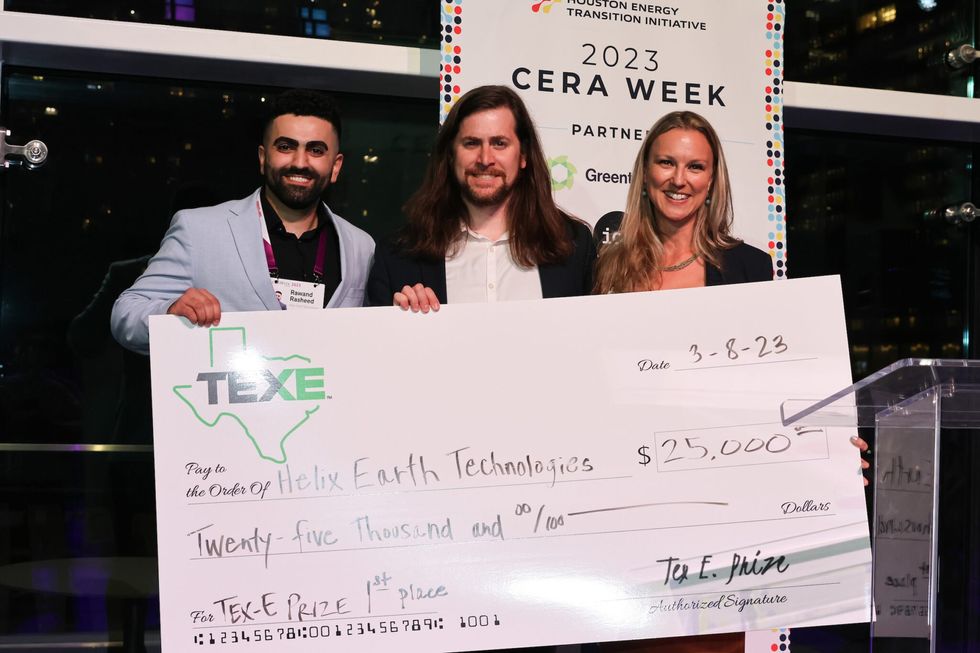
Helix Earth Technologies walked away with the top prize of the TEX-E category. Photo via greentownlabs.com

The next sets of startup pitches we broken down by funding stages — pre-seed and seed, series A, and series B and beyond.

Red Shift Energy, uses plasma energy to produce hydrogen from hydrogen sulfide, won fan favorite in the pre-seed and seed category sponsored by HX Venture Fund. A member of Halliburton Labs, the company also was recognized as Chevron favorite.

Per the judging panel, CanaGas won the title of most promising in the pre-seed and seed category sponsored by Alchemy Industrial. The Canadian company liquifies natural gas without costly cryogenics or stripping of the gas.

Houston-based Criterion Energy Partners won both the most-promising series A company category sponsored by SLB, but also the fan favorite series A category sponsored by Guerrella LLC. A geothermal energy tech company, Criterion was also a member of Rice's inaugural Clean Energy Accelerator cohort.

OptiSeis Solutions also won in both categories for the series B track. The company, a geophysical acquisition design and software company, won the title of most promising in the series B category sponsored by Pana LCE Investments and the series B fan favorite category sponsored by Halliburton Labs.

Lastly, the competition named the Most Impactful DEI, a category sponsored by Pana LCE Investments. Austin-based Gazelle Ecosystems, a social innovation startup with eco-solutions for corporations, won that category.

Ad Placement 300x100
Ad Placement 300x600

CultureMap Emails are Awesome

Innovative Houston-area hardtech startup closes $5M seed round

fresh funding

Conroe-based hardtech startup FluxWorks has closed a $5 million seed round.

The funding was led by Austin-based Scout Ventures, which invests in early-stage startups working to solve national security challenges.

Michigan Capital Network also contributed to the round from its MCN Venture Fund V. The fund is one of 18 selected by the Department of Defense and Small Business Administration to participate in the Small Business Investment Company Critical Technologies Initiative, which will invest $4 billion into over 1,700 portfolio companies.

FluxWorks reports that it will use the funding to drive the commercialization of its flagship Celestial Gear technology.

"At Scout, we invest in 'frontier tech' that is essential to national interest. FluxWorks is doing exactly that by solving critical hardware bottlenecks with its flagship Celestial Gear technology ... This is about more than just gears; it’s about strengthening our industrial infrastructure," Scout Ventures shared in a LinkedIn post.

Fluxworks specializes in making contactless magnetic gears for use in extreme conditions, which can enhance in-space manufacturing. Its contactless design leads to less wear, debris and maintenance. Its technology is particularly suited for space applications because it does not require lubricants, which can be difficult to control at harsh temperatures and in microgravity.

The company received a grant from the Texas Space Commission last year and was one of two startups to receive the Technology in Space Prize, funded by Boeing and the Center for the Advancement of Science in Space (CASIS), in 2024. It also landed $1.2 million through the National Science Foundation's SBIR Phase II grant this fall.

Fluxworks was founded in College Station by CEO Bryton Praslicka in 2021. Praslicka moved the company to Conroe 2024.

5 Houston scientists named winners of prestigious Hill Prizes 2026

prized research

Five Houston scientists were recognized for their "high-risk, high-reward ideas and innovations" by Lyda Hill Philanthropies and the Texas Academy of Medicine, Engineering, Science and Technology (TAMEST).

The 2026 Hill Prizes provide seed funding to top Texas researchers. This year's prizes were given out in seven categories, including biological sciences, engineering, medicine, physical sciences, public health and technology, and the new artificial intelligence award.

Each recipient’s institution or organization will receive $500,000 in direct funding from Dallas-based Lyda Hill Philanthropies. The organization has also committed to giving at least $1 million in discretionary research funding on an ad hoc basis for highly-ranked applicants who were not selected as recipients.

“It is with great pride that I congratulate this year’s Hill Prizes recipients. Their pioneering spirit and unwavering dedication to innovation are addressing some of the most pressing challenges of our time – from climate resilience and energy sustainability to medical breakthroughs and the future of artificial intelligence,” Lyda Hill, founder of Lyda Hill Philanthropies, said in a news release.

The 2026 Houston-area recipients include:

Biological Sciences: Susan M. Rosenberg, Baylor College of Medicine

Rosenberg and her team are developing ways to fight antibiotic resistance. The team will use the funding to screen a 14,000-compound drug library to identify additional candidates, study their mechanisms and test their ability to boost antibiotic effectiveness in animal models. The goal is to move toward clinical trials, beginning with veterans suffering from recurrent infections.

Medicine: Dr. Raghu Kalluri, The University of Texas MD Anderson Cancer Center

Kalluri is developing eye drops to treat age-related macular degeneration (AMD), the leading cause of vision loss globally. Kalluri will use the funding to accelerate studies and support testing for additional ocular conditions. He was also named to the National Academy of Inventors’ newest class of fellows last month.

Engineering: Naomi J. Halas, Rice University

Co-recipeints: Peter J. A. Nordlander and Hossein Robatjazi, Rice University

Halas and her team are working to advance light-driven technologies for sustainable ammonia synthesis. The team says it will use the funding to improve light-driven catalysts for converting nitrogen into ammonia, refine prototype reactors for practical deployment and partner with industry collaborators to advance larger-scale applications. Halas and Nordlander are co-founders of Syzygy Plasmonics, and Robatjazi serves as vice president of research for the company.

The other Texas-based recipients include:

  • Artificial Intelligence: Kristen Grauman, The University of Texas at Austin
  • Physical Sciences: Karen L. Wooley, Texas A&M University; Co-Recipient: Matthew Stone, Teysha Technologies
  • Public Health: Dr. Elizabeth C. Matsui, The University of Texas at Austin and Baylor College of Medicine
  • Technology: Kurt W. Swogger, Molecular Rebar Design LLC; Co-recipients: Clive Bosnyak, Molecular Rebar Design, and August Krupp, MR Rubber Business and Molecular Rebar Design LLC

Recipients will be recognized Feb. 2 during the TAMEST 2026 Annual Conference in San Antonio. They were determined by a committee of TAMEST members and endorsed by a committee of Texas Nobel and Breakthrough Prize Laureates and approved by the TAMEST Board of Directors.

“On behalf of TAMEST, we are honored to celebrate the 2026 Hill Prizes recipients. These outstanding innovators exemplify the excellence and ambition of Texas science and research,” Ganesh Thakur, TAMEST president and a distinguished professor at the University of Houston, added in the release. “Thanks to the visionary support of Lyda Hill Philanthropies, the Hill Prizes not only recognize transformative work but provide the resources to move bold ideas from the lab to life-changing solutions. We are proud to support their journeys and spotlight Texas as a global hub for scientific leadership.”

Investment bank opens new Houston office focused on energy sector

Investment bank Cohen & Co. Capital Markets has opened a Houston office to serve as the hub of its energy advisory business and has tapped investment banking veteran Rahul Jasuja as the office’s leader.

Jasuja joined Cohen & Co. Capital Markets, a subsidiary of financial services company Cohen & Co., as managing director, and head of energy and energy transition investment banking. Cohen’s capital markets arm closed $44 billion worth of deals last year.

Jasuja previously worked at energy-focused Houston investment bank Mast Capital Advisors, where he was managing director of investment banking. Before Mast Capital, Jasuja was director of energy investment banking in the Houston office of Wells Fargo Securities.

“Meeting rising [energy] demand will require disciplined capital allocation across traditional energy, sustainable fuels, and firm, dispatchable solutions such as nuclear and geothermal,” Jasuja said in a news release. “Houston remains the center of gravity where capital, operating expertise, and execution come together to make that transition investable.”

The Houston office will focus on four energy verticals:

  • Energy systems such as nuclear and geothermal
  • Energy supply chains
  • Energy-transition fuel and technology
  • Traditional energy
“We are making a committed investment in Houston because we believe the infrastructure powering AI, defense, and energy transition — from nuclear to rare-earth technology — represents the next secular cycle of value creation,” Jerry Serowik, head of Cohen & Co. Capital Markets, added in the release.

---

This article originally appeared on EnergyCaptialHTX.com.