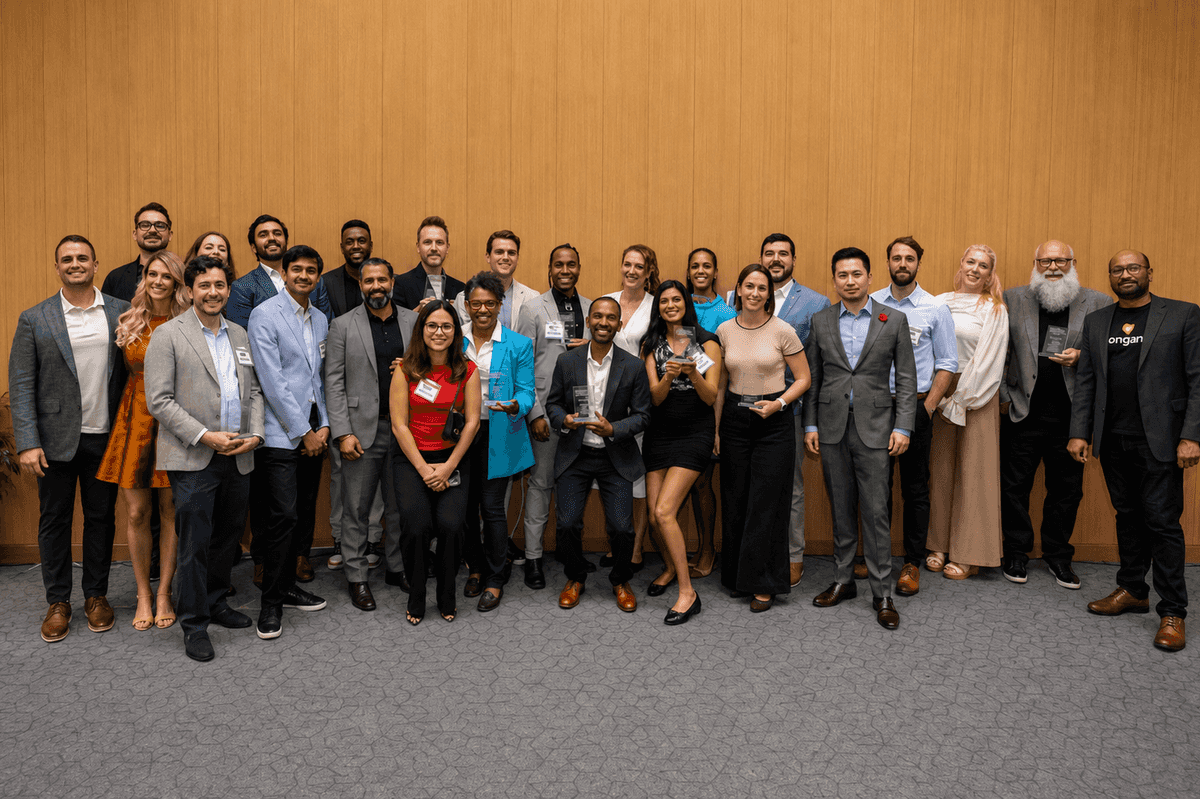
The inaugural Activate Houston cohort has 11 fellows across energy, materials, life sciences, space, and other sectors. Photo via activate.org

A national hardtech-focused organization has named its 2024 batch of innovators, which includes the inaugural Houston-based cohort.

Activate named 62 fellows and 50 companies for is latest class, which spans Berkley, California — where the organization is based, Boston, New York, and Houston. Additionally, Activate Anywhere, the program's virtual and remote cohort, was named. According to Activate, it received over 1,000 applicants.

“People, not ideas alone, move the world forward. It is through the drive and determination of brilliant scientists and engineers that we are witnessing true progress,” says Activate CEO Cyrus Wadia in a news release. “Our current Activate Fellows and alumni are already pioneering innovative solutions that make a measurable difference. We’re thrilled to support the next 62 visionaries who will lead the charge in addressing our most urgent issues through groundbreaking science and technology.”

It's the first year Activate has hosted a Houston-based cohort. The organization initially announced its expansion early last year. The inaugural cohort has 11 fellows across energy, materials, life sciences, space, and other sectors.

The named Houston fellows selected for the 2024 class include:

  • Krish Mehta, founder and CEO of Phoenix Materials, a company that decarbonizes concrete using industrial waste.
  • Gabriel Cossio, founder and CEO of Nanoscale Labs, which is developing a high-throughput and low-cost nanomanufacturing system.
  • Matthew McDermott, founder and CEO of Refound Materials, a materials technology company developing more efficient synthesis recipes for accelerated materials discovery.
  • Alec Ajnsztajn, founder and CEO of Coflux Purification, a company that's creating a product that allows industries and water providers to cheaply remove forever chemicals to provide safe drinking water at a fraction of current energy use.
  • Ryan DuChanois and Yang Xia , co-founders of Solidec, a Houston-based startup redefining chemical manufacturing.
  • Meagan Pitcher, co-founder and CEO of Bairitone Health, which brings advanced imaging diagnostics into the home environment.
  • Wei Meng, co-founder and CEO of LumiStrain, a startup offering novel technology for mechanical strain mapping.
  • Sonia Dagan of Atolla Tech, which is developing a lidar and machine-learning algorithm for identifying and quantifying airborne insects.
  • Rodrigo Alvarez-Icaza, founder and CEO of Elysium Robotics, a company that's replacing electric motors with muscle-like actuators to enable massive deployment of highly capable and low-cost robotic systems.
  • Blake Herren, CEO and Co-founder of Raven Space Systems, which is modernizing composite manufacturing with 3D printing and Industry 4.0 solutions to build the factories of the future.

------

This article originally ran on EnergyCapital.

Ad Placement 300x100
Ad Placement 300x600

CultureMap Emails are Awesome

$5B Austin medical center, anchored by MD Anderson, to break ground this fall

moving forward

Construction on the $1 billion first phase of the AI-native University of Texas Dell Medical Center in Austin—which will feature a hospital operated by Houston’s UT MD Anderson Cancer Center—is set to start this fall.

The UT System Board of Regents approved funding for first-phase construction on Aug. 12.

The medical center—now expected to cost $5 billion, up from the initial $2.9 billion estimate—will span about 2.5 million square feet. It will include 300 to 500 patient beds, outpatient facilities, an emergency department and specialized care for cancer patients.

MD Anderson will bring its world-renowned oncology programs to the center’s integrated health care model, Dr. Claudia Lucchinetti, senior vice president of medical affairs at UT Austin and dean of the university’s Dell Medical School, tells Health Leaders.

Earlier this year, Austin tech billionaire Michael Dell and his wife, Susan, pledged $750 million for development of the medical center. The medical center, scheduled for completion in December 2030, will be a cornerstone of the new 300-acre UT Dell Campus for Advanced Research, a medical education and research hub.

“Through this new campus and medical center, Texas will lead America in health care innovation,” Gov. Greg Abbott said when the research campus was announced in April. “The next generation of medical breakthroughs will take place in Central Texas.”

The medical center will fold AI tools and other technology into the infrastructure, rather than having them added after it’s built. Among other capabilities, the technology will monitor real-time medical data, automate data entry, and help health care professionals quickly predict and identify risks to patients, according to Health Leaders.

“We are not just building a new medical center,” Lucchinetti says. “We are building a fundamentally new model of health. It’s not just a new facility. It’s not just a new collaboration. It is a convergence of capabilities that rarely come together at the same time.”

Rice lands $15M U.S. Army award to launch next-gen wireless research center

defense funding

The U.S. Army Research Office has awarded Rice University $15 million to establish a new center for next-generation sensing and communications.

The five-year research center—dubbed the Center for Large Aperture Secure Sensing, Imaging and Communications (CLASSIC)—will unite researchers from universities and national laboratories to develop advanced antenna technologies for future wireless systems. Edward Knightly, the Sheafor-Lindsay Professor of Electrical and Computer Engineering at Rice, will lead the center that “combines expertise in wireless networking, antennas, radar, artificial intelligence, circuits and physics to address growing demands on wireless systems,” according to Rice.

“The challenges we’re tackling require advances that span physics, hardware, communications and computing," Knightly said in a news release. “By combining those strengths in a single center, we can accelerate the development and demonstration of technologies that would not be possible through individual efforts alone.”

Joining Knightly will be Ashutosh Sabharwal of Rice, Sensen Li of the University of Texas at Austin, Hou-Tong Chen of Los Alamos National Laboratory, Danijela Cabric of UCLA, Josep M. Jornet and Tommaso Melodia of Northeastern University, Daniel M. Mittleman of Brown University, and Willie Padilla of Duke University.

Industry partners include Booz Allen Hamilton, Intel, Keysight, Lockheed Martin, MITRE, Northrop Grumman, Qualcomm and Raytheon.

CLASSIC researchers will investigate how large-scale antenna arrays (ELSAAs) can expand the capabilities of wireless systems where technology is limited.

ELSAAs use thousands of coordinated antenna elements to direct radio waves. Researchers aim to develop ways to use the technology to help maintain steady communication when signals are blocked or disrupted and to detect and generate detailed images of concealed objects.

Along with ELSAAs, the center will work to develop sensing techniques for threat detection, study wireless jamming and build resilient high-speed wireless networks. Researchers will ultimately validate the technology in labs and via drone-based field trials.

CLASSIC will also work on developing an AI-driven modeling framework that will simulate complex electromagnetic environments in real time.

“This award demonstrates Rice’s leadership in tackling complex national research challenges through collaboration across disciplines and institutions,” David Sholl, executive vice president for research at Rice, added in the release.