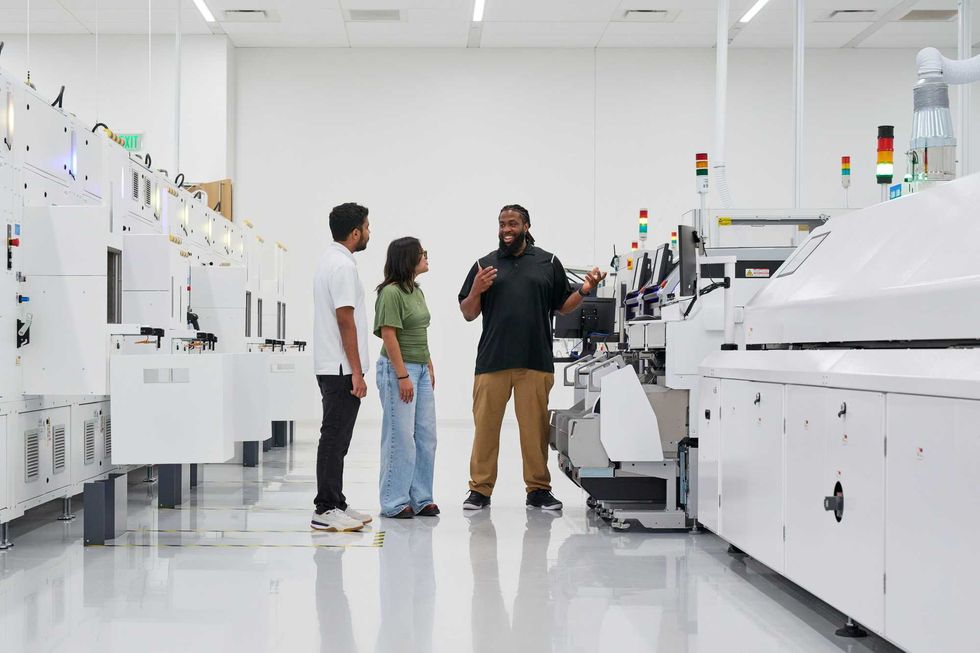
Mercator.ai, founded in 2020 by Chloe Smith and Hogan Lee, expanded in Austin earlier this year. The company has now established a presence in Houston and plans to break into the Dallas-Fort Worth and San Antonio markets next. Photo via mercator.ai

Construction tech startup Mercator.ai has entered the Houston area’s $22.3 billion commercial construction market with its AI-powered business development platform.

Calgary, Canada-based Mercator.ai says that although 80 percent of construction projects are secured through relationships, business development specialists spend about two-thirds of their time hunting for construction leads. The startup says its business development platform flips that script for the Houston area, Texas’ biggest commercial construction market.

“Houston’s construction community is known for innovation and relationship-building,” Chloe Smith, co-founder and CEO of Mercator.ai, says in a news release.

Mercator.ai says its expansion into the Houston market enables local general contractors, subcontractors, and providers of construction service to gain real-time insight into upcoming project opportunities.

“Houston’s sprawling growth and increasing competitive landscape make it ripe for innovation and the perfect next step in our Texas expansion,” Smith says.

“Our platform transforms how construction professionals discover and qualify new projects,” she adds, “reducing weeks of business development research into minutes and enabling teams to start building mutually profitable relationships at the earliest possible project stage.”

Mercator.ai, founded in 2020, announced its entry into the Texas market in April. The startup’s expansion into its first Texas market, Austin, represented its introduction to the U.S. market. Aside from Houston and Austin, Mercator.ai plans to break into the Dallas-Fort Worth and San Antonio markets.

Ad Placement 300x100
Ad Placement 300x600

CultureMap Emails are Awesome

Houston cleantech, space startups named to World Economic Forum cohort

top honor

Two Houston-based startups have been selected to join the World Economic Forum's Technology Pioneers community.

The two-year program aims to help mission-driven, early-stage start-ups scale their innovations through multi-stakeholder initiatives, co-creating partnerships and other gatherings for community members. One-hundred startups are selected each year from around the globe, this year hailing from 23 countries and working in AI, energy, space, biotech markets and more.

Cleantech startup Vaulted Deep was one of 11 energy and climate companies to be named to the cohort. Julia Reichelstein and Omar Abou-Sayed founded the company in 2023. Its technology injects excess organic waste underground to remove carbon dioxide from the atmosphere.

Last year, Vaulted Deep inked a 12-year deal with Microsoft to remove up to 4.9 million metric tons of carbon dioxide from the environment.

The startup has earned several accolades in recent years, including a No. 3 spot on Fast Company’s list of the World’s Most Innovative Companies of 2026. It was also recently named to market intelligence and advisory firm Cleantech Group's annual Global Cleantech 100 list for a second year in a row.

"Waste management is one of the world's great invisible infrastructure systems ... The need for new infrastructure is growing as disposal challenges become more complex and regulations evolve. Vaulted is building the first new disposal pathway for organic waste in decades by putting it deep underground, permanently," the company shared in a LinkedIn post. "This year, we're joining the World Economic Forum's 2026 Tech Pioneers alongside innovators working on the many interconnected challenges shaping our future."

Houston-based Venus Aerospace was also selected to join the cohort, along with six other spacetech companies. The company was founded in 2020 by Sassie and Andrew Duggleby.

The startup specializes in next-generation rocket engine propulsion as a cleaner alternative to traditional combustion engines. The company's rotating detonation rocket engine (RDRE) burns fuel more efficiently and completed a successful high-thrust test flight last year. Venus says it’s the only company in the world that makes a flight-proven, high-thrust RDRE with a “clear path to scaled production.”

"Frontier technologies matter most when they expand what people, industries, and nations can do," Sassie Duggleby, co-founder and CEO of Venus, said in a news release. "For Venus, RDRE does not just represent a more efficient engine. It is a foundation for faster movement, more capable space systems, and new forms of connectivity across the planet. Being named a Technology Pioneer validates the potential of this technology to help shape a future where distance is less limiting."

---

This article originally appeared on our sister site, EnergyCapitalHTX.com.

Houston Methodist receives record $110M gift, names future tower

historic gift

Houston Methodist has received the largest gift in the health system's history to establish new funds for neurological, neuroscience, and women’s health research and treatment.

The $110 million gift comes from Houston-based The Brockman Medical Research Foundation, which supports education and research in the science, medicine and healthcare fields. In response, Houston Methodist announced that it will name its forthcoming 26-story hospital facility the Brockman Centennial Tower.

The tower’s entrance will be named the Anna Margaret Bellows Centennial Hall to honor Anna Margaret Bellows, a young camper who died during the Camp Mystic flooding last summer.

“This extraordinary gift accelerates discovery and transforms how care is delivered,” Dr. Marc Boom, president and CEO of Houston Methodist, said in a news release. “We are grateful to The Brockman Medical Research Foundation for its incredible generosity and vision that will help change the lives of generations of patients. Naming Centennial Tower in recognition of this gift reflects the scale of this commitment and its impact on the future of neuroscience, neurological care and women’s health.”

The gift will be divided into two parts:

  • $100 million will go toward creating an innovation fund within the Houston Methodist Academic Institute and the Houston Methodist Neurological Institute
  • $10 million will be devoted to Houston Methodist's Department of Obstetrics and Gynecology

“This tremendous gift will accelerate translational research that broadens our understanding of neurological and other diseases,” Dr. Jenny Chang, president and CEO of the Houston Methodist Academic Institute, added in the release. “It will allow us to leverage state-of-the-art platforms to detect, diagnose and deliver therapeutics, keeping patient care at the center of our mission.”

The Brockman Centennial Tower is expected to open next year in the Texas Medical Center. Spanning more than 1 million square feet, it will house 400 patient beds, an expanded emergency department, new operating rooms and a rooftop garden. It will be connected to Houston Methodist's flagship Paula and Joseph C. “Rusty” Walter III Tower, which opened in 2018. The Centennial Tower was estimated to cost $1.4 billion when announced in 2022.

In addition to the news of the Brockman gift, Houston Methodist also announced this month that it has launched the Houston Methodist Center for Cell and Gene Therapy and tapped an internationally recognized scientist as its leader.

The new center is focused on discovering and developing innovative and cost-effective therapies for a variety of congenital and acquired diseases, including cancer, HIV and cardiovascular disease.

Dr. Malcolm Brenner has been named as the center's inaugural leader and will assume the role starting in October. He will work alongside scientists and support staff from Baylor College of Medicine and Texas Children's Hospital.

Brenner is a professor of pediatrics, medicine, molecular and human genetics and translational biology at Baylor College of Medicine. He is known for making early advances in using bone marrow transplantation as a form of cell therapy and in engineered immune-cell treatments for cancer and infections, according to a release from Houston Methodist.

“Malcolm Brenner is a pioneer in the field of cell and gene therapy and is uniquely qualified to lead Houston Methodist’s research efforts in this field,” Chang added. “His vision and leadership will play a pivotal role in advancing our work in this space.”