


Xfinity goes all-in with new national internet plan

Everything's Included

Photo courtesy of Xfinity

Following the successful launch and positive consumer reaction to Xfinity’s new 5-year guarantee, the nation’s largest Internet Service Provider (ISP) has launched its everyday pricing (EDP) structure with four simple national Internet tiers that include unlimited data and the advanced Xfinity WiFi Gateway for one low monthly price.

This move is part of the company’s broader strategy to give consumers simple, predictable, all-in plans for the best WiFi in the market. All plans include a line of Xfinity Mobile at no additional cost for a year.

“We said we were going to go ‘all-in’ on a new pricing strategy and we are delivering with our 5-year price lock and our new everyday price plans," says Steve Croney, chief operating officer, Connectivity & Platforms at Comcast. "Now all our Xfinity Internet packages are built on simplicity and transparency — no hidden fees, no confusion — just the best, most reliable and secure WiFi that sets a new standard for the ultimate connected experience. We’re coming out swinging with a superior WiFi product that easily beats the competition at an even better price point for customers.”

Xfinity pricing table Graphic courtesy of Xfinity

Xfinity delivers the fastest, most reliable* WiFi experience with multi-gig speeds, a low-lag connection for gaming and streaming, the capacity to connect hundreds of devices in the home, and unbeatable wall-to-wall WiFi coverage.

The Xfinity WiFi Gateway blankets the home with cybersecurity protection and provides other advanced WiFi features and parental controls, all easily accessible in the newly redesigned Xfinity app, allowing customers to optimize and manage their WiFi experience in the home.

An unlimited line of Xfinity Mobile is also included at no cost for a year with these plans.

Only Xfinity Mobile customers have access to WiFi PowerBoost, a game-changing feature which increases Xfinity Mobile speeds up to 1 gig — no matter the plan they choose — when they are connected over WiFi in the home or anywhere else on the Xfinity WiFi network, the largest and fastest in the nation.

With 90 percent of mobile traffic traveling over WiFi, Xfinity Mobile is created for how customers use their mobile devices, combining the nation’s best WiFi with the most reliable 5G network.

Consumers can sign up for Xfinity Internet and Xfinity Mobile online at www.xfinity.com or at their local Xfinity store.

---
*www.opensignal.com

Photo courtesy of Comcast

Xfinity cranks up internet speeds in Southeast Texas at no extra cost

Power Your Digital Life

Here's some excellent news: Comcast has upgraded Xfinity Internet speeds for more than 20 million customers, including hundreds of thousands of Southeast Texas customers, for no additional cost.

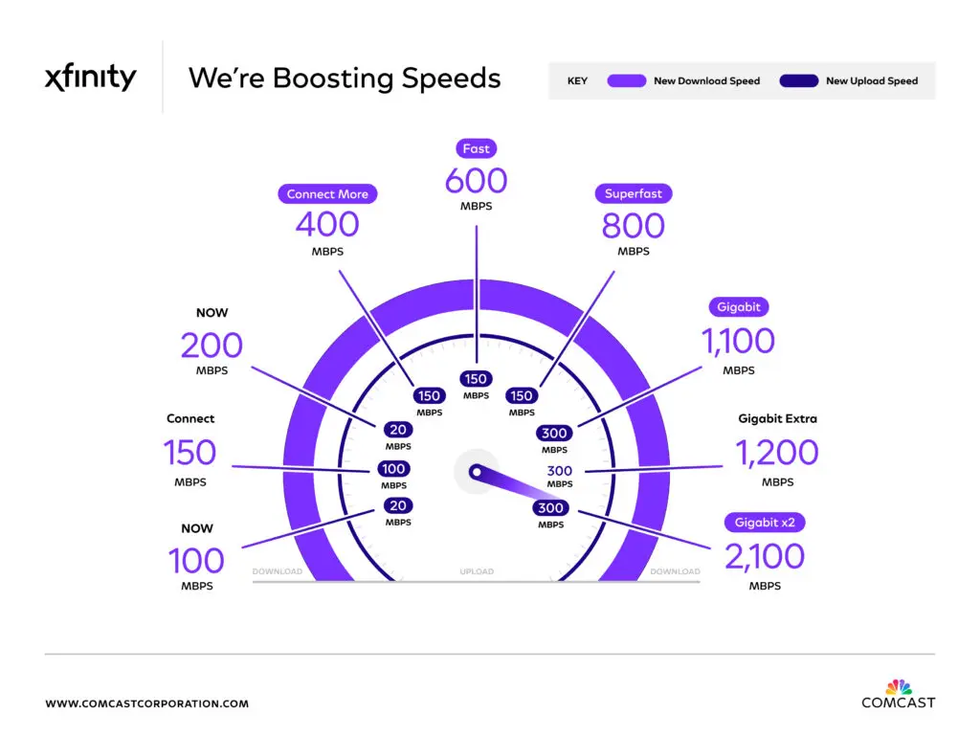
Xfinity Internet tiers, and the NOW branded prepaid products, will now benefit from 50 to 100 percent faster upload speeds, helping customers upload large files in a flash when working from home or post videos to social media in seconds. Download speeds will also increase for most internet tiers.

Xfinity boosting speeds graphicGraphic courtesy of Comcast

Customers can view the details of their current internet plan by going to the Account, Your Plan section in the Xfinity app. While there, customers can also test their internet speed.

As the demand for connectivity continues to skyrocket in hyper-connected households, the new speed increases will provide even faster download and upload speeds to ensure customers can do more of what they love online — stream, game, chat, surf, and more — on all their devices, all at the same time.

“We want and need seamless connectivity for everything,” says Jose Espinel, Comcast Texas’ regional senior vice president. “Our faster download and upload speeds, combined with our world-class WiFi equipment, ultra-low-lag internet experience, and WiFi PowerBoost that delivers speeds up to a gig, are providing a converged connectivity experience that we believe is unmatched in the industry.”

With 94 percent of devices connecting to the internet via WiFi, fast speeds are only as good as the WiFi that connects them. At home, Xfinity’s WiFi gateways and extenders create a fast, reliable, and secure connection to every corner of the house. Outside of the home, Comcast’s Xfinity internet customers have access to the nation’s largest network of WiFi hotspots to connect on the go.

In addition to faster speeds, new and existing Xfinity Internet customers can now get a line of Unlimited on Xfinity Mobile included for a year when they subscribe to a 400 Mbps or faster plan.

And with WiFi PowerBoost, Xfinity Mobile and Comcast Business Mobile customers seamlessly receive WiFi speeds up to 1 Gbps no matter what internet speed tier they subscribe to, in and out of the home, on the nation’s largest and fastest WiFi network.

Fast download and upload speeds are an important feature of a comprehensive connectivity experience that delivers incredible benefits to consumers, including:

  • Reliability: Xfinity has greater than 99 percent reliability, and the Xfinity network utilizes artificial intelligence to keep customers connected by fixing issues before customers even know they happened.
  • Ultra-low-lag: Comcast recently introduced the first customers in the world to a pioneering new feature of Xfinity Internet that dramatically reduces latency when using interactive applications like gaming, videoconferencing, and virtual reality. Customers will have less delay and a smoother, more responsive end-to-end online experience.
  • Great WiFi in and out of the home: Next-generation Xfinity gateways deliver advanced WiFi capacity to power hundreds of devices in homes, and more than a billion devices each year across Comcast’s network. WiFi PowerBoost delivers Xfinity Mobile customers speeds up to 1 Gbps over WiFi at home or at millions of WiFi hotspots across the country.
  • Digital security: xFi Advanced Security, included free for customers who lease an Xfinity gateway, protects connected devices from malware and other threats at the gateway before they reach connected household devices. Since launching xFi Advanced Security, Xfinity has stopped more than 10 billion cyber security threats.

Customers can take advantage of the unlimited mobile line offer via their account on Xfinity.com, in the Xfinity app, or by calling 1-800-XFINITY.

Ad Placement 300x100
Ad Placement 300x600

CultureMap Emails are Awesome

Houston scientists develop breakthrough AI-driven process to design, decode genetic circuits

biotech breakthrough

Researchers at Rice University have developed an innovative process that uses artificial intelligence to better understand complex genetic circuits.

A study, published in the journal Nature, shows how the new technique, known as “Combining Long- and Short-range Sequencing to Investigate Genetic Complexity,” or CLASSIC, can generate and test millions of DNA designs at the same time, which, according to Rice.

The work was led by Rice’s Caleb Bashor, deputy director for the Rice Synthetic Biology Institute and member of the Ken Kennedy Institute. Bashor has been working with Kshitij Rai and Ronan O’Connell, co-first authors on the study, on the CLASSIC for over four years, according to a news release.

“Our work is the first demonstration that you can use AI for designing these circuits,” Bashor said in the release.

Genetic circuits program cells to perform specific functions. Finding the circuit that matches a desired function or performance "can be like looking for a needle in a haystack," Bashor explained. This work looked to find a solution to this long-standing challenge in synthetic biology.

First, the team developed a library of proof-of-concept genetic circuits. It then pooled the circuits and inserted them into human cells. Next, they used long-read and short-read DNA sequencing to create "a master map" that linked each circuit to how it performed.

The data was then used to train AI and machine learning models to analyze circuits and make accurate predictions for how untested circuits might perform.

“We end up with measurements for a lot of the possible designs but not all of them, and that is where building the (machine learning) model comes in,” O’Connell explained in the release. “We use the data to train a model that can understand this landscape and predict things we were not able to generate data on.”

Ultimately, the researchers believe the circuit characterization and AI-driven understanding can speed up synthetic biology, lead to faster development of biotechnology and potentially support more cell-based therapy breakthroughs by shedding new light on how gene circuits behave, according to Rice.

“We think AI/ML-driven design is the future of synthetic biology,” Bashor added in the release. “As we collect more data using CLASSIC, we can train more complex models to make predictions for how to design even more sophisticated and useful cellular biotechnology.”

The team at Rice also worked with Pankaj Mehta’s group in the department of physics at Boston University and Todd Treangen’s group in Rice’s computer science department. Research was supported by the National Institutes of Health, Office of Naval Research, the Robert J. Kleberg Jr. and Helen C. Kleberg Foundation, the American Heart Association, National Library of Medicine, the National Science Foundation, Rice’s Ken Kennedy Institute and the Rice Institute of Synthetic Biology.

James Collins, a biomedical engineer at MIT who helped establish synthetic biology as a field, added that CLASSIC is a new, defining milestone.

“Twenty-five years ago, those early circuits showed that we could program living cells, but they were built one at a time, each requiring months of tuning,” said Collins, who was one of the inventors of the toggle switch. “Bashor and colleagues have now delivered a transformative leap: CLASSIC brings high-throughput engineering to gene circuit design, allowing exploration of combinatorial spaces that were previously out of reach. Their platform doesn’t just accelerate the design-build-test-learn cycle; it redefines its scale, marking a new era of data-driven synthetic biology.”

Axiom Space wins NASA contract for fifth private mission, lands $350M in financing

ready for takeoff

Editor's note: This story has been updated to include information about Axiom's recent funding.

Axiom Space, a Houston-based space infrastructure company that’s developing the first commercial space station, has forged a deal with NASA to carry out the fifth civilian-staffed mission to the International Space Station.

Axiom Mission 5 is scheduled to launch in January 2027, at the earliest, from NASA’s Kennedy Space Center in Florida. The crew of non-government astronauts is expected to spend up to 14 days docked at the International Space Station (ISS). Various science and research activities will take place during the mission.

The crew for the upcoming mission hasn’t been announced. Previous Axiom missions were commanded by retired NASA astronauts Michael López-Alegría, the company’s chief astronaut, and Peggy Whitson, the company’s vice president of human spaceflight.

“All four previous [Axiom] missions have expanded the global community of space explorers, diversifying scientific investigations in microgravity, and providing significant insight that is benefiting the development of our next-generation space station, Axiom Station,” Jonathan Cirtain, president and CEO of Axiom, said in a news release.

As part of Axiom’s new contract with NASA, Voyager Technologies will provide payload services for Axiom’s fifth mission. Voyager, a defense, national security, and space technology company, recently announced a four-year, $24.5 million contract with NASA’s Johnson Space Center in Houston to provide mission management services for the ISS.

Axiom also announced today, Feb. 12, that it has secured $350 million in a financing round led by Type One Ventures and Qatar Investment Authority.

The company shared in a news release that the funding will support the continued development of its commercial space station, known as Axiom Station, and the production of its Axiom Extravehicular Mobility Unit (AxEMU) under its NASA spacesuit contract.

NASA awarded Axiom a contract in January 2020 to create Axiom Station. The project is currently underway.

"Axiom Space isn’t just building hardware, it’s building the backbone of humanity’s next era in orbit," Tarek Waked, Founding General Partner at Type One Ventures, said in a news release. "Their rare combination of execution, government trust, and global partnerships positions them as the clear successor-architect for life after the ISS. This is how the United States continues to lead in space.”

Houston edtech company closes oversubscribed $3M seed round

fresh funding

Houston-based edtech company TrueLeap Inc. closed an oversubscribed seed round last month.

The $3.3 million round was led by Joe Swinbank Family Limited Partnership, a venture capital firm based in Houston. Gamper Ventures, another Houston firm, also participated with additional strategic partners.

TrueLeap reports that the funding will support the large-scale rollout of its "edge AI, integrated learning systems and last-mile broadband across underserved communities."

“The last mile is where most digital transformation efforts break down,” Sandip Bordoloi, CEO and president of TrueLeap, said in a news release. “TrueLeap was built to operate where bandwidth is limited, power is unreliable, and institutions need real systems—not pilots. This round allows us to scale infrastructure that actually works on the ground.”

True Leap works to address the digital divide in education through its AI-powered education, workforce systems and digital services that are designed for underserved and low-connectivity communities.

The company has created infrastructure in Africa, India and rural America. Just this week, it announced an agreement with the City of Kinshasa in the Democratic Republic of Congo to deploy a digital twin platform for its public education system that will allow provincial leaders to manage enrollment, staffing, infrastructure and performance with live data.

“What sets TrueLeap apart is their infrastructure mindset,” Joe Swinbank, General Partner at Joe Swinbank Family Limited Partnership, added in the news release. “They are building the physical and digital rails that allow entire ecosystems to function. The convergence of edge compute, connectivity, and services makes this a compelling global infrastructure opportunity.”

TrueLeap was founded by Bordoloi and Sunny Zhang and developed out of Born Global Ventures, a Houston venture studio focused on advancing immigrant-founded technology. It closed an oversubscribed pre-seed in 2024.