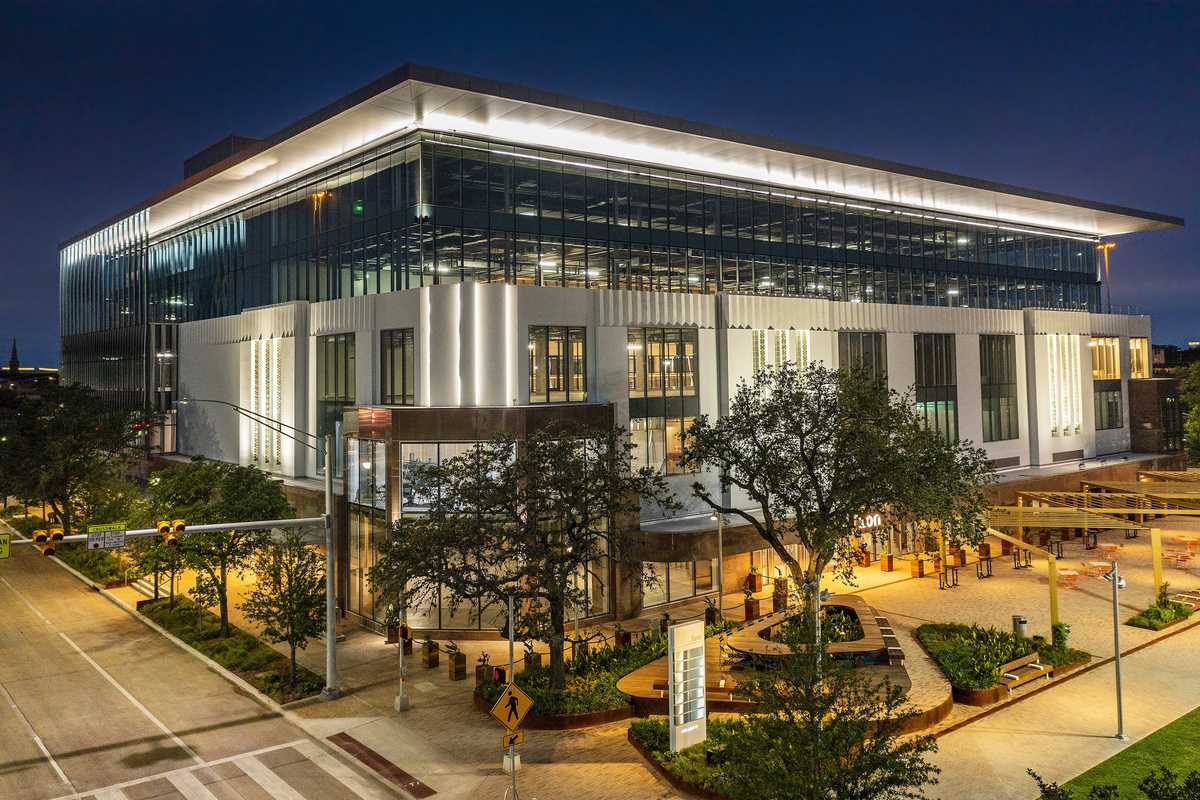
Wei Gao (center), a UH assistant professor of pharmacology, and her team have developed Nano-273, which helps the immune system fight pancreatic and lung cancers. Photo courtesy UH.

With a relative five-year survival rate of 50 percent, pancreatic cancer is a diagnosis nobody wants. At 60 percent, the prognosis for lung cancer isn’t much rosier. That’s because both cancers contain regulatory B cells (Bregs), which block the body’s natural immunity, making it harder to fight the enemies within.

Newly popular immunotherapies in a category known as STING agonists may stimulate natural cancer defenses. However, they can also increase Bregs while simultaneously causing significant side effects. But Wei Gao, assistant professor of pharmacology at the University of Houston College of Pharmacy, may have a solution to that conundrum.

Gao and her team have developed Nano-273, a dual-function drug, packaged in an albumin-based particle, that boosts the immune system to help it better fight pancreatic and lung cancers. Gao’s lab recently received a $900,000 grant from the Cancer Prevention and Research Institute of Texas (CPRIT) to aid in fueling her research into the nanodrug.

“Nano-273 both activates STING and blocks PI3Kγ—a pathway that drives Breg expansion, while albumin nanoparticles help deliver the drug directly to immune cells, reducing unwanted side effects,” Gao said in a press release. “This approach reduces harmful Bregs while boosting immune cells that attack cancer, leading to stronger and more targeted anti-tumor responses.”

In studies using models of both pancreatic and lung cancers, Nano-273 has shown great promise with low toxicity. Its best results thus far have involved using the drug in combination with immunotherapy or chemotherapy.

With the CPRIT funds, Gao and her team will be able to charge closer to clinical use with a series of important steps. Those include continuing to test Nano-273 alongside other drugs, including immune checkpoint inhibitors. Safety studies will follow, but with future patients in mind, Gao will also work toward improving her drug’s production, making sure that it’s safe and high-quality every time, so that it is eventually ready for trials.

Gao added: “If successful, this project could lead to a new type of immunotherapy that offers lasting tumor control and improved survival for patients with pancreatic and lung cancers, two diseases that urgently need better treatments."


Ad Placement 300x100
Ad Placement 300x600

CultureMap Emails are Awesome

Houston booms as No. 2 U.S. metro for new home construction

Construction Boom

Driven by population growth, more residential rooftops are popping up across Houston and the rest of Texas than anywhere else in America.

Using data from the U.S. Census Bureau and Zillow, Construction Coverage found 65,747 new residential units were authorized in greater Houston in 2024. That figure landed Houston in second place among major metro areas for the total number of housing permits, including those for single-family homes, apartments, and condos.

Just ahead of Houston was the Dallas-Fort Worth Metroplex, which took first place with 71,788 residential permits approved in 2024. In third place was the country’s largest metro, New York City (57,929 permits).Elsewhere in Texas, the Austin metro ranked sixth (32,294 permits), and the San Antonio metro ranked 20th (14,857 permits).

Construction Coverage also sorted major metro areas based on the number of new housing units authorized per 1,000 existing homes in 2024. Raleigh, North Carolina, held the No. 1 spot (28.8 permits per 1,000 existing homes), followed by Austin at No. 2 (28.6), DFW at No. 3 (22.2), Houston at No. 4 (21.6), and San Antonio at No. 13 (13.6).

A Newsweek analysis of Census Bureau data shows building permits for 225,756 new residential units were approved in 2024 in Texas — a trend fueled largely by activity in DFW, Houston, Austin, and San Antonio. That put Texas atop the list of states building the most residential units for the year.

Through the first eight months of last year, 145,901 permits for new residential units were approved in Texas, according to Census Bureau data. That’s nearly 80,000 permits shy of the 2024 total.

Among the states, Construction Coverage ranks Texas sixth for the number of residential building permits approved in 2024 per 1,000 existing homes (17.9).

Extra housing is being built in Texas to meet demand spurred by population growth. From April 2020 to July 2024, the state’s population increased 7.3 percent, the Census Bureau says.

While builders are busy constructing new housing in Texas, they’re not necessarily profiting a lot from homebuilding activity.

“Market conditions remain challenging, with two-thirds of builders reporting they are offering incentives to move buyers off the fence,” North Carolina homebuilder Buddy Hughes, chairman of the National Association of Home Builders, said in a December news release. “Meanwhile, builders are contending with rising material and labor prices, as tariffs are having serious repercussions on construction costs.”

5+ must-know application deadlines for Houston innovators

apply now

Editor's note: As 2026 ramps up, the Houston innovation scene is looking for the latest groups of innovative startups that'll make an impact. A number of accelerators and competitions have opened applications. Read below to see which might be a good fit for you or your venture. And take careful note of the deadlines. Please note: this article may be updated to include additional information and programs.

Did we miss an accelerator or competition accepting applications? Email innoeditor@innovationmap.com for editorial consideration.

2026 HCC Business Plan Competition

Deadline: Jan. 26

Details: HCC’s annual Business Plan Competition (BPC) is an opportunity for proposed, startup and existing entrepreneurs to develop focused plans to start or grow their businesses. Accepted teams will be announced and training will begin in late February and run through early June, with six free, three-hour training sessions. Advising will be provided to each accepted team. Applicants can apply as a team of up to five persons. Finalists will present to to gudges on May 27, 2026. Last year, $26,000 was awarded in seed money to the top five teams. In-kind prizes were also awarded to all graduating teams including free products, services and memberships, with an estimated in-kind value totaling $147,000. Find more information here.

University of Houston Technology Bridge Innov8 Hub (Spring 2026)

Deadline: Jan . 30

Details: UHTB Innov8 Hub’s immersive, 12-week startup acceleration program designed to help early-stage founders launch and scale their technology startups. Selected participants will gain access to expert mentors and advisors, collaborate with a cohort of peers, and compete for cash prizes during our final pitch event. The cohort begins Feb. 16, 2026. The program culminates in Pitch Day, where participants present their ventures to an audience of investors and partners from across the UH innovation ecosystem. Find more information here.

Rice Business Plan Competition 2026

Deadline: Jan. 31

Details: The Rice Business Plan Competition, hosted by the Rice Alliance for Technology and Entrepreneurship, gives collegiate entrepreneurs real-world experience to pitch their startups, enhance their business strategy and learn what it takes to launch a successful company. Forty-two teams will compete for more than $1 million in cash, investments and prizes on April 9-11, 2026. Find more information here.

Rice Veterans Business Battle 2026

Deadline: Jan. 31

Details: The Rice Veterans Business Battle is one of the nation’s largest pitch competitions for veteran-led startups, providing founders with mentorship, exposure to investors and the opportunity to compete for non-dilutive cash prizes. The event has led to more than $10 million of investments since it began in 2015. Teams will compete April 8-9, 2026. Find more information here.

TEX-E Fellows Application 2026-2027

Deadline: Feb. 10

Details: The TEX‑E Fellowship is a hands-on program designed for students interested in energy, climate, and entrepreneurship across Texas. It connects participants with industry mentors, startup founders, investors and academic leaders while providing practical, "real-world" experience in customer discovery, business modeling, and energy-transition innovation. Fellows gain access to workshops, real-world projects, and a statewide network shaping the future of energy and climate solutions. Participants must be a student at PVAMU, UH, UT Austin, Rice University, MIT or Texas A&M. Find more information here.

2026 Energy Venture Day & Pitch Competition

Deadline: Feb. 13

Details: The Rice Alliance, the Houston Energy Transition Initiative (HETI) and TEX-E will present the annual Energy Venture Day and Pitch Competition during CERAWeek on March 24-25, 2026. Energy Venture Day features two days of presentations by energy tech ventures driving efficiency and advancements toward the energy transition. On March 24, the Pitch Preview at the Ion will feature over 50 companies presenting in front of Rice Alliance's robust network of investors and industry partners. On March 25, the Energy Venture Day and Pitch Competition during CERAWeek will showcase 36 ventures at the George R Brown Convention Center. The pitch competition is divided up into the TEX-E university track, in which Texas student-led energy startups compete for $50,000 in cash prizes, and the industry ventures track. The industry track is subdivided into three additional tracks, spanning materials to clean energy. The top three companies from each industry track will be named. The winner of the CERAWeek competition will also have the chance to advance and compete for the $1 million investment prize at the Startup World Cup. Find more information here.

Greentown Go Make 2026

Deadline: March 10

Details: Greentown Go Make 2026 is an open-innovation program with Shell and Technip Energies. The six-month program is advancing industrial decarbonization by accelerating catalytic innovations. Selected startups will gain access to a structured platform to engage leadership from Shell and Technip Energies and explore potential partnership outcomes, including pilots and demonstrations. They’ll also receive networking opportunities, partnership-focused programming, and marketing visibility throughout the program. The cohort will be selected in May. Find more information here.

Houston startups closed $1.75 billion in 2025 VC funding, says report

by the numbers

Going against national trends, Houston-area startups raised 7 percent less venture capital last year than they did in 2024, according to the new PitchBook-NVCA Venture Monitor report.

The report shows local startups collected $1.75 billion in venture capital in 2025, down from $1.89 billion the previous year.

Houston-based geothermal energy company Fervo Energy received a big chunk of the region’s VC funding last year. Altogether, the startup snagged $562 million in investments, as well as a $60 million extension of an existing loan and $45.6 million in debt financing. The bulk of the 2025 haul was a $462 million Series E round.

In the fourth quarter of last year, Houston-area VC funding totaled $627.68 million. That was a 22 percent drop from $765.03 million during the same period in 2024. Still, the Q4 total was the biggest quarterly total in 2025.

Across the country, startups picked up $339.4 trillion in VC funding last year, a 59 percent increase from $213.2 trillion in 2024, according to the report. Over the last 10 years, only the VC total in 2021 ($358.2 trillion) surpassed the total from 2025.

Nationwide, startups in the artificial intelligence and machine learning sector accounted for the biggest share of VC funding (65.4 percent) in 2025, followed by software-as-a-service (SaaS), big data, manufacturing, life sciences and healthtech, according to the report.

“Despite an overall lack of new fundraising and a liquidity market that did not shape up as hoped in 2025, deal activity has begun a phase of regrowth, with deal count estimates showing increases at each stage, and deal value, though concentrated in a small number of deals, falling just [8 percent] short of the 2021 figure,” the report reads.