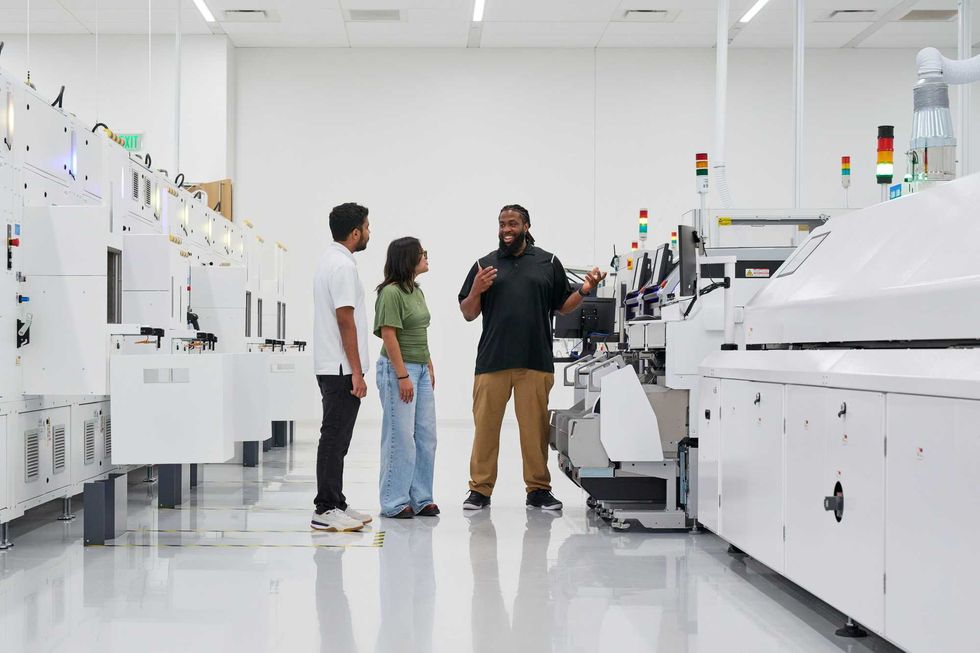
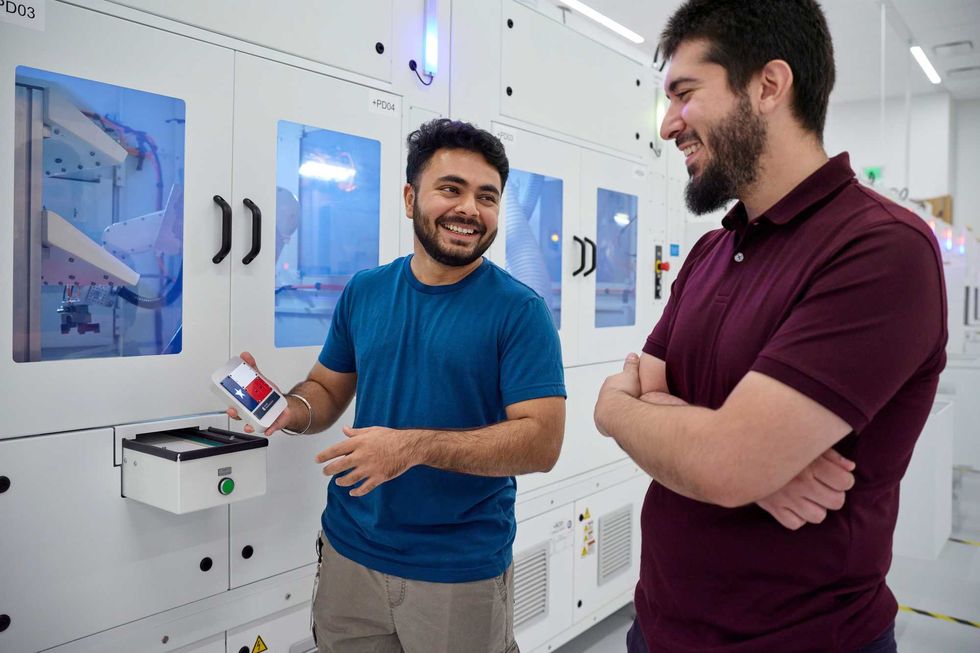
The inaugural Activate Houston cohort has 11 fellows across energy, materials, life sciences, space, and other sectors. Photo via activate.org

A national hardtech-focused organization has named its 2024 batch of innovators, which includes the inaugural Houston-based cohort.

Activate named 62 fellows and 50 companies for is latest class, which spans Berkley, California — where the organization is based, Boston, New York, and Houston. Additionally, Activate Anywhere, the program's virtual and remote cohort, was named. According to Activate, it received over 1,000 applicants.

“People, not ideas alone, move the world forward. It is through the drive and determination of brilliant scientists and engineers that we are witnessing true progress,” says Activate CEO Cyrus Wadia in a news release. “Our current Activate Fellows and alumni are already pioneering innovative solutions that make a measurable difference. We’re thrilled to support the next 62 visionaries who will lead the charge in addressing our most urgent issues through groundbreaking science and technology.”

It's the first year Activate has hosted a Houston-based cohort. The organization initially announced its expansion early last year. The inaugural cohort has 11 fellows across energy, materials, life sciences, space, and other sectors.

The named Houston fellows selected for the 2024 class include:

  • Krish Mehta, founder and CEO of Phoenix Materials, a company that decarbonizes concrete using industrial waste.
  • Gabriel Cossio, founder and CEO of Nanoscale Labs, which is developing a high-throughput and low-cost nanomanufacturing system.
  • Matthew McDermott, founder and CEO of Refound Materials, a materials technology company developing more efficient synthesis recipes for accelerated materials discovery.
  • Alec Ajnsztajn, founder and CEO of Coflux Purification, a company that's creating a product that allows industries and water providers to cheaply remove forever chemicals to provide safe drinking water at a fraction of current energy use.
  • Ryan DuChanois and Yang Xia , co-founders of Solidec, a Houston-based startup redefining chemical manufacturing.
  • Meagan Pitcher, co-founder and CEO of Bairitone Health, which brings advanced imaging diagnostics into the home environment.
  • Wei Meng, co-founder and CEO of LumiStrain, a startup offering novel technology for mechanical strain mapping.
  • Sonia Dagan of Atolla Tech, which is developing a lidar and machine-learning algorithm for identifying and quantifying airborne insects.
  • Rodrigo Alvarez-Icaza, founder and CEO of Elysium Robotics, a company that's replacing electric motors with muscle-like actuators to enable massive deployment of highly capable and low-cost robotic systems.
  • Blake Herren, CEO and Co-founder of Raven Space Systems, which is modernizing composite manufacturing with 3D printing and Industry 4.0 solutions to build the factories of the future.

------

This article originally ran on EnergyCapital.

Ad Placement 300x100
Ad Placement 300x600

CultureMap Emails are Awesome

Aegis Aerospace appoints Houston space leader as new president

moving up

Houston-based Aegis Aerospace's current chief strategy officer, Matt Ondler, will take on the additional role of president on Jan. 1. Ondler will succeed Bill Hollister, who is retiring.

“Matt's vision, experience, and understanding of our evolving markets position us to build on our foundation and pursue new frontiers,” Stephanie Murphy, CEO of Aegis Aerospace, said in a news release.

Hollister guided Aegis Aerospace through expansion and innovation in his three years as president, and will continue to serve in the role of chief technology officer (CTO) for six months and focus on the company's technical and intellectual property frameworks.

"Bill has played an instrumental role in shaping the success and growth of our company, and his contributions leave an indelible mark on both our culture and our achievements," Murphy said in a news release.

Ondler has a background in space hardware development and strategic leadership in government and commercial sectors. Ondler founded subsea robots and software company Houston Mechatronics, Inc., now known as Nauticus Robotics, and also served as president, CTO and CSO during a five-year tenure at Axiom Space. He held various roles in his 25 years at NASA and was also named to the Texas Aerospace Research and Space Economy Consortium Executive Committee last year.

"I am confident that with Matt at the helm as president and Bill supporting us as CTO, we will continue to build on our strong foundation and further elevate our impact in the space industry," Murphy said in a news release. "Matt's vision, experience, and understanding of our evolving markets position us to build on our foundation and pursue new frontiers."

Rice University launches new center to study roots of Alzheimer’s and Parkinson’s

neuro research

Rice University launched its new Amyloid Mechanism and Disease Center last month, which aims to uncover the molecular origins of Alzheimer’s, Parkinson’s and other amyloid-related diseases.

The center will bring together Rice faculty in chemistry, biophysics, cell biology and biochemistry to study how protein aggregates called amyloids form, spread and harm brain cells. It will serve as the neuroscience branch of the Rice Brain Institute, which was also recently established.

The team will work to ultimately increase its understanding of amyloid processes and will collaborate with the Texas Medical Center to turn lab discoveries into real progress for patients. It will hold its launch event on Jan. 21, 2026, and hopes to eventually be a launchpad for future external research funding.

The new hub will be led by Pernilla Wittung-Stafshed, a Rice biophysicist and the Charles W. Duncan Jr.-Welch Chair in Chemistry.

“To make a real difference, we have to go all the way and find a cure,” Wittung-Stafshede said in a news release. “At Rice, with the Amyloid Mechanism and Disease Center as a catalyst, we have the people and ideas to open new doors toward solutions.”

Wittung-Stafshede, who was recruited to Rice through a Cancer Prevention and Research Institute of Texas grant this summer, has led pioneering work on how metal-binding proteins impact neurodegenerative disorders, including Alzheimer’s and Parkinson’s diseases. Her most recent study, published in Advanced Science, suggests a new way of understanding how amyloids may harm cells and consume the brain’s energy molecule, ATP.

According to Alzheimer’s Disease International, neurodegenerative disease cases could reach around 78 million by 2030 and 139 million by 2050. Wittung-Stafshede’s father died of dementia several years ago.

“This is close to my heart,” Wittung-Stafshede added in the news release. “Neurodegenerative diseases such as dementia, Alzheimer’s and Parkinson’s are on the rise as people live longer, and age is the largest risk factor. It affects everyone.”

This Houston airport saw sharp passenger decline in 2025, study shows

Travel Talk

A new global airport travel study has revealed passenger traffic at Houston's William P. Hobby Airport (HOU) sharply decreased from 2024 to 2025.

The analysis from travel magazine LocalsInsider examined recently released data from the Bureau of Transportation Statistics (BTS), the U.S. International Trade Association, and a nationwide survey to determine the following American traveler habits: The most popular U.S. and international destinations, emerging hotspots, and destinations on the decline. The study covered passenger travel trends from January through July 2025.

In the report's ranking of the 40 U.S. airports with the sharpest declines in passenger traffic, HOU ranked 13th on the list.

About 4.26 million arrivals were reported at HOU from January through July 2024, compared to about 3.96 million during the same seven-month period in 2025. According to the data, that's a significant 7.1 percent drop in passenger traffic year-over-year, or a loss of 300,974 passengers.

"As travelers chase new hotspots, some destinations are seeing reduced passenger traffic whether due to rising costs, shifting airline schedules, or evolving traveler preferences, some destinations are seeing a decrease in visitors," the report's author wrote.

It appears most major Texas airports had drops in passenger traffic from 2024 to 2025. Dallas Love Field Airport (DAL) saw the worst in the state, with a dramatic 7.4 percent dip in arrivals. DAL also ranked 11th on the list of U.S. airports with the steepest declines in passenger traffic.

More than 5.13 million arrivals were reported at DAL from January through July 2024, compared to over 4.75 million during the same seven-month period in 2025.

This is how passenger traffic has fallen at other major Texas airports from 2024 to 2025:

Austin-Bergstrom International Airport (AUS):

  • 6,107,597 – Passenger arrivals from January to July 2024
  • 5,828,396 – Passenger arrivals from January to July 2025
  • -4.6 percent – Year-over-year passenger change
Dallas/Fort Worth International Airport (DFW):
  • 23,830,017 – Passenger arrivals from January to July 2024
  • 23,251,302 – Passenger arrivals from January to July 2025
  • -2.4 percent – Year-over-year passenger change

San Antonio International Airport (SAT):

  • 2,937,870 – Passenger arrivals from January to July 2024
  • 2,836,774 – Passenger arrivals from January to July 2025
  • -3.4 percent – Year-over-year passenger change
El Paso International Airport (ELP):
  • 1,094,431 – Passenger arrivals from January to July 2024
  • 1,076,845 – Passenger arrivals from January to July 2025
  • -1.6 percent – Year-over-year passenger change
---

This story originally appeared on CultureMap.com.