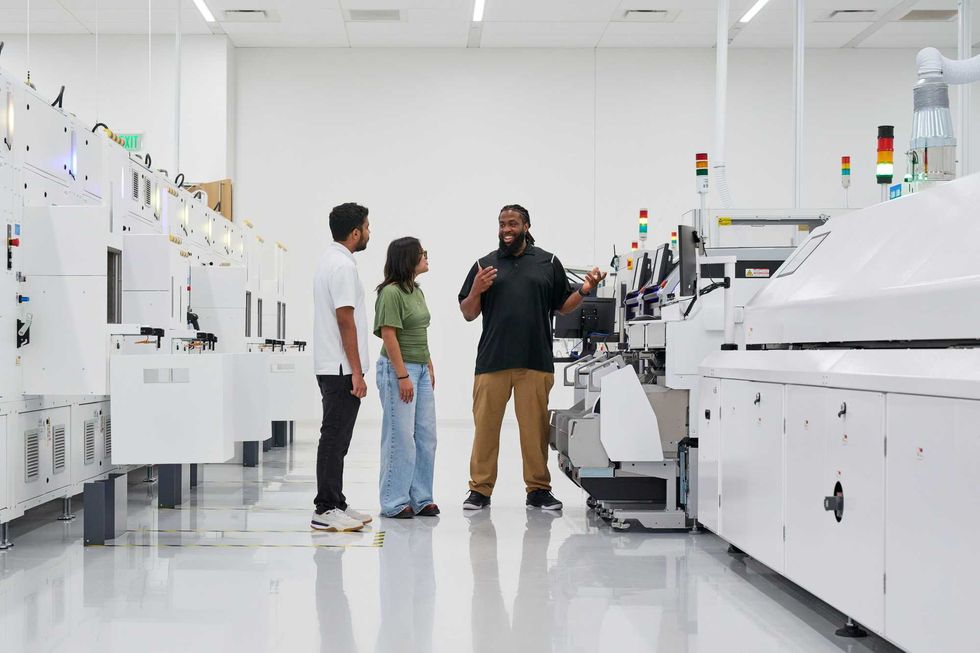
DivInc wrapped its inaugural Clean Energy Tech accelerator this month. Photo via LinkedIn

DivInc, a Texas-based accelerator focused on uplifting people of color and women founders, recently concluded their inaugural clean energy cohort, catapulting several early-stage companies to major milestones.

The 12-week intensive Clean Energy Tech accelerator program sponsored by Chevron and Microsoft instructed seven clean energy startup founders at the Ion, through a variety of workshops, mentor sessions, and deep dives with VC professionals. DivInc also gave each startup a non-dilutive $10,000 grant to use during the course of the program.

Cherise Luter, marketing director at DivInc, said the Austin-based development program decided to expand from its previous accelerators — Women in Tech and Sports Tech — into clean energy because it is a newer industry with ample potential.

“Clean energy is an emerging space where founders like ours, women and POC founders, can really get in on the ground floor in a great way so that they are building as well as benefiting from this new space,” Luter tells EnergyCapital.

Luter said corporate partners Chevron and Microsoft were similarly on board with prioritizing diversity in the clean energy sector and together they agreed Houston would be the best place to headquarter the accelerator for its expansive resources, particularly VCs.

“Houston, as the energy capital, the resources, connections, and network are here, and we have found that those are the things that are most important for our founders to be able to really take their companies to the next level,” Luter explains.

The participating startups’ focuses ranged from innovations in solar power to electric vehicle charging stations, but these corporations were all united in aiding the clean energy transition.

“It’s so interesting with this particular cohort, how they are really merging the human part of clean energy – how it’s contributing to a better life for people–with a better situation for our environment and our climate,” Luter says.

The inaugural cohort included one to two entrepreneurs from the following companies:

  • BlackCurrant Inc., based in Chicago, is transforming the hydrogen industry by simplifying OTC transactions and offering a comprehensive platform for businesses to seamlessly obtain equipment, fuel, and services essential for hydrogen adoption.
  • Owanga Solar, founded by two Emory University law students in Georgia, delivers sustainable and affordable solar energy solutions to households and businesses in the Democratic Republic of Congo.
  • Maryland-based Pirl Technology Inc. is building next generation electric vehicle charging stations.
  • Houston-based Quantum New Energy has a software platform, called EnerWisely, that helps those who own assets that reduce carbon emissions, like solar panels, generate high quality, verifiable carbon credits that don’t green wash.
  • SOL roofs, founded by Austinite Daniel Duerto, is creating the next generation of solar roofs through innovating existing technologies.
  • WIP International Services LLC, a Houston-based company, is addressing drinking water scarcity with its atmospheric water generators, which produce fresh drinking water from the humidity in the air.

Tracy Jackson, CEO of WIP International Services LLC, announced on the accelerator’s demo day her Houston-based company that produces atmospheric water generators, which transform humid air into clean drinking water, contracted with several schools in El Salvador for a pilot program to send 40 of their smaller models.

“We’re going to continue on our path and we’re looking forward to signing more international contracts and look forward to having any local opportunities that we can develop as well,” Jackson says.

Since the program ended, Luter shared WIP has also secured a “major international contract in Mexico.”

Luter also shared that accelerator participant Quantum New Energy, a climatech Houston-based company, has pre-launched expansion of EnerWisely, their software that tracks carbon credits, for commercial facilities.

Luter says DivInc plans to eventually host another cohort of their clean energy accelerator and they are continuing to accept applications from founders on a rolling basis.

------

This article originally ran on EnergyCapital.

Ad Placement 300x100
Ad Placement 300x600

CultureMap Emails are Awesome

Cancer diagnostics startup wins top prize at annual Rice competition​

winner, winners

Rice University student-founded companies took home a total of $115,000 in equity-free funding at the annual Liu Idea Lab for Innovation and Entrepreneurship's H. Albert Napier Rice Launch Challenge last week.

2025 Rice Innovation Fellow Alexandria Carter won the top prize and $50,000 for her startup Bionostic. The startup offers personalized diagnostics for cancer patients by using 3D culturing through its Advanced Tumor Landscape Analysis System (ATLAS) platform.

Carter is working toward her PhD in bioengineering in Professor Michael King's laboratory. She recently completed the Rice Innovation Fellows program and plans to commercialize ATLAS, according to a news release from Rice.

Actile Technologies, founded by another former Rice Innovation Fellow, Barclay Jumet, won second place and $25,000. The company is developing and commercializing textile-integrated technologies. InnovationMap first covered Jumet's wearable technology back in 2023.

Kairos took home the third-place prize and $15,000, plus the $2,000 audience choice award and the $5,000 undergraduate business award. Founded last year by Sanjana Kavula and Adhira Tippur, Kairos is an AI-powered patient intake platform built specifically for independent dental practices.

The NRLC features top startups founded by undergraduate, graduate and MBA students at Rice each year. The top three finishers were named among a group of five finalists earlier this year, which also included HAAST Autonomous and Project Kestrel.

HAAST is developing an unmanned aircraft for organ transport, while Kestrel uses machine learning to organize bird photographers’ photo collections.

Teams presented multiple five-minute pitches throughout the application process over Zoom and in-person before the five finalists presented at the NRLC Championships April 21 at the Rice Memorial Center. Each finalist walked away with an equity-free investment.


Other awards went to:

UnitCode

  • $5,000 MBA Venture Award

HAAST Autonomous

  • $2,500 Chan-Kang Family Prize for Bold Ambition
  • $1,000 Healthcare Innovations Prize

Telstar Networks

  • $2,500 Outstanding Undergraduate Startup Award

Multiplay

  • $1,500 Frank Liu Jr. Prize for Creative Innovation in Music, Fashion, & the Arts

Butterfly Books

  • $1,500 Social Impact Award

SOOZ

  • $1,000 Interdisciplinary Innovation Prize sponsored by OURI

Dooly

  • $1,000 Consumer Goods Prize

Project Kestrel

  • $1,000 AI Prize

Veloci Running won the NRLC last year for its naturally shaped running shoe. Founder and CEO Tyler Strothman recently told InnovationMap that the company has gone on to sell roughly 10,000 pairs of its flagship Ascent shoe, designed to relieve lower leg tightness and absorb impact. Read more here.

Houston-based, NASA-founded cleantech startup closes $12M seed round

Fresh Funds

Houston-based Helix Earth Technologies has closed a $12 million Seed 2 funding round to scale manufacturing of its energy-efficient commercial HVAC add-on technology.

Veriten, a Houston-based energy investment firm, led the round. Rua Ventures, Carnrite Ventures, Skywriter LLC and Textbook Ventures also participated.

Helix Earth—which was founded based on NASA technology, spun out of Rice University and has been incubated at Greentown Labs—is developing high-efficiency retrofit dehumidification systems that aim to reduce the energy consumption of commercial HVAC units. The company reports that its technology can lead to "healthier indoor air, lower energy bills, reduced building maintenance, and more comfortable spaces for building owners and occupants."

"Building owners are dealing with rising energy costs, uncontrolled humidity, and aging infrastructure with no viable, cost-effective path forward. We are in the field today solving these problems for commercial customers, and this capital puts us on an aggressive path to scale,” Rawand Rasheed, Helix Earth co-founder and CEO, said in a news release.

“The strength of this round reinforces our team's conviction that we can transform innovation-starved sectors with transformational solutions that deliver order-of-magnitude improvements to owners and operators, for both their bottom line and the environment,” Rasheed added.

Maynard Holt, Veriten’s founder and CEO, said that the investment firm is tripling its investment in Helix Earth.

"The team has built breakthrough technology with real applicability across multiple industries,” Holt said in the release. “Their first product will have an immediate and measurable impact on our energy system, and they are already pursuing adjacent innovations to help heavy industries operate more efficiently and with less waste. This is a well-rounded team with a proven track record of strong execution and disciplined capital management.”

Helix Earth also closed a $5.6 million seed funding round in 2024, led by Veriten.

Last year, the company secured a $1.2 million Small Business Innovation Research (SBIR) Phase II grant and won in the Smart Cities, Transportation & Sustainability contest at the 2025 SXSW Pitch Showcase. Rasheed was also named to the Forbes 30 Under 30 Energy and Green Tech list for 2025.

---

This article originally appeared on EnergyCapital HTX.com.

Texas earns 22nd 'best state for business' title as GDP hits $2.9T

booming economy

The Texas business sector recently received a double dose of good news.

For the 22nd consecutive year, Chief Executive magazine named Texas the best state for business. In tandem with that achievement, preliminary new estimates from the U.S. Bureau of Economic Analysis show the size of Texas’ economy jumped to $2.9 trillion in 2025, up by a nation-leading growth rate of 2.5 percent compared with the previous year.

Speaking about the Chief Executive honor, Gov. Greg Abbott says Texas benefits from pro-growth policies, a strong workforce, strategic investments in education, training for high-demand skills and the presence of critical infrastructure.

“Texas is where businesses innovate and where opportunity abounds. … We will continue to move at the speed of business as we build a more prosperous Texas for generations to come,” the governor says.

An annual Chief Executive survey of CEOs, presidents and business owners determines which state is the best for business. Texas has landed at No. 1 every year since Chief Executive launched the ranking.

“Truly, this is an incredible run that Texas has going,” says Christopher Chalk, publisher of Chief Executive. “CEOs are a tough group to please, and yet year after year Texas continues to earn the top spot—no small feat.”

It’s also no small feat for a state to notch annual gains in its gross domestic product (GDP), a measurement of economic power based on the value of goods and services produced each year.

With an estimated GDP of $2.9 trillion last year, Texas maintains its position as the eighth-largest global economy compared with the nations of the world, based on preliminary estimates from the International Monetary Fund.

In reference to Texas’ GDP growth, Abbott says the Lone Star State is “the premier destination for job creators from across the country and world. We will keep attracting world-class investment, create jobs, and expand opportunity for Texans for generations to come.”