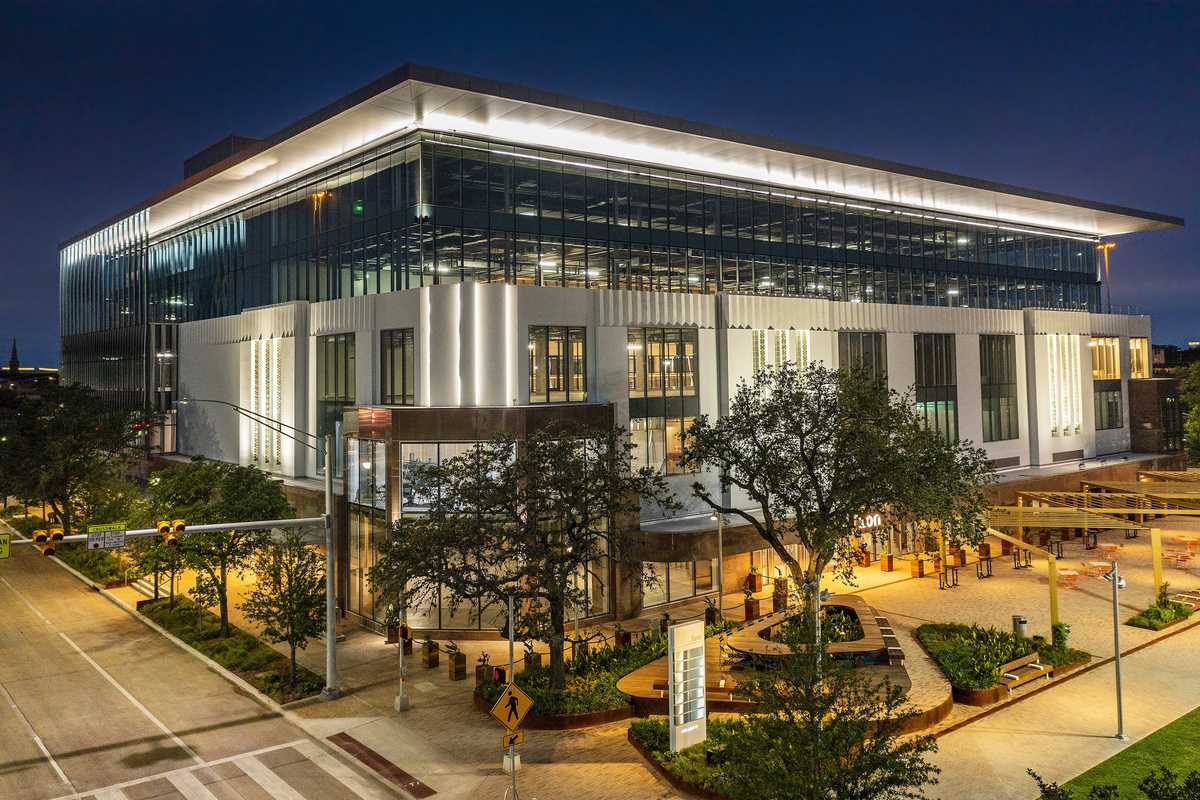
Tilman Fertitta's online gambling biz has changed hands. Photo by J. Thomas Ford

DraftKings, the nationally renown fantasy sports and online sportsbook company (Nasdaq: DKNG), announced it will acquire Houston billionaire Tilman Fertitta's Golden Nugget Online Gaming, Inc. (Nasdaq: GNOG) in an all-stock transaction valued at $1.56 billion. In addition, DraftKings has reached an agreement with Fertitta Entertainment on a partnership with the Houston Rockets, Golden Nugget casinos, and the Landry's vast network of restaurants.

"Our acquisition of Golden Nugget Online Gaming, a brand synonymous with iGaming and entertainment, will enhance our ability to instantly reach a broader consumer base, including Golden Nugget's loyal 'iGaming-first' customers," Jason Robins, DraftKings' CEO and chairman of the board, said in a statement. "We look forward to Tilman being an active member of our Board and one of our largest shareholders."

Golden Nugget Online Gaming began operating in New Jersey in 2013. The company offers online gaming such as blackjack and slot machines that are accessible by computers, tablets, and smartphones. Live dealers enhance the experience for players.

Fertitta took Golden Nugget Online Gaming public in 2020. At the time, the deal valued the company at approximately $745 million. Fertitta currently owns approximately 46 percent of the shares in GNOG, according to a press release, and serves as its chairman and CEO.

"This transaction will add great value to the shareholders as two market leaders merge into a leading global player in digital sports, entertainment and online gaming," Fertitta said. "We believe that DraftKings is one of the leading players in this burgeoning space and couldn't be more excited to lock arms with Jason and the DraftKings family across our entire portfolio of assets, including the Houston Rockets, the Golden Nugget casinos, and Landry's vast portfolio of restaurants. This is a strong commercial agreement for both companies."

DraftKings' agreement with Fertitta Entertainment will provide for it to become the exclusive daily fantasy sports, sports betting, and iGaming partner of the Houston Rockets. Additionally, if sports betting becomes legal in Texas, DraftKings will open a sportsbook at the Toyota Center.

The boards of directors of both directors of both companies have approved the transaction, which is subject to regulatory approvals. It is expected to close in the first quarter of 2022.

------

This article originally ran on CultureMap.

Ad Placement 300x100
Ad Placement 300x600

CultureMap Emails are Awesome

How Houston innovators played a role in the historic Artemis II splashdown

safe landing

Research from Rice University played a critical role in the safe return of U.S. astronauts aboard NASA’s Artemis II mission this month.

Rice mechanical engineer Tayfun E. Tezduyar and longtime collaborator Kenji Takizawa developed a key computational parachute fluid-structure interaction (FSI) analysis system that proved vital in NASA’s Orion capsule’s descent into the Pacific Ocean. The FSI system, originally developed in 2013 alongside NASA Johnson Space Center, was critical in Orion’s three-parachute design, which slowed the capsule as it returned to Earth, according to Rice.

The model helped ensure that the parachute design was large enough to slow the capsule for a safe landing while also being stable enough to prevent the capsule from oscillating as it descended.

“You cannot separate the aerodynamics from the structural dynamics,” Tezduyar said in a news release. “They influence each other continuously and even more so for large spacecraft parachutes, so the analysis must capture that interaction in a robustly coupled way.”

The end result was a final parachute system, refined through NASA drop tests and Rice’s computational FSI analysis, that eliminated fluctuations and produced a stable descent profile.

Apart from the dynamic challenges in design, modeling Orion’s parachutes also required solving complex equations that considered airflow and fabric deformation and accounted for features like ringsail canopy construction and aerodynamic interactions among multiple parachutes in a cluster.

“Essentially, my entire group was dedicated to that work, because I considered it a national priority,” Tezduyar added in the release. “Kenji and I were personally involved in every computer simulation. Some of the best graduate students and research associates I met in my career worked on the project, creating unique, first-of-its-kind parachute computer simulations, one after the other.”

Current Intuitive Machines engineer Mario Romero also worked on Orion during his time at NASA. From 2018 to 2021, Romero was a member of the Orion Crew Capsule Recovery Team, which focused on creating likely scenarios that crewmembers could encounter in Orion.

The team trained in NASA’s 6.2-million-gallon pool, using wave machines to replicate a range of sea conditions. They also simulated worst-case scenarios by cutting the lights, blasting high-powered fans and tipping a mock capsule to mimic distress situations. In some drills, mock crew members were treated as “injured,” requiring the team to practice safe, controlled egress procedures.

“It’s hard to find the appropriate descriptors that can fully encapsulate the feeling of getting to witness all the work we, and everyone else, did being put into action,” Romero tells InnovationMap. “I loved seeing the reactions of everyone, but especially of the Houston communities—that brought me a real sense of gratitude and joy.”

Intuitive Machines was also selected to support the Artemis II mission using its Space Data Network and ground station infrastructure. The company monitored radio signals sent from the Orion spacecraft and used Doppler measurements to help determine the spacecraft's precise position and speed.

Tim Crain, Chief Technology Officer at Intuitive Machines, wrote about the experience last week.

"I specialized in orbital mechanics and deep space navigation in graduate school,” Crain shared. “But seeing the theory behind tracking spacecraft come to life as they thread through planetary gravity fields on ultra-precise trajectories still seems like magic."

UH breakthrough moves superconductivity closer to real-world use

Energy Breakthrough

University of Houston researchers have set a new benchmark in the field of superconductivity.

Researchers from the UH physics department and the Texas Center for Superconductivity (TcSUH) have broken the transition temperature record for superconductivity at ambient pressure. The accomplishment could lead to more efficient ways to generate, transmit and store energy, which researchers believe could improve power grids, medical technologies and energy systems by enabling electricity to flow without resistance, according to a release from UH.

To break the record, UH researchers achieved a transition temperature 151 Kelvin, which is the highest ever recorded at ambient pressure since the discovery of superconductivity in 1911.

The transition temperature represents the point just before a material becomes superconducting, where electricity can flow through it without resistance. Scientists have been working for decades to push transition temperature closer to room temperature, which would make superconducting technologies more practical and affordable.

Currently, most superconductors must be cooled to extremely low temperatures, making them more expensive and difficult to operate.

UH physicists Ching-Wu Chu and Liangzi Deng published the research in the Proceedings of the National Academy of Sciences earlier this month. It was funded by Intellectual Ventures and the state of Texas via TcSUH and other foundations. Chu, founding director and chief scientist at TcSUH, previously made the breakthrough discovery that the material YBCO reaches superconductivity at minus 93 K in 1987. This helped begin a global competition to develop high-temperature superconductors.

“Transmitting electricity in the grid loses about 8% of the electricity,” Chu, who’s also a professor of physics at UH and the paper’s senior author, said in a news release. “If we conserve that energy, that’s billions of dollars of savings and it also saves us lots of effort and reduces environmental impacts.”

Chu and his team used a technique known as pressure quenching, which has been adapted from techniques used to create diamonds. With pressure quenching, researchers first apply intense pressure to the material to enhance its superconducting properties and raise its transition temperature.

Next, researchers are targeting ambient-pressure, room-temperature superconductivity of around 300 K. In a companion PNAS paper, Chu and Deng point to pressure quenching as a promising approach to help bridge the gap between current results and that goal.

“Room-temperature superconductivity has been seen as a ‘holy grail’ by scientists for over a century,” Rohit Prasankumar, director of superconductivity research at Intellectual Ventures, said in the release. “The UH team’s result shows that this goal is closer than ever before. However, the distance between the new record set in this study and room temperature is still about 140 C. Closing this gap will require concerted, intentional efforts by the broader scientific community, including materials scientists, chemists, and engineers, as well as physicists.”

---

This article originally appeared on EnergyCapitalHTX.com.