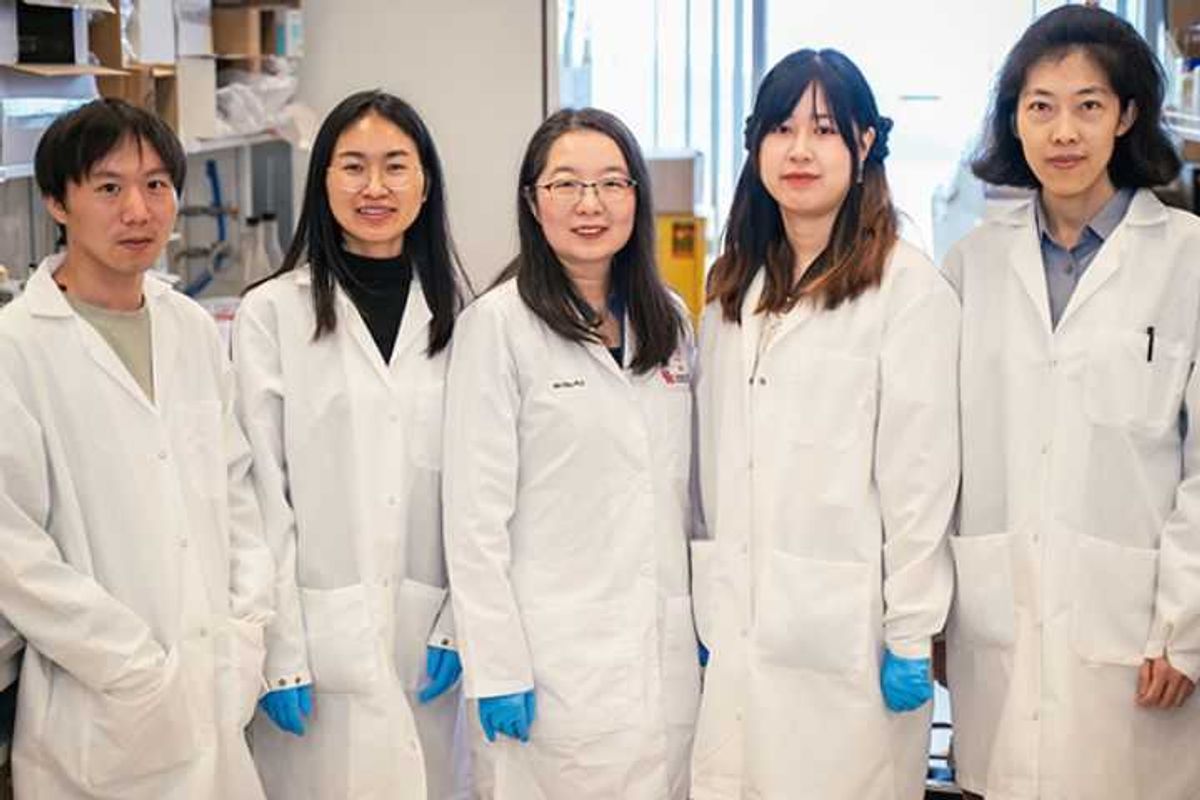
Wei Gao (center), a UH assistant professor of pharmacology, and her team have developed Nano-273, which helps the immune system fight pancreatic and lung cancers. Photo courtesy UH.

Houston team uses CPRIT funding to develop nanodrug for cancer immunotherapy
cancer research

With a relative five-year survival rate of 50 percent, pancreatic cancer is a diagnosis nobody wants. At 60 percent, the prognosis for lung cancer isn’t much rosier. That’s because both cancers contain regulatory B cells (Bregs), which block the body’s natural immunity, making it harder to fight the enemies within.

Newly popular immunotherapies in a category known as STING agonists may stimulate natural cancer defenses. However, they can also increase Bregs while simultaneously causing significant side effects. But Wei Gao, assistant professor of pharmacology at the University of Houston College of Pharmacy, may have a solution to that conundrum.

Gao and her team have developed Nano-273, a dual-function drug, packaged in an albumin-based particle, that boosts the immune system to help it better fight pancreatic and lung cancers. Gao’s lab recently received a $900,000 grant from the Cancer Prevention and Research Institute of Texas (CPRIT) to aid in fueling her research into the nanodrug.

“Nano-273 both activates STING and blocks PI3Kγ—a pathway that drives Breg expansion, while albumin nanoparticles help deliver the drug directly to immune cells, reducing unwanted side effects,” Gao said in a press release. “This approach reduces harmful Bregs while boosting immune cells that attack cancer, leading to stronger and more targeted anti-tumor responses.”

In studies using models of both pancreatic and lung cancers, Nano-273 has shown great promise with low toxicity. Its best results thus far have involved using the drug in combination with immunotherapy or chemotherapy.

With the CPRIT funds, Gao and her team will be able to charge closer to clinical use with a series of important steps. Those include continuing to test Nano-273 alongside other drugs, including immune checkpoint inhibitors. Safety studies will follow, but with future patients in mind, Gao will also work toward improving her drug’s production, making sure that it’s safe and high-quality every time, so that it is eventually ready for trials.

Gao added: “If successful, this project could lead to a new type of immunotherapy that offers lasting tumor control and improved survival for patients with pancreatic and lung cancers, two diseases that urgently need better treatments."

Ad Placement 300x100
Ad Placement 300x600

CultureMap Emails are Awesome

Houston energy hub opens new fundraising cohort to fuel startups

Apply Now

EnergyTech Cypher has opened applications for its second Liftoff fundraising program.

Applications close May 20 for the 10-week virtual fundraising sprint. The program is geared toward energy and climatech founders preparing to raise their first institutional round. It will cover fundraising requisites, like pitch materials, term sheet negotiation and round closing, according to a release from EnergyTech Cypher.

The program kicks off June 1 and runs every Monday from 1-3 p.m. CST. It will conclude with an in-person capstone simulation in Houston on August 3, where founders will work to close a mock round.

Jason Ethier, EnergyTech Cypher founder and CEO, will lead the program with Payal Patel, an EnergyTech fellow and entrepreneur in residence.

The program is available through Cephyron, EnergyTech Cypher's new investor relationship management platform, built specifically for energy and climatech founders. Users must have a Cephyron Boost membership to participate in the Liftoff program.

The Cephyron IRM app recently went live and is available to founders at any point in their fundraising process, according to the news release. The platform aggregates investor data, tracks market signals and delivers curated weekly recommendations.

EnergyTech Cypher launched Liftoff last year. The inaugural cohort included 19 startups, including Houston-based AtmoSpark Technologies, The Woodlands-based Resollant and others. Each participant closed at least one fundraising deal, according to EnergyTech Cypher.

EnergyTech Cypher rebranded from EnergyTech Nexus earlier this year. It also launched its CoPilot accelerator in 2025. The inaugural group presented its first showcase during CERAWeek last month.

EnergyTech Cypher's annual Pilotathon Pilot Pitch and Showcase applications also opened this month. Find more information here.

---

This article originally appeared on EnergyCaptialHTX.com.

Cancer diagnostics startup wins top prize at annual Rice competition​

winner, winners

Rice University student-founded companies took home a total of $115,000 in equity-free funding at the annual Liu Idea Lab for Innovation and Entrepreneurship's H. Albert Napier Rice Launch Challenge last week.

2025 Rice Innovation Fellow Alexandria Carter won the top prize and $50,000 for her startup Bionostic. The startup offers personalized diagnostics for cancer patients by using 3D culturing through its Advanced Tumor Landscape Analysis System (ATLAS) platform.

Carter is working toward her PhD in bioengineering in Professor Michael King's laboratory. She recently completed the Rice Innovation Fellows program and plans to commercialize ATLAS, according to a news release from Rice.

Actile Technologies, founded by another former Rice Innovation Fellow, Barclay Jumet, won second place and $25,000. The company is developing and commercializing textile-integrated technologies. InnovationMap first covered Jumet's wearable technology back in 2023.

Kairos took home the third-place prize and $15,000, plus the $2,000 audience choice award and the $5,000 undergraduate business award. Founded last year by Sanjana Kavula and Adhira Tippur, Kairos is an AI-powered patient intake platform built specifically for independent dental practices.

The NRLC features top startups founded by undergraduate, graduate and MBA students at Rice each year. The top three finishers were named among a group of five finalists earlier this year, which also included HAAST Autonomous and Project Kestrel.

HAAST is developing an unmanned aircraft for organ transport, while Kestrel uses machine learning to organize bird photographers’ photo collections.

Teams presented multiple five-minute pitches throughout the application process over Zoom and in-person before the five finalists presented at the NRLC Championships April 21 at the Rice Memorial Center. Each finalist walked away with an equity-free investment.


Other awards went to:

UnitCode

  • $5,000 MBA Venture Award

HAAST Autonomous

  • $2,500 Chan-Kang Family Prize for Bold Ambition
  • $1,000 Healthcare Innovations Prize

Telstar Networks

  • $2,500 Outstanding Undergraduate Startup Award

Multiplay

  • $1,500 Frank Liu Jr. Prize for Creative Innovation in Music, Fashion, & the Arts

Butterfly Books

  • $1,500 Social Impact Award

SOOZ

  • $1,000 Interdisciplinary Innovation Prize sponsored by OURI

Dooly

  • $1,000 Consumer Goods Prize

Project Kestrel

  • $1,000 AI Prize

Veloci Running won the NRLC last year for its naturally shaped running shoe. Founder and CEO Tyler Strothman recently told InnovationMap that the company has gone on to sell roughly 10,000 pairs of its flagship Ascent shoe, designed to relieve lower leg tightness and absorb impact. Read more here.

Houston-based, NASA-founded cleantech startup closes $12M seed round

Fresh Funds

Houston-based Helix Earth Technologies has closed a $12 million Seed 2 funding round to scale manufacturing of its energy-efficient commercial HVAC add-on technology.

Veriten, a Houston-based energy investment firm, led the round. Rua Ventures, Carnrite Ventures, Skywriter LLC and Textbook Ventures also participated.

Helix Earth—which was founded based on NASA technology, spun out of Rice University and has been incubated at Greentown Labs—is developing high-efficiency retrofit dehumidification systems that aim to reduce the energy consumption of commercial HVAC units. The company reports that its technology can lead to "healthier indoor air, lower energy bills, reduced building maintenance, and more comfortable spaces for building owners and occupants."

"Building owners are dealing with rising energy costs, uncontrolled humidity, and aging infrastructure with no viable, cost-effective path forward. We are in the field today solving these problems for commercial customers, and this capital puts us on an aggressive path to scale,” Rawand Rasheed, Helix Earth co-founder and CEO, said in a news release.

“The strength of this round reinforces our team's conviction that we can transform innovation-starved sectors with transformational solutions that deliver order-of-magnitude improvements to owners and operators, for both their bottom line and the environment,” Rasheed added.

Maynard Holt, Veriten’s founder and CEO, said that the investment firm is tripling its investment in Helix Earth.

"The team has built breakthrough technology with real applicability across multiple industries,” Holt said in the release. “Their first product will have an immediate and measurable impact on our energy system, and they are already pursuing adjacent innovations to help heavy industries operate more efficiently and with less waste. This is a well-rounded team with a proven track record of strong execution and disciplined capital management.”

Helix Earth also closed a $5.6 million seed funding round in 2024, led by Veriten.

Last year, the company secured a $1.2 million Small Business Innovation Research (SBIR) Phase II grant and won in the Smart Cities, Transportation & Sustainability contest at the 2025 SXSW Pitch Showcase. Rasheed was also named to the Forbes 30 Under 30 Energy and Green Tech list for 2025.

---

This article originally appeared on EnergyCapital HTX.com.