


San Jacinto College's new Center for Biotechnology at the Generation Park Campus is expected to be completed early next year. Photo courtesy of San Jacinto College

San Jacinto College and McCord Development Inc. broke ground on the new Center for Biotechnology at the Generation Park Campus in Northeast Houston.

The 4,000-square-foot, state-of-the-art facility is slated to allow for more hands-on training within simulated environments and will allow students to earn associate of applied science degrees in biomanufacturing technology, as well as credentials for those already in the workforce. It's scheduled to be completed in the first quarter of 2025.

“The Center and the overall components of the Biotechnology program will play a vital role in meeting the growing demand for skilled professionals in the biotechnology sector,” Brenda Hellyer, chancellor of San Jacinto College, says in a statement.

“We are committed to equipping our students with the skills and knowledge necessary for success in the dynamic biopharmaceutical industry," she continues. "Our vision is to not only meet the workforce needs of today but will also shape the future of biotechnology education and training in our region.”
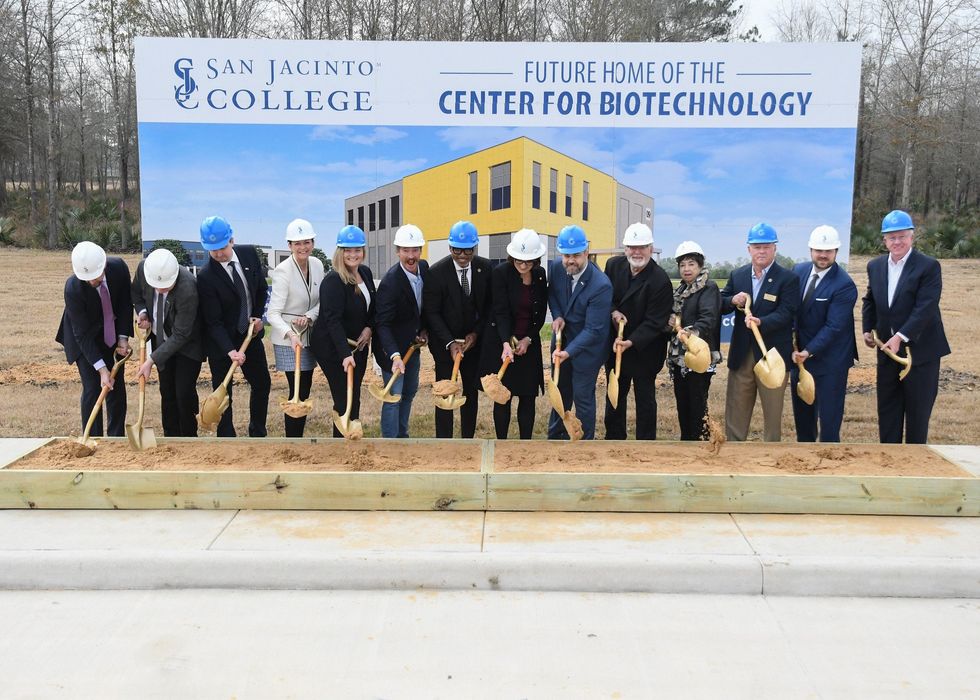
San Jacinto College and McCord Development Inc. celebrated the groundbreaking of the new Center for Biotechnology at the Generation Park Campus in Northeast Houston. Photo courtesy of San Jacinto College

The new Center for Biotechnology curriculum is in partnership with the Ireland-based National Institute for Bioprocessing Research and Training. It is the only NIBRT-licensed training in the Southwest and Southeast region.

At the groundbreaking, San Jacinto College celebrated the ribbon-cutting for the Biomanufacturing Training Program at the South Campus, the first of the college's comprehensive biotechnology offerings.

The Biomanufacturing Training Program will be a customizable two-week hybrid program that combines theoretical teachings with hands-on experience.

“This program is designed to provide a seamless entry into the field for new professionals, with a focus on practical experience and exposure to industry practices,” Christopher Wild, executive director of San Jacinto College Center for Biotechnology, added in a statement.

The new center is part of Generation Park, a 4,300-acre master-planned development in Northeast Houston. In late 2022, San Jac and McCord, which is developing Generation Park, shared that they had signed a memorandum of understanding with the NIBRT to launch the program and center.

At the time, San Jacinto College was slated to be the institute’s sixth global partner and second U.S. partner.

Last summer, McCord also revealed plans for its 45-acre biomanufacturing campus at Generation Park.
Ad Placement 300x100
Ad Placement 300x600

CultureMap Emails are Awesome

Houston edtech company closes oversubscribed $3M seed round

fresh funding

Houston-based edtech company TrueLeap Inc. closed an oversubscribed seed round last month.

The $3.3 million round was led by Joe Swinbank Family Limited Partnership, a venture capital firm based in Houston. Gamper Ventures, another Houston firm, also participated with additional strategic partners.

TrueLeap reports that the funding will support the large-scale rollout of its "edge AI, integrated learning systems and last-mile broadband across underserved communities."

“The last mile is where most digital transformation efforts break down,” Sandip Bordoloi, CEO and president of TrueLeap, said in a news release. “TrueLeap was built to operate where bandwidth is limited, power is unreliable, and institutions need real systems—not pilots. This round allows us to scale infrastructure that actually works on the ground.”

True Leap works to address the digital divide in education through its AI-powered education, workforce systems and digital services that are designed for underserved and low-connectivity communities.

The company has created infrastructure in Africa, India and rural America. Just this week, it announced an agreement with the City of Kinshasa in the Democratic Republic of Congo to deploy a digital twin platform for its public education system that will allow provincial leaders to manage enrollment, staffing, infrastructure and performance with live data.

“What sets TrueLeap apart is their infrastructure mindset,” Joe Swinbank, General Partner at Joe Swinbank Family Limited Partnership, added in the news release. “They are building the physical and digital rails that allow entire ecosystems to function. The convergence of edge compute, connectivity, and services makes this a compelling global infrastructure opportunity.”

TrueLeap was founded by Bordoloi and Sunny Zhang and developed out of Born Global Ventures, a Houston venture studio focused on advancing immigrant-founded technology. It closed an oversubscribed pre-seed in 2024.

Texas space co. takes giant step toward lunar excavator deployment

Out of this world

Lunar exploration and development are currently hampered by the fact that the moon is largely devoid of necessary infrastructure, like spaceports. Such amenities need to be constructed remotely by autonomous vehicles, and making effective devices that can survive the harsh lunar surface long enough to complete construction projects is daunting.

Enter San Antonio-based Astroport Space Technologies. Founded in San Antonio in 2020, the company has become a major part of building plans beyond Earth, via its prototype excavator, and in early February, it completed an important field test of its new lunar excavator.

The new excavator is designed to function with California-based Astrolab's Flexible Logistics and Exploration (FLEX) rover, a highly modular vehicle that will perform a variety of functions on the surface of the moon.

In a recent demo, the Astroport prototype excavator successfully integrated with FLEX and proceeded to dig in a simulated lunar surface. The excavator collected an average of 207 lbs (94kg) of regolith (lunar surface dust) in just 3.5 minutes. It will need that speed to move the estimated 3,723 tons (3,378 tonnes) of regolith needed for a lunar spaceport.

After the successful test, both Astroport and Astrolab expressed confidence that the excavator was ready for deployment. "Leading with this successful excavator demo proves that our technology is no longer theoretical—it is operational," said Sam Ximenes, CEO of Astroport.

"This is the first of many implements in development that will turn Astrolab's FLEX rover into the 'Swiss Army Knife' of lunar construction. To meet the infrastructure needs of the emerging lunar economy, we must build the 'Port' before the 'Ship' arrives. By leveraging the FLEX platform, we are providing the Space Force, NASA, and commercial partners with a 'Shovel-Ready' construction capability to secure the lunar high ground."

"We are excited to provide the mobility backbone for Astroport's groundbreaking construction technology," said Jaret Matthews, CEO of Astrolab, in a release. "Astrolab is dedicated to establishing a viable lunar ecosystem. By combining our FLEX rover's versatility with Astroport's civil engineering expertise, we are delivering the essential capabilities required for a sustainable lunar economy."

---

This article originally appeared on CultureMap.com.

Houston biotech co. raises $11M to advance ALS drug development

drug money

Houston-based clinical-stage biotechnology company Coya Therapeutics (NASDAQ: COYA) has raised $11.1 million in a private investment round.

India-based pharmaceuticals company Dr. Reddy’s Laboratories Inc. led the round with a $10 million investment, according to a news release. New York-based investment firm Greenlight Capital, Coya’s largest institutional shareholder, contributed $1.1 million.

The funding was raised through a definitive securities purchase agreement for the purchase and sale of more than 2.5 million shares of Coya's common stock in a private placement at $4.40 per share.

Coya reports that it plans to use the proceeds to scale up manufacturing of low-dose interleukin-2 (IL-2), which is a component of its COYA 302 and will support the commercial readiness of the drug. COYA 302 enhances anti-inflammatory T cell function and suppresses harmful immune activity for treatment of Amyotrophic Lateral Sclerosis (ALS), Frontotemporal Dementia (FTD), Parkinson’s disease and Alzheimer’s disease.

The company received FDA acceptance for its investigational new drug application for COYA 302 for treating ALS and FTD this summer. Its ALSTARS Phase 2 clinical trial for ALS treatment launched this fall in the U.S. and Canada and has begun enrolling and dosing patients. Coya CEO Arun Swaminathan said in a letter to investors that the company also plans to advance its clinical programs for the drug for FTD therapy in 2026.

Coya was founded in 2021. The company merged with Nicoya Health Inc. in 2020 and raised $10 million in its series A the same year. It closed its IPO in January 2023 for more than $15 million. Its therapeutics uses innovative work from Houston Methodist's Dr. Stanley H. Appel.