


The long-awaited Ismaili Center, Houston is set to open to the public next month. The 11-acre site has been painstakingly designed and constructed to offer indoor and outdoor public spaces for Houstonians to enjoy, connect, and engage. As the only Ismaili Center in the United States — and seventh in the world — it joins its international communities in London, Vancouver, Lisbon, Dubai, Dushanbe, and Toronto.
Nearly 20 years in the making, the Ismaili Center, Houston features a prayer hall, rotating art installations, a black box theater, a cafe, numerous social halls for weddings and other events, and nine acres of outdoor space and landscaped botanical gardens. Involved parties hope that the community will see the space as an extension of the neighboring parks along the bayou, and have included a garden entrance to the north lawn and gardens at the corner of Montrose Boulevard and Allen Parkway.
While Houston is known for its many community engagement centers, the architects and designers believe that the seamless integration of indoor and outdoor spaces sets the Ismaili Center, Houston apart from all others.
“What we know is the connections between buildings, environment, quality of life, and landscape — this is nothing new,” structural and facade engineer Hanif Kara says. “But, certainly, it’s hard to see that in other developments, particularly when they are done by developers. It’s quite difficult to find community spaces, and to see how quality of life is improved for everyone. I think we’ve all experienced that kind of hope that it will play out something like this.”
Designed by Farshid Moussavi Architecture and Nelson Byrd Woltz Landscape Architects, the remarkable 11-acre site is designed both to receive LEED Gold certification and to withstand the tests of Houston’s sometimes extreme weather conditions.
Principal architect Farshid Moussavi looks forward to seeing the Houston community utilize the space she’s worked so hard to deliver: “We’ve given the hardware to the community, now the software needs to come in. So I hope that there will be music recitals, or lectures, or book fairs, or other kinds of markets that can happen—even simultaneously. This is not an experiment, it’s the seventh in the world.”
Community welcome events are scheduled for December 12 and 13, but, until then, here are 10 features and things to know about the Ismaili Center, Houston.
What is the Ismaili Center, Houston?
“The use of the building is really meant for, or our hope, is that we are able to—on an enhanced view of what the community does today—have engagement on service projects, arts and culture, interfaith dialogue, and even just in bringing people together,” Omar Samji, Ismaili Council for the United States of America, says. “The notion of bringing people together in a place where it is easy to create connections because it’s an open space, and because it’s specifically designed to be a place where people interact and where people find commonality. Because whether you’re out in the gardens, or on the environs, or in the atrium, this enables connection.”
Who is His Highness the Aga Khan?
His Highness Prince Rahim Aga Khan V is the 50th hereditary Imam (spiritual leader) of the Shia Ismaili Muslims and a direct descendant of the Prophet Muhammad. He was educated at Philipps Academy in Andover and Brown University (Class of 1995). He became Imam in February 2025 upon the passing of his father, His Highness Prince Karim Aga Khan IV.
The Aga Khan promotes an understanding of Islam rooted in values of generosity, tolerance, pluralism, environmental stewardship, and the shared unity of humanity. He also chairs the Aga Khan Development Network (AKDN), one of the world’s largest private development agencies, which works across more than 30 countries to improve quality of life for marginalized communities regardless of faith or background.
The scale
The center stretches across an 11-acre site along Montrose Boulevard, from West Dallas to Allen Parkway. The physical building is 150,000 square feet, leaving nine acres for garden spaces on both the north and south sides of the building. The south side of the property is more formal, with gardens and community spaces that flank an 80-foot reflection pool and other water features. The gardens on the north side of the building are more informal, but densely planted and vast.
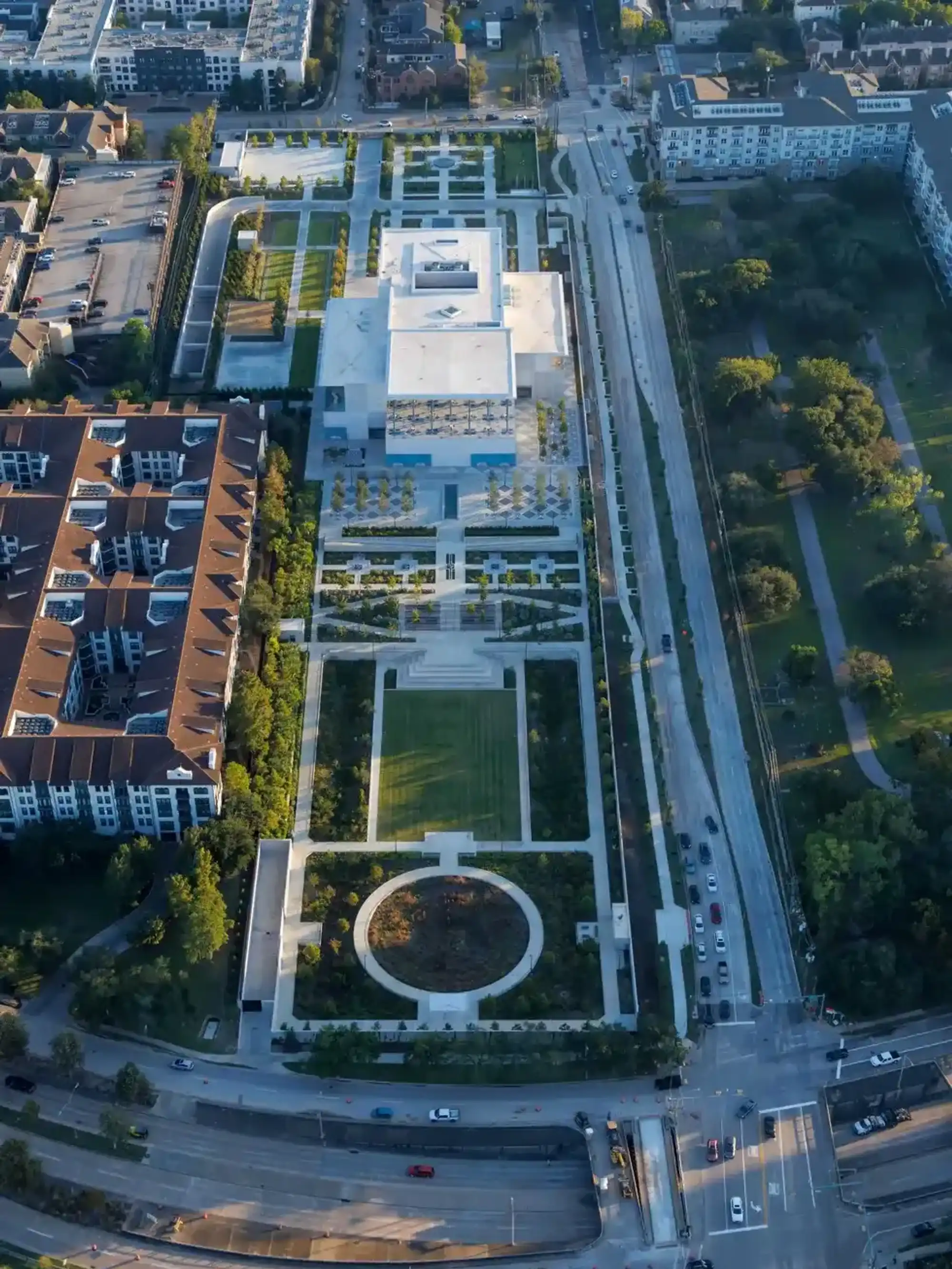 Photo by Iwan Baan
The creation
The development of the Ismaili Center was led by the Ismaili Council. It was initiated by His Highness Prince Karim Aga Khan IV (1936-2025), and completed under the leadership of his eldest son, Prince Rahim Aga Khan V.
The project was designed and constructed by a team of both local and international firms. Farshid Moussavi Architecture joined forces with structural and facade engineer Hanif Kara, co-founder and creative director of AKT II. DLR Group is the architect and engineer of record, while contractor McCarthy Building Companies built the project. Thomas Woltz, senior principal and owner of landscape architecture firm Nelson Byrd Woltz, along with principal Jeff Aten taking lead on the nine acres of garden space. The project is targeting LEED Gold certification.
The focus on native Texas plants and trees
The center will be recognized as a leading cultural asset for the City of Houston, complementing nearby institutions such as The Menil Collection, Rothko Chapel, Asia Society Texas, and the Museum of Fine Arts, Houston. While the surrounding gardens will add to the other notable Nelson Byrd Woltz projects within close proximity at Memorial Park, Rothko Chapel, and Rice University.
“We’ve been building massive projects in Houston for 12 years,” Woltz says. “We know the horticultural community in the region, and we did a deep, deep dive in ecological research to understand ‘What are the native plants of whatever region?’ It’s just baked into our process. Right when we are starting any project in Houston—right to the river. Look at the soils, ‘What are the plants appropriate to that place?’ Its solar aspect, its humidity, it’s moisture in soils, the shadow of the building.
But then, this idea of taking a section across the state of Texas, so that each of those distinct ecological regions is represented by one of the terraced gardens — so it’s very clear. It’s a diagram of the state of Texas and all of its native plants. This is functioning like a botanic garden and a repository for biodiversity — this is work in service.”
The eco-friendly exterior
The exterior of the building is clad in stone, a durable material with low embodied carbon. The stone cladding is a rainscreen over in-situ ‘fair-faced’ concrete walls, exposed on the interior to minimize additional material use. The concrete mix used has replaced 35-62 percent of Portland cement with fly ash and slag, reducing CO2 emissions by roughly 30 percent compared to standard mixes. The exterior stone rainscreen uses smaller tiles to increase the stone yield, utilizing 20-25 percent more of the irregular blocks they are cut from. This reduction in waste has also lent itself to crafting the cladding in a unique way.
The tessellation of the stone pieces changes across the building's surfaces to create different patterns on different sides of the buildings and at the corners. Relief stone tiles are used to add texture to the facades.
The space for outdoor events
The north-facing botanical gardens that will accommodate the 200-year flood plain offer a 27 foot gradient toward the building. This allowed for various levels of seating and gathering areas that culminate at an elevated terrace that will act as a stage for various events such as plays and concerts. Attendees can stretch out and enjoy the shows from an extensive lawn area that is surrounded by dense gardens of native trees and plants.
The black box theater
A 2,600-square-foot black box multipurpose space which seats 125 people is found on the second floor of the building’s west wing. It can host public events, such as exhibitions, film screenings, theatrical performances, music recitals, and other artistic programs throughout the year. It will also serve as a flexible space for teaching and learning. With acoustic isolation to surrounding spaces and the mechanical mezzanine above, it is designed to operate simultaneously without disrupting other events in the building. Design includes an upper-level control room, pipe grid, and flexible drapery and seating configurations to allow for a wide variety of programming.
The cafe
The center’s café is a 1,600-square-foot, double-height space located in the west wing (Montrose side) that opens onto an enormous terrace, offering visitors the option to enjoy their coffee or food outdoors. The terrace near the cafe is lined by an exterior wall and long, trough-style fountains that aid in noise reduction from Montrose Boulevard. The second-floor wall overlooking the Café is fully glazed, creating visual connection with the levels above.
The prayer hall
The prayer hall is 12,240 square feet, featuring a unique structural system of seven interlocking squares, formed from steel beams spanning the 115-by-115-foot open space. These beams are clad in concrete to enhance durability, beneath which lies a two-layer perforated aluminum ceiling with integrated diffused lighting. Its intricate pattern recalls the traditional jālī screens of Islamic architecture creating a soft, seemingly infinite ceiling effect, adding to the serenity of the prayer hall.
---
A version of this article first appeared on CultureMap.com