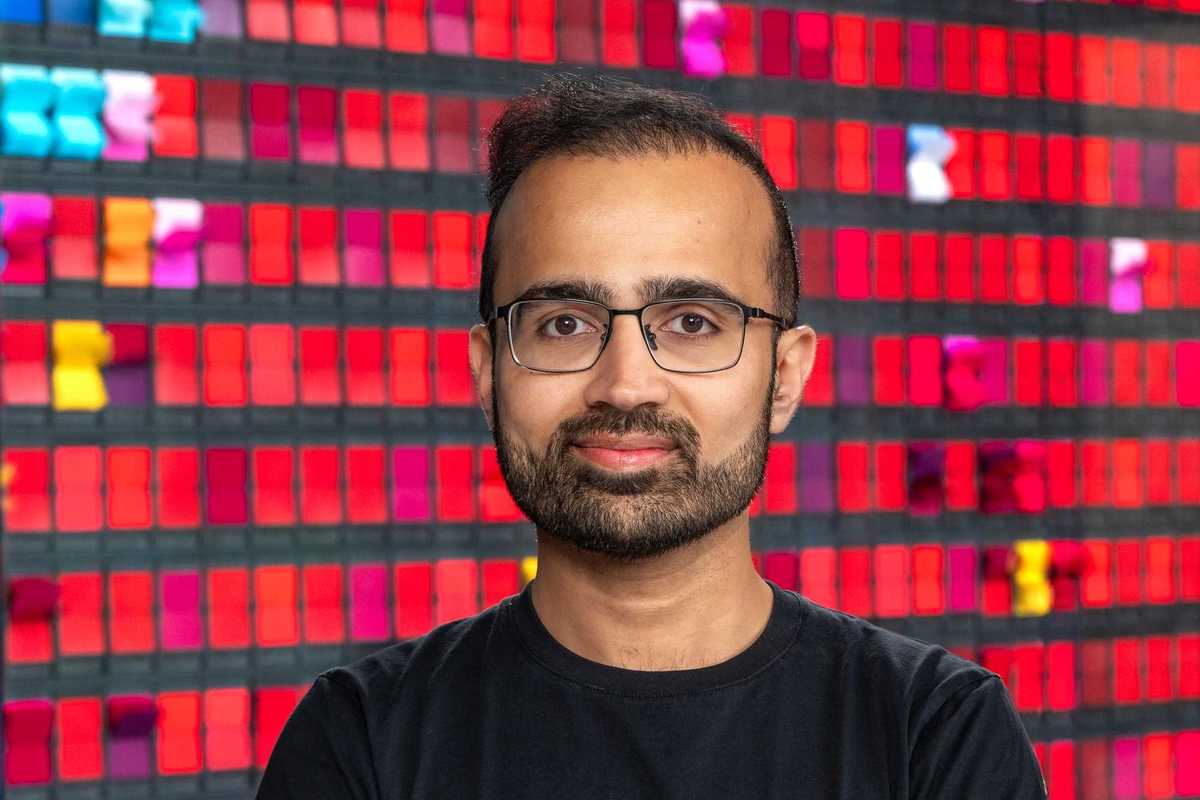
Paul Cherukuri, Rice’s first vice president for innovation and chief innovation officer, will leave his post next month. Photo via Rice.edu

Paul Cherukuri, Rice University's top innovation executive, responsible for some of Rice’s major innovative projects like the Rice BioTech LaunchPad and Rice Nexus, will leave the university next month to accept a position at the University of Virginia.

Cherukuri, Rice’s first vice president for innovation and chief innovation officer, will become the University of Virginia’s Donna and Richard Tadler University Professor of Entrepreneurship and the school's first chief innovation officer, according to a release from Rice. Cherukuri, who has served for more than 10 years at Rice, plans to depart his current position on Sept. 30.

Adrian Trömel, associate vice president for innovation strategy and investments at Rice, will serve as interim vice president for innovation and chief innovation officer after Cherukuri departs, and as the university starts an international search for his replacement.

“We appointed Paul to build an ambitious and high-functioning innovation operation, and he has succeeded remarkably in short order,” Rice President Reginald DesRoches said in the release. “In every area, from technology translation and startup creation to commercialization and entrepreneurship training, he has led the effort to vastly improve our structure, operations and relationships. He has contributed immensely both to our strategies and their implementation across numerous areas, and we’ll miss him greatly.”

Cherukuri is a physicist, chemist and medical technology entrepreneur, and has been a member of DesRoches’ leadership team since 2022. Cherukuri served as executive director of Rice’s Institute of Biosciences and Bioengineering from 2016 to 2022, where he helped in the development of interdisciplinary translational research partnerships with federal and corporate agencies. His work helped earn nearly $37 million in funding for accelerating the development of new technologies into commercial products. In the energy transition field, Cherukuri led a $12.5 million partnership with Woodside Energy to transform greenhouse gases into advanced nanomaterials for next-generation batteries and transistors.

Initiatives the Rice Biotech Launch Pad, an accelerator focused on expediting the translation of the university’s health and medical technology; RBL LLC, a biotech venture studio in the Texas Medical Center’s Helix Park dedicated to commercializing lifesaving medical technologies from the Launch Pad; and Rice Nexus, an AI-focused "innovation factory" at the Ion; were all launched under Cherukuri’s leadership. With his work at the Ion, Cherukuri also led the announcement of a partnership with North America’s largest climate tech incubator, Greentown Labs.

“I am proud of the relentless innovative spirit we have built for Rice in Houston and around the world,” Cherukuri said in the release. “I look forward to bringing new energy and vision to UVA’s efforts in this critical space for our country, its success and future.”

Ad Placement 300x100
Ad Placement 300x600

CultureMap Emails are Awesome

Houston scores $120M in new cancer research and prevention grants

cancer funding

The Cancer Prevention and Research Institute of Texas has granted more than $120 million to Houston organizations and companies as part of 73 new awards issued statewide.

The funds are part of nearly $154 million approved by the CPRIT's governing board earlier this month, bringing the organization's total investment in cancer prevention and research to more than $4 billion since its inception.

“Today marks an important milestone for CPRIT and for every Texan affected by cancer,” CEO Kristen Doyle said in a news release. “Texas has invested $4 billion in the fight against one of the world’s greatest public health challenges. Over 16 years, that support has helped Texas lead the search for breakthrough treatments, develop new cancer-fighting drugs and devices, and—most importantly—save tens of thousands of lives through early cancer detection and prevention. Every Texan should know this effort matters, and we’re not finished yet. Together, we will conquer cancer.”

A portion of the funding will go toward recruiting leading cancer researchers to Houston. CPRIT granted $5 million to bring John Quackenbush to Baylor College of Medicine. Quackenbush comes from the Harvard T.H. Chan School of Public Health and is an expert in computational and systems biology. His research focuses on complex genomic data to understand cancer and develop targeted therapies.

The University of Texas M.D. Anderson Cancer Center also received $3 million to recruit Irfan Asangani, an associate professor at the University of Pennsylvania Perelman School of Medicine. His research focuses on how chromatin structure and epigenetic regulation drive the development and progression of cancer, especially prostate cancer.

Other funds will go towards research on a rare, aggressive kidney cancer that impacts children and young adults; screening programs for breast and cervical cancer; and diagnostic technology.

In total, cancer grants were given to:

  • The University of Texas M.D. Anderson Cancer Center: $29.02 million
  • Baylor College of Medicine: $15.04 million
  • The University of Texas Health Science Center at Houston: $9.37 million
  • Texas A&M University System Health Science Center: $1.2 million
  • University of Houston: $900,000

Additional Houston-based companies landed grants, including:

  • Crossbridge Bio Inc.: $15.01 million
  • OncoMAGNETx Inc.: $13.97 million
  • Immunogenesis Inc.: $10.85 million
  • Diakonos Oncology Corporation: $7.16 million
  • Iterion Therapeutics Inc.: $7.13 million
  • NovaScan Inc.: $3.7 million
  • EMPIRI Inc.: $2.59 million
  • Air Surgical Inc.: $2.58 million
  • Light and Salt Association: $2.45 million

See the full list of awards here.

U.S. News names 5 Houston suburbs as the best places to retire in 2026

Retirement Report

Houston-area suburbs should be on the lookout for an influx of retirees in 2026. A new study by U.S. News and World Report has declared The Woodlands and Spring as the fourth and fifth best cities to retire in America, with three other local cities making the top 25.

The annual report, called "250 Best Places to Retire in the U.S. in 2026" initially compared 850 U.S. cities, and narrowed the list down to a final 250 cities (up from 150 previously). Each locale was analyzed across six indexes: quality of life for individuals reaching retirement age, value (housing affordability and cost of living), health care quality, tax-friendliness for retirees, senior population and migration rates, and the strength of each city's job market.

Midland, Michigan was crowned the No. 1 best place to retire in 2026. The remaining cities that round out the top five are Weirton, West Virginia (No. 2) and Homosassa Springs, Florida (No. 3).

According to U.S. News, about 15 percent of The Woodlands' population is over the age of 65. The median household income in this suburb is $139,696, far above the national average median household income of $79,466.

Though The Woodlands has a higher cost of living than many other places in the country, the report maintains that the city "offers a higher value of living compared to similarly sized cities."

"If you want to buy a house in The Woodlands, the median home value is $474,279," the city's profile on U.S. News says. "And if you're a renter, you can expect the median rent here to be $1,449." For comparison, the report says the national average home value is $370,489.

Spring ranked as the fifth best place to retire in 2026, boasting a population of more than 68,000 residents, 11 percent of whom are seniors. This suburb is located less than 10 miles south of The Woodlands, while still being far enough away from Houston (about 25 miles) for seniors to escape big city life for the comfort of a smaller community.

"Retirees are prioritizing quality of life over affordability for the first time since the beginning of the COVID-19 pandemic," said U.S. News contributing editor Tim Smart in a press release.

The median home value in Spring is lower than the national average, at $251,247, making it one of the more affordable places to buy a home in the Houston area. Renters can expect to pay a median $1,326 in monthly rent, the report added.

Elsewhere in Houston, Pearland ranked as the 17th best place to retire for 2026, followed by Conroe (No. 20) and League City (No. 25).

Other Texas cities that ranked among the top 50 best places to retire nationwide include Victoria (No. 12), San Angelo (No. 28), and Flower Mound (No. 37).

The top 10 best U.S. cities to retire in 2026 are:

  • No. 1 – Midland, Michigan
  • No. 2 – Weirton, West Virginia
  • No. 3 – Homosassa Springs, Florida
  • No. 4 – The Woodlands, Texas
  • No. 5 – Spring, Texas
  • No. 6 – Rancho Rio, New Mexico
  • No. 7 – Spring Hill, Florida
  • No. 8 – Altoona, Pennsylvania
  • No. 9 – Palm Coast, Florida
  • No. 10 – Lynchburg, Virginia
---

This article originally appeared on CultureMap.com.

Micro-nuclear reactor to launch at Texas A&M innovation campus in 2026

nuclear pilot

The Texas A&M University System and Last Energy plan to launch a micro-nuclear reactor pilot project next summer at the Texas A&M-RELLIS technology and innovation campus in Bryan.

Washington, D.C.-based Last Energy will build a 5-megawatt reactor that’s a scaled-down version of its 20-megawatt reactor. The micro-reactor initially will aim to demonstrate safety and stability, and test the ability to generate electricity for the grid.

The U.S. Department of Energy (DOE) fast-tracked the project under its New Reactor Pilot Program. The project will mark Last Energy’s first installation of a nuclear reactor in the U.S.

Private funds are paying for the project, which Robert Albritton, chairman of the Texas A&M system’s board of regents, said is “an example of what’s possible when we try to meet the needs of the state and tap into the latest technologies.”

Glenn Hegar, chancellor of the Texas A&M system, said the 5-megawatt reactor is the kind of project the system had in mind when it built the 2,400-acre Texas A&M-RELLIS campus.

The project is “bold, it’s forward-looking, and it brings together private innovation and public research to solve today’s energy challenges,” Hegar said.

As it gears up to build the reactor, Last Energy has secured a land lease at Texas A&M-RELLIS, obtained uranium fuel, and signed an agreement with DOE. Founder and CEO Bret Kugelmass said the project will usher in “the next atomic era.”

In February, John Sharp, chancellor of Texas A&M’s flagship campus, said the university had offered land at Texas A&M-RELLIS to four companies to build small modular nuclear reactors. Power generated by reactors at Texas A&M-RELLIS may someday be supplied to the Electric Reliability Council of Texas (ERCOT) grid.

Also in February, Last Energy announced plans to develop 30 micro-nuclear reactors at a 200-acre site about halfway between Lubbock and Fort Worth.

---

This article originally appeared on our sister site, EnergyCapitalHTX.com.