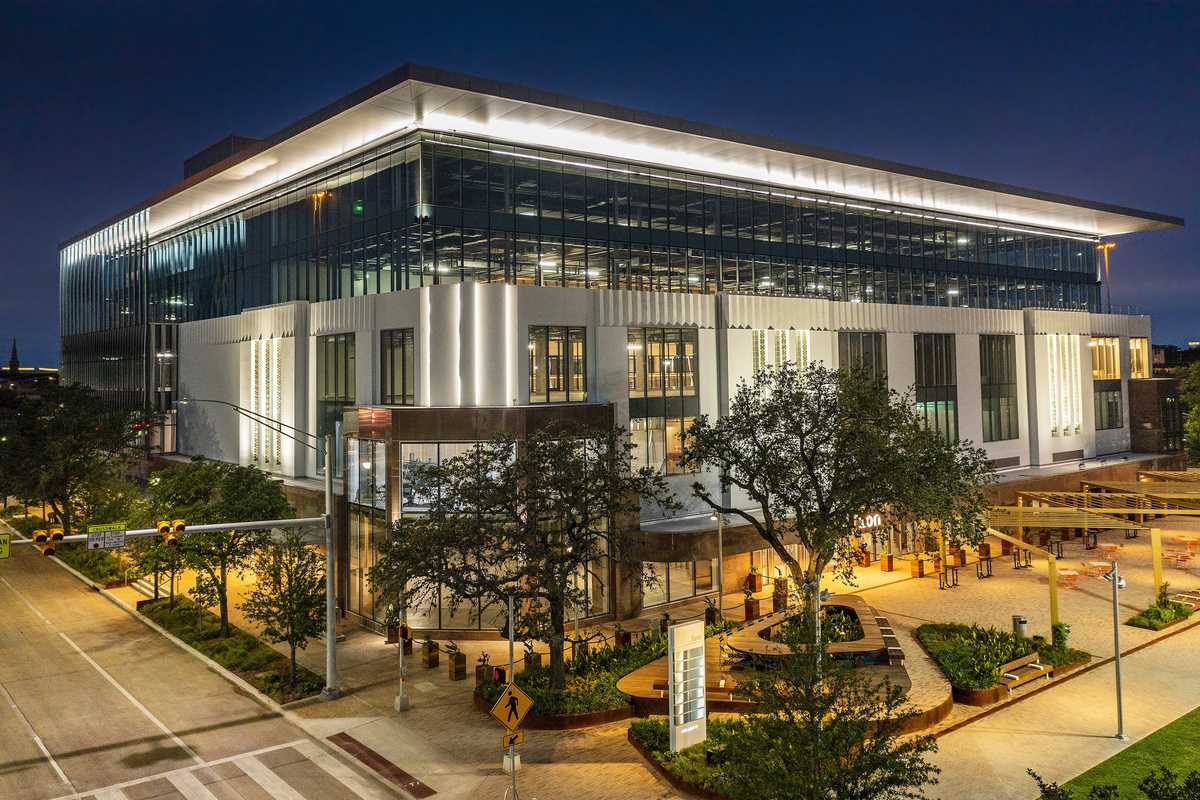
UH researchers have developed a thin film that could allow AI chips to run cooler and faster. Photo courtesy University of Houston.

A team of researchers at the University of Houston has developed an innovative thin-film material that they believe will make AI devices faster and more energy efficient.

AI data centers consume massive amounts of electricity and use large cooling systems to operate, adding a strain on overall energy consumption.

“AI has made our energy needs explode,” Alamgir Karim, Dow Chair and Welch Foundation Professor at the William A. Brookshire Department of Chemical and Biomolecular Engineering at UH, explained in a news release. “Many AI data centers employ vast cooling systems that consume large amounts of electricity to keep the thousands of servers with integrated circuit chips running optimally at low temperatures to maintain high data processing speed, have shorter response time and extend chip lifetime.”

In a report recently published in ACS Nano, Karim and a team of researchers introduced a specialized two-dimensional thin film dielectric, or electric insulator. The film, which does not store electricity, could be used to replace traditional, heat-generating components in integrated circuit chips, which are essential hardware powering AI.

The thinner film material aims to reduce the significant energy cost and heat produced by the high-performance computing necessary for AI.

Karim and his former doctoral student, Maninderjeet Singh, used Nobel prize-winning organic framework materials to develop the film. Singh, now a postdoctoral researcher at Columbia University, developed the materials during his doctoral training at UH, along with Devin Shaffer, a UH professor of civil engineering, and doctoral student Erin Schroeder.

Their study shows that dielectrics with high permittivity (high-k) store more electrical energy and dissipate more energy as heat than those with low-k materials. Karim focused on low-k materials made from light elements, like carbon, that would allow chips to run cooler and faster.

The team then created new materials with carbon and other light elements, forming covalently bonded sheetlike films with highly porous crystalline structures using a process known as synthetic interfacial polymerization. Then they studied their electronic properties and applications in devices.

According to the report, the film was suitable for high-voltage, high-power devices while maintaining thermal stability at elevated operating temperatures.

“These next-generation materials are expected to boost the performance of AI and conventional electronics devices significantly,” Singh added in the release.


Ad Placement 300x100
Ad Placement 300x600

CultureMap Emails are Awesome

Axiom Space wins NASA contract for fifth private mission, lands $350M in financing

ready for takeoff

Editor's note: This story has been updated to include information about Axiom's recent funding.

Axiom Space, a Houston-based space infrastructure company that’s developing the first commercial space station, has forged a deal with NASA to carry out the fifth civilian-staffed mission to the International Space Station.

Axiom Mission 5 is scheduled to launch in January 2027, at the earliest, from NASA’s Kennedy Space Center in Florida. The crew of non-government astronauts is expected to spend up to 14 days docked at the International Space Station (ISS). Various science and research activities will take place during the mission.

The crew for the upcoming mission hasn’t been announced. Previous Axiom missions were commanded by retired NASA astronauts Michael López-Alegría, the company’s chief astronaut, and Peggy Whitson, the company’s vice president of human spaceflight.

“All four previous [Axiom] missions have expanded the global community of space explorers, diversifying scientific investigations in microgravity, and providing significant insight that is benefiting the development of our next-generation space station, Axiom Station,” Jonathan Cirtain, president and CEO of Axiom, said in a news release.

As part of Axiom’s new contract with NASA, Voyager Technologies will provide payload services for Axiom’s fifth mission. Voyager, a defense, national security, and space technology company, recently announced a four-year, $24.5 million contract with NASA’s Johnson Space Center in Houston to provide mission management services for the ISS.

Axiom also announced today, Feb. 12, that it has secured $350 million in a financing round led by Type One Ventures and Qatar Investment Authority.

The company shared in a news release that the funding will support the continued development of its commercial space station, known as Axiom Station, and the production of its Axiom Extravehicular Mobility Unit (AxEMU) under its NASA spacesuit contract.

NASA awarded Axiom a contract in January 2020 to create Axiom Station. The project is currently underway.

"Axiom Space isn’t just building hardware, it’s building the backbone of humanity’s next era in orbit," Tarek Waked, Founding General Partner at Type One Ventures, said in a news release. "Their rare combination of execution, government trust, and global partnerships positions them as the clear successor-architect for life after the ISS. This is how the United States continues to lead in space.”

Houston edtech company closes oversubscribed $3M seed round

fresh funding

Houston-based edtech company TrueLeap Inc. closed an oversubscribed seed round last month.

The $3.3 million round was led by Joe Swinbank Family Limited Partnership, a venture capital firm based in Houston. Gamper Ventures, another Houston firm, also participated with additional strategic partners.

TrueLeap reports that the funding will support the large-scale rollout of its "edge AI, integrated learning systems and last-mile broadband across underserved communities."

“The last mile is where most digital transformation efforts break down,” Sandip Bordoloi, CEO and president of TrueLeap, said in a news release. “TrueLeap was built to operate where bandwidth is limited, power is unreliable, and institutions need real systems—not pilots. This round allows us to scale infrastructure that actually works on the ground.”

True Leap works to address the digital divide in education through its AI-powered education, workforce systems and digital services that are designed for underserved and low-connectivity communities.

The company has created infrastructure in Africa, India and rural America. Just this week, it announced an agreement with the City of Kinshasa in the Democratic Republic of Congo to deploy a digital twin platform for its public education system that will allow provincial leaders to manage enrollment, staffing, infrastructure and performance with live data.

“What sets TrueLeap apart is their infrastructure mindset,” Joe Swinbank, General Partner at Joe Swinbank Family Limited Partnership, added in the news release. “They are building the physical and digital rails that allow entire ecosystems to function. The convergence of edge compute, connectivity, and services makes this a compelling global infrastructure opportunity.”

TrueLeap was founded by Bordoloi and Sunny Zhang and developed out of Born Global Ventures, a Houston venture studio focused on advancing immigrant-founded technology. It closed an oversubscribed pre-seed in 2024.

Texas space co. takes giant step toward lunar excavator deployment

Out of this world

Lunar exploration and development are currently hampered by the fact that the moon is largely devoid of necessary infrastructure, like spaceports. Such amenities need to be constructed remotely by autonomous vehicles, and making effective devices that can survive the harsh lunar surface long enough to complete construction projects is daunting.

Enter San Antonio-based Astroport Space Technologies. Founded in San Antonio in 2020, the company has become a major part of building plans beyond Earth, via its prototype excavator, and in early February, it completed an important field test of its new lunar excavator.

The new excavator is designed to function with California-based Astrolab's Flexible Logistics and Exploration (FLEX) rover, a highly modular vehicle that will perform a variety of functions on the surface of the moon.

In a recent demo, the Astroport prototype excavator successfully integrated with FLEX and proceeded to dig in a simulated lunar surface. The excavator collected an average of 207 lbs (94kg) of regolith (lunar surface dust) in just 3.5 minutes. It will need that speed to move the estimated 3,723 tons (3,378 tonnes) of regolith needed for a lunar spaceport.

After the successful test, both Astroport and Astrolab expressed confidence that the excavator was ready for deployment. "Leading with this successful excavator demo proves that our technology is no longer theoretical—it is operational," said Sam Ximenes, CEO of Astroport.

"This is the first of many implements in development that will turn Astrolab's FLEX rover into the 'Swiss Army Knife' of lunar construction. To meet the infrastructure needs of the emerging lunar economy, we must build the 'Port' before the 'Ship' arrives. By leveraging the FLEX platform, we are providing the Space Force, NASA, and commercial partners with a 'Shovel-Ready' construction capability to secure the lunar high ground."

"We are excited to provide the mobility backbone for Astroport's groundbreaking construction technology," said Jaret Matthews, CEO of Astrolab, in a release. "Astrolab is dedicated to establishing a viable lunar ecosystem. By combining our FLEX rover's versatility with Astroport's civil engineering expertise, we are delivering the essential capabilities required for a sustainable lunar economy."

---

This article originally appeared on CultureMap.com.