TMEIC Corporation Americas has moved its U.S. headquarters to Houston. Photo via tmeic.com

TMEIC Corporation Americas has officially relocated its headquarters from Roanoke, Virginia, to Houston.

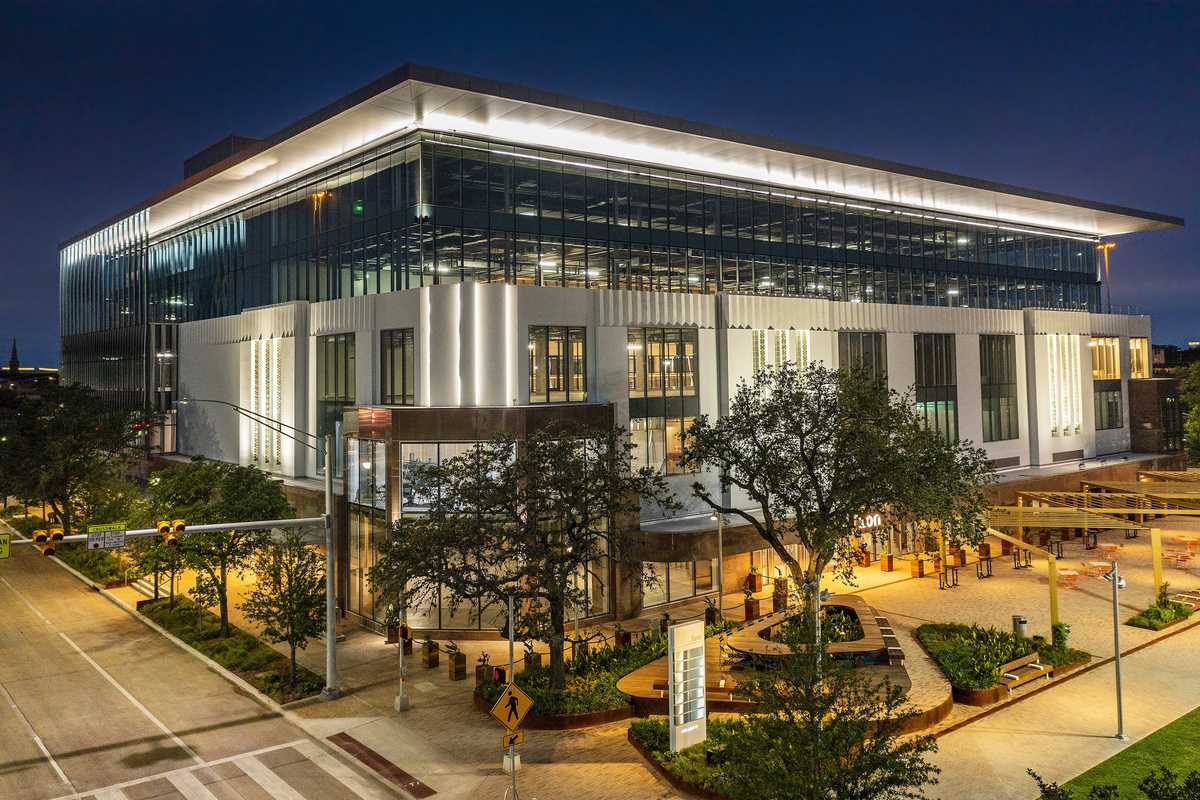
TMEIC Corporation Americas, a group company of Japan-based TMEIC Corporation Japan, recently inaugurated its new space in the Energy Corridor, according to a news release. The new HQ occupies the 10th floor at 1080 Eldridge Parkway, according to ConnectCRE. The company first announced the move last summer.

TMEIC Corporation Americas specializes in photovoltaic inverters and energy storage systems. It employs approximately 500 people in the Houston area, and has plans to grow its workforce in the city in the coming year as part of its overall U.S. expansion.

"We are thrilled to be part of the vibrant Greater Houston community and look forward to expanding our business in North America's energy hub," Manmeet S. Bhatia, president and CEO of TMEIC Corporation Americas, said in the release.

The TMEIC group will maintain its office in Roanoke, which will focus on advanced automation systems, large AC motors and variable frequency drive systems for the industrial sector, according to the release.

TMEIC Corporation Americas also began operations at its new 144,000-square-foot, state-of-the-art facility in Brookshire, which is dedicated to manufacturing utility-scale PV inverters, earlier this year. The company also broke ground on its 267,000-square-foot manufacturing facility—its third in the U.S. and 13th globally—this spring, also in Waller County. It's scheduled for completion in May 2026.

"With the global momentum toward decarbonization, electrification, and domestic manufacturing resurgence, we are well-positioned for continued growth," Bhatia added in the release. "Together, we will continue to drive industry and uphold our legacy as a global leader in energy and industrial solutions."

---

This article originally appeared on EnergyCapitalHTX.com.

ChurchSpace, founded in Houston by Day Edwards and Emmanuel Brown, is moving to Detroit. Photo courtesy ChurchSpace.

Houston-founded startup raises $1.2M and moves headquarters to Detroit

moving forward

Houston-founded ChurchSpace, known as the Airbnb for churches, has formed an official partnership with the City of Detroit and will relocate its headquarters.

The announcements come as the company successfully closed a $1.2 million oversubscribed funding round. The round was led by California-based Black Ops Ventures, with participation from Michigan Rise and Dug Song of Minor Capital, who is also the founder of the Song Foundation, another Michigan-based organization.

"This raise is more than a business milestone—it's a testament to what happens when strategy meets faith. In today's climate, raising capital takes grit and resilience—especially without deep networks or traditional access. By God's grace, doors have opened, and our mission is clearer than ever. Now, with capital in hand, we're building boldly toward a future where the Church isn't just surviving—but leading community transformation," Emmanuel Brown, co-founder and CEO of ChurchSpace, said in a statement.

In Detroit, ChurchSpace plans to activate underutilized church campuses as micro-logistics spaces for food distribution and retail partnerships, as well as last-mile delivery centers. To kick off its relocation, ChurchSpace will host a Detroit Pastor Meetup on July 19.

"We welcome ChurchSpace's investment in Detroit and the jobs and innovation it will bring," Detroit Mayor Mike Duggan added in the release. "Our faith community has long been a critical backbone of our neighborhoods. Through ChurchSpace's groundbreaking work, they will continue to be anchors of opportunity and resilience in our city's future."

ChurchSpace was originally founded to convert underutilized church real estate into event, meeting and commercial kitchen space to boost revenue and relieve financial burden while remaining compliant with IRS regulations for non-profits. The company participated in the inaugural cohort of the AWS Impact Accelerator for Black Founders, which included a pre-seed fundraising campaign and a $125,000 equity injection from Amazon in 2022. It was also one of two Houston companies to receive $100,000 as part of the Google for Startups Black Founders Fund that same year.

The company reports that its platform in Texas has generated up to $100,000 annually in new revenue that was reinvested into church ministries, food programs and community initiatives.

"What we built in Houston was more than technology—it was transformation. We expanded our purpose and packaged proven strategies to help churches thrive, transform communities, and even combat food insecurity," Day Edwards, co-founder and president of ChurchSpace, added in the statement. "Now, with prayer and the support of our team and investors, we're bringing that same impact to Detroit—to help churches, communities, and small businesses redefine pulpits and rediscover communal possibilities."

Ad Placement 300x100
Ad Placement 300x600

CultureMap Emails are Awesome

Baylor College of Medicine names Minnesota med school dean as new president, CEO ​

new leader

Dr. Jakub Tolar, dean of the University of Minnesota Medical School, is taking over as president, CEO and executive dean of Houston’s Baylor College of Medicine on July 1.

Tolar—who’s also vice president for clinical affairs at the University of Minnesota and a university professor—will succeed Dr. Paul Klotman as head of BCM. Klotman is retiring June 30 after leading Texas’ top-ranked medical school since 2010.

In tandem with medical facilities such as Baylor St. Luke’s Medical Center and Texas Children’s Hospital, Baylor trains nearly half of the doctors who work at Texas Medical Center. In addition, Baylor is home to the Dan L Duncan Comprehensive Cancer Center and the Texas Heart Institute.

The hunt for a new leader at Baylor yielded 179 candidates. The medical school’s search firm interviewed 44 candidates, and the pool was narrowed to 10 contenders who were interviewed by the Board of Trustees’ search committee. The full board then interviewed the four finalists, including Tolar.

Greg Brenneman, chair of Baylor’s board and the search committee, says Tolar is “highly accomplished” in the core elements of the medical school’s mission: research, patient care, education and community service.

“Baylor is phenomenal. Baylor is a superpower in academic medicine,” Tolar, a native of the Czech Republic, says in a YouTube video filmed at the medical school. “And everything comes together here because science saves lives. That is the superpower.”

Tolar’s medical specialties include pediatric blood and bone marrow transplants. His research, which he’ll continue at Baylor, focuses on developing cellular therapies for rare genetic disorders. In the research arena, he’s known for his care of patients with recessive dystrophic epidermolysis bullosa, a severe genetic skin disorder.

In a news release, Tolar praises Baylor’s “achievements and foundation,” as well as the school’s potential to advance medicine and health care in “new and impactful ways.”

The Baylor College of Medicine employs more than 9,300 full-time faculty and staff. For the 2025-26 academic year, nearly 1,800 students are enrolled in the School of Medicine, Graduate School of Biomedical Sciences and School of Health Professions. Its M.D. program operates campuses in Houston and Temple.

In the fiscal year that ended June 30, 2024, Baylor recorded $2.72 billion in operating revenue and $2.76 billion in operating expenses.

The college was founded in 1900 in Dallas and relocated to Houston in 1943. It was affiliated with Baylor University in Waco from 1903 to 1969.

​Planned UT Austin med center, anchored by MD Anderson, gets $100M gift​

med funding

The University of Texas at Austin’s planned multibillion-dollar medical center, which will include a hospital run by Houston’s University of Texas MD Anderson Cancer Center, just received a $100 million boost from a billionaire husband-and-wife duo.

Tench Coxe, a former venture capitalist who’s a major shareholder in chipmaking giant Nvidia, and Simone Coxe, co-founder and former CEO of the Blanc & Otus PR firm, contributed the $100 million—one of the largest gifts in UT history. The Coxes live in Austin.

“Great medical care changes lives,” says Simone Coxe, “and we want more people to have access to it.”

The University of Texas System announced the medical center project in 2023 and cited an estimated price tag of $2.5 billion. UT initially said the medical center would be built on the site of the Frank Erwin Center, a sports and entertainment venue on the UT Austin campus that was demolished in 2024. The 20-acre site, north of downtown and the state Capitol, is near Dell Seton Medical Center, UT Dell Medical School and UT Health Austin.

Now, UT officials are considering a bigger, still-unidentified site near the Domain mixed-use district in North Austin, although they haven’t ruled out the Erwin Center site. The Domain development is near St. David’s North Medical Center.

As originally planned, the medical center would house a cancer center built and operated by MD Anderson and a specialty hospital built and operated by UT Austin. Construction on the two hospitals is scheduled to start this year and be completed in 2030. According to a 2025 bid notice for contractors, each hospital is expected to encompass about 1.5 million square feet, meaning the medical center would span about 3 million square feet.

Features of the MD Anderson hospital will include:

  • Inpatient care
  • Outpatient clinics
  • Surgery suites
  • Radiation, chemotherapy, cell, and proton treatments
  • Diagnostic imaging
  • Clinical drug trials

UT says the new medical center will fuse the university’s academic and research capabilities with the medical and research capabilities of MD Anderson and Dell Medical School.

UT officials say priorities for spending the Coxes’ gift include:

  • Recruiting world-class medical professionals and scientists
  • Supporting construction
  • Investing in technology
  • Expanding community programs that promote healthy living and access to care

Tench says the opportunity to contribute to building an institution from the ground up helped prompt the donation. He and others say that thanks to MD Anderson’s participation, the medical center will bring world-renowned cancer care to the Austin area.

“We have a close friend who had to travel to Houston for care she should have been able to get here at home. … Supporting the vision for the UT medical center is exactly the opportunity Austin needed,” he says.

The rate of patients who leave the Austin area to seek care for serious medical issues runs as high as 25 percent, according to UT.