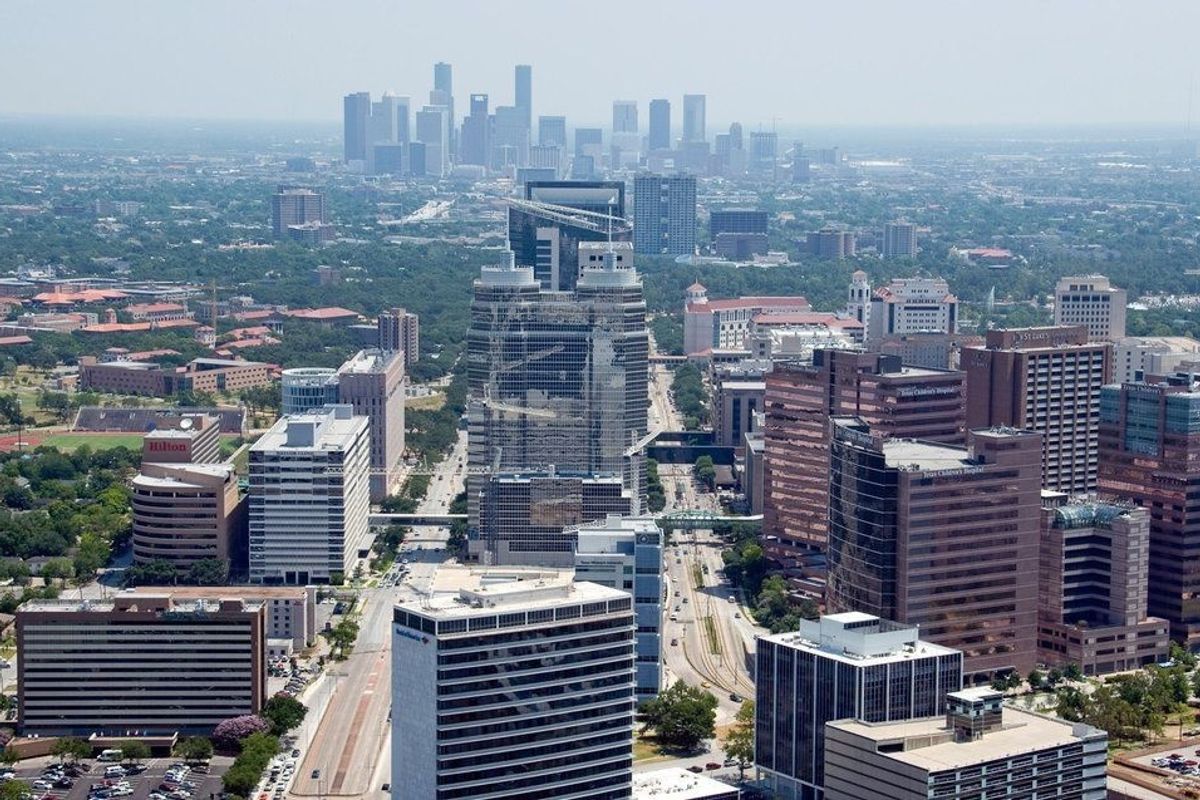
These Houston employers reign supreme when it comes to the best workplaces. Photo by Scott Halleran/Getty Images

Houston company crowned No. 1 large employer in Texas by Fortune Magazine, joining 21 local firms on list

love your job

Houstonians looking for their next employment opportunity might want to consider these 22 Houston-based companies that were just named the best workplaces in Texas by Fortune Magazine and Great Place to Work.

David Weekley Homes was named the No. 1 large employer in Texas, with workers celebrating that their company goes "above and beyond in almost every way possible" and values trust more than anything else.

"They trust you to get your work done and you never feel guilty about having to leave early for a medical appointment, or to pick your kid up from school," the report says. "They trust you to get your work done while maintaining a normal personal life."

The report also speaks highly of the construction company's 401K matching plan, and that workers can become owners in the company after two years of employment.

The remaining Houston companies that make up the top three best large Texas employers include information technology providers Hewlett Packard Enterprise Company (No. 2), and real estate investors Camden Property Trust (No. 3).

Also earning a spot in the top 10 is Hilcorp Energy Company (No. 8).

Speaking on Camden Property Trust, employees in the report say their leaders have developed a "one-of-a-kind" workplace culture, similar to a large family.

"Our celebrations, conferences, meetings feel like a family reunion," the report says. "Our leaders truly care about each and every single person and make decisions with everyone's best interest in mind."

The Best Workplaces in Texas award, which saw some of the same companies on the 2022 list, is the only one of its kind in the U.S. that "selects winners based on how fairly employees are treated," according to a press release. The companies are evaluated based on how well they treat their employees across several factors, including race, gender, age, disability status, and more.

The other Houston-based companies that made it onto Fortune's Best Large Workplaces in Texas 2023 include Transwestern (No. 12), Cornerstone Home Lending, Inc. (No. 14), and KBR (No. 24).

Furthermore, 17 additional Houston employers made it onto Fortune's Best Small and Medium Workplaces in Texas ranking. While Dallas companies dominate the top three, Houston's continuing education and learning center Continued made it into No. 4.

"[Continued] provide[s] so many benefits to better our home and work-life balance," the report says. "There is also a great focus on appreciating diversity and inclusion."The other Houston employers that earned spots on Fortune's Best Small and Medium Workplaces in Texas 2023 report are:

  • No. 12 – Hilltop Residential
  • No. 13 – WizeHire
  • No. 14 – Republic State Mortgage Co.
  • No. 16 – E.A.G. Business Holdings, Incorporated
  • No. 23 – Venterra Realty
  • No. 26 – Optimum Consultancy Services
  • No. 39 – 9th Wonder
  • No. 40 – Entelligence
  • No. 52 – Detechtion Technologies
  • No. 53 – Tricon Energy
  • No. 57 – Eagle Point Solutions
  • No. 64 – Hatch Agency Real Estate
  • No. 66 – Simucase
  • No. 69 – Crestwood Equity Partners

Just outside Houston, Cypress-based Specialized Assessment and Consulting ranked No. 31 and TK Trailer Parts in Madisonville ranked No. 65 in the small and medium workplace report.The full list of 2023's best workplaces in Texas can be found on greatplacetowork.com.

------

This article originally ran on CultureMap.

A.J. "Jim" Teague received glowing reviews from ex-employees. EnterprisePartnersProducts

Houston energy exec scores well on list of top CEOs at Fortune 100 companies

Best boss

Correction: The original article referenced information from a ranking from Upslide that mistakenly reported Jim Teague's Glassdoor employee approval ratings as 9 percent, rather than his actual approval rating of 96 percent. The corrected story is below.

CEO A.J. "Jim" Teague, of Houston-based pipeline company Enterprise Products Partners LP, has received top marks according to Glassdoor data. Teague receives 96 percent approval rating from employees who've reviewed him on the platform, according to Glassdoor.

The Money Inc. website says Teague, who became CEO in 2016, is working to reconfigure the culture at Enterprise Products Partners. "His goal is to shape that culture so that the company itself can become more popular with the general public," the website notes.

Teague has also received positive reviews locally. In December, the Greater Houston Port Bureau named him its 2020 Maritime Leader of the Year to recognize his support of the Houston Ship Channel.

"Building on the legacy of the late Dan L. Duncan, who started Enterprise in 1968, Teague has remained loyal to the founder's values of hard work, integrity, and perseverance, with an uncompromising commitment to safety," the bureau says in a release.

Fellow Texans also received top marks. As Fortune magazine once observed, Michael Dell's leadership style revolves around "vision, inspiration, curiosity, and ultimately passion." And as it turns out, employees of Round Rock-based Dell Technologies Inc. are equally passionate about their company's chairman and CEO.

According to Glassdoor reviews, Dell has a 97 percent approval rating from employees of Dell Technologies.

In October 2013, Forbes magazine offered a glimpse into how Dell interacts with employees of the tech company he founded in 1984.

After speaking to a group of Dell workers for about 45 minutes, "more than a dozen employees rush forward to have their picture taken with their iconic chief," Forbes wrote, "because they know he'll happily pose — something not many other tech executives would do. He doesn't disappoint. And he leaves them laughing and cheering again after answering a question about what's keeping him up at night. 'I've been sleeping pretty well lately.'"

You might be sleeping pretty well, too, if your net worth were $31.4 billion, making Dell the richest person in Austin and the 18th richest person in the U.S.

Another Fortune 100 company exec, Kelcy Warren, chairman and CEO of Dallas-based pipeline company Energy Transfer Partners, scores highly on Glassdoor as well. Warren's employee rating stands at 97 percent.

The respect paid to Warren by Energy Transfer Partner employees almost certainly stems, at least in part, from his laid-back demeanor. He reportedly favors a "non-hierarchical, collaborative management style."

"For all of his success, Warren remains a small-town sort of guy who likes to have buddies to his Dallas mansion on Wednesdays for beers, shuffleboard, and chain yanking," according to a 2015 article published by the Bloomberg news service.

With a net worth of $4.3 billion, Warren ranks 159th on Forbes' list of the richest Americans.

------

This article originally ran on CultureMap.

Three Houston companies made Fortune's list of best places for millennials. Photo by Katya Horner

Houston energy company with big perks named among best workplaces for millennials

Young life

When it comes to keeping young professionals happy in the workplace, Houston is doing a bang-up job — some companies more than others. A new report released by Fortune magazine and Great Place to Work finds three Houston companies, and a total of 11 Texas companies, among the top 100 Best Workplaces for Millennials 2018.

Making the national list is Hilcorp Energy Company, an organization known for giving its employees huge bonuses, such as $100,000 in 2015 and $50,000 toward a new car in 2010. The Houston-based company has 93 percent of employees saying their workplace is great, likely because of these aggressive financial incentives, which include a revenue sharing program, a bonus program, "helping hands" community assistance programs, and a generous referral incentive, according to the Fortune piece.

Hilcorp, even with its big perks, isn't actually the top Houston company on the national list. That distinction goes to Houston-based David Weekley Homes. The construction and real estate powerhouse, leads the Texas pack at No. 19. Houston's construction/real estate company Camden Property Trust comes in at No. 94, and manufacturing/production firm Hilcorp appears at No. 95.

More than 434,000 survey respondents from Great Place to Work-Certified companies provided input into this annual list. The study analyzed how millennials rated their organizations on more than 50 different metrics defining great workplaces, such as managers' competence, respect and fairness in the workplace, opportunities for meaningful work, executive leadership, and opportunities to innovate and contribute to the organization's success.

The report also analyzed an index of factors where millennials often lag behind other workers, such as access to meaningful work, fair pay, and plans for a future with their organizations. Companies were evaluated as to whether they were creating great workplaces for all millennials — regardless of who they are or what they do for the organization.

Surveys were anonymous, and companies needed to employ at least 50 millennials to be considered. Employees rated the companies on challenges, atmosphere, rewards, pride, communication, and bosses with a numerical ranking. Here's what made the other Houston companies shine:

David Weekley Homes, where 96 percent of employees say their workplace is great, was lauded for offering an employee's children's scholarship program, product discounts, profit sharing, sabbaticals, and even spiritual assistance.

At Camden, where 92 percent of employees say their workplace is great, employees are given apartment discounts, holiday suites, scholarships, tuition assistance, an aggressive stock purchase plan, and even tickets to hot sporting events.

Elsewhere In Texas, familiar San Antonio insurance/financial service brand USAA (United Services Automobile Association) comes in at No. 40, followed by Dallas professional services firm Ryan, Inc. at No. 44 and Dallas' Prime Lending at No. 58.

Austin is represented by tech firm WP Engine, Inc. at No. 61. Dallas' Encompass Home Health checks in at No. 66, while San Antonio transportation company NuStar Energy L.P. follows at No. 69. Abilene makes an appearance with Funeral Directors Life Insurance Company at No. 92, and rounding out the Texas representation is Arlington's Texas Health Resources, Inc. at No. 96.

------

This story originally appeared on CultureMap.

Ad Placement 300x100
Ad Placement 300x600

CultureMap Emails are Awesome

How Houston innovators played a role in the historic Artemis II splashdown

safe landing

Research from Rice University played a critical role in the safe return of U.S. astronauts aboard NASA’s Artemis II mission this month.

Rice mechanical engineer Tayfun E. Tezduyar and longtime collaborator Kenji Takizawa developed a key computational parachute fluid-structure interaction (FSI) analysis system that proved vital in NASA’s Orion capsule’s descent into the Pacific Ocean. The FSI system, originally developed in 2013 alongside NASA Johnson Space Center, was critical in Orion’s three-parachute design, which slowed the capsule as it returned to Earth, according to Rice.

The model helped ensure that the parachute design was large enough to slow the capsule for a safe landing while also being stable enough to prevent the capsule from oscillating as it descended.

“You cannot separate the aerodynamics from the structural dynamics,” Tezduyar said in a news release. “They influence each other continuously and even more so for large spacecraft parachutes, so the analysis must capture that interaction in a robustly coupled way.”

The end result was a final parachute system, refined through NASA drop tests and Rice’s computational FSI analysis, that eliminated fluctuations and produced a stable descent profile.

Apart from the dynamic challenges in design, modeling Orion’s parachutes also required solving complex equations that considered airflow and fabric deformation and accounted for features like ringsail canopy construction and aerodynamic interactions among multiple parachutes in a cluster.

“Essentially, my entire group was dedicated to that work, because I considered it a national priority,” Tezduyar added in the release. “Kenji and I were personally involved in every computer simulation. Some of the best graduate students and research associates I met in my career worked on the project, creating unique, first-of-its-kind parachute computer simulations, one after the other.”

Current Intuitive Machines engineer Mario Romero also worked on Orion during his time at NASA. From 2018 to 2021, Romero was a member of the Orion Crew Capsule Recovery Team, which focused on creating likely scenarios that crewmembers could encounter in Orion.

The team trained in NASA’s 6.2-million-gallon pool, using wave machines to replicate a range of sea conditions. They also simulated worst-case scenarios by cutting the lights, blasting high-powered fans and tipping a mock capsule to mimic distress situations. In some drills, mock crew members were treated as “injured,” requiring the team to practice safe, controlled egress procedures.

“It’s hard to find the appropriate descriptors that can fully encapsulate the feeling of getting to witness all the work we, and everyone else, did being put into action,” Romero tells InnovationMap. “I loved seeing the reactions of everyone, but especially of the Houston communities—that brought me a real sense of gratitude and joy.”

Intuitive Machines was also selected to support the Artemis II mission using its Space Data Network and ground station infrastructure. The company monitored radio signals sent from the Orion spacecraft and used Doppler measurements to help determine the spacecraft's precise position and speed.

Tim Crain, Chief Technology Officer at Intuitive Machines, wrote about the experience last week.

"I specialized in orbital mechanics and deep space navigation in graduate school,” Crain shared. “But seeing the theory behind tracking spacecraft come to life as they thread through planetary gravity fields on ultra-precise trajectories still seems like magic."

UH breakthrough moves superconductivity closer to real-world use

Energy Breakthrough

University of Houston researchers have set a new benchmark in the field of superconductivity.

Researchers from the UH physics department and the Texas Center for Superconductivity (TcSUH) have broken the transition temperature record for superconductivity at ambient pressure. The accomplishment could lead to more efficient ways to generate, transmit and store energy, which researchers believe could improve power grids, medical technologies and energy systems by enabling electricity to flow without resistance, according to a release from UH.

To break the record, UH researchers achieved a transition temperature 151 Kelvin, which is the highest ever recorded at ambient pressure since the discovery of superconductivity in 1911.

The transition temperature represents the point just before a material becomes superconducting, where electricity can flow through it without resistance. Scientists have been working for decades to push transition temperature closer to room temperature, which would make superconducting technologies more practical and affordable.

Currently, most superconductors must be cooled to extremely low temperatures, making them more expensive and difficult to operate.

UH physicists Ching-Wu Chu and Liangzi Deng published the research in the Proceedings of the National Academy of Sciences earlier this month. It was funded by Intellectual Ventures and the state of Texas via TcSUH and other foundations. Chu, founding director and chief scientist at TcSUH, previously made the breakthrough discovery that the material YBCO reaches superconductivity at minus 93 K in 1987. This helped begin a global competition to develop high-temperature superconductors.

“Transmitting electricity in the grid loses about 8% of the electricity,” Chu, who’s also a professor of physics at UH and the paper’s senior author, said in a news release. “If we conserve that energy, that’s billions of dollars of savings and it also saves us lots of effort and reduces environmental impacts.”

Chu and his team used a technique known as pressure quenching, which has been adapted from techniques used to create diamonds. With pressure quenching, researchers first apply intense pressure to the material to enhance its superconducting properties and raise its transition temperature.

Next, researchers are targeting ambient-pressure, room-temperature superconductivity of around 300 K. In a companion PNAS paper, Chu and Deng point to pressure quenching as a promising approach to help bridge the gap between current results and that goal.

“Room-temperature superconductivity has been seen as a ‘holy grail’ by scientists for over a century,” Rohit Prasankumar, director of superconductivity research at Intellectual Ventures, said in the release. “The UH team’s result shows that this goal is closer than ever before. However, the distance between the new record set in this study and room temperature is still about 140 C. Closing this gap will require concerted, intentional efforts by the broader scientific community, including materials scientists, chemists, and engineers, as well as physicists.”

---

This article originally appeared on EnergyCapitalHTX.com.