


The winner of the contest will be announced at a Rockets game in early April. Courtesy of Greater Houston Convention and Visitors Bureau

It's game on for Houston startups looking to compete in the Launchpad contest backed by BBVA USA and the Houston Rockets.

Houston startups have until February 28 to submit their companies for the competition. Judges from BBVA and the Rockets will select four by late March, and fans will vote on their favorite company. The winner will be presented with a $10,000 check at a Rockets game in late April. The winning startup will also receive consultations with Rockets and BBVA USA executives.

It's the fourth time BBVA has sought out entrepreneurs, but last year the organization revamped the program to focus on technology-driven startups.

"Over the past three years, we have been proud to partner with BBVA to highlight small businesses in Houston and their contribution to our economy," says Rockets Chief Revenue Officer Gretchen Sheirr. "Entering its fourth year, the Launchpad contest seeks nominees focused on using best in class digital strategies to enhance their small business. We look forward to reviewing submissions and honoring the great work that is being done by these businesses in our community.

BBVA's new Houston CEO Dillan Knudson, who was promoted to his new position in November, is excited for his inaugural involvement in the contest.

"It's extremely exciting to collaborate with the Rockets for the first time, and for such a great initiative that helps Houston's thriving small business scene," says Knudson. "Part of my new role is to create opportunities and financial freedom for Houston's communities through the bank's ample resources, and to do that in collaboration with a staple organization of this city is an honor."
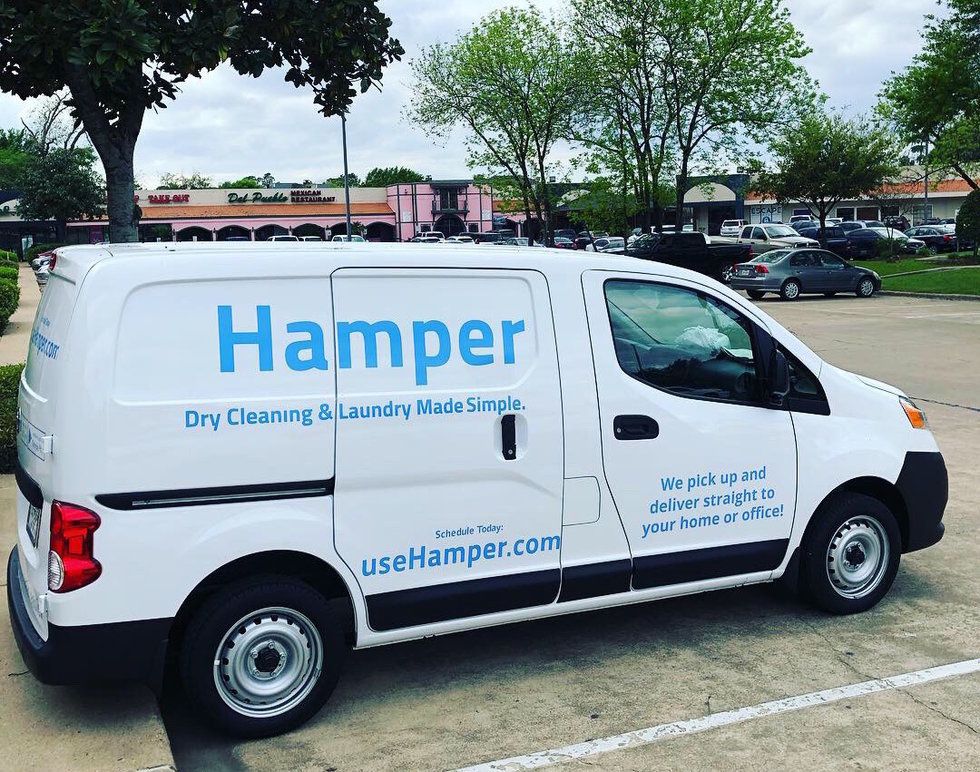
Houston-based Hamper, which makes dry cleaning convenient, won the Rockets and BBVA Compass' LaunchPad competition. Courtesy of Hamper

Last year, Launchpad's winner was Hamper. Hamper's co-founder and CEO Safir Ali started his company to use technology to optimize the dry cleaning business and compares Hamper to the "Red Box of dry cleaning." The win was big for Hamper's future.

"It was an absolute pleasure to be recognized by BBVA and the Houston Rockets as the winner of the 2019 Launchpad Contest," says Ali in the release. "It was a very exciting moment for Hamper, and we are very grateful to have the opportunity to be recognized in our community. Many thanks to both BBVA and the Houston Rockets for empowering Houston businesses and giving them such a great platform to be recognized for their efforts, and for playing an active role in empowering entrepreneurship in Houston."

Ad Placement 300x100
Ad Placement 300x600

CultureMap Emails are Awesome

Houston clocks in as one of the hardest working cities in America

Ranking It

Houston and its residents are proving their tenacity as some of the hardest working Americans in 2026, so says a new study.

WalletHub's annual "Hardest-Working Cities in America (2026)" report ranked Houston the 37th most hardworking city nationwide. H-town last appeared as the 28th most industrious American city in 2025, but it still remains among the top 50.

The personal finance website evaluated 116 U.S. cities based on 11 key indicators across "direct" and "indirect" work factors, such as an individual's average workweek hours, average commute times, employment rates, and more.

The U.S. cities that comprised the top five include Cheyenne, Wyoming (No. 1); Anchorage, Alaska (No. 2); Washington, D.C. (No. 2); Sioux Falls, South Dakota (No. 4); and Irving, Texas (No. 5). Dallas and Austin also earned a spot among the top 10, landing as No. 7 and No. 10, respectively.

Based on the report's findings, Houston has the No. 31-best "direct work factors" ranking in the nation, which analyzed residents' average workweek hours, employment rates, the share of households where no adults work, the share of workers leaving vacation time unused, the share of "engaged" workers, and the rate of "idle youth" (residents aged 16-24 that are not in school nor have a job).

However, Houston lagged behind in the "indirect work factors" ranking, landing at No. 77 out of all 116 cities in the report. "Indirect" work factors that were considered include residents' average commute times, the share of workers with multiple jobs, the share of residents who participate in local groups or organizations, annual volunteer hours, and residents' average leisure time spent per day.

Based on data from The Organisation for Economic Co-operation and Development (OECD), WalletHub said the average American employee works hundreds of more hours than workers residing in "several other industrialized nations."

"The typical American puts in 1,796 hours per year – 179 more than in Japan, 284 more than in the U.K., and 465 more than in Germany," the report's author wrote. "In recent years, the rise of remote work has, in some cases, extended work hours even further."

WalletHub also tracked the nation's lowest and highest employment rates based on the largest city in each state from 2009 to 2024.

ranking

Source: WalletHub

Other Texas cities that earned spots on the list include Fort Worth (No. 13), Corpus Christi (No. 14), Arlington (No. 15), Plano (No. 17), Laredo (No. 22), Garland (No. 24), El Paso (No. 43), Lubbock (No. 46), and San Antonio (No. 61).

Data for this study was sourced from the U.S. Census Bureau, Bureau of Labor Statistics, U.S. Travel Association, Gallup, Social Science Research Council, and the Corporation for National & Community Service as of January 29, 2026.

---

This article originally appeared on CultureMap.com.

With boost from Houston, Texas is the No. 1 state for economic development

governor's cup

Texas is on a 14-year winning streak as the top state for attracting job-creating business location and expansion projects.

Once again, Texas has claimed Site Selection magazine’s Governor’s Cup. This year’s honor recognizes the state with the highest number of economic development projects in 2025. Texas landed more than 1,400 projects last year.

Ron Starner, executive vice president of Site Selection, calls Texas “a dynasty in economic development.”

Among metro areas, Houston lands at No. 2 for the most economic development projects secured last year (590), behind No. 1 Chicago and ahead of No. 3 Dallas-Fort Worth.

In praising Houston as a project magnet, Gov. Greg Abbott cites the November announcement by pharmaceutical giant Lilly that it’s building a $6.5 billion manufacturing plant at Houston’s Generation Park.

“Growth in the Greater Houston region is a great benefit to our state’s economy, a major location for foreign direct investment and key industry sectors like energy, aerospace, advanced manufacturing, and life sciences,” Abbott tells Site Selection. “Houston is also home to one of the largest concentrations of U.S. headquarters for companies from around the world.”

In 2025, Fortune ranked Houston as the U.S. city with the third-highest number of Fortune 500 headquarters (26).

Texas retained the Governor’s Cup by gaining over 1,400 business location and expansion projects last year, representing more than $75 billion in capital investments and producing more than 42,000 new jobs.

Site Selection says Texas’ project count for 2025 handily beat second-place Illinois (680 projects) and third-place Ohio (467 projects). Texas’ number for 2025 represented 18% of all qualifying U.S. projects tracked by Site Selection.

“You can see that we are on a trajectory to ensure our economic diversification is going to inoculate us in good times, as well as bad times, to ensure our economy is still going to grow, still create new jobs, prosperity, and opportunities for Texans going forward,” Abbott says.

Houston e-commerce giant Cart.com raises $180M, surpasses $1B in funding

fresh funding

Editor's note: This article has been updated to clarify information about Cart.com's investors.

Houston-based commerce and logistics platform Cart.com has raised $180 million in growth capital from private equity firm Springcoast Partners, pushing the startup past the $1 billion funding mark since its founding in 2020.

Cart.com says it will use the capital to scale its logistics network, expand AI capabilities and develop workflow automation tools.

“This investment will strengthen our balance sheet and provide us with the flexibility to accelerate our strategic priorities,” Omair Tariq, CEO of Cart.com, said in a news release. “We’ve built a platform that combines commerce software with a scaled logistics network, and we’re just getting started.”

In conjunction with the funding, Springcoast executive-in-residence Russell Klein has been appointed to Cart.com’s board of directors. Before joining Springcoast, he was chief commercial officer at Austin-based Commerce.com (Nasdaq: CMRC). Klein co-led Commerce.com’s IPO, led the company’s mergers-and-acquisitions strategy and played a key role in several funding rounds.

“The team at Cart.com has demonstrated excellence in their ability to scale efficiently while continuing to innovate,” Klein said. “I’m excited to join the board and support the company as it expands its AI-driven capabilities, deepens enterprise relationships, and further strengthens its position as a category-defining commerce and fulfillment platform.”

Before this funding round, Cart.com had raised $872 million in venture capital and reached a valuation of about $1.6 billion, according to CB Insights. With the new funding, the startup has collected over $1 billion in just six years.