


The site will manufacture Lilly's first synthetic oral GLP-1 medication and other advanced therapeutics. Photo via gov.texas.gov

Leading pharmaceutical company Eli Lilly broke ground today, Sept. 21, on its $6.5 billion manufacturing site at Houston's Generation Park.

The 236-acre, state-of-the art factory is expected to come online in 2030 and will manufacture Foundayo, the company's first synthetic oral GLP-1 medication, currently under regulatory review, as well as other advanced therapeutics.

"We are thrilled to break ground on our latest ‘medicines made in America’ site in the great state of Texas," David Ricks, Lilly chair and CEO, said in a prepared statement. "This $6.5 billion investment will help change the game for tens of millions of people suffering from overweight, obesity and its consequences like diabetes. We will make and ship Lilly’s latest products from Texas to people here at home and around the world.”

Houston was up against more than 300 locations in the U.S. for the factory, as part of Lilly’s $50 billion investment in domestic medicine production that has launched 10 manufacturing sites since 2020. Lilly first announced Houston had been selected for the site last September.
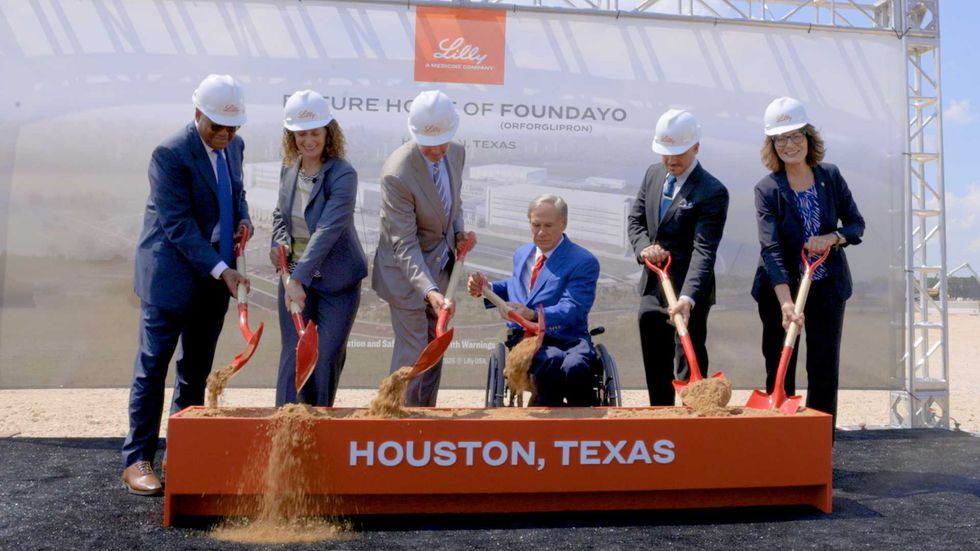
Photo via gov.texas.gov

As Abbott mentioned, the site is expected to create hundreds of jobs, and will hire engineers, scientists, operations personnel and lab technicians once up and running. It will create 4,000 construction jobs while being built.

In an effort to support workforce development, Lilly also announced a $12.5 million commitment to Houston's San Jacinto College in addition to a $2.5 million charitable donation to the San Jacinto College Foundation. The funding will go toward hands-on training, equipment and facilities to support future technicians, operators, maintenance professionals, and other manufacturing talent, according to Lilly. The charitable donation will fund scholarships for students.

"This relationship will build a strong, sustainable talent pipeline for Lilly while creating meaningful, high-demand career opportunities across our region,” Brenda Hellyer, chancellor of San Jacinto College, said in the release.

"When you invest in a place like Houston, you invest in its people first," Edgardo Hernandez, executive vice president and president of Lilly Manufacturing Operations, added. "This facility will run on the talent of this community, powered by our relationship with San Jacinto College. We're hiring across the greater Houston area to help residents build careers close to home."

Lilly previously said it chose Generation Park, a 4,300-acre, master-planned commercial district near Lake Houston, because of factors such as financial incentives, access to utilities and transportation and the region’s business-friendly environment. Generation Park is home to campuses for San Jacinto College and Lone Star College.

Since Lilly first announced plans for the site, another fellow pharma giant has made plans to move into Generation Park. Bristol Myers Squibb Co. announced last month that it would build a $2.3 billion factory in the district. The site is expected to manufacture small molecule, biologic and antibody-drug conjugates and will also come online around 2030. Read more here.

Ad Placement 300x100
Ad Placement 300x600

CultureMap Emails are Awesome

UH Health names leader of new digital health institute

new exec

Recently launched UH Health has named the first-ever executive director of its new Institute for Digital Healthcare Transformation at the University of Houston.

Beto López has been tapped to lead the new initiative that aims to help develop and commercialize health care technologies centered around university research.

Launched in August, the Institute for Digital Healthcare Transformation leans on experts from UH’s engineering, medicine, business, law and other departments and will connect with industry partners. It will initially focus on mobile health applications, sensors, wearables and artificial intelligence, according to UH.

“Most digital health initiatives and commercialization efforts start with the technology and hope adoption follows. But the translation gap isn't a science problem — it’s a scaffolding problem between researchers, the community and the market,” López said in a news release. “I've spent the past 10 years building that scaffolding in places that weren’t wired for it, and I'm looking forward to building it here at UH to help ensure new health care technologies reach the people and communities that can benefit from them most.”

López previously spent 10 years at San Francisco-based innovation consultancy company IDEO, where he led over 100 projects for Fortune 500 companies and public agencies. He co-founded and served as managing director of the Design Institute for Health at UT Austin’s Dell Medical School; and also co-founded a social venture studio/venture capital fund focused on health care innovation. He worked alongside Houston’s Legacy Community Health during the COVID-19 pandemic.

“Beto understands that breakthrough technology alone doesn't transform health care — it has to be designed around the needs of patients, providers and communities and have a clear path into practice,” Jonathan McCullers, vice president for health affairs at UH, added in the news release. “His experience spanning academic health care and venture capital equips him to bring together researchers, health care organizations, entrepreneurs and investors. This makes him uniquely suited to lead this institute and help turn the university's innovation into solutions that improve people's lives.”

The University of Houston launched UH Health, its new cross-disciplinary academic venture, in July. It aims to bring together the university's health-related education, research and community impact under one umbrella.

ExxonMobil gets approval for $5B Texas Gulf Coast carbon capture project

CCS Expansion

Spring-based ExxonMobil has won approval from the Texas Railroad Commission for a $5 billion carbon capture and storage project in East Texas.

Dominic Genetti, senior vice president of CCS at ExxonMobil, told The Financial Times, which broke the news, that the Railroad Commission’s action is a “major milestone” that lets the company keep expanding along the Gulf Coast. In a 2-1 vote, commissioners authorized a carbon sequestration permit for the project.

“The Railroad Commission clearly recognizes the important role carbon capture and storage can play in meeting growing global demand for lower-carbon products while supporting new jobs and economic growth,” Genetti said.

The U.S. Environmental Protection Agency (EPA) approved ExxonMobil’s Rose CCS project last year.

The project will enable the company to inject about 53 metric tons of industrial customers’ carbon emissions into three underground wells it drilled in the Beaumont-Port Arthur area. Over a 13-year period, ExxonMobil plans to inject about 4 million metric tons per year into the Fleming and Upper Frio rock formations, according to Carbon Herald.

ExxonMobil says it owns the world’s first and largest CCS system, comprising 1,300 miles of CO2 pipeline and secure storage sites. Seventy percent of the pipelines are along the Gulf Coast.

The company ramped up its CCS business in 2023 with the $4.9 billion purchase of Denbury, which owned about 1,000 miles of CO2 pipelines.

“Our expertise, combined with Denbury’s talent and CO2 pipeline network, expands our low-carbon leadership and best positions us to meet the decarbonization needs of industrial customers while also reducing emissions in our own operations,” ExxonMobil Chairman and CEO Darren Woods said when the deal closed.

In January, Genetti wrote in a post on ExxonMobil’s website that the company is committed to CCS “for the long haul.”

“CCS is not new technology, but it’s flown relatively under the radar compared with the attention that production of hydrocarbons commands,” he wrote. “Now, as the world becomes more aware of the need to reduce emissions, CCS finally has a brighter spotlight and a broader runway to scale up.”

The company also announced this week that it has begun CCS operations at a direct reduced iron facility in Convent, Louisiana. The project will capture, transport and store up to 800,000 metric tons of CO2 per year, according to the company.

---

This article first appeared on EnergyCapitalHTX.com.

Houston researchers develop breakthrough device that could bypass spinal injuries

breakthrough research

Scientists at Houston Methodist have announced a significant leap forward for spinal cord injury recovery.

The researchers have developed a device that essentially bypasses spinal injuries, allowing signals from previously “lost” functions to reach the brain, a new study published in Nature Communications shows.

“Most current technologies try to improve whatever function remains after a spinal cord injury,” Dr. Damiano Barone, assistant professor of neurosurgery in the Department of Neurosurgery at Houston Methodist and co-lead on the study, said in a news release. “Our goal is different. Rather than fixing the injury itself, we want to bypass it completely and create an alternative route for signals to travel.”

The study involved a single ultrathin circumferential electrode array made to conform around the spinal cord without penetrating neural tissue, which was implanted into rodent and pig models with spinal injuries. The electrode array was able to interpret motor, sensory and autonomic signals around the injury. Think of it as a set of detours that restore road access to isolated towns after a disaster destroys the highway instead of just rebuilding the highway.

Over the course of three days, the arrays detected signals of intended movement from low-frequency spinal oscillations with more than 94 percent accuracy. This worked across species and was replicated in feasibility studies on human cadavers.

This research could serve as a new foundation for neuroprosthetic implants that could restore connectivity to the 2.5 million people worldwide suffering from spinal injuries that result in loss of ability. Future development could result in everything from restored organ function to mobility, according to Houston Methodist.

George Malliaras, the Prince Professor of Technology in the Department of Engineering at the University of Cambridge, who co-led the study, sees it as a fundamental restructuring of the science of spinal trauma.

“This could represent a paradigm change in how we think about spinal cord injuries,” Malliaras said. “Instead of starting from the idea that what is lost is gone forever, this approach asks whether we can restore function by carrying the signal around the injury.”

Further work involving laboratory models will need to be completed before launching human trials.

Grants from the National Institutes of Health, Houston Methodist Katz Investigator Award, Helaers Research Award and the Engineering and Physical Sciences Research Council helped support the study. Other collaborators on the study include Salim Hadwe, Ruben Serrano, George Psaltakis, Margaux Forner, Chaeyeon Lee, Sydney Swedick, Moleca Ghnnam, Tawfique Hasan and Alejandro Carnicer-Lombarte from the University of Cambridge; and Anton Banta and Xueer Zhang from Houston Methodist.