


Goodwill Houston, in collaboration with Accenture, BlocPower, and Goodwill Industries International hosted a celebration for the Clean Tech Accelerator. Photo courtesy of Goodwill

A major nonprofit and a worldwide corporate leader have teamed up to advance cleantech jobs — and the program has officially celebrated its launch in Houston.

Goodwill Houston, in collaboration with Accenture, BlocPower, and Goodwill Industries International hosted a celebration for the Clean Tech Accelerator, an industry-focused full-time free jobs training program that was originally announced last year. The first cohort graduated earlier this year, and the second is ongoing.

"Through the CTA, we want to shape the future of sustainable energy in Houston by recruiting underrepresented jobseekers and equipping them with technical proficiency, safety and clean tech certifications, and facilitating placement with local employers," a representative from Accenture states in an email. "Following a quiet initial launch, this event was the official kickoff."

The event also demonstrated the opportunities within the CTA program for job seekers to prepare for the most in-demand clean energy careers in Houston. The accelerator is targeting a specific set of advanced energy jobs — the 40 percent that don't require college degrees and and pay more than the median salary in the United States.

According to Accenture and Goodwill, the plan is to grow the program to 20 cities in the next seven years and train an estimated 7,000 job seekers. The program, which was co-designed by Accenture, will be run by Goodwill. Participants identified as under and unemployed individuals and accepted into the program will be compensated as they undergo the training and career placement services.

"As our labor market transitions, we see important opportunities for people to move into more promising roles with better pay. It is essential that we provide the training and other support needed to ensure people capture these opportunities," Steve Preston, president and CEO of Goodwill Industries International, says in a news release announcing the program. "The Goodwill Clean Tech Accelerator will open doors for people in an expanding industry and provide support to employers who are helping us transition to a more sustainable world."
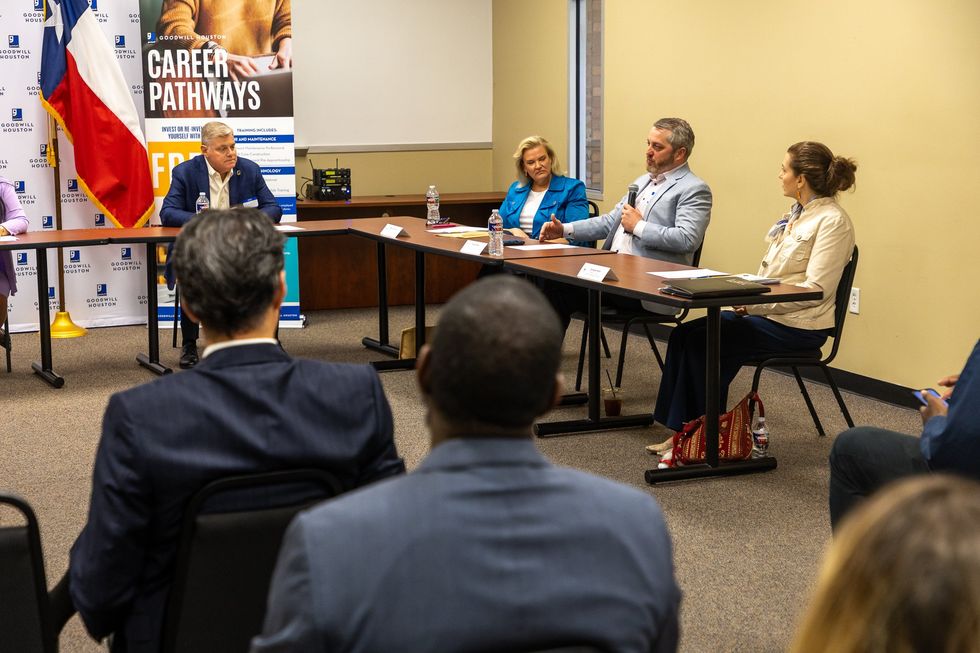
Speakers included leaders from the participating organizations. Photo courtesy of Accenture

Ad Placement 300x100
Ad Placement 300x600

CultureMap Emails are Awesome

With boost from Houston, Texas is the No. 1 state for economic development

governor's cup

Texas is on a 14-year winning streak as the top state for attracting job-creating business location and expansion projects.

Once again, Texas has claimed Site Selection magazine’s Governor’s Cup. This year’s honor recognizes the state with the highest number of economic development projects in 2025. Texas landed more than 1,400 projects last year.

Ron Starner, executive vice president of Site Selection, calls Texas “a dynasty in economic development.”

Among metro areas, Houston lands at No. 2 for the most economic development projects secured last year (590), behind No. 1 Chicago and ahead of No. 3 Dallas-Fort Worth.

In praising Houston as a project magnet, Gov. Greg Abbott cites the November announcement by pharmaceutical giant Lilly that it’s building a $6.5 billion manufacturing plant at Houston’s Generation Park.

“Growth in the Greater Houston region is a great benefit to our state’s economy, a major location for foreign direct investment and key industry sectors like energy, aerospace, advanced manufacturing, and life sciences,” Abbott tells Site Selection. “Houston is also home to one of the largest concentrations of U.S. headquarters for companies from around the world.”

In 2025, Fortune ranked Houston as the U.S. city with the third-highest number of Fortune 500 headquarters (26).

Texas retained the Governor’s Cup by gaining over 1,400 business location and expansion projects last year, representing more than $75 billion in capital investments and producing more than 42,000 new jobs.

Site Selection says Texas’ project count for 2025 handily beat second-place Illinois (680 projects) and third-place Ohio (467 projects). Texas’ number for 2025 represented 18% of all qualifying U.S. projects tracked by Site Selection.

“You can see that we are on a trajectory to ensure our economic diversification is going to inoculate us in good times, as well as bad times, to ensure our economy is still going to grow, still create new jobs, prosperity, and opportunities for Texans going forward,” Abbott says.

Houston e-commerce giant Cart.com raises $180M, surpasses $1B in funding

fresh funding

Editor's note: This article has been updated to clarify information about Cart.com's investors.

Houston-based commerce and logistics platform Cart.com has raised $180 million in growth capital from private equity firm Springcoast Partners, pushing the startup past the $1 billion funding mark since its founding in 2020.

Cart.com says it will use the capital to scale its logistics network, expand AI capabilities and develop workflow automation tools.

“This investment will strengthen our balance sheet and provide us with the flexibility to accelerate our strategic priorities,” Omair Tariq, CEO of Cart.com, said in a news release. “We’ve built a platform that combines commerce software with a scaled logistics network, and we’re just getting started.”

In conjunction with the funding, Springcoast executive-in-residence Russell Klein has been appointed to Cart.com’s board of directors. Before joining Springcoast, he was chief commercial officer at Austin-based Commerce.com (Nasdaq: CMRC). Klein co-led Commerce.com’s IPO, led the company’s mergers-and-acquisitions strategy and played a key role in several funding rounds.

“The team at Cart.com has demonstrated excellence in their ability to scale efficiently while continuing to innovate,” Klein said. “I’m excited to join the board and support the company as it expands its AI-driven capabilities, deepens enterprise relationships, and further strengthens its position as a category-defining commerce and fulfillment platform.”

Before this funding round, Cart.com had raised $872 million in venture capital and reached a valuation of about $1.6 billion, according to CB Insights. With the new funding, the startup has collected over $1 billion in just six years.

This is the income required to be a middle class earner in Houston in 2026

Cashing In

A new study tracking the upper and lower thresholds for middle class households across the nation's largest cities has revealed Houstonians need to make at least a grand more than last year to maintain their middle class status this year.

According to SmartAsset's just-released annual report, "What It Takes to Be Middle Class in America – 2026 Study," Houston households need to make anywhere from $42,907 to $128,722 to qualify as middle class earners this year.

Compared to 2025, Houstonians need to make $1,153 more per year to meet the minimum threshold for a middle class status, whereas the upper bound has stretched $3,448 higher. The median income for a Houston household in 2024 was $64,361, the study added.

SmartAsset's experts used 2024 Census Bureau median household income data for the 100 biggest U.S. cities and all 50 states and determined middle class income ranges by using a variation of Pew Research's definition of a middle class household, stating the salary range is "two-thirds to double the median U.S. salary."

In the report's ranking of the U.S. cities with the highest household incomes needed to maintain a middle class status, Houston ranked No. 80.

In the report's state-by-state comparison, Texas has the 24th highest middle class income range. Overall, Texas households need to make between $53,147 and $159,442 to be labeled "middle class" in 2026. For additional context, the median income for a Texas household in 2024 came out to $79,721.

"Often, the expectations that come with the term 'middle class' include reaching home ownership, raising kids, the comfort of modest emergency funds and retirement savings, and the occasional splurge or vacation," the report said. "And as the median household income varies widely across the U.S. depending on the local job market, housing market, infrastructure and other factors, so does swing the bounds on what constitutes a middle class income in America."

What it takes to be middle class elsewhere around Texas

Two Dallas-Fort Worth suburbs – Frisco and Plano – have some of the highest middle class income ranges in the country for 2026, SmartAsset found.

Frisco households need to make between $96,963 and $290,888 to qualify as middle class this year, which is the third-highest middle class income range nationwide.

Plano's middle class income range is the eighth highest nationally, with households needing to make between $77,267 and $231,802 for the designation.

Salary range needed to be a middle class earner in other Texas cities:

  • No. 28 – Austin: between $60,287 and $180,860
  • No. 40 – Irving: between $56,566 and $169,698
  • No. 44 – Fort Worth: between $55,002 and $165,006
  • No. 57 – Garland: between $50,531 and $151,594
  • No. 60 – Arlington: between $49,592 and $148,77
  • No. 61 – Dallas: between $49,549 and $148,646
  • No. 73 – Corpus Christi: between $44,645 and $133,934
  • No. 77 – San Antonio: between $44,117 and $132,352
  • No. 83 – Lubbock: between $41,573 and $124,720
  • No. 84 – Laredo: between $41,013 and $123,038
  • No. 89 – El Paso: between $39,955 and $119,864
---

This article originally appeared on CultureMap.com.