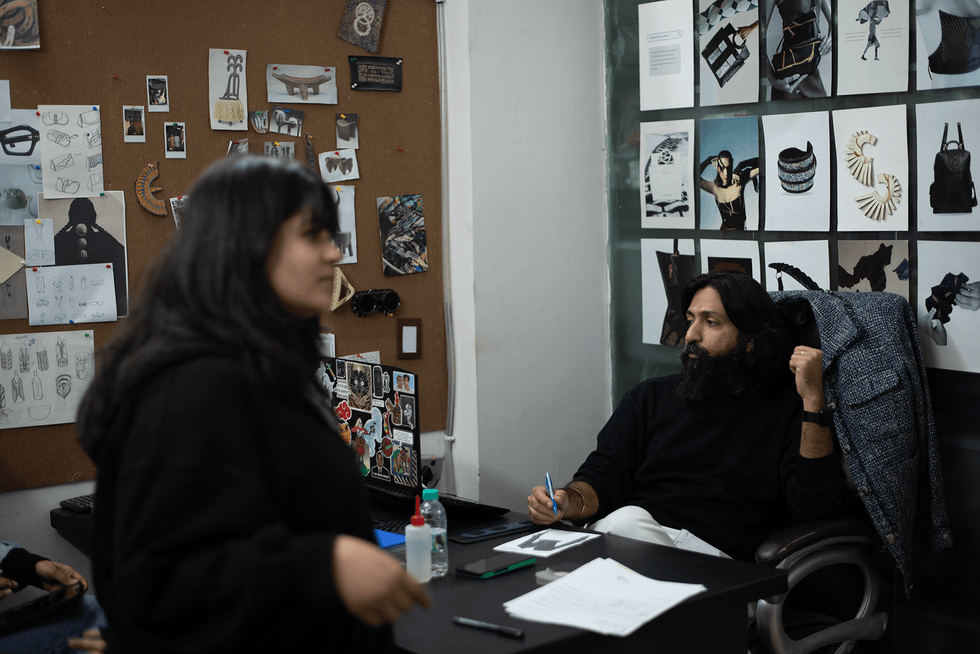
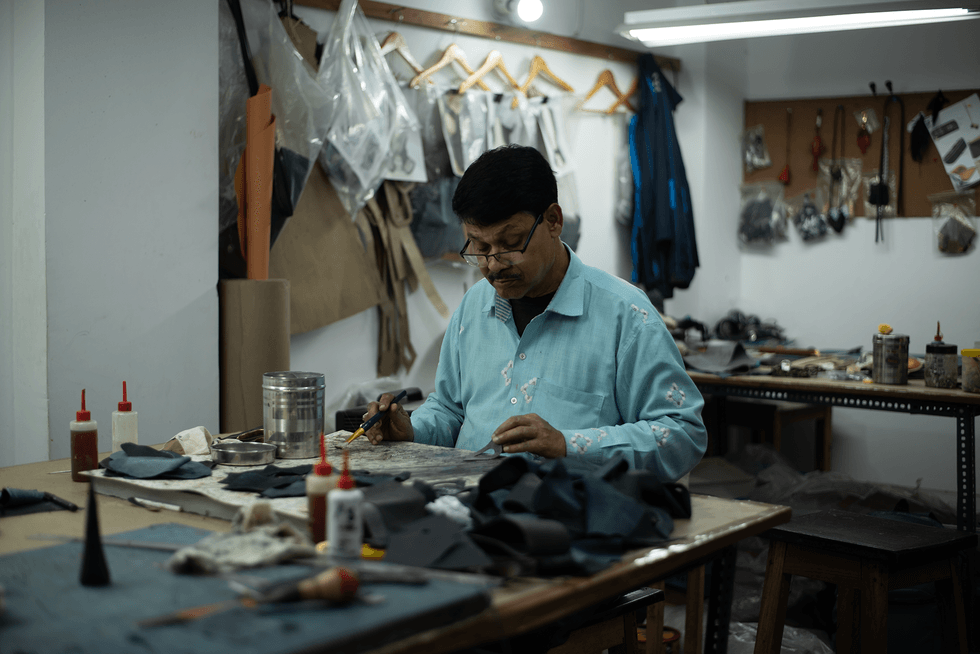
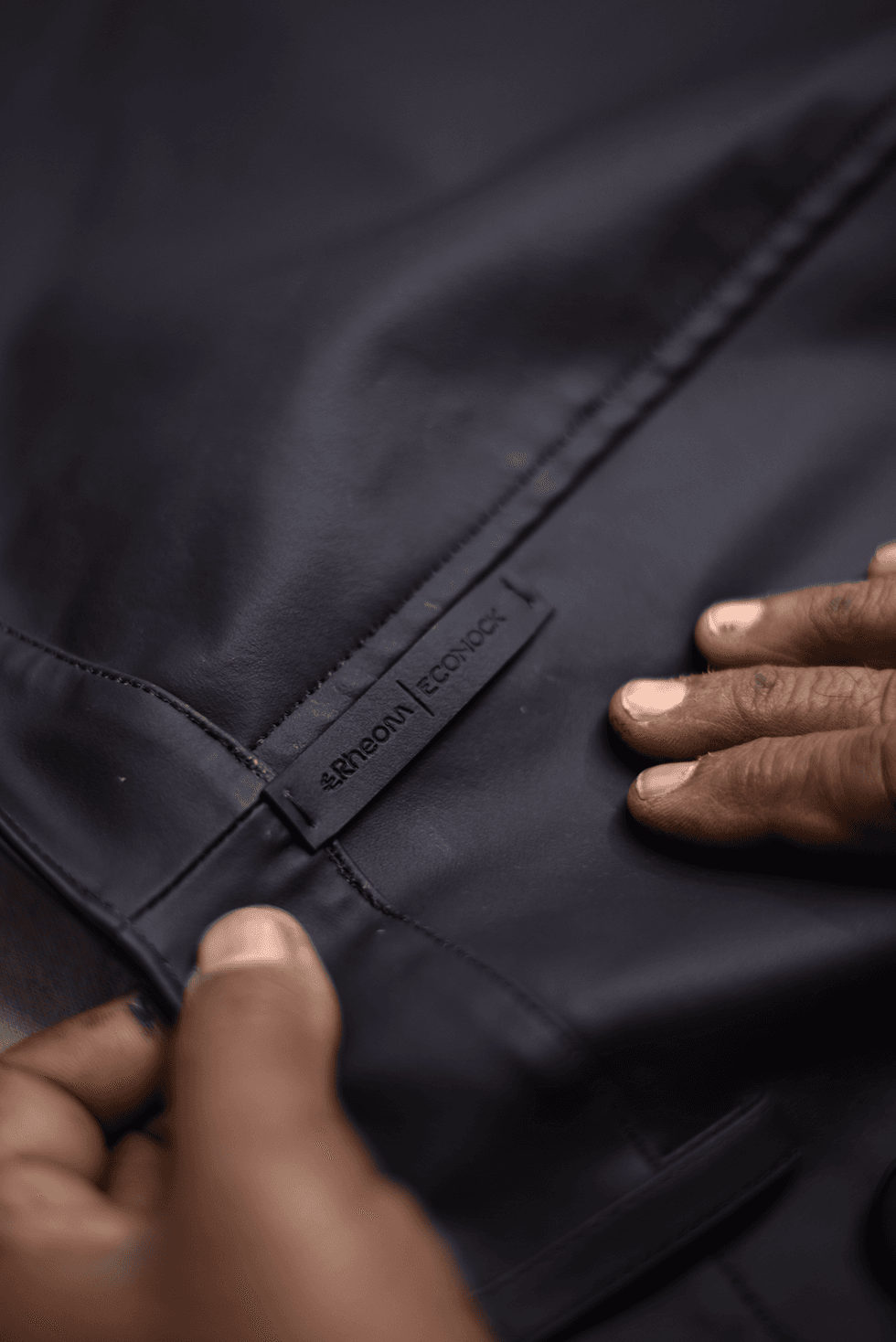
Rheom Materials turned heads in Milan this month with a collection centered around Shorai, its sugar-based leather alternative. Photo courtesy Rheom Materials.

Earlier this month, Houston-based Rheom Materials and India’s conscious design studio Econock unveiled a collaborative capsule collection that signaled more than just a product launch.

Hosted at Lineapelle—long considered the global epicenter of the world's premier leather supply chain—in the vaulted exhibition halls of Rho-Fiera Milano, the collection centered around Rheom’s 91 percent bio-based leather alternative, Shorai.

It was a bold move, one that shifted sustainability from a concept discussed in panel sessions to garments that buyers could touch and wear.

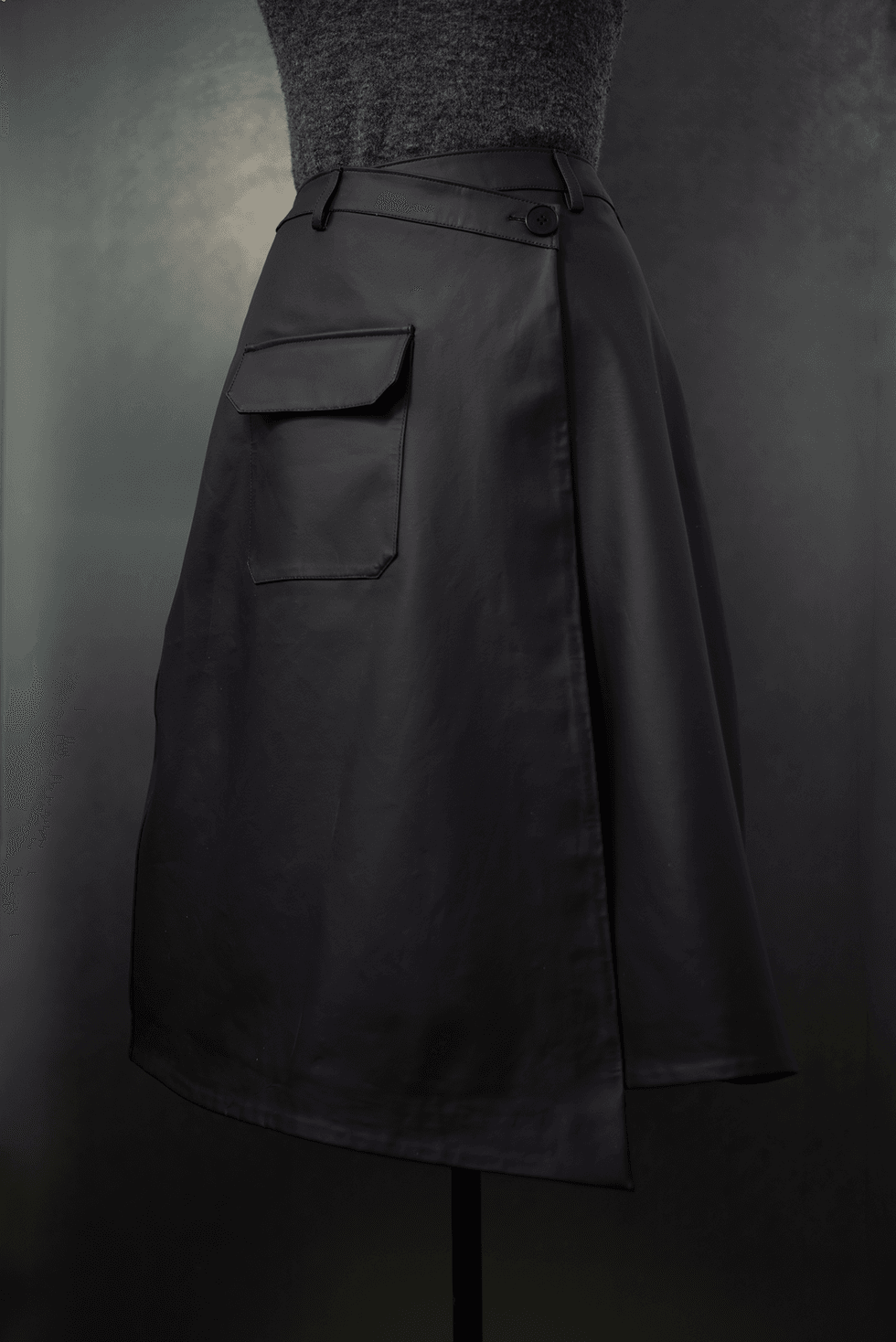
The collection featured a bomber-style jacket, an asymmetrical skirt and a suite of accessories—all fabricated from Shorai.

The standout piece, a sculptural jacket featuring a funnel neck and dual-zip closure, was designed for movement, challenging assumptions about performance limitations in bio-based materials. The design of the asymmetrical skirt was drawn from Indian armored warrior traditions, according to Rheom, with biodegradable corozo fasteners.

Built as a modular wardrobe rather than isolated pieces, the collection reflects a shared belief between Rheom and Econock in designing objects that adapt to daily life, according to the companies.

The collection was born out of a new partnership between Rheom and Econock, focused on bringing biobased materials to the market. According to Rheom, the partnership solves a problem that has stalled the adoption of many next-gen textiles: supply chain friction.

While Rheom focuses on engineering scalable bio-based materials, New Delhi-based Econock brings the complementary design and manufacturing ecosystem that integrates artisans, circular materials and production expertise to translate the innovative material into finished goods.

"This partnership removes one of the biggest barriers brands face when adopting next-generation materials,” Megan Beck, Rheom’s director of product, shared in a news release. “By reducing friction across the supply chain, Rheom can connect brands directly with manufacturers who already know how to work with Shorai, making the transition to more sustainable materials far more accessible.”

Sanyam Kapur, advisor of growth and impact at Econock, added: “Our partnership with Rheom Materials represents the benchmark of responsible design where next-gen materials meet craft, creativity, and real-world scalability.”

Rheom, formerly known as Bucha Bio, has developed Shorai, a sustainable leather alternative that can be used for apparel, accessories, car interiors and more; and Benree, an alternative to plastic without the carbon footprint. In 2025, Rheom was a finalist for Startup of the Year in the Houston Innovation Awards.

Shorai is already used by fashion lines like Wuxly and LuckyNelly, according to Rheom. The company scaled production of the sugar-based material last year and says it is now produced in rolls that brands can take to market with the right manufacturer.
Houston startup debuts leather alternative fashion collection in Milan
A team led by M.A.S.R. Saadi and Muhammad Maksud Rahman has developed a biomaterial that they hope could be used for the “next disposable water bottle." Photo courtesy Rice University.

Houston researchers develop strong biomaterial that could replace plastic

plastic problem

Collaborators from two Houston universities are leading the way in engineering a biomaterial into a scalable, multifunctional material that could potentially replace plastic.

The research was led by Muhammad Maksud Rahman, an assistant professor of mechanical and aerospace engineering at the University of Houston and an adjunct assistant professor of materials science and nanoengineering at Rice University. The team shared its findings in a study in the journal Nature Communications earlier this month. M.A.S.R. Saadi, a doctoral student in material science and nanoengineering at Rice, served as the first author.

The study introduced a biosynthesis technique that aligns bacterial cellulose fibers in real-time, which resulted in robust biopolymer sheets with “exceptional mechanical properties,” according to the researchers.

Biomaterials typically have weaker mechanical properties than their synthetic counterparts. However, the team was able to develop sheets of material with similar strengths to some metals and glasses. And still, the material was foldable and fully biodegradable.

To achieve this, the team developed a rotational bioreactor and utilized fluid motion to guide the bacteria fibers into a consistent alignment, rather than allowing them to align randomly, as they would in nature.

The process also allowed the team to easily integrate nanoscale additives—like graphene, carbon nanotubes and boron nitride—making the sheets stronger and improving the thermal properties.

“This dynamic biosynthesis approach enables the creation of stronger materials with greater functionality,” Saadi said in a release. “The method allows for the easy integration of various nanoscale additives directly into the bacterial cellulose, making it possible to customize material properties for specific applications.”

Ultimately, the scientists at UH and Rice hope this discovery could be used for the “next disposable water bottle,” which would be made by biodegradable biopolymers in bacterial cellulose, an abundant resource on Earth.

Additionally, the team sees applications for the materials in the packaging, breathable textiles, electronics, food and energy sectors.

“We envision these strong, multifunctional and eco-friendly bacterial cellulose sheets becoming ubiquitous, replacing plastics in various industries and helping mitigate environmental damage,” Rahman said the release.

---

This article originally appeared on our sister site, EnergyCapitalHTX.com.

Ad Placement 300x100
Ad Placement 300x600

CultureMap Emails are Awesome

This is the income required to be a middle class earner in Houston in 2026

Cashing In

A new study tracking the upper and lower thresholds for middle class households across the nation's largest cities has revealed Houstonians need to make at least a grand more than last year to maintain their middle class status this year.

According to SmartAsset's just-released annual report, "What It Takes to Be Middle Class in America – 2026 Study," Houston households need to make anywhere from $42,907 to $128,722 to qualify as middle class earners this year.

Compared to 2025, Houstonians need to make $1,153 more per year to meet the minimum threshold for a middle class status, whereas the upper bound has stretched $3,448 higher. The median income for a Houston household in 2024 was $64,361, the study added.

SmartAsset's experts used 2024 Census Bureau median household income data for the 100 biggest U.S. cities and all 50 states and determined middle class income ranges by using a variation of Pew Research's definition of a middle class household, stating the salary range is "two-thirds to double the median U.S. salary."

In the report's ranking of the U.S. cities with the highest household incomes needed to maintain a middle class status, Houston ranked No. 80.

In the report's state-by-state comparison, Texas has the 24th highest middle class income range. Overall, Texas households need to make between $53,147 and $159,442 to be labeled "middle class" in 2026. For additional context, the median income for a Texas household in 2024 came out to $79,721.

"Often, the expectations that come with the term 'middle class' include reaching home ownership, raising kids, the comfort of modest emergency funds and retirement savings, and the occasional splurge or vacation," the report said. "And as the median household income varies widely across the U.S. depending on the local job market, housing market, infrastructure and other factors, so does swing the bounds on what constitutes a middle class income in America."

What it takes to be middle class elsewhere around Texas

Two Dallas-Fort Worth suburbs – Frisco and Plano – have some of the highest middle class income ranges in the country for 2026, SmartAsset found.

Frisco households need to make between $96,963 and $290,888 to qualify as middle class this year, which is the third-highest middle class income range nationwide.

Plano's middle class income range is the eighth highest nationally, with households needing to make between $77,267 and $231,802 for the designation.

Salary range needed to be a middle class earner in other Texas cities:

  • No. 28 – Austin: between $60,287 and $180,860
  • No. 40 – Irving: between $56,566 and $169,698
  • No. 44 – Fort Worth: between $55,002 and $165,006
  • No. 57 – Garland: between $50,531 and $151,594
  • No. 60 – Arlington: between $49,592 and $148,77
  • No. 61 – Dallas: between $49,549 and $148,646
  • No. 73 – Corpus Christi: between $44,645 and $133,934
  • No. 77 – San Antonio: between $44,117 and $132,352
  • No. 83 – Lubbock: between $41,573 and $124,720
  • No. 84 – Laredo: between $41,013 and $123,038
  • No. 89 – El Paso: between $39,955 and $119,864
---

This article originally appeared on CultureMap.com.

Houston leads Texas with 7 new National Academy of Inventors senior members

top honor

The University of Houston is now home to seven new senior members of the National Academy of Inventors.

The distinction honors active faculty, scientists and administrators from NAI member institutions that have demonstrated innovation and produced technologies that have “brought, or aspire to bring, real impact on the welfare of society,” according to the NAI. The members have also succeeded in patents, licensing and commercialization, and educating and mentoring.

According to UH, its seven new members represent the largest group from any single Texas institution this year, bringing the university's total senior member count to 46.

UH faculty also represented three of Houston's four new senior members in 2025. Six Houstonians were also named to the NIA's class of fellows late last year.

“This recognition affirms what we see every day at the University of Houston—bold, collaborative innovation focused on improving lives," Ramanan Krishnamoorti, vice president of energy at UH, said in a news release. "Having seven faculty members named Senior Members reflects our momentum and a culture where discovery moves beyond the lab into solutions that strengthen communities and drive economic growth.”

UH’s new senior members include:

  • Haleh Ardebili, endowed professor of mechanical and aerospace engineering and assistant vice president for Entrepreneurship and Startup Ecosystem. Ardebili develops flexible lithium batteries and holds four patents
  • Vemuri Balakotaiah, distinguished university chair and professor of chemical and biomolecular engineering. Balakotaiah holds is patents, with five pending, and develops mathematical models for the clean energy research.
  • Jakoah Brgoch, professor of chemistry. Brgoch develops next-generation inorganic materials and holds four patents.
  • Jose L. Contreras-Vidal, distinguished professor in electrical and computer engineering and director of UH’s NSF neurotechnology research center. Conreras-Vidal develops brain-machine interface technologies. He holds five patents, with two technologies advancing through clinical trials.
  • Preethi Gunaratne, professor in the department of biology and biochemistry and director of the UH Sequencing Core in UH’s College of Natural Sciences and Mathematics. Gunaratne holds five patents in biology and energy technologies and has made significant large-scale genome discoveries.
  • Jae-Hyun Ryou, professor of mechanical and aerospace engineering. Ryou holds 13 patents and has develops innovative semiconductor materials and devices for flexible electronics.
  • Yingcai Zheng, professor in applied geophysics and director of the UH Rock Physics Lab. Zheng's work focuses on energy production, geothermal development and carbon management strategies. He holds two patents.

Other Texas institutions also had strong showings this year. Additional new Texas senior members from NAI institutions include:

Texas A&M University

  • Guillermo Aguilar
  • Stavros Kalafatis
  • Narendra Kumar
  • Heng Pan
  • Xingyong Song
  • Yubin Zhou

Texas State University

  • Bahram Asiabanpour
  • Martin Burtscher
  • Nihal Dharmasiri
  • Alexander Kornienko
  • Ted Lehr
  • Christopher Rhodes

The University of Texas at Arlington

  • Brian H. Dennis
  • Nicholas Gans
  • Frederick M. MacDonnell
  • Charles Philip Shelor
  • Liping Tang

The University of Texas at San Antonio

  • Robert De Lorenzo
  • Marc Feldman
  • Daohong Zhou

The University of Texas at El Paso

  • XiuJun Li
  • Yirong Lin
  • David Roberson

Texas Tech University Health Sciences Center

  • Thomas John Abbruscato
  • Annette Louise Sobel
  • Sanjay K. Srivastava

Texas Tech University

  • Gerardo Games
  • Dy Dinh Le

Baylor University

  • David Jack

The University of Texas Rio Grande Valley

  • Upal Roy

This year's class is the largest since the NAI launched its senior member recognition program in 2018. The new senior members come from 82 NAI institutions ad hoe more than over 2,000 U.S. patents. Accoring to the NAI, it has 945 senior members who hold more than 11,000 U.S. patents today.

“This year’s senior member class is a truly impressive cohort. These innovators come from a variety of fields and disciplines, translating their technologies into tangible impact,” Paul R. Sanberg, president of NAI, added in a news release. “I commend them on their incredible pursuits and I’m honored to welcome them to the Academy.”

The Senior Member Induction Ceremony will honor the 2026 class at NAI’s Annual Conference June 1-4 in Los Angeles.

Texas takes the No. 1 spot on new energy resilience report

Ranking It

A new report by mineral group Texas Royalty Brokers ranks Texas as the No. 1 most energy-resilient state.

The study focused on four main sources of electricity in hydroelectric dams, natural gas plants, nuclear reactors and petroleum facilities. Each state was given an Energy Resilience Score based on size and diversity of its power infrastructure, energy production and affordability for residents.

Texas earned a score of 71.3 on the report, outpacing much of the rest of the country. Pennsylvania came in at No. 2 with a score of 55.8, followed by New York (49.1) and California (48.4).

According to the report, Texas produces 11.7 percent of the country’s total energy, made possible by the state’s 141,000-megawatt power infrastructure—the largest in America.

Other key stats in the report for Texas included:

  • Per-capita consumption: 165,300 kWh per year
  • Per-capita expenditures: $5,130 annually
  • Total summer capacity: 141,200 megawatts

Despite recent failures in the ERCOT grid, including the 2021 power grid failure during Winter Storm Uri and continued power outages with climate events like 2024’s Hurricane Beryl that left2.7 million without power, Texas still was able to land No. 1 on an energy resilience list. Texas has had the most weather-related power outages in the country in recent years, with 210 events from 2000 to 2023, according to an analysis by the nonprofit Climate Central. It's also the only state in the lower 48 with no major connections to neighboring states' power grids.

Still, the report argues that “(Texas’ infrastructure) is enough to provide energy to 140 million homes. In total, Texas operates 732 power facilities with over 3,000 generators spread across the state, so a single failure can’t knock out the entire grid here.”

The report acknowledges that a potential problem for Texas will be meeting the demands of AI data centers. Eric Winegar, managing partner at Texas Royalty Brokers, warns that these projects consume large amounts of energy and water.

According to another Texas Royalty Brokers report, Texas has 17 GPU cluster sites across the state, which is more than any other region in the United States. GPUs are specialized chips that run AI models and perform calculations.

"Energy resilience is especially important in the age of AI. The data centers that these technologies use are popping up across America, and they consume huge amounts of electricity. Some estimates even suggest that AI could account for 8% of total U.S. power consumption by 2030,” Winegar commented in the report. “We see that Texas is attracting most of these new facilities because it already has the infrastructure to support them. But we think the state needs to keep expanding capacity to meet growing demand."

---

This article originally appeared on EnergyCapitalHTX.com.