


Construction is underway on the sustainable 3D-printed community. Courtesy of Cole Klein Builders

Houston is putting itself front-and-center to help make sustainable, affordable housing a reality for 80 homeowners in an innovative scalable housing community. Developer Cole Klein Builders has partnered with HiveASMBLD to pioneer what’s touted as the world’s first large-scale, one-of-a-kind, affordable housing development using 3D printing technology — merging robotics, design, and sustainability.

Located across from Sterling Aviation High School, near Hobby Airport, Zuri Gardens will offer 80 two-bedroom, two-bathroom homes of approximately 1,360 square feet, situated in a park-like setting that includes walking trails and a community green space.

Homes in Zuri Gardens will hit the market in early summer of 2026. Final pricing has yet to be determined, but Cole Klein Builders expects it to be in the mid-to-high 200s.

Interestingly, none of the homes will offer garages or driveways, which the developer says will provide a cost savings of $25,000-$40,000 per home. Instead of parking for individual units, 140 parking spaces will be provided.

Each two-story home is comprised of a ground floor printed by HiveASMBLD, using a proprietary low-carbon cement alternative by Eco Material Technologies that promises to enhance strength and reduce CO2 emissions. The hybrid homes will have a second floor built using engineered wood building products by LP Building Solutions. Overall, the homes are designed to be flood, fire, and possibly even tornado-proof.

The "Zuri" in Zuri Gardens is the Swahili word for “beautiful,” a choice that is fitting considering that the parks department will be introducing a five acre park to the project — with 3D-printed pavilions and benches — plus, a three-acre farm is located right across the street. The Garver Heights area is classified as a food desert, which means that access to fresh food is limited. Residents will have access to the farm’s fresh produce, plus opportunities to participate in gardening and nutrition workshops.
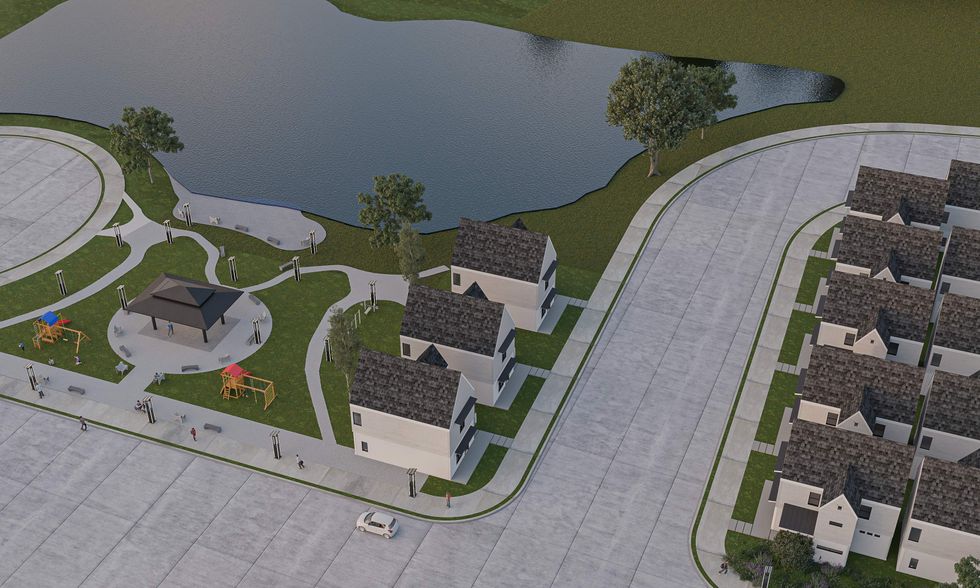
zuri gardens 3d-printed housing community First large-scale affordable housing project of 3D-printed homes rises in Houston Zuri Gardens is getting closer to completion. Courtesy rendering

Cole Klein Builders created Zuri Gardens in partnership with the Houston Housing Community Development Department, who provided infrastructure reimbursements for the roads, sewer lines, and water lines. In return, CKB agreed to push the purchase prices for the homes as low as possible.

Zuri Gardens also received $1.8 million dollars from the Uptown Tourism Bond, 34 percent of which must be used with minority-owned small businesses. Qualified buyers must fit a certain area of median income according to HUD guidelines, and homes must be owner-occupied at all times. Zuri Gardens already has an 800-person waitlist.

“They’re trying to bridge that gap to make sure there is a community for the homebuyers who need it — educators, law enforcement, civil workers, etc.,” Cole Klein Builders’ co-principal Vanessa Cole says. “You have to go through a certification process with the housing department to make sure that your income is in alignment for this community. It has been great, and everyone has been really receptive.”

Cole has also brought insurance underwriters to visit the site and to help drive premiums below regular rates for Houston homeowners, as claim risks for one of the 3D homes are extremely low.

Tim Lankau, principal at HiveASMBLD, notes that the 3D hybrid design allows for a more traditional appearance, while having the benefits of a concrete structure: “That’s where the floodwaters would go, that’s where you can hide when there’s a tornado, and that’s where termites would eat. So you get the advantages of it while having a traditionally-framed second floor.”

It’s important to note that Zuri Gardens is not located in a flood prone area, nor did it flood during Hurricane Harvey — being flood-proof is merely a perk of a cement house. The concrete that Eco Material Technologies developed is impervious. The walls are printed into hollow forms, which house rebar, plumbing, and accessible conduits for things like electrical lines and smart house features. Those walls are then filled with a foamcrete product that expands to form a “monolithic concrete wall.”

David McNitt, of Eco Material Technologies, explains that his proprietary concrete is made of PCV, and contains zero Portland cement. Instead, McNitt’s cement is made from coal ash and is 99 percent green (there are a few chemicals added to the ash). Regardless, it’s made from 100 percent waste products.

“This is a product that has really been landfilled before,” says McNitt. “It’s coal ash, and it’ll set within 8-10 minutes. It’s all monolithic, and one continuous pour — it’s literally all one piece.”

Eco Material Technologies’ concrete product is impressively durable. A traditional cinderblock wall will crush at around 800 psi, while this material crushes at about 8,000 psi.

“It’s ten times stronger than a cinderblock wall that can withstand hurricanes,” claims McNitt. “I don’t think you’d even notice a hurricane. It’ll be really quiet inside, too — so you won’t get interrupted during your hurricane party. It’s way over-engineered, it really is.”

The second story is built using weatherproof and eco-friendly products by LP Building Solutions. Their treated, engineered wood products come with a 50 year warranty, and their radiant barrier roof decking product blocks 97% of UV rays, and keeps attic temperatures 30° cooler than traditional building materials. These materials, combined with the concrete first floor, will keep heating and cooling costs low — something the folks at HiveASMBLD refer to as “thermal mass performance.”

---

This article originally appeared on CultureMap.com.

Ad Placement 300x100
Ad Placement 300x600

CultureMap Emails are Awesome

Houston hospitals win $50M grant for ibogaine addiction treatment research

ibogaine funding

The Texas Health and Human Services Commission has awarded $50 million to UTHealth Houston in collaboration with The University of Texas Medical Branch at Galveston (UTMB Health) to co-lead a multicenter research trial to evaluate the effect of ibogaine, a powerful psychoactive compound, on patients suffering from addiction, traumatic brain injury and other behavioral health conditions.

The funding will establish a two-year initiative—known as Ibogaine Medicine for PTSD, Addiction, and Cognitive Trauma (IMPACT)—and a consortium of Texas health institutions focused on clinical trials and working toward potential FDA-approved treatments.

The consoritum will also include Texas Tech University, Texas Tech University Health Sciences Center El Paso, The University of Texas at Austin, The University of Texas Health Science Center at San Antonio, The University of Texas at Tyler, The University of Texas Rio Grande Valley, Texas A&M University, The University of North Texas Health Science Center, Baylor College of Medicine and JPS Health Network in Dallas.

Ibogaine is a plant-based, psychoactive substance derived from the iboga shrub. Research suggests that the substance could be used for potential treatment for patients with traumatic brain injuries, which is a leading cause of post-traumatic stress disorders. Ibogaine has also shown potential as a treatment for addiction and other neurological conditions.

UTHealth and partners will focus on ways that ibogaine can treat addiction and associated conditions. Meanwhile, UT Austin and Baylor College of Medicine will concentrate on using it to treat traumatic brain injury, especially in veterans, according to a news release from the institutions.

The consortium will also support drug developers and teaching hospitals to conduct FDA-approved clinical trials. The Texas Health and Human Services Commission will oversee the grant program.

“This landmark clinical trial reflects our unwavering commitment to advancing research that improves lives and delivers the highest standards of care,” Dr. Melina Kibbe, UTHealth Houston president and the Alkek-Williams Distinguished Chair, said in the news release. “By joining forces with outstanding partners across our state, we are building on Texas’ tradition of innovation to ensure patients struggling with addiction and behavioral health conditions have access to the best possible outcomes. Together, we are shaping discoveries that will serve Texans and set a model for the nation.”

The consortium was authorized by the passage of Senate Bill 2308. The bill provides $50 million in state-matching funds for an ibogaine clinical trial managed by a public university in partnership with a drug company and a hospital.

“This is the first major step towards the legislature’s goal of obtaining FDA approval through clinical trials of ibogaine — a potential breakthrough medication that has brought thousands of America’s war-fighters back from the darkest parts of depression, anxiety, PTSD, and chronic addiction,” Texas Rep. Cody Harris added in the release. “I am excited to walk alongside UTHealth Houston and UTMB as these stellar institutions lead the nation in a first-of-its-kind clinical trial in the U.S.”

Recently, the University of Houston also received a $2.6 million gift from the estate of Dr. William A. Gibson to support and expand its opioid addiction research, which includes the development of a fentanyl vaccine that could block the drug's ability to enter the brain. Read more here.

Tesla no longer world's biggest EV maker as sales fall for second year

Tesla Talk

Tesla lost its crown as the world’s bestselling electric vehicle maker as a customer revolt over Elon Musk’s right-wing politics, expiring U.S. tax breaks for buyers and stiff overseas competition pushed sales down for a second year in a row.

Tesla said that it delivered 1.64 million vehicles in 2025, down 9% from a year earlier.

Chinese rival BYD, which sold 2.26 million vehicles last year, is now the biggest EV maker.

It's a stunning reversal for a car company whose rise once seemed unstoppable as it overtook traditional automakers with far more resources and helped make Musk the world's richest man. The sales drop came despite President Donald Trump's marketing effort early last year when he called a press conference to praise Musk as a “patriot” in front of Teslas lined up on the White House driveway, then announced he would be buying one, bucking presidential precedent to not endorse private company products.

For the fourth quarter, Tesla sales totaled 418,227, falling short of even the much reduced 440,000 target that analysts recently polled by FactSet had expected. Sales were hit hard by the expiration of a $7,500 tax credit for electric vehicle purchases that was phased out by the Trump administration at the end of September.

Tesla stock fell 2.6% to $438.07 on Friday.

Even with multiple issues buffeting the company, investors are betting that Tesla CEO Musk can deliver on his ambitions to make Tesla a leader in robotaxi services and get consumers to embrace humanoid robots that can perform basic tasks in homes and offices. Reflecting that optimism, the stock finished 2025 with a gain of approximately 11%.

The latest quarter was the first with sales of stripped-down versions of the Model Y and Model 3 that Musk unveiled in early October as part of an effort to revive sales. The new Model Y costs just under $40,000 while customers can buy the cheaper Model 3 for under $37,000. Those versions are expected to help Tesla compete with Chinese models in Europe and Asia.

For fourth-quarter earnings coming out in late January, analysts are expecting the company to post a 3% drop in sales and a nearly 40% drop in earnings per share, according to FactSet. Analysts expect the downward trend in sales and profits to eventually reverse itself as 2026 rolls along.

Musk said earlier last year that a “major rebound” in sales was underway, but investors were unruffled when that didn't pan out, choosing instead to focus on Musk's pivot to different parts of business. He has has been saying the future of the company lies with its driverless robotaxis service, its energy storage business and building robots for the home and factory — and much less with car sales.

Tesla started rolling out its robotaxi service in Austin in June, first with safety monitors in the cars to take over in case of trouble, then testing without them. The company hopes to roll out the service in several cities this year.

To do that successfully, it needs to take on rival Waymo, which has been operating autonomous taxis for years and has far more customers. It also will also have to contend with regulatory challenges. The company is under several federal safety investigations and other probes. In California, Tesla is at risk of temporarily losing its license to sell cars in the state after a judge there ruled it had misled customers about their safety.

“Regulatory is going to be a big issue,” said Wedbush Securities analyst Dan Ives, a well-known bull on the stock. “We're dealing with people's lives.”

Still, Ives said he expects Tesla's autonomous offerings will soon overcome any setbacks.

Musk has said he hopes software updates to his cars will enable hundreds of thousands of Tesla vehicles to operate autonomously with zero human intervention by the end of this year. The company is also planning to begin production of its AI-powered Cybercab with no steering wheel or pedals in 2026.

To keep Musk focused on the company, Tesla’s directors awarded Musk a potentially enormous new pay package that shareholders backed at the annual meeting in November.

Musk scored another huge windfall two weeks ago when the Delaware Supreme Court reversed a decision that deprived him of a $55 billion pay package that Tesla doled out in 2018.

Musk could become the world's first trillionaire later this year when he sells shares of his rocket company SpaceX to the public for the first time in what analysts expect would be a blockbuster initial public offering.

8+ can't-miss Houston business and innovation events in January

where to be

Editor's note: Kick off 2026 by hearing insightful talks and making meaningful connections in Houston's innovation scene. From networking workshops to presentations from major industry leaders, here's what not to miss and how to register. Please note: this article may be updated to include additional event listings.

Jan. 13 – Financing the Future

Hear from James Blake, head of capital markets at Fervo Energy, in this informative talk. Blake will cover the current investment landscape for geothermal power, how geothermal projects are structured and the role of policy incentives and innovative financing models in moving the industry forward. A small reception follows.

This event is Tuesday, Jan. 13, from 5:30-7:30 p.m. at the Ion. Register here.

Jan. 13 – Your Path to the Boardroom

Visit Sesh Coworking to hear from Keith Dorsey, an executive advisor and author of The Boardroom Journey, as he shares insights and lessons from hundreds of corporate board members and presents an actionable roadmap for women at every stage of their careers. Dorsey will speak on what "optimal diversity” means in the boardroom, how purpose-driven leaders sustain resilience under relentless pressure and why inclusive leadership is non-negotiable for growth and innovation.

This event is Tuesday, Jan. 13, from 6-8 p.m. at Sesh Coworking. Register here.

Jan. 14 — A Conversation with Dr. Wayne J. Riley on Leading Through Healthcare Transformation

Rice Business Partners will host Dr. Wayne J. Riley, president of SUNY Downstate Health Sciences University, for a moderated discussion with Dean Peter Rodriguez. Riley will share insights on leading complex healthcare organizations in an era of unprecedented industry challenges and reflect on his time at the Jones Graduate School of Business.

This event is Wednesday, Jan. 14, from 6:30-8:30 p.m. at McNair Hall on Rice University's campus. Register here.

Jan. 14 — VDW: Igniting Connections for Startup Success

Entrepreneurial communications instructor Diana Massaro will lead Lilie's latest Venture Development Workshop, focused on soft skills like clear communication, active listening and compelling introductions. Attendees will gain a personalized networking game plan and communication tools to turn casual encounters into meaningful relationships to support their ventures or careers.

This event is Wednesday, Jan. 14, from 6-7:30 p.m. at the Liu Idea Lab for Innovation and Entrepreneurship on Rice University's campus. Register here.

Jan. 21 — Upstream: Digital Tech Meetup

This month's Upstream: Digital Tech Meetup will explore how AI and real-time monitoring are being applied in safety-critical offshore environments, what’s working today, where the biggest gaps remain going into 2026 and how operators and service companies are approaching adoption. Expect to hear from leaders at NOV, Incom Solutions, Timbergrove and others.

This event is Wednesday, Jan. 21, from 8:30-10:30 a.m. at the Ion. Find more information here.

Jan. 22 — HEAD AND HEART: Leading Technology with Humanity While Everything Changes

Hear from Chris Hyams, former CEO of Indeed, at the latest installment of Rice's Master of Engineering Management & Leadership Seminar Series. Hyams will present on the intersection of technology, humanity and change—and how AI is reshaping all three.

This event is Thursday, Jan. 22, at 6 p.m. at Duncan Hall on Rice University's campus. Find more information here.

Jan. 22 – NASA Tech Talk

This month's NASA Tech Talks will feature a special delegation from the UK Science and Technology Network. Expect to hear from a panel of UK space experts, followed by a fireside chat featuring David Alexander, head of the Rice Space Institute, and Meganne Christian, ESA reserve astronaut and senior exploration manager.

This event is Thursday, Jan. 22, from 6-7 p.m. at the Ion. Find more information here.

Jan. 29 – Ignition Hub Startup Career Fair

Lilie will host the Ignition Hub Startup Career Fair this month in partnership with Rice University’s Center for Career Development and Career Development Office. The fair will bring together some of the most innovative, high-growth companies to offer Rice students exciting opportunities. Startups can apply to be considered for the fair. The event is open to Rice University undergraduate, graduate, MBA, and PhD students.

This event is Thursday, Jan. 29, at Grand Hall on Rice University's campus. Find more information here.

Jan. 29 – Health Policy Symposium: Value-Based Care & the Health Care Workforce

The Humana Integrated Health Systems Science Institute at the University of Houston will host its latest Health Policy Symposium this month, focused on the evolving landscape of value-based care and the importance of preparing and strengthening the health care workforce. Hear keynote addresses from leaders at Humana, UH, the American Medical Association and Houston Health Department.

This event is Thursday, Jan. 29, from 11:30 a.m.-1:30 p.m. at the Tilman J. Fertitta Family College of Medicine on Rice University's campus. Find more information here.

Jan. 30 — GHP Annual Meeting

The Greater Houston Partnership's premier event will highlight the region’s progress, honor visionary leadership and set the tone for the year ahead. Hear reflections from outgoing board chair, Gretchen Watkins (former -president of Shell USA); welcome incoming board chair, Armando Perez (EVP of H-E-B Houston); and more

This event is Friday, Jan. 30, from 11:30 a.m.-1:30 p.m. at Hilton Americas. Find more information here.