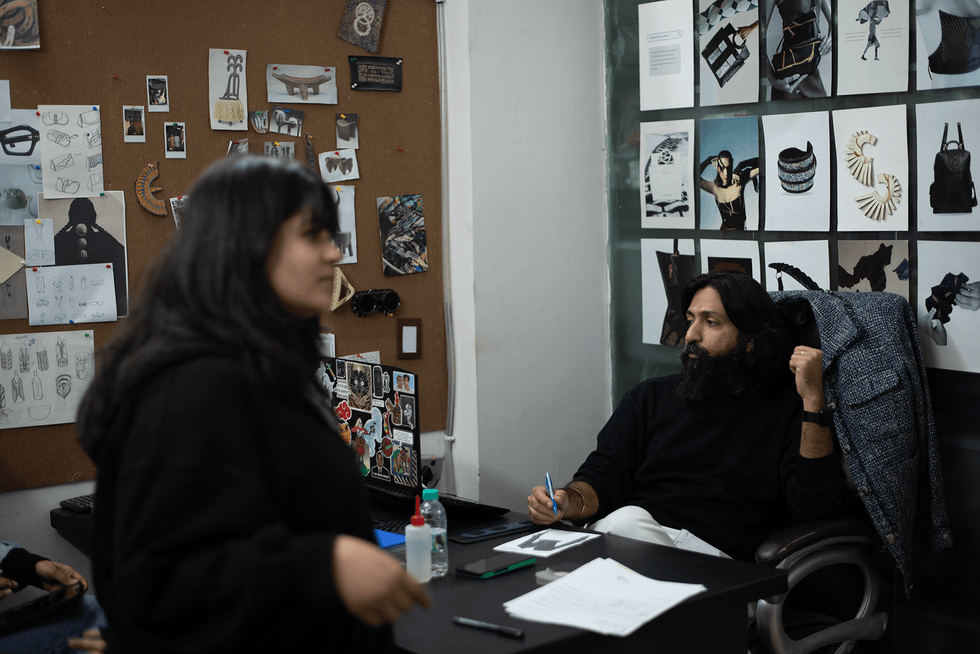
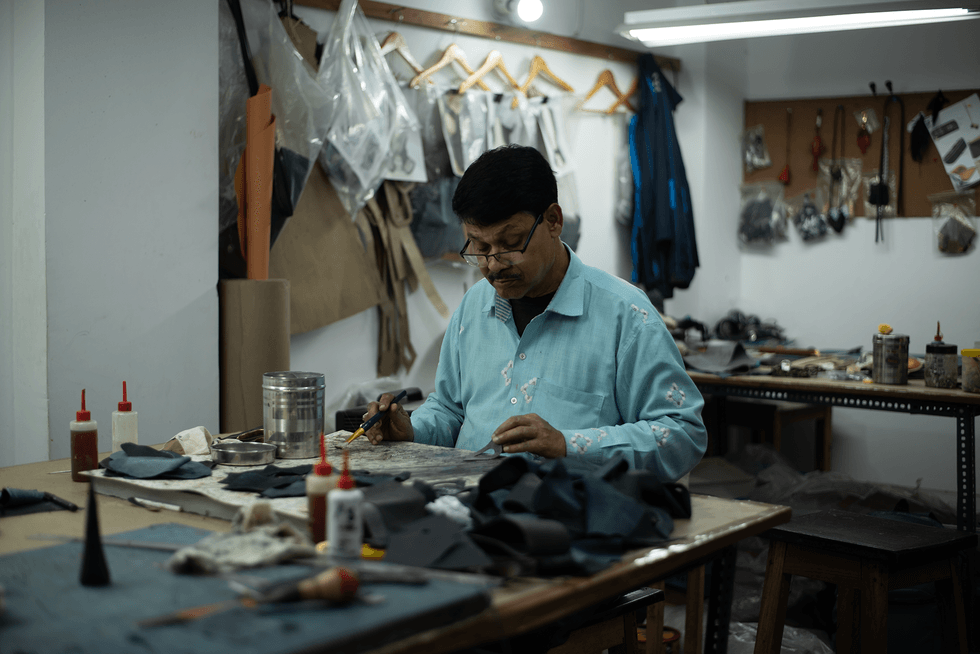
Rheom Materials turned heads in Milan this month with a collection centered around Shorai, its sugar-based leather alternative. Photo courtesy Rheom Materials.

Earlier this month, Houston-based Rheom Materials and India’s conscious design studio Econock unveiled a collaborative capsule collection that signaled more than just a product launch.

Hosted at Lineapelle—long considered the global epicenter of the world's premier leather supply chain—in the vaulted exhibition halls of Rho-Fiera Milano, the collection centered around Rheom’s 91 percent bio-based leather alternative, Shorai.

It was a bold move, one that shifted sustainability from a concept discussed in panel sessions to garments that buyers could touch and wear.

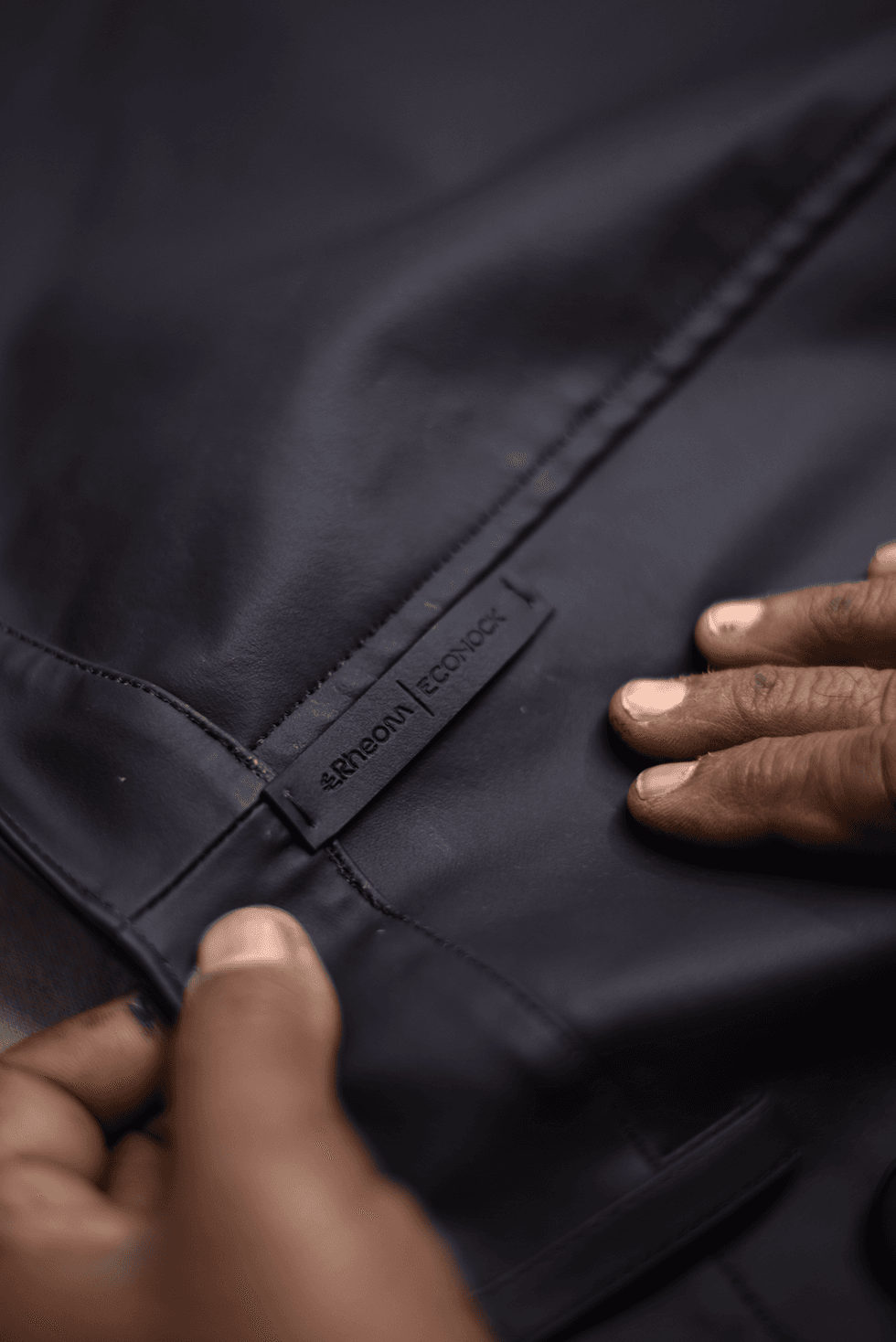
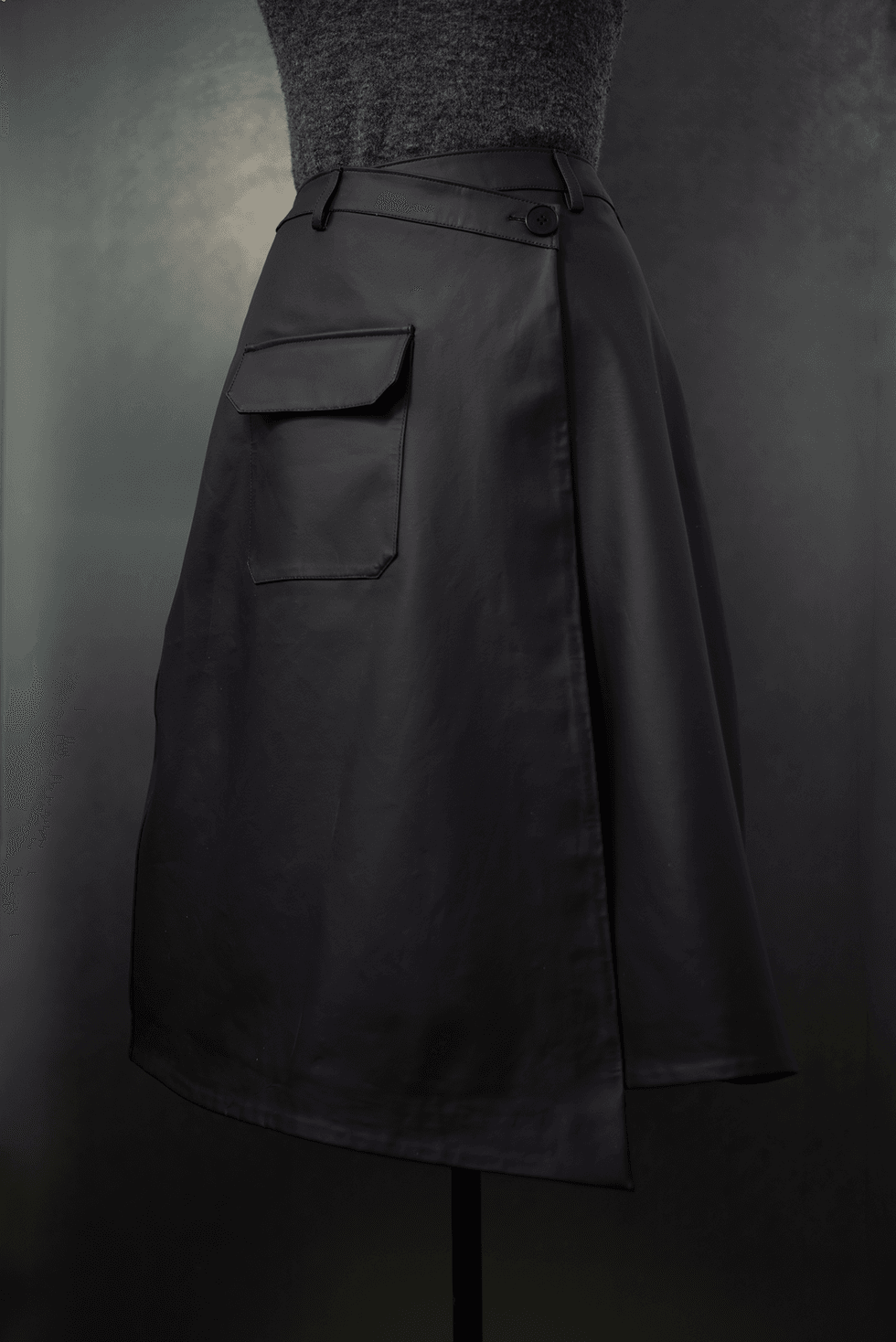
The collection featured a bomber-style jacket, an asymmetrical skirt and a suite of accessories—all fabricated from Shorai.

The standout piece, a sculptural jacket featuring a funnel neck and dual-zip closure, was designed for movement, challenging assumptions about performance limitations in bio-based materials. The design of the asymmetrical skirt was drawn from Indian armored warrior traditions, according to Rheom, with biodegradable corozo fasteners.

Built as a modular wardrobe rather than isolated pieces, the collection reflects a shared belief between Rheom and Econock in designing objects that adapt to daily life, according to the companies.

The collection was born out of a new partnership between Rheom and Econock, focused on bringing biobased materials to the market. According to Rheom, the partnership solves a problem that has stalled the adoption of many next-gen textiles: supply chain friction.

While Rheom focuses on engineering scalable bio-based materials, New Delhi-based Econock brings the complementary design and manufacturing ecosystem that integrates artisans, circular materials and production expertise to translate the innovative material into finished goods.

"This partnership removes one of the biggest barriers brands face when adopting next-generation materials,” Megan Beck, Rheom’s director of product, shared in a news release. “By reducing friction across the supply chain, Rheom can connect brands directly with manufacturers who already know how to work with Shorai, making the transition to more sustainable materials far more accessible.”

Sanyam Kapur, advisor of growth and impact at Econock, added: “Our partnership with Rheom Materials represents the benchmark of responsible design where next-gen materials meet craft, creativity, and real-world scalability.”

Rheom, formerly known as Bucha Bio, has developed Shorai, a sustainable leather alternative that can be used for apparel, accessories, car interiors and more; and Benree, an alternative to plastic without the carbon footprint. In 2025, Rheom was a finalist for Startup of the Year in the Houston Innovation Awards.

Shorai is already used by fashion lines like Wuxly and LuckyNelly, according to Rheom. The company scaled production of the sugar-based material last year and says it is now produced in rolls that brands can take to market with the right manufacturer.
Houston startup debuts leather alternative fashion collection in Milan
Ad Placement 300x100
Ad Placement 300x600

CultureMap Emails are Awesome

European spacecraft developer expands to Houston with U.S. business, new lab

houston hq

European aerospace manufacturer The Exploration Company has established its first U.S. entity and named Space City as its headquarters.

The company announced earlier this month that it has launched TEC Federal to support U.S. government customers and agencies, and to scale The Exploration Company's engineering operations in the country.

Mark Kirasich serves as president of TEC Federal. Kirasich most recently served as the senior director of human spaceflight at Blue Origin after a nearly 40-year career at NASA.

The Exploration Company is developing the reusable Nyx space vehicle. Nyx is designed to take off from any heavy launcher in the world. It will then dock at space stations, retrieve up to 3,000 kilograms of cargo, splash down and return the cargo to Earth. The company aims to make Nyx fully reusable for up to 10 missions, making it a more affordable and sustainable option for aerospace missions.

The Exploration Company completed a successful drop test of the spacecraft in May in the Mojave Desert. The company says Nyx is slated to perform its first flight demonstration in 2028.

In addition to launching the Houston business, The Exploration Company also opened its new Rapid Innovation Lab near Houston's NASA Johnson Space Center on Space Park Drive.

The Exploration Company opened its Rapid Innovation Lab earlier this month. Photo via LinkedIn

The Rapid Innovation Lab features a full-scale mockup of the future Nyx crew capsule as well as ongoing development and testing of the Nyx cargo capsule, according to the company.

The Exploration Company says the new lab will allow its engineers, designers, and operators to prototype and test crew interfaces. It will also support partnerships with NASA personnel and astronauts.

“Houston gives us direct access to the people and expertise that have built and operated human spaceflight systems for decades. We’re excited to invest and expand around that— engineers, operators, and astronauts working together and moving quickly towards building a crew capsule.” Hélène Huby, founder and CEO of The Exploration Company, said in a blog post.

According to The Houston Chronicle, The Exploration Company has about 30 employees in the Houston area.

The company was founded in 2021 by Huby, a French rocket scientist, and has raised more than $350 million in venture capital. It operates out of Germany, France, Luxembourg, Spain and Italy, with offices in the U.S. and the United Arab Emirates. It is also developing a reusable, high-thrust rocket engine known as Storm.

UH lands $4M NIH grant to study early signs of autoimmune disease

NIH funding

The University of Houston recently received a $4 million National Institutes of Health grant to support a 10-year longitudinal study to identify the earliest biological markers of autoimmune disease.

Led by Chandra Mohan, the Hugh Roy and Lillie Cranz Cullen Endowed Professor of Biomedical Engineering, the study aims to examine what causes Systemic Autoimmune Rheumatic Diseases (SARDs) and to identify targets for future treatments. The study will be carried out in collaboration with Dr. Karen Costenbader at Harvard Medical School, Boston.

SARDs include conditions like rheumatoid arthritis, systemic lupus erythematosus, Sjögren’s syndrome and systemic sclerosis—all are considered chronic diseases currently without a cure. Autoimmune diseases affect over 30 million people globally, according to UH.

SARDs occur when the body’s immune system attacks healthy, non-threatening tissues and organs. According to UH, in these diseases, the body often attacks nuclear antigens, creating anti-nuclear autoantibodies, which can be early detection signs for SARDs in more than 50 percent of patients, Mohan says.

Researchers will study blood samples and environmental exposure over the 10 years to better understand anti-nuclear autoantibodies.

“Collectively, these studies will help identify the genetic, environmental and cellular factors that are operative at the two steps of SARD development, namely the emergence of anti-nuclear autoantibodies and disease onset,” Mohan said in a news release. “ More importantly, these studies will highlight functional molecular pathways and mechanisms that may be operative at each step."

Mohan predicts that looking at SARDs’ shared characteristics, rather than each disease individually, could help identify more treatment methods.

“Individual SARDs have been examined in silos without an attempt to discern shared underlying features at the molecular level,” he added in the release. “Current understanding of the initial (and likely shared) origins of SARDs is only rudimentary but urgently needed to develop means for prevention and treatment.”

Earlier this year, UH also received an $11 million NIH grant to conduct a first-of-its-kind study of early language development in children ages 18 to 24 months. Read more here.