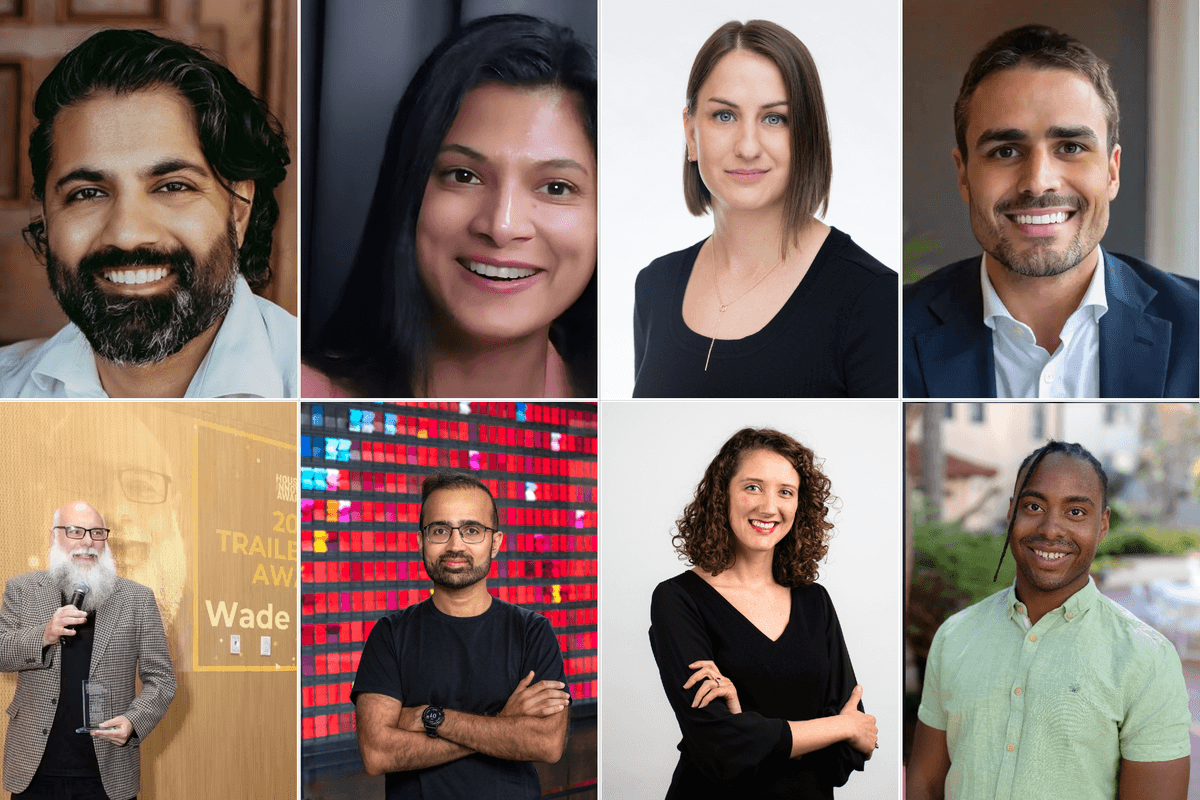
Volunteers pictured at the Columbia Tap Trail in Third Ward. Photo by Cindy Torres

The FIFA World Cup 2026 Houston Host Committee has announced new details about its massive Green Corridor project, including the many improvements that will outlast the iconic sporting event taking place in Houston this summer.

The Green Corridor will be a 14-mile long verdant artery connecting multiple major landmarks in Houston through safe, walkable paths that include shade trees and other improvements. First conceived in 2024 by the Sustainability Subcommittee led by Elizabeth Carlson, it will unite East Downtown, Downtown, Midtown, the Museum District, and Third Ward through a hike and bike trail as well as METRO Rail stops. Though the Green Corridor is beginning its life as a showcase for the city to visitors attending the FIFA World Cup June 14 -July 4, it will remain a permanent installation for Houstonians to travel the city without cars.

Management of the project is being handled by Impact Houston 26, a portion of the Host Committee empowered by the Harris County-Houston Sports Authority’s Sports Authority Foundation to promote long-term benefits to the city after the World Cup. Funding partners include private corporations as well as civic organizations such as the City of Sugar Land and Rice University.

“The Green Corridor reflects what Impact Houston 26 is all about, using the FIFA World Cup as a catalyst to deliver lasting environmental benefits for our city,” Carlson said in a statement. “Through Impact Houston’s pillar on sustainability, we’re able to collaborate with local stakeholders to create not just demonstrations of resilience and innovation but education and engagement in the community, a meaningful legacy long after 2026.”

The corridor will provide access to both Houston Stadium (also known as NRG Stadium) and the FIFA Fan Festival, as well as improve existing paths like the Columbia Tap Trail in Third Ward. These improvements include the installation of shade structures, native plantings, expanding the tree canopy, air quality monitoring devices, and water and bike repair stations.

Impact Houston 26 is also working with local institutions like the Houston Zoo, Greentown Labs, and Discovery Green to install various educational materials along the Green Corridor.
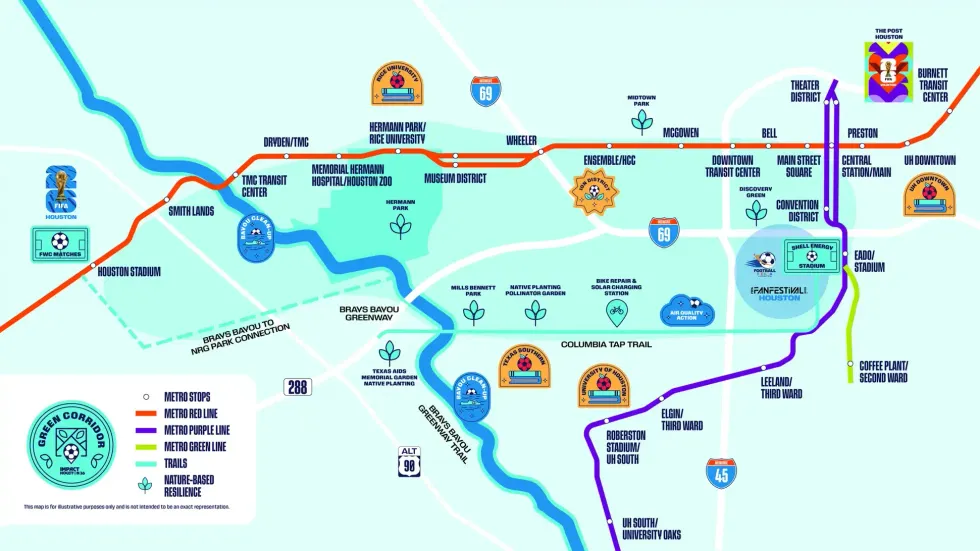
The Green Corridor initiative.Courtesy rendering

Below is a breakdown of other improvements planned or completed as part of the Green Corridor.

  • Downtown Houston Main Street Promenade: Four permanent shade structures, native plants, and expanding the tree canopy by 154% to be implemented by May 2026. Further shade structures and plantings planned for Texas Avenue.
  • East Downtown Management District: Native tree plantings and landscaping in and around the FIFA Fan Festival site to improve first/last mile connectivity around the Green Corridor.
  • Columbia Tap Trail: Installation of 325 solar lights.
  • Stadium Park/Astrodome and TMC/Dryden plus Fannin South Transit Center: Various landscaping and safety enhancements.
  • Midtown Houston: $1.5 million in landscaping and beautification along the Red Line, including over 80 trees, native plantings, water stations, waste receptacles, crosswalk improvements, and public art installations.

The Green Corridor is only one of the World Cup Host Committee's sustainability initiatives. In January, it announced the "New Year, New Hou" program that provides hospitality businesses such as restaurants and hotels with one of three certifications.

---

This article originally appeared on CultureMap.com.

The new AI Native Dual-Use Sports, Health & Wellness Accelerator is expected to launch in March. Photo courtesy of the Ion

New accelerator for AI startups to launch at Houston's Ion this spring

The Collectiv Foundation and Rice University have established a sports, health and wellness startup accelerator at the Ion District’s Collectiv, a sports-focused venture capital platform.

The AI Native Dual-Use Sports, Health & Wellness Accelerator, scheduled to formally launch in March, will back early-stage startups developing AI for the sports, health and wellness markets. Accelerator participants will gain access to a host of opportunities with:

  • Mentors
  • Advisers
  • Pro sports teams and leagues
  • University athletics programs
  • Health care systems
  • Corporate partners
  • VC firms
  • Pilot projects
  • University-based entrepreneurship and business initiatives

Accelerator participants will focus on sports tech verticals inlcuding performance and health, fan experience and media platforms, data and analytics, and infrastructure.

“Houston is quickly becoming one of the most important innovation hubs at the intersection of sports, health, and AI,” Ashley DeWalt, co-founder and managing partner of The Collectiv and founder of The Collectiv Foundation, said in a news release.

“By launching this platform with Rice University in the Ion District,” he added, “we are building a category-defining acceleration engine that gives founders access to world-class research, global sports properties, hospital systems, and venture capital. This is about turning sports-validated technology into globally scalable companies at a moment when the world’s attention is converging on Houston ahead of the 2026 World Cup.”

The Collectiv accelerator will draw on expertise from organizations such as the Rice-Houston Methodist Center for Human Performance, Rice Brain Institute, Rice Gateway Project and the Texas Medical Center.

“The combination of Rice University’s research leadership, Houston’s unmatched health ecosystem, and The Collectiv’s operator-driven investment platform creates a powerful acceleration engine,” Blair Garrou, co-founder and managing partner of the Mercury Fund VC firm and a senior adviser for The Collectiv, added in the release.

Additional details on programming, partners and application timelines are expected to be announced in the coming weeks.

Graphic courtesy of Xfinity

Kids, kicks and connectivity: Xfinity makes soccer a shared experience

The Beautiful Game

For soccer mom Lana Chase, weekends were a whirlwind of cleats, carpooling, and cheering from the sidelines. Now that her daughter Miah graduated high school in May, the Chase Family’s love for the game hasn't stopped. It's shifted to their living room, where Comcast’s new Xfinity streaming platform brings the global game home.

“We’re a soccer family through and through,” says Chase. “Miah played soccer from about age 8 until 16, and we love the World Cup! Xfinity makes it easy for all of us to watch what we love together.”

One platform, every goal

Xfinity's new World Soccer Ticket package eliminates the chaos of juggling apps, subscriptions, or subpar streams. Families can now enjoy more than 1,500 matches from across the globe.

With parental controls, age-appropriate content, and smart recommendations, Xfinity turns soccer into family-friendly entertainment. Whether it’s a weekend watch party or a quiet school night, the platform adapts to every household’s rhythm.

“Figuring out where to watch your favorite team or match is often a painful game of chance. Now, with World Soccer Ticket, there’s no better way to watch the beautiful game than with Xfinity,” says Jon Gieselman, chief growth officer for Comcast's connectivity & platforms. “It’s easy, we did the work for our customers and pulled together the most coveted leagues and tournaments – from Premier League, LALIGA and Champions League to the World Cup – and put them in one place. We added some magic to the experience, with innovations like Multiview, 4K, and Sports Zone all easily accessible with one simple click or voice command.”

World Cup in Houston

With the 2026 World Cup on the horizon, the timing couldn't have been better. The world tournament will be the largest Spanish-language coverage ever offered by Telemundo, powered by Comcast NBCUniversal's technology, storytelling, and scale.

Telemundo and Peacock hold the exclusive Spanish language rights to "el Mundial," including all 104 matches streaming live on Peacock, with 92 matches airing on Telemundo and 12 on Universo. Live crews will cover every event in all 16 host cities, including Houston.

Xfinity customers will have access to pregame, halftime, and postgame coverage with unprecedented immersive experiences. The 2026 World Cup will be the most exciting event of the summer.

"We know other soccer families who watch matches with their little brothers and sisters. It’s not just a game, it’s family time. It's an even bigger deal with the tournament being just down the road in Houston next year,” Chase adds.

Comcast’s AI-powered platform personalizes the viewing experience, recommending matches and highlights based on each family member’s preferences.

World Soccer Ticket is available for an all-in monthly price of $85. It includes nearly 60 broadcast, cable news, and English- and Spanish-language sports channels, and a subscription to Peacock Premium so customers can enjoy a huge collection of movies, shows, news, and other live sports alongside all their favorite soccer programming.

Subscribe to World Soccer Ticket here.

Ad Placement 300x100
Ad Placement 300x600

CultureMap Emails are Awesome

Houston medtech startup clears FDA approval for new surgical tool

precision surgery

Houston-based Prana Surgical will soon bring a new electrosurgical tool to operating rooms around the country. The Prana System officially cleared U.S. Food and Drug Administration (FDA) approval earlier this month.

"Receiving FDA clearance for the Prana System represents a defining milestone for our company," Joanna Nathan, CEO and co-founder of Prana Surgical, said in a news release. "Surgeons today are increasingly focused on achieving precise outcomes while minimizing disruption to healthy tissue. The Prana System was designed to support that shift by integrating targeting and excision into a single, streamlined tool."

Prana Surgical began as Prana Thoracic in 2022. Back then, the company primarily focused on developing screening tools for lung cancer diagnosis. It raised $6 million in series A funding rounds in 2023 and 2024 before transitioning to broader surgical needs in 2025.

The Prana System is a minimally invasive, image-guided, single-use tissue extraction tool designed to retrieve samples without damaging healthy tissue. The tool is still designed with the respiratory system in mind, helping Prana in the fight against lung cancer and other thoracic diseases.

Reducing the impact of tissue extraction via electrosurgery and enhanced image scanning can significantly reduce complications. The Prana System combines localization and tissue-cutting capabilities in one, which keeps surgeons from having to swap out components during a procedure, making for a smoother process. It can core, cut and feel blood vessels on the way toward the intended target, giving surgeons greater control over tissue preservation.

"Electrosurgery is foundational to modern surgery, but there is still opportunity to improve how energy-based tools are applied in minimally invasive settings," Nathan added. "Our goal is to introduce a new class of image-guided surgical tools that enable more precise intervention across a range of procedures."

The company projects sales of $7.5 billion from the Prana System in the United States, estimating that 2.5 million surgical modules will be able to use the new tool. While starting out focused on biopsies, the company plans to evolve the system into other procedures, such as ablation, in the future. It is also planning for a controlled U.S. clinical rollout as it moves toward commercialization

Texas still ranks as No. 1 in U.S. for inbound moves, but growth dips

by the numbers

Texas continues to be the country’s No. 1 magnet for newcomers from other states, giving a boost to the state’s economy. However, Texas’ appeal weakened in 2024 compared with the previous year, due in large part to spiking home prices.

An analysis of U.S. Census Bureau data by self-storage platform StorageCafe shows Texas saw net interstate migration of 76,000 people in 2024. Texas’ net interstate migration dropped nearly 50 percent from 2023, according to the analysis. Net migration refers to the number of incoming residents minus the number of outgoing residents.

California remained the top source of newcomers for Texas, sending nearly 77,000 residents to the Lone Star State in 2024, the analysis says. Florida ranked second, followed by New York, Colorado and Illinois.

“These trends reveal Texas’ continued pull from both high-cost coastal markets and other large Sun Belt states, resulting in a mix of affordability-driven and job-driven relocation,” StorageCafe says.

Putting a damper on the influx of new residents: a roughly 124 percent surge in Texas home prices over the past decade, according to StorageCafe.

“While the state remains significantly more affordable than California, its top feeder state, the once-wide pricing gap has narrowed,” says StorageCafe. “For many movers, Texas is still a relative bargain, but no longer an undisputed one.”

Nonetheless, Texas keeps attracting young, highly educated people, which bodes well for the state’s long-term economic outlook, StorageCafe says. More than half of new arrivals to Texas in 2024 held at least a bachelor’s degree, and the age of newcomers averaged 32.

Where are most of these young, highly educated newcomers settling?

Lloyd Potter, former Texas state demographer, tells StorageCafe that population growth in Texas is happening most rapidly in suburban “ring counties” at the expense of slowing growth in urban cores. Ring counties are on the outskirts of major metro areas.

“Many people are moving from urban cores to suburban rings seeking lower costs, newer housing, better schools, and more space,” Potter says. “Typically, a move to a suburban county will be within commuting or hybrid‑commuting distance of major metro economies.”

Artemis II makes historic call to space station with help from Houston Mission Control

History in the making

Still aglow from their triumphant lunar flyby, the Artemis II astronauts made more history Tuesday, April 7: calling their friends aboard the International Space Station hundreds of thousands of miles away as they headed home from the moon.

It was the first moonship-to-spaceship radio linkup ever. NASA's Apollo crews had no off-the-planet company back in the 1960s and 1970s, the last time humanity set sail for deep space.

"We have been waiting for this like you can’t imagine,” Artemis II commander Reid Wiseman called out.

For Christina Koch on Artemis II and Jessica Meir aboard the space station, it marked a joyous space reunion despite being 230,000 miles (370,000 kilometers) apart. The two teamed up for the world's first all-female spacewalk in 2019 outside the orbiting lab.

Koch told her “astro-sister” that she'd hoped to meet up with her again in space “but I never thought it would be like this — it's amazing.”

“I'm so happy that we are back in space together,” Meir replied, “even if we are a few miles apart.”

Houston's Mission Control arranged the cosmic chitchat between the four lunar travelers and the space station's three NASA and one French residents.

Koch described being awe-struck by not just the beauty of Earth, “but how much blackness there was around it.”

“It just made it even more special. It truly emphasized how alike we are, how the same thing keeps every single person on planet Earth alive,” she told the space station crew. “The specialness and preciousness of that really is emphasized” when viewing the home planet from the moon.

By late Tuesday afternoon, the Artemis II astronauts had beamed back more than 50 gigabytes' worth of pictures and other data from the previous day's lunar rendezvous, which set a new distance record for humanity. The highlight: an Earthset photo reminiscent of Apollo 8's Earthrise shot from 1968.

"While they are inspirational and, I think, allow all of us to really feel a little bit of what they were feeling, there's also a lot of science hidden inside of those images," said Mission Control's lead lunar scientist Kelsey Young. “The conversations and the science lessons learned are just beginning."

During a debriefing with Young, the astronauts recounted how they spotted a cascade of pinpricks of light on the lunar surface from impacting cosmic debris. The flashes lasted mere milliseconds and coincided by chance with Monday evening's total solar eclipse.

Young said it was too soon to know whether the crew witnessed an actual meteor shower or more random, run-of-the-mill micrometeoroid hits. Either way, there were “audible screams of delight” in the science operations center, she said.

Koch described being awe-struck by not just the beauty of Earth, “but how much blackness there was around it.”

“It just made it even more special. It truly emphasized how alike we are, how the same thing keeps every single person on planet Earth alive,” she told the space station crew. “The specialness and preciousness of that really is emphasized” when viewing the home planet from the moon.

The first lunar explorers since Apollo 17 in 1972, Wiseman and his crew are aiming for a splashdown off the San Diego coast on Friday to wrap up the nearly 10-day test flight. The recovery ship USS John P. Murtha left port Tuesday for the target zone.

It sets the stage for next year's Artemis III, a lunar lander docking demo in orbit around Earth. Artemis IV will follow in 2028 with two astronauts attempting to land near the lunar south pole.

As for the Orion capsule’s pesky potty, Mission Control assured the astronauts that no maintenance was required Tuesday. The toilet has been on-and-off limits to the crew ever since last week’s launch, prompting them to rely on a backup bag-and-funnel system for urinating.

NASA Administrator Jared Isaacman told the crew following the lunar flyby Monday night: “We definitely have to fix some of the plumbing” ahead of the next Artemis mission. Engineers suspect a clogged filter in the overboard flushing system.

Aside from the toilet and other relatively minor matters, the mission has gone well, Isaacman noted at a news conference Tuesday, “but I'll breathe easier when we get through reentry and everybody's under chutes and in the water.”