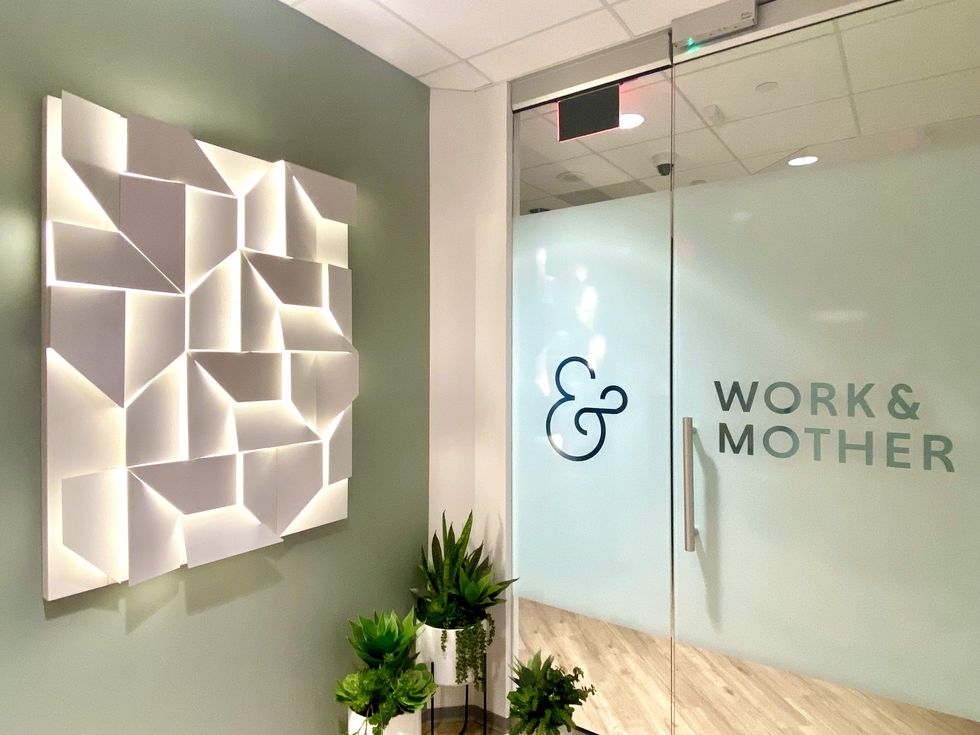
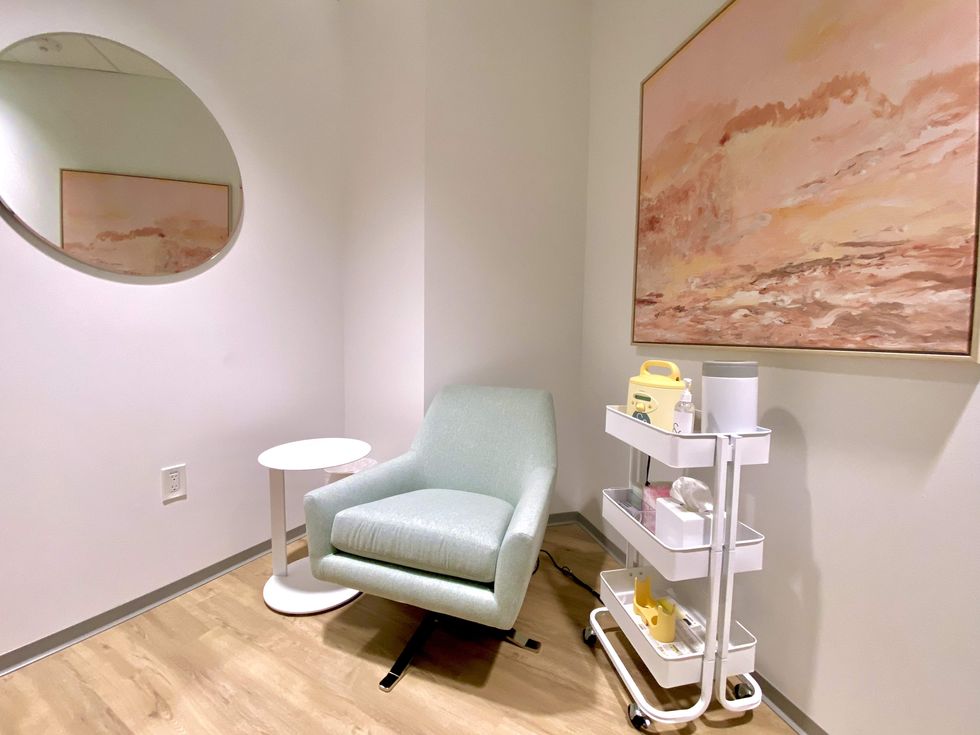
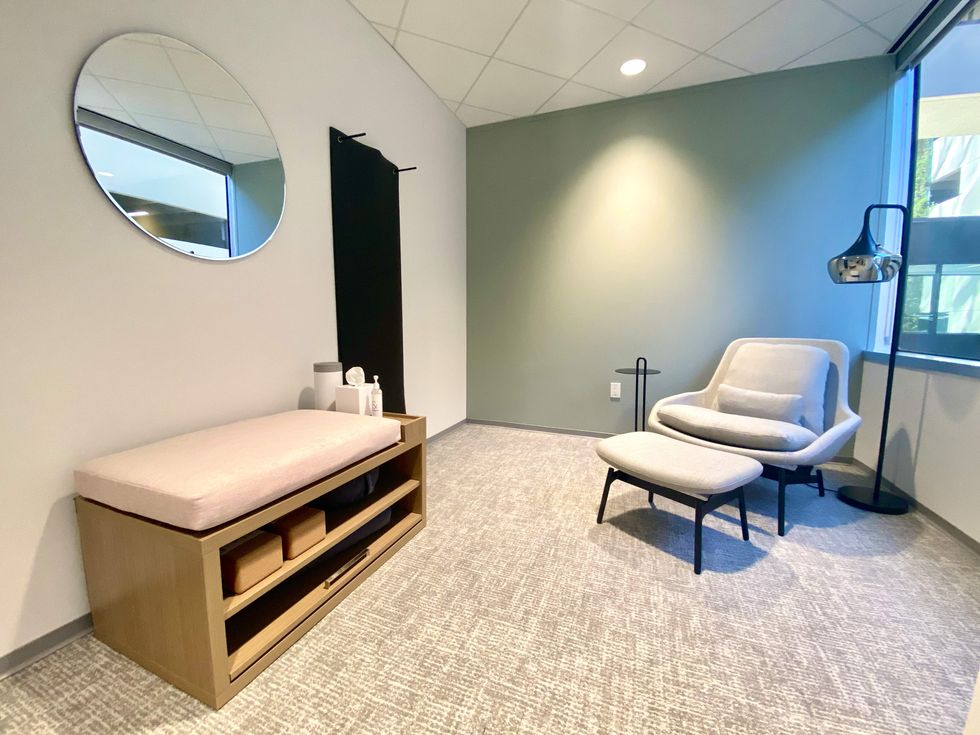
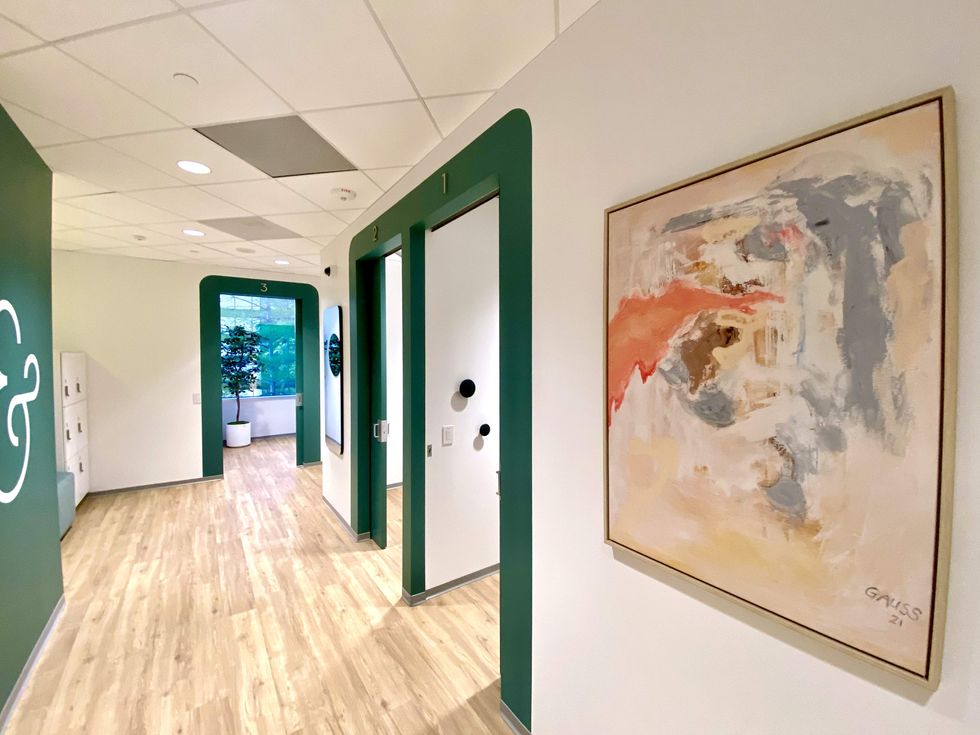
After a recent rebrand, Work& (previously Work&Mother) has introduced its first employee wellness space at a major Houston office plaza. Photos courtesy MetroNational

Houston-based femtech company Work&, previously Work&Mother, debuted new lactation suites and its first employee wellness space at MetroNational’s Memorial City Plazas this month.

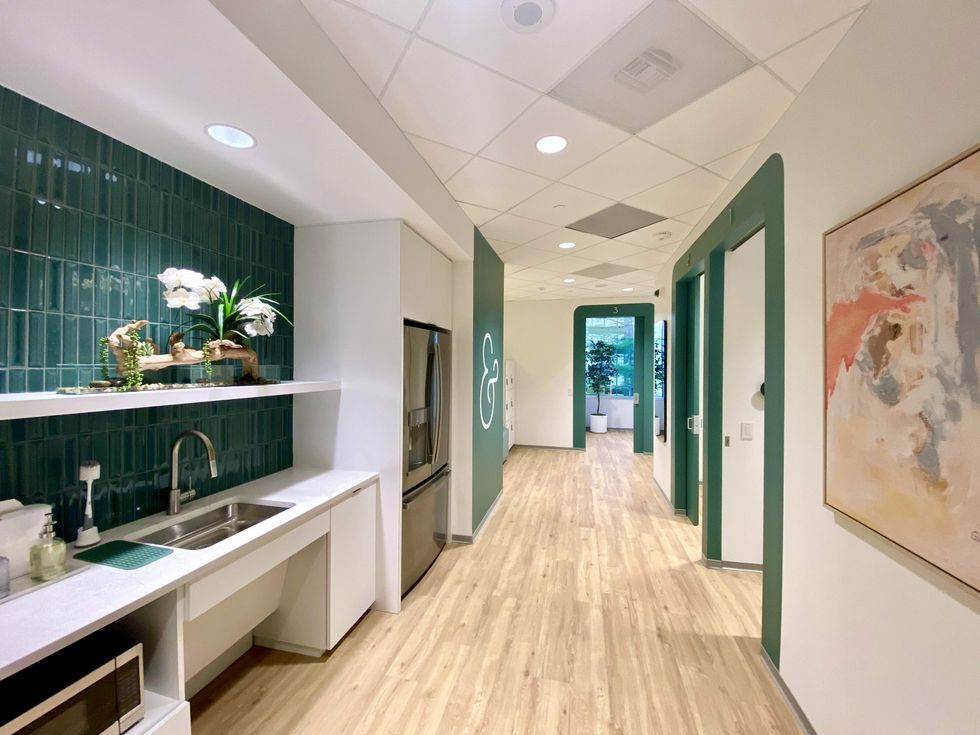
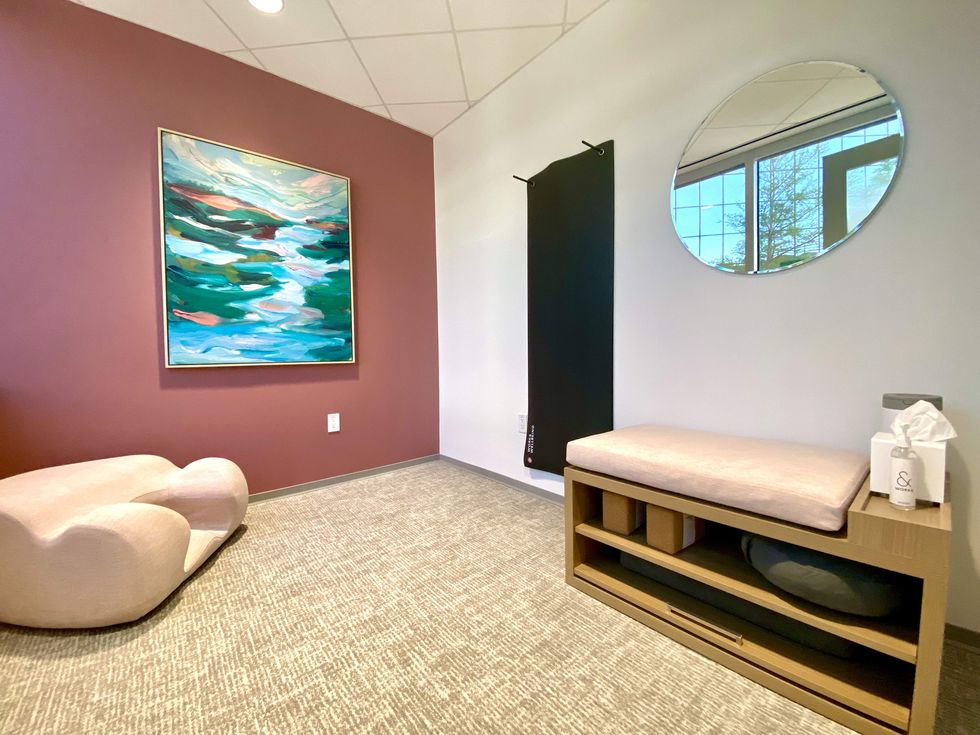
The 1,457-square-foot Work& space features three lactation rooms and five wellness suites, the latter of which are intended to offer employees a private space and time for telehealth appointments, meditation, prayer, and other needs. The hybrid space, designed by Houston-based Inventure, represents Work&'s shift to offer an array of holistic health and wellness solutions to landlords for tenants.

Work& rebranded from Work&Mother earlier this year. The company was previously focused on outfitting commercial buildings with lactation accommodations for working parents, equipped with a hospital-grade pump, milk storage bags, sanitizing wipes, and other supplies. While Work& will still offer these services through its Work&Mother branch, the addition of its Work&Wellbeing arm allows the company to also "address the broader wellness needs of all employees," according to an announcement made on LinkedIn.

"We are thrilled to bring Work&Mother and Work&Wellbeing to The Plazas," Jules Lairson, co-founder and COO of Work&, said in a news release. “This partnership brings every stakeholder together – employees, employers and landlords all benefit from this kind of forward-thinking tenant experience. We are excited to launch our Work&Wellbeing concept with MetroNational to ensure that all employees have their wellness needs met with private, clean, quiet spaces for use during the workday.”

The new space is available to all tenants across Memorial City Plazas, comprised of three office towers totaling 1 million square feet of Class A office space. In addition to the lactation and wellness suites, the space also features custom banquettes, private lounge seating and phone booths.

“As a family-owned and operated company, MetroNational is deeply committed to fostering a workplace that supports both productivity and the well-being of all our tenants,” Anne Marie Ratliff, vice president of asset management for MetroNational, added in the release. “Partnering with Work& reinforces this commitment, enhancing our workplace experience and setting a new standard for tenant amenities.”

Work& has five Houston locations and several others in major metros, including New York, Austin, D.C., Boston, Chicago, San Francisco, and Miami. According to its website, the company will also introduce a Work&Wellbeing suite in New York.

Abbey Donnell spoke with InnovationMap on the Houston Innovators Podcast about why she founded the company and its plans for growth in 2021. Click here to learn more.
Ad Placement 300x100
Ad Placement 300x600

CultureMap Emails are Awesome

New Texas Stock Exchange officially begins trading in Dallas

Welcome to Y'all Street

Two-step aside, New York Stock Exchange and Nasdaq. The Dallas-based Texas Stock Exchange, nicknamed Y’all Street, just kicked off live trading with five stocks — and lots of Lone Star ambition.

“The Texas Stock Exchange aims to revitalize competition for [stock] issuers, establish the premier venue for listings, and create a world-class trading platform for all market participants,” the exchange says in a fact sheet.

The exchange — whose Texas-influenced nickname is a nod to New York City’s Wall Street — has collected at least $275 million in investments. The roughly 90 financial backers of TXSE include Bank of America, BlackRock, Charles Schwab, Citadel Securities, Dell Family Office, Fortress, Goldman Sachs, and JPMorgan Chase.

Representatives of TXSE couldn’t be reached for comment. On its website, the exchange calls itself “the most well-capitalized equities exchange to ever be approved” by the U.S. Securities and Exchange Commission (SEC).

Not to be outdone, NYSE has launched Dallas-based NYSE Texas and Nasdaq has expanded its presence in Dallas.

Y’all Street adds to Dallas-Fort Worth’s rising status as a major hub for financial services, with The Wall Street Journal naming North Texas the country’s second biggest financial hub after New York City.

“A homegrown national exchange means more jobs, more investment, and more growth opportunities for businesses and communities across the Lone Star State,” Gabriela von zur Muehlen, senior vice president and chief policy officer at the Texas Association of Business, told The Texas Tribune.

Bulent Temel, an associate professor of practice in economics at the University of Texas at San Antonio, told Texas Standard that TXSE “is going to boost the credibility of the Texas economy.”

Texas’ estimated gross domestic product (GDP), a yardstick for the size of an economy, climbed to a record-setting $2.9 trillion in 2025, making it the state with the second highest GDP after California. DFW’s estimated GDP in 2023 stood at $744.6 billion, eclipsing the GDP of many countries.

“The center of gravity for American capitalism is now headquartered in the Boom Belt,” Abbott proclaimed in April, referring to an 11-state region (including Texas) in the South and Southeast that’s seeing tremendous economic and population growth. “The Texas Stock Exchange is the natural extension of that capitalism. It ensures that capital markets will reflect the quadrant that is driving American growth.”

---

This article originally appeared on CultureMap.com.

Orion vehicle manager reflects on Artemis II, looks to 2028 moon mission

Q&A

Humanity is finally headed back to the moon after more than half a century. This year's launch of the Artemis II mission in the Orion spacecraft put four crew members in lunar orbit and tested the new ship developed by Lockheed Martin.

Everything went smoothly, safely returning astronauts home, but there is always room to improve. InnovationMap chatted via email with Orion vehicle manager Branelle Rodriguez, shortly after a talk at The Ion, for insight on how Orion might perform in the future as the next lunar landing approaches in early 2028.

InnovationMap: How satisfied are you with the way Orion operated on this past mission?

Branelle Rodriguez: Orion performed exceptionally well during Artemis II, successfully demonstrating critical spacecraft capabilities, including life support systems, displays and controls, and executing manual piloting operations. Artemis II brought humans back to the moon, achieving key exploration and scientific imagery, while validating systems essential for future Artemis missions.

IM: What is the most important thing you learned about improving Orion for the next mission?

BR: The Artemis II mission provided invaluable insights into crew operations and spacecraft performance in a deep-space environment. With every mission, NASA applies lessons learned to continuously improve Orion’s operations, validate design and ensure mission readiness. Artemis II offered our first opportunity to evaluate several new systems and gain a deeper understanding of what it is like for astronauts to live and work inside the spacecraft. The operational, technical and human factors data collected are being integrated across the program to refine future missions, reduce risk and enhance overall mission success.

IM: How has Orion helped the mission to explore space?

BR: Orion is one of NASA’s foundational elements for human deep space exploration—not only supporting the mission but serving as a core component of it. It is currently the only spacecraft capable of carrying crew on deep space missions and returning them safely to Earth from the high speeds required from the vicinity of the moon. No other spacecraft has the technology to endure the extremes that come with human deep-space travel, such as advanced environmental and life support, navigation, communications, radiation shielding, and the world’s largest ablative heat shield to protect the astronauts during reentry into Earth’s atmosphere. Orion has already taken astronauts to explore space farther than ever before—252,756 miles from Earth— and will carry crews to the moon on future missions to explore the lunar South Pole region. The astronauts’ observations, samples, and data collected on these future missions will expand our understanding of our solar system and home planet.

---

This conversation has been edited for brevity and clarity.

Houston VC funding nears $1B in first half of 2026, report says

by the numbers

Despite a weak second quarter, venture capital funding for Houston-area startups approached $1 billion in the first half of 2026, the region’s highest first-half total since 2022, according to the latest PitchBook-NVCA Venture Monitor.

This year’s first-half total of $962.4 million represented a nearly 8 percent increase over last year’s first-half total of $891.7 million. Dating back to 2016, this year’s first-half haul lags behind only 2021 and 2022 for the most first-half funding.

Houston’s year-over-year VC jump of 73 percent in the first quarter of 2026 more than made up for the year-over-year drop of 34 percent in the second quarter of 2026, according to the report.

Deal count tells a more encouraging story: Houston startups closed 102 deals in the first half, up from 93 a year earlier and the region’s busiest first half since 2022. However, the average deal size shrank, as no single funding source dominated the total.

Keep in mind that PitchBook and NVCA routinely revise quarterly numbers upward to reflect deals that were reported after a previous quarter’s data was published. So, in the case of Houston, numbers initially reported for the first quarter of 2026 may not match newly reported numbers.

Perhaps the most notable Houston-area deal announced in the first half of this year was Cart.com’s $180 million growth equity investment, led by Springcoast Partners. Cart.com is an e-commerce platform and logistics provider.

PitchBook-NVCA data shows Houston’s VC activity is growing modestly, delivering better numbers in the first half of 2026 versus 2024 and 2025, but it still sits below the highs of 2021 and 2022. This is one sign that so far in 2026, the national VC boom isn’t benefiting non-hub markets like Houston the way it’s boosting some hub markets, especially Silicon Valley and New York City.

Nationwide, AI dominated VC funding in the first half of this year. The sector made up 86 percent of VC from January through June. The report notes that the markets have still struggled to unlock IPOs, with SpaceX being the biggest exception, and few M&A deals outside health care have been significant.