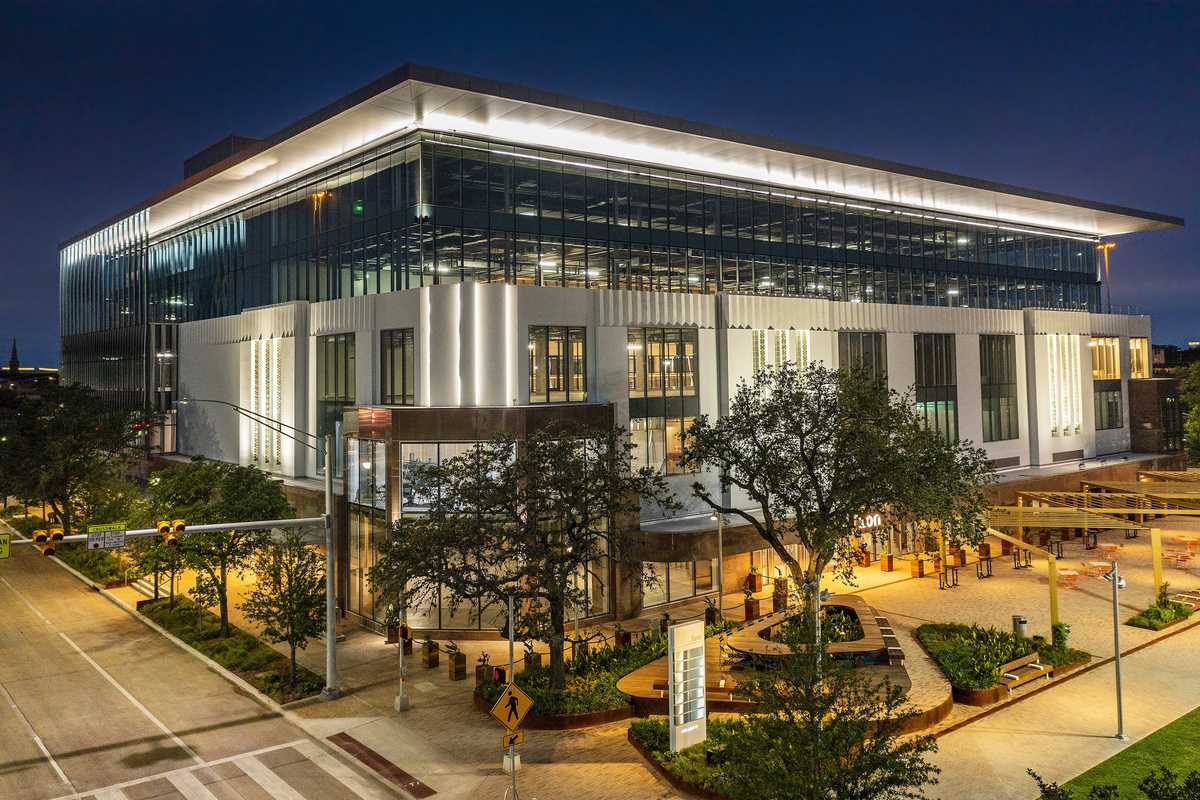
Hobby Airport's new solar canopy is operating at 100% capacity. Photo courtesy Houston Airports.

Houston's William P. Hobby Airport is generating its own clean energy.

Houston Airports announced that Hobby's red garage is now home to a "solar canopy" that is producing energy at 100 percent capacity to power daily operations. The photovoltaic (PV) solar system generated more than 1.1 gigawatt-hours of electricity in testing, and is expected to produce up to 1 megawatt-hour now that it's operating at full power.

“This project is proof that sustainability can be practical, visible and directly tied to the passenger experience,” Jim Szczesniak, director of aviation for Houston Airports, said in a news release. “Passengers now park under a structure that shields their cars from the Texas sun while generating clean energy that keeps airport operations running efficiently, lowering overall peak demand electrical costs during the day and our carbon footprint. It’s a win for travelers, the city and the planet.”

The project was completed by Texas A&M Engineering Experiment Station (TEES) and CenterPoint Energy. It's part of Houston Airport's efforts to reduce carbon emissions by 40 percent over its 2019 baseline.

In a separate announcement, the airport system also shared that it recently reached Level 3 in the Airports Council International (ACI) Airport Carbon Accreditation program after reducing emissions by 19 percent in three years. This includes reductions at George Bush Intercontinental Airport (IAH), Hobby and Ellington Airport/Houston Spaceport.

The reductions have come from initiatives such as adding electric vehicles to airport fleets, upgrading airfield lighting with LED bulbs, adding smarter power systems to terminals, and improving IAH's central utility plant with more efficient equipment. Additionally, the expansion to Hobby's West Concourse and renovations at IAH Terminal B incorporate cleaner equipment and technology.

According to Houston Airports, from 2019 to 2023:

  • IAH reduced emissions by 17 percent
  • Hobby reduced emissions by 32 percent
  • Ellington Airport reduced emissions by 4 percent

"I see firsthand how vital it is to link infrastructure with sustainability,” Houston City Council Member Twila Carter, chair of the council’s Resilience Committee, said in the release. “Reducing carbon emissions at our airports isn’t just about cleaner travel — it’s about smarter planning, safer communities and building a Houston that can thrive for generations to come.”

Memorial Day weekend kicks off the busy summer 2025 travel season. Photo courtesy of Visit Houston

Houston airports poised for 1.3 million travelers on Memorial Day weekend

Taking Off

George Bush Intercontinental Airport (IAH) and William P. Hobby Airport (HOU) are estimated to see 1.3 million travelers during the Memorial Day period (May 20 - May 28). Despite large crowds, the airports say they have prepared with multiple new improvements designed to slow traffic and make check-ins easier.

“Air travel drives jobs, business and tourism — and this summer, Houston Airports is powering that growth,” said Jim Szczesniak, director of aviation for Houston Airports.

“From streamlined security to a smarter website to new flights and fresh amenities, we’re delivering improvements that support Mayor Whitmire’s call for a more user-friendly Houston. These upgrades aren’t just about moving people — they’re about moving our economy forward.”

IAH in particular has seen remarkable drops in wait times thanks to the new IAH International Arrivals Curb. Part of the $1.458 billion IAH Terminal Redevelopment Program (ITRP), it reduced airport traffic during the Christmas holidays by a whopping 99 percent, with the average wait time reaching only two minutes. Other improvements include TSA Precheck enrollment pods at both airports and the agility for international travelers to recheck bags without leaving the terminal after they have passed through customs.

The amount of travelers expected for Memorial Day is slightly below 2024 numbers, but Houston Airports expects record-breaking travel over the summer. Current estimates show 19.5 million people moving through both airports through Labor Day, a 250,000 increase over last year. Part of this can be attributed to IAH's increasing status as the gateway to Mexico, Central America, and South America, running nonstop flights to new tourist hot spots like Puerto Escondido.

In additions to streamlining the flight processes, Houston Airports are expanding concession and shop offerings. Hobby recently opened The Rustic, Chick-fil-A, Pei Wei, and Throughgood Bistro. Bush added Hip & Humble, a boutique gift and souvenir seller focused on the items for women travelers and those looking for a little luxury when they return home. And, as always, Houston Airports have some of the finest art in the country. All of it together makes traveling to and from the city much less stressful than the big crowds would portend.

"We’re ready to welcome millions with efficiency and a warm Houston spirit,” said Szczesniak. “This summer, travelers will see and feel the difference we’ve made.”

---

This story originally appeared on our sister site, CultureMap.com.

Ad Placement 300x100
Ad Placement 300x600

CultureMap Emails are Awesome

Houston wearable biosensing company closes $13M pre-IPO round

fresh funding

Wellysis, a Seoul, South Korea-headquartered wearable biosensing company with its U.S. subsidiary based in Houston, has closed a $13.5 million pre-IPO funding round and plans to expand its Texas operations.

The round was led by Korea Investment Partners, Kyobo Life Insurance, Kyobo Securities, Kolon Investment and a co-general partner fund backed by SBI Investment and Samsung Securities, according to a news release.

Wellysis reports that the latest round brings its total capital raised to about $30 million. The company is working toward a Korea Securities Dealers Automated Quotations listing in Q4 2026 or Q1 2027.

Wellysis is known for its continuous ECG/EKG monitor with AI reporting. Its lightweight and waterproof S-Patch cardiac monitor is designed for extended testing periods of up to 14 days on a single battery charge.

The company says that the funding will go toward commercializing the next generation of the S-Patch, known as the S-Patch MX, which will be able to capture more than 30 biometric signals, including ECG, temperature and body composition.

Wellysis also reports that it will use the funding to expand its Houston-based operations, specifically in its commercial, clinical and customer success teams.

Additionally, the company plans to accelerate the product development of two other biometric products:

  • CardioAI, an AI-powered diagnostic software platform designed to support clinical interpretation, workflow efficiency and scalable cardiac analysis
  • BioArmour, a non-medical biometric monitoring solution for the sports, public safety and defense sectors

“This pre-IPO round validates both our technology and our readiness to scale globally,” Young Juhn, CEO of Wellysis, said in the release. “With FDA-cleared solutions, expanding U.S. operations, and a strong AI roadmap, Wellysis is positioned to redefine how cardiac data is captured, interpreted, and acted upon across healthcare systems worldwide.”

Wellysis was founded in 2019 as a spinoff of Samsung. Its S-Patch runs off of a Samsung Smart Health Processor. The company's U.S. subsidiary, Wellysis USA Inc., was established in Houston in 2023 and was a resident of JLABS@TMC.

Elon Musk vows to launch solar-powered data centers in space

To Outer Space

Elon Musk vowed this week to upend another industry just as he did with cars and rockets — and once again he's taking on long odds.

The world's richest man said he wants to put as many as a million satellites into orbit to form vast, solar-powered data centers in space — a move to allow expanded use of artificial intelligence and chatbots without triggering blackouts and sending utility bills soaring.

To finance that effort, Musk combined SpaceX with his AI business on Monday, February 2, and plans a big initial public offering of the combined company.

“Space-based AI is obviously the only way to scale,” Musk wrote on SpaceX’s website, adding about his solar ambitions, “It’s always sunny in space!”

But scientists and industry experts say even Musk — who outsmarted Detroit to turn Tesla into the world’s most valuable automaker — faces formidable technical, financial and environmental obstacles.

Feeling the heat

Capturing the sun’s energy from space to run chatbots and other AI tools would ease pressure on power grids and cut demand for sprawling computing warehouses that are consuming farms and forests and vast amounts of water to cool.

But space presents its own set of problems.

Data centers generate enormous heat. Space seems to offer a solution because it is cold. But it is also a vacuum, trapping heat inside objects in the same way that a Thermos keeps coffee hot using double walls with no air between them.

“An uncooled computer chip in space would overheat and melt much faster than one on Earth,” said Josep Jornet, a computer and electrical engineering professor at Northeastern University.

One fix is to build giant radiator panels that glow in infrared light to push the heat “out into the dark void,” says Jornet, noting that the technology has worked on a small scale, including on the International Space Station. But for Musk's data centers, he says, it would require an array of “massive, fragile structures that have never been built before.”

Floating debris

Then there is space junk.

A single malfunctioning satellite breaking down or losing orbit could trigger a cascade of collisions, potentially disrupting emergency communications, weather forecasting and other services.

Musk noted in a recent regulatory filing that he has had only one “low-velocity debris generating event" in seven years running Starlink, his satellite communications network. Starlink has operated about 10,000 satellites — but that's a fraction of the million or so he now plans to put in space.

“We could reach a tipping point where the chance of collision is going to be too great," said University at Buffalo's John Crassidis, a former NASA engineer. “And these objects are going fast -- 17,500 miles per hour. There could be very violent collisions."

No repair crews

Even without collisions, satellites fail, chips degrade, parts break.

Special GPU graphics chips used by AI companies, for instance, can become damaged and need to be replaced.

“On Earth, what you would do is send someone down to the data center," said Baiju Bhatt, CEO of Aetherflux, a space-based solar energy company. "You replace the server, you replace the GPU, you’d do some surgery on that thing and you’d slide it back in.”

But no such repair crew exists in orbit, and those GPUs in space could get damaged due to their exposure to high-energy particles from the sun.

Bhatt says one workaround is to overprovision the satellite with extra chips to replace the ones that fail. But that’s an expensive proposition given they are likely to cost tens of thousands of dollars each, and current Starlink satellites only have a lifespan of about five years.

Competition — and leverage

Musk is not alone trying to solve these problems.

A company in Redmond, Washington, called Starcloud, launched a satellite in November carrying a single Nvidia-made AI computer chip to test out how it would fare in space. Google is exploring orbital data centers in a venture it calls Project Suncatcher. And Jeff Bezos’ Blue Origin announced plans in January for a constellation of more than 5,000 satellites to start launching late next year, though its focus has been more on communications than AI.

Still, Musk has an edge: He's got rockets.

Starcloud had to use one of his Falcon rockets to put its chip in space last year. Aetherflux plans to send a set of chips it calls a Galactic Brain to space on a SpaceX rocket later this year. And Google may also need to turn to Musk to get its first two planned prototype satellites off the ground by early next year.

Pierre Lionnet, a research director at the trade association Eurospace, says Musk routinely charges rivals far more than he charges himself —- as much as $20,000 per kilo of payload versus $2,000 internally.

He said Musk’s announcements this week signal that he plans to use that advantage to win this new space race.

“When he says we are going to put these data centers in space, it’s a way of telling the others we will keep these low launch costs for myself,” said Lionnet. “It’s a kind of powerplay.”

Johnson Space Center and UT partner to expand research, workforce development

onward and upward

NASA’s Johnson Space Center in Houston has forged a partnership with the University of Texas System to expand collaboration on research, workforce development and education that supports space exploration and national security.

“It’s an exciting time for the UT System and NASA to come together in new ways because Texas is at the epicenter of America’s space future. It’s an area where America is dominant, and we are committed as a university system to maintaining and growing that dominance,” Dr. John Zerwas, chancellor of the UT System, said in a news release.

Vanessa Wyche, director of Johnson Space Center, added that the partnership with the UT System “will enable us to meet our nation’s exploration goals and advance the future of space exploration.”

The news release noted that UT Health Houston and the UT Medical Branch in Galveston already collaborate with NASA. The UT Medical Branch’s aerospace medicine residency program and UT Health Houston’s space medicine program train NASA astronauts.

“We’re living through a unique moment where aerospace innovation, national security, economic transformation, and scientific discovery are converging like never before in Texas," Zerwas said. “UT institutions are uniquely positioned to partner with NASA in building a stronger and safer Texas.”

Zerwas became chancellor of the UT System in 2025. He joined the system in 2019 as executive vice chancellor for health affairs. Zerwas represented northwestern Ford Bend County in the Texas House from 2007 to 2019.

In 1996, he co-founded a Houston-area medical practice that became part of US Anesthesia Partners in 2012. He remained active in the practice until joining the UT System. Zerwas was chief medical officer of the Memorial Hermann Hospital System from 2003 to 2008 and was its chief physician integration officer until 2009.

Zerwas, a 1973 graduate of the Houston area’s Bellaire High School, is an alumnus of the University of Houston and Baylor College of Medicine.