UH expands Medical Center footprint with $77M research facility
breaking ground
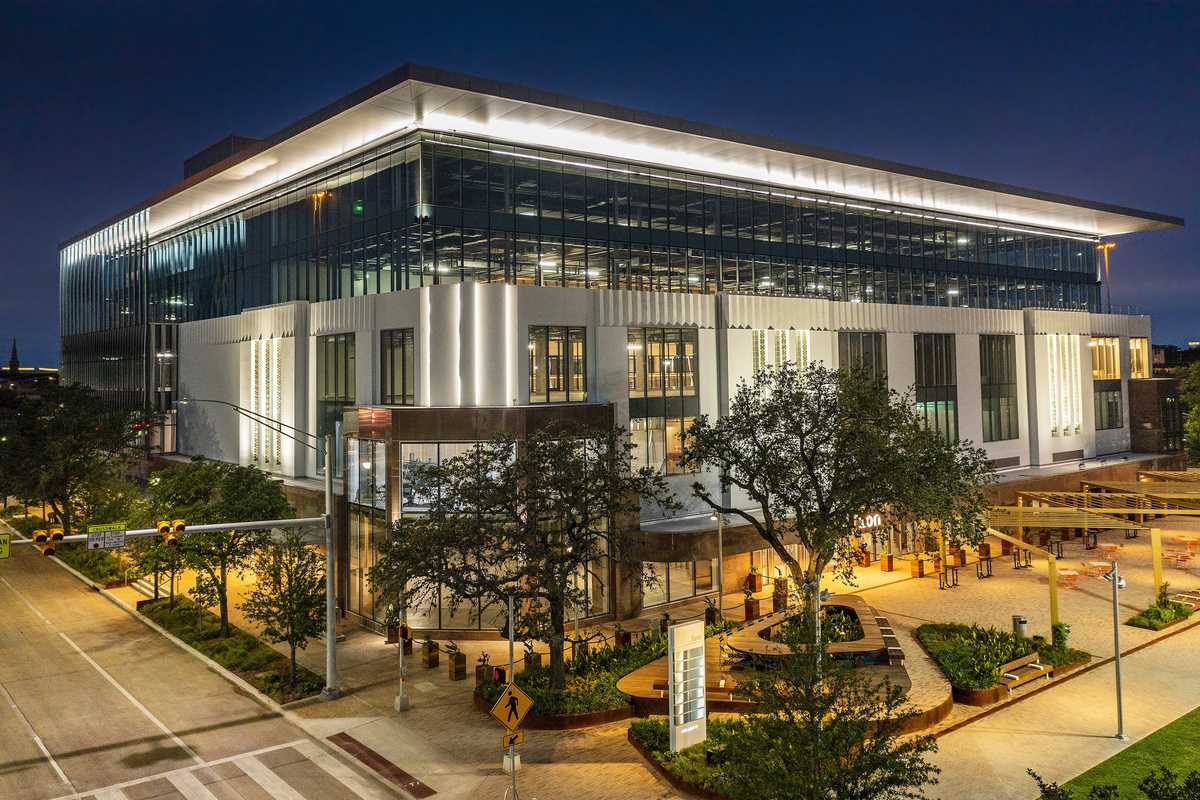
The University of Houston broke ground on a brand new $77.5 million Medical Research Building last week that will host clinical trials and a virtual reality behavioral health suite, among other laboratories. Designed by SmithGroup, it will be the second building on the UH Medical Center campus after the Fertitta College of Medicine opened in 2022.
“The Medical Research Building was designed to foster collaboration and discovery while creating a welcoming environment for students, researchers and the community,” Kalman Nagy, higher education studio design leader for SmithGroup, said in a news release. “As the second building on the University of Houston’s medical campus, we wanted to create a strong connection to the College of Medicine and the surrounding woodlands, with outdoor terraces, shared learning spaces and natural views that inspire interaction and innovation.”
Located just behind the Fertitta building at 5150 Medical Service Drive, the 57,000-square-foot building will house wet laboratories, computational research spaces and specialized facilities for clinical research. The virtual reality behavioral health suite will use immersive technology to deliver care through manufactured audio and visual environments. It’s part of the college’s vision for developing new medical advancements in the heart of Houston’s medical community. The groundbreaking comes on the heels of the launch of the university's cross-disciplinary academic venture, UH Health, this summer.
“This groundbreaking marks an important next step in the growth of the Fertitta College of Medicine and UH Health,” Dr. Jonathan McCullers, vice president for health affairs at UH, added in the release. “We are building the research capacity to match our ambitions—bringing together scientists, physicians and experts from across the University to accelerate discovery and turn promising ideas into solutions that improve people’s lives.”
UH’s journey to establish a significant presence alongside the University of Texas and Baylor in the Medical Center started in 2009 when it became an official full institutional member. The university launched its plans for the Fertitta building in 2013, and is pursuing Health Science Center designation from the Texas Legislature in the next year’s session.
“The research that will take place here will directly benefit our community,” UH President Renu Khator added. “Diseases do not recognize disciplinary silos, and neither should our research. This building will bring together experts from across UH to break down those barriers, work across disciplines and tackle some of our most complex health challenges.”
The building is slated to open in 2028.