Space City has had a busy month.
Houston-based aerospace institutions Venus Aerospace, Axiom Space, and Aegis Aerospace have each recently announced advancements in their respective fields that include expansions and new contracts from U.S. and international government agencies.
Here’s the latest:
Venus launches new test stand
Earlier this month, Venus Aerospace added infrastructure to support the ongoing progress of its Rotating Detonation Rocket Engine (RDRE) with the opening of its new propulsion test stand at the Houston Spaceport.
The Texas Space Commission's Space Exploration and Aeronautics Research Fund is funding the test stand, which is part of a larger effort from the state to increase investments in the aerospace economy. The ribbon-cutting event on Sept. 10 welcomed officials from Venus Aerospace, the Texas Space Commission, the Houston Spaceport, Houston business and local community leaders.
With the new stand, Venus will be able to test at higher thrust and for longer durations, which will allow the company to better replicate real-life conditions.
"Building and testing propulsion systems at this pace requires the right infrastructure around the technology," Sassie Duggleby, CEO and co-founder of Venus Aerospace, said in a news release. "We're grateful to the Texas Space Commission and the State of Texas for investing alongside companies like Venus. Public investment like this helps companies move faster and keeps critical aerospace capability growing here in Texas."
Venus closed a $91 million Series B in July and expanded its leadership team.
Axiom partners in Europe
Axiom Space has signed a memorandum of understanding with the European Space Agency for “sustained European access to low-Earth orbit (LEO)” following the retirement of the International Space Station, according to a news release from the company.
Under the agreement, Axiom and the ESA agreed to explore future astronaut missions on the ISS and Axiom Station, research, transportation and spacesuit partnerships. The organizations will explore using the ESA’s European Cargo Return service and potentially a future European crew vehicle to support operations at Axiom Station, the company's forthcoming commercial space station. The partnership could also involve Axiom's AxEMU spacesuit for orbital and lunar applications, according to the release.
“With the upcoming de-orbitation of the ISS, it is our duty to anticipate and prepare future solutions to ensure our access to low-Earth orbit,” Daniel Neuenschwander, director of human and robotic exploration at ESA, said in the release. “The two documents signed today underline both our commitment to safeguard our ability to pursue in-orbit science and to keep offering flight opportunities to our European astronaut corps, as well as the growing interest of international partners for our ongoing project to develop an autonomous European cargo vehicle.”
The announcement comes as Axiom has made several international moves this year. The company shared plans to establish Axiom Space Switzerland this summer and launched Axiom Space Japan in July.
"The path to a sustainable human presence in space runs through international collaboration — reliable supply chains, shared innovation, and partners who bring real capability," Jonathan Cirtain, CEO and President of Axiom Space, said in the release. "Europe's contributions to microgravity science and deep space technology make ESA exactly that kind of partner. This MoU strengthens our work together, and we look forward to ESA and its member states joining us as customers for future astronaut missions."
Aegis expands DoW deal
Webster, Texas-based Aegis Aerospace announced that it has won a new task order to continue supporting the U.S. Space Force’s Space Test Program.
The contract starts in October and covers designing, building, testing and operating Department of War payloads or equipment on NASA, government, and commercial launch vehicles and platforms. The contract was issued by the USSF Space Systems Command, Space Test Program under NASA Johnson Space Center’s Research, Engineering, and Mission Integration Services 2 (REMIS 2).
Currently, the company is working on three payload facilities on the ISS and has plans for two more in development.
“Aegis Aerospace is grateful to continue our exceptional payload integration support to the USSF and the STP to meet their critical mission objectives,” President Matt Ondler added in the release. “This work is more important than ever to maintain U.S. superiority in space. This new contract will take us beyond the current life of the ISS and see us integrate and test payloads on commercial space stations, free-flyers, and cislunar missions.”



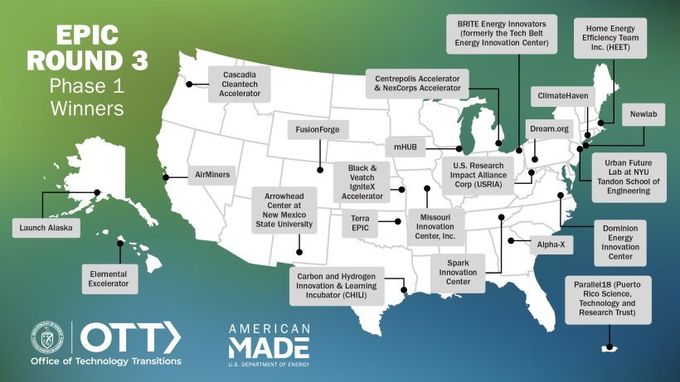 The DOE's OTT selections are nationwide. Photo via energy.gov