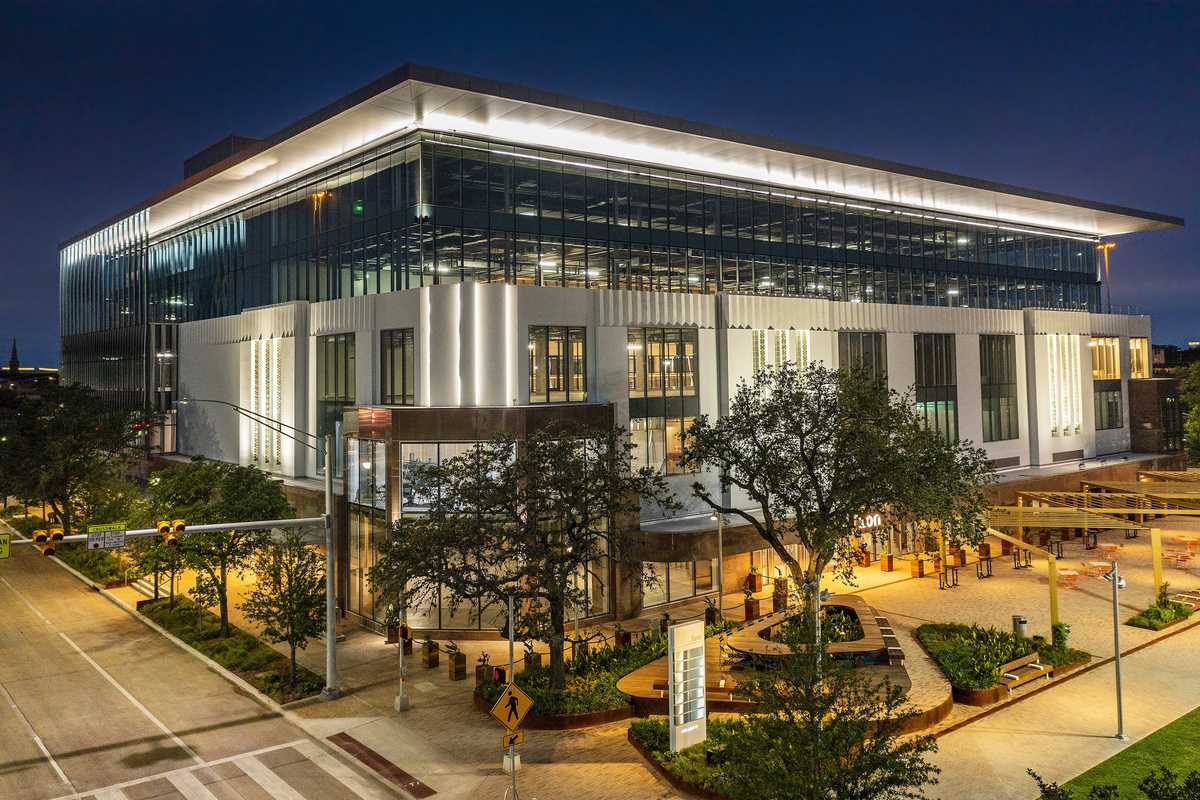
Levy Park is one of only two parks in the world to receive the recent honor. Photo by Midway Companies

A recently redesigned Upper Kirby park has bloomed to international recognition, thanks to a high-profile award.

Levy Park has been selected as one of the winners of this year's prestigious Urban Land Institute's Urban Open Space Award. The award recognizes outstanding examples of successful large-scale and small-scale public spaces that have socially enriched and revitalized the economy of their surrounding communities, according to a statement.

The revitalized, six-acre Upper Kirby gem was recently named a winner at the 2018 ULI Fall Meeting in Boston. The only other park in the world to receive the Urban Space Award is Madrid Río Park in Madrid, Spain. The winners were selected from a collection of entries representing urban areas from across the globe.

"The jury found Levy Park to be a dynamic public-private partnership that was unique in how it was structured," says ULI trustee and jury chairman Stuart I. Ackerberg. The park is architecturally very strong and executed extremely well, and it provides appealing programming and amenities that benefit the entire Houston community."

While landscape architecture and urban design were factors in the judging process, the jury selected finalists based on a broader set of criteria, including overall project performance and how each impacted or revived the surrounding areas, according to the release. Levy Park's redesign was led by OJB Landscape Architecture.

Once home to an average of 50 visitors a week, Levy Park has evolved into a popular Inner Loop destination that welcomes an estimated 7,000 weekly visitors who pack its dog park, community events, farmers market, and public gardens. The center has become a favorite for families who flock to the children's park, which offers interactive sculptures, fountains, and a 150-foot-long treehouse nestled among massive live oaks.

The park has been lauded for fostering a sense of community through performances, workshops, movie nights, and exercise programs. Praise also flows for its gardens, which harness harvest and reuse stormwater.

---

This story originally appeared on CultureMap.

Ad Placement 300x100
Ad Placement 300x600

CultureMap Emails are Awesome

Modular nuclear reactor co. NuScale Power moves into Houston market

New to Hou

The nuclear energy renaissance continues in Texas with an announcement by NuScale Power. The Oregon-based provider of proprietary and innovative advanced small modular reactor (SMR) nuclear technology announced in April it would be opening office space in Houston’s CityCentre.

“Opening this space in Houston underscores our commitment to meeting rising energy demand with safe, scalable nuclear technology,” John Hopkins, NuScale president and CEO, said in a news release. “This move expands our presence in a key market for partners, prospective customers, and stakeholders in addition to positioning us for the future as we focus on the near-term deployment of our industry-leading technology. Texas is leading the way in embracing advanced nuclear for grid resilience and industrial decarbonization, and we’re proud to expand our footprint and capabilities in this important region.”

Interest in nuclear power has been growing in recent years thanks to tensions with oil-rich nations, concerns about man-made climate change from fossil fuels, and the rapidly increasing power needs of data centers. Both Dow and Texas A&M University have announced expanded nuclear power projects in the last year, with an eye of changing the face of Texas’s energy industry through smaller, safer fission reactors.

Enter NuScale, founded in 2007 from technology developed at the University of Oregon. Their modular SMR technology generates 77 megawatts and is one of the only small modular reactors (SMR) to receive design approval from the U.S. Nuclear Regulatory Commission (NRC). These advances have led to runaway success for NuScale, whose stock has risen by more than 1,670 percent since the start of 2024.

The new operations campus in CityCentre is expected to facilitate the movement, installation and coordination of NuScale technology into the various energy systems. Typically, SMRs are used for off-grid installations, desalination operations, mining facilities and similar areas that lack infrastructure. However, the modularity means that they can be easily deployed to a variety of areas.

It comes none too soon. ERCOT projects that Texas data centers alone will require 77,965 megawatts by 2030.

---

This article first appeared on EnergyCapitalHTX.com.

Pharma giant considers Houston for $1 billion manufacturing campus

in the works

Another pharmaceutical giant is considering Houston’s Generation Park for a manufacturing hub.

According to a recent filing with the Texas Jobs, Energy, Technology and Innovation (JETI) program, Bristol Myers Squibb Co. is considering the northeast Houston management district for a new $1 billion multi-modal pharmaceutical manufacturing campus.

If approved, the campus, known as Project Argonaut, could create 489 jobs in Texas by 2031. Jobs would include operations technicians, engineering roles, administrative and management roles, production specialists, maintenance support, and quality control/assurance. The company predicts annual average wages for these positions to be around $96,000, according to the filing.

The project currently includes the 600,000-square-foot facility, but according to the filing, Bristol Myers Squibb “envisions this site growing in scale and capability well beyond its opening configuration."

The Texas JETI program offers companies temporary school property tax limitations in exchange for major capital investment and job creation. E.R. Squibb & Sons LLC applied for a 10-year tax abatement agreement in the Sheldon Independent School District.

The agreement promises a $ 1 billion investment. Construction would begin in 2027 and wrap in 2029.

“The proposed project reflects [Bristol Myers Squibb Co.’s] enduring commitment to bringing innovative medicines to patients and ensuring the long-term supply reliability they depend on,” the filing says. “The proposed project is purpose-built to support and manufacture medicines spanning multiple therapeutic areas and modalities, positioning the site as a long-term launch and commercial campus for decades to come. These medicines will provide therapies to the [Bristol Myers Squibb Co.’s] patients located in markets both nationally and internationally.”

The Fortune 100 company is considering 16 other cities for the new manufacturing facility in the Central and Eastern markets in the U.S. According to the Houston Chronicle, Bristol Myers Squibb Co is still in the “evaluation process” for its potential manufacturing site.

Last fall, Eli Lilly and Co. selected Generation Park for its $6.5 billion manufacturing plant. More than 300 locations in the U.S. competed for the factory. Read more here.

Houston health tech co. lands NIH grant for AI cancer prediction tool

fresh funding

Houston-based CellChorus and Stanford Medicine were recently awarded a Phase I Small Business Innovation Research grant for the company's AI platform to test how certain cancer patients will respond to therapies.

The funding comes from the National Cancer Institute of the National Institutes of Health. According to a filing, the grant totaled just under $400,000.

CellChorus, which spun out from the University of Houston’s Technology Bridge, has developed TIMING (Time-lapse Imaging Microscopy In Nanowell Grids), which analyzes the behavior of thousands of individual immune cells over time and can identify early indicators of treatment success or failure.

The company will work with Stanford's Dr. David Miklos and Dr. Saurabh Dahiya, who have built the Bone Marrow Transplantation and Cell Therapy Biobank. The biobank manages and stores biological samples from patients treated at their clinic and in clinical trials.

"Predicting which patients will achieve durable responses after CAR-T therapy remains one of the most important challenges in the field,” Miklos said in a news release. “We aim to uncover functional cellular signatures that can guide treatment decisions and improve patient outcomes.”

The project will specifically profile cells from patients with relapsed/refractory large B-cell lymphoma (r/rLBCL). According to CellChorus, only about half of r/rLBCL patients who receive CAR-T therapy "achieve a durable, long-term remission." Others do not respond to therapy or experience relapse.

“The sooner we know whether a cancer therapy is working, the better. To maximize patient benefit, we need technology that can provide a robust and early prediction of response to therapy. The technology needs to be scalable, cost-efficient, and capable of rapid turnaround times,” Rebecca Berdeaux, chief scientific officer of CellChorus, added in the release. “We are excited to work with Drs. David Miklos and Saurabh Dahiya and their colleagues on this very important project.”

CellChorus has previously received SBIR grants from federal agencies, including a $2.5 million award in 2024 from its National Center for Advancing Translational Sciences (NCATS) and a $2.3 million SBIR Fast-Track award from the National Institute of General Medical Sciences in 2023.