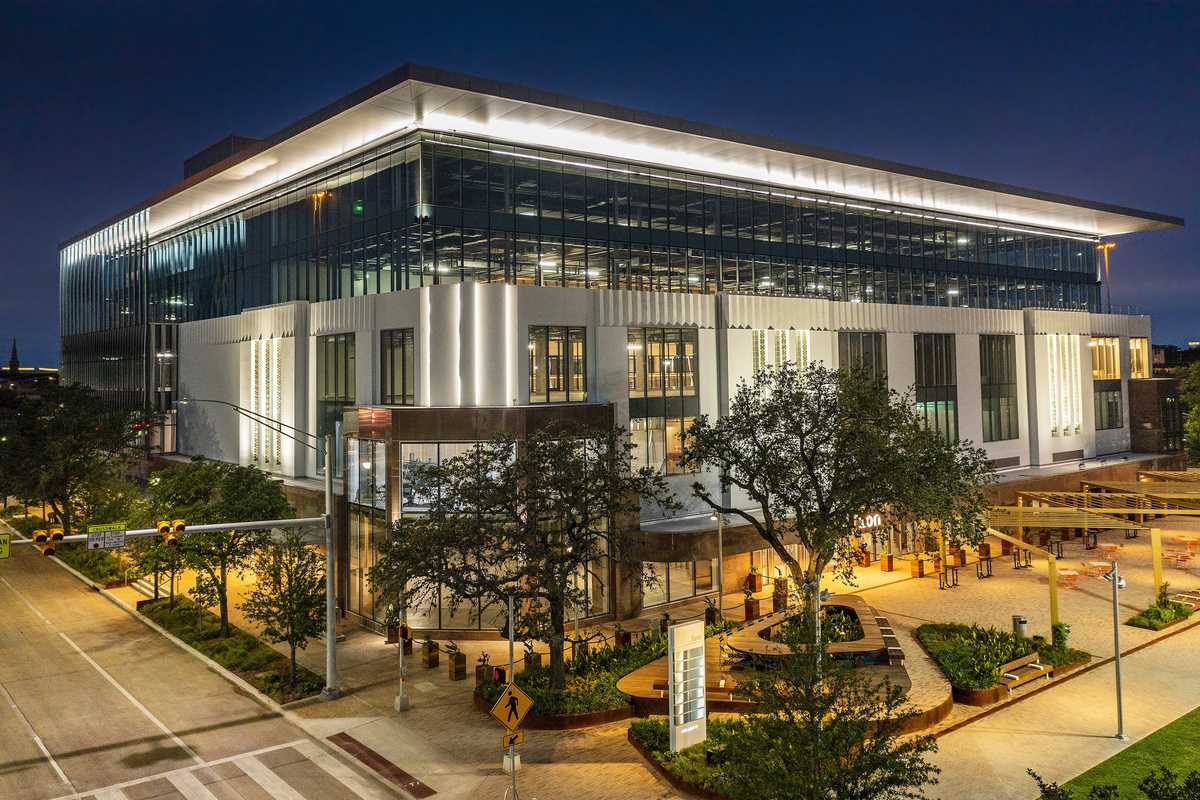
A Houston-based fintech company has taken a huge step in the right direction for growth. Getty Images

Houston-based fintech company HighRadius Corp. has forged a partnership with Canadian conglomerate Thomson Reuters Corp. that will open up more markets for its enterprise software-as-a-service.

The partnership equips HighRadius to tap into the global network of Confirmation.com, a unit of Thomson Reuters. Confirmation's network features more than 1,000 banks. Credit managers at those banks will be able to use HighRadius' software to automate the credit process for online credit applications.

"This partnership will allow us to expand our credit inquiry solution to new markets," Mark Portanova, Confirmation.com's vice president of sales for the Americas, says in a release. "We will enhance workflows, reporting capabilities, and client authorization processes within the HighRadius platform. These measures will progress the traditionally slow, manual, and time-consuming credit approval processes … ."

HighRadius' AI-powered software is designed to streamline accounts-receivable and cash-management processes. For instance, HighRadius' Cash Application software relies on AI to comb through documents like emails and invoices to automatically match incoming payments with customers' accounts.

Sayid Shabeer, chief product officer at HighRadius, says the company's suite of product ultimately lets companies free up millions of dollars in working capital and reallocate employees' time to higher-value tasks.

Among HighRadius' customers are corporate heavyweights like healthcare giant Johnson & Johnson, apparel maker adidas, food company Danone, and Dr Pepper Snapple Group. In January, HighRadius reported it had passed the 350-customer mark last year and doubled the size of its European workforce.

"2018 was the year that the bets we've been making over the last few years started to pay off in scale," Sashi Narahari, founder and CEO of HighRadius, says in a release.

Among HighRadius' competitors are Billtrust, Rimilia Holdings, Cforia Software, and Financial National Information Services. The global market for credit management software is forecast to exceed $2.1 billion by 2022, up from $636.4 million in 2017.

HighRadius, founded in 2006, employs more than 1,000 people in North America, Europe, and Asia. Since its inception, HighRadius has raised more than $50 million from Philadelphia-based Susquehanna Growth Equity, and has collected strategic investments from banking behemoths Citi and PNC.

HighRadius recently hired Jon Keating as vice president and general manager of its Europe, Middle East, and Africa (EMEA) markets. Keating most recently was chief sales officer at San Francisco fintech company Taulia. Earlier in the year, the company tapped SaaS veteran Natalie Fedie as vice president of customer success to help propel its global growth.

"HighRadius continues to invest in talent across Europe and Asia to fuel its growth plans and keep ahead of the innovation curve," Shabeer says.

Last year, HighRadius moved its headquarters to 200 Westlake Park Blvd. in the Energy Corridor. More than 150 employees relocated there. HighRadius subleases the space from BP America.

"The expansion of HighRadius into the Katy area represents another high-tech company choosing to mature in our community," Lance LaCour, president and CEO of the Katy Area Economic Development Corp., said at the time. "HighRadius is projected to have an estimated regional economic impact of over $600 million over a five-year period."

Ad Placement 300x100
Ad Placement 300x600

CultureMap Emails are Awesome

Texas falls to bottom of national list for AI-related job openings

jobs report

For all the hoopla over AI in the American workforce, Texas’ share of AI-related job openings falls short of every state except Pennsylvania and Florida.

A study by Unit4, a provider of cloud-based enterprise resource planning (ERP) software for businesses, puts Texas at No. 49 among the states with the highest share of AI-focused jobs. Just 9.39 percent of Texas job postings examined by Unit4 mentioned AI.

Behind Texas are No. 49 Pennsylvania (9.24 percent of jobs related to AI) and No. 50 Florida (9.04 percent). One spot ahead of Texas, at No. 47, is California (9.56 percent).

Unit4 notes that Texas’ and Florida’s low rankings show “AI hiring concentration isn’t necessarily tied to population size or GDP.”

“For years, California, Texas, and New York dominated tech hiring, but that’s changing fast. High living costs, remote work culture, and the democratization of AI tools mean smaller states can now compete,” Unit4 spokesperson Mark Baars said in a release.

The No. 1 state is Wyoming, where 20.38 percent of job openings were related to AI. The Cowboy State was followed by Vermont at No. 2 (20.34 percent) and Rhode Island at No. 3 (19.74 percent).

“A company in Wyoming can hire an AI engineer from anywhere, and startups in Vermont can build powerful AI systems without being based in Silicon Valley,” Baars added.

The study analyzed LinkedIn job postings across all 50 states to determine which ones were leading in AI employment. Unit4 came up with percentages by dividing the total number of job postings in a state by the total number of AI-related job postings.

Experts suggest that while states like Texas, California and Florida “have a vast number of total job postings, the sheer volume of non-AI jobs dilutes their AI concentration ratio,” according to Unit4. “Moreover, many major tech firms headquartered in California are outsourcing AI roles to smaller, more affordable markets, creating a redistribution of AI employment opportunities.”

Houston energy trailblazer Fervo closes $462 million Series E

Fresh Funds

Houston-based geothermal energy company Fervo Energy has closed an oversubscribed $462 million series E funding round, led by new investor B Capital.

“Fervo is setting the pace for the next era of clean, affordable, and reliable power in the U.S.,” Jeff Johnson, general partner at B Capital, said in a news release.

“With surging demand from AI and electrification, the grid urgently needs scalable, always-on solutions, and we believe enhanced geothermal energy is uniquely positioned to deliver. We’re proud to support a team with the technical leadership, commercial traction, and leading execution capabilities to bring the world’s largest next-generation geothermal project online and make 24/7 carbon-free power a reality.”

The financing reflects “strong market confidence in Fervo’s opportunity to make geothermal energy a cornerstone of the 24/7 carbon-free power future,” according to the company. The round also included participation from Google, a longtime Fervo Partner, and other new and returning investors like Devon Energy, Mitsui & Co., Ltd., Mitsubishi Heavy Industries and Centaurus Capital. Centaurus Capital also recently committed $75 million in preferred equity to support the construction of Cape Station Phase I, Fervo noted in the release.

The latest funding will support the continued buildout of Fervo’s Utah-based Cape Station development, which is slated to start delivering 100 MW of clean power to the grid beginning in 2026. Cape Station is expected to be the world's largest next-generation geothermal development, according to Fervo. The development of several other projects will also be included in the new round of funding.

“This funding sharpens our path from breakthrough technology to large-scale deployment at Cape Station and beyond,” Tim Latimer, CEO and co-founder of Fervo, added in the news release. “We’re building the clean, firm power fleet the next decade requires, and we’re doing it now.”

Fervo recently won Scaleup of the Year at the 2025 Houston Innovation Awards, and previously raised $205.6 million in capital to help finance the Cape Station earlier this year. The company fully contracted the project's capacity with the addition of a major power purchase agreement from Shell this spring. Fervo’s valuation has been estimated at $1.4 billion and includes investments and support from Bill Gates.

“This new investment makes one thing clear: the time for geothermal is now,” Latimer added in a LinkedIn post. “The world desperately needs new power sources, and with geothermal, that power is clean and reliable. We are ready to meet the moment, and thrilled to have so many great partners on board.”

---

This article originally appeared on EnergyCapitalHTX.com.

Baylor center receives $10M NIH grant to continue rare disease research

NIH funding

Baylor College of Medicine’s Center for Precision Medicine Models received a $10 million, five-year grant from the National Institutes of Health last month that will allow it to continue its work studying rare genetic diseases.

The Center for Precision Medicine Models creates customized cell, fly and mouse models that mimic specific genetic variations found in patients, helping scientists to better understand how genetic changes cause disease and explore potential treatments.

The center was originally funded by an NIH grant, and its models have contributed to the discovery of several new rare disease genes and new symptoms caused by known disease genes. It hosts an online portal that allows physicians, families and advocacy groups to nominate genetic variants or rare diseases that need further investigation or new treatments.

Since its founding in 2020, it has received 156 disease/variant nominations, accepted 63 for modeling and produced more than 200 precision models, according to Baylor.

The center plans to use the latest round of funding to bring together more experts in rare disease research, animal modeling and bioinformatics, and to expand its focus and model more complex diseases.

Dr. Jason Heaney, associate professor in the Department of Molecular and Human Genetics at BCM, serves as the lead principal investigator of the center.

“The Department of Molecular and Human Genetics is uniquely equipped to bring together the diverse expertise needed to connect clinical human genetics, animal research and advanced bioinformatics tools,” Heaney added in the release. “This integration allows us to drive personalized medicine forward using precision animal models and to turn those discoveries into better care for patients.”