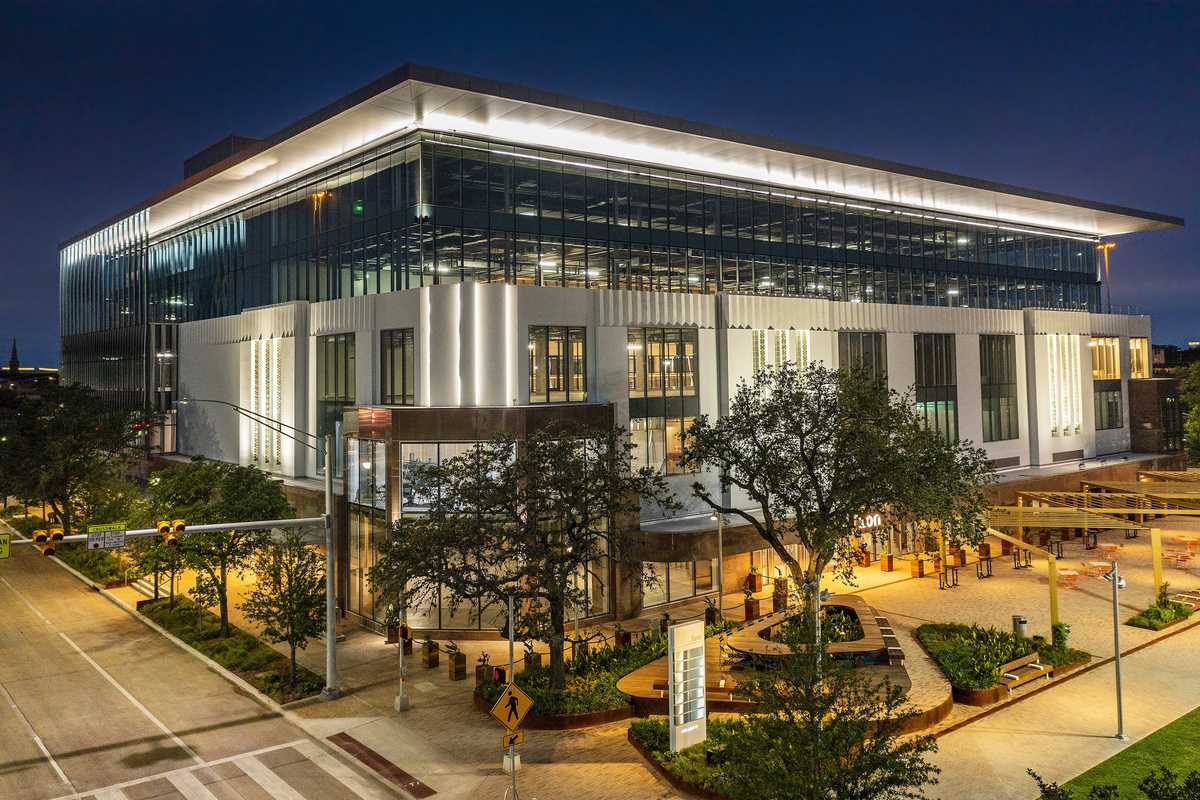
CodeLaunch, which pairs startups with software consultants, is returning to Houston this spring. Photo via codelaunch.com

A traveling seed-stage accelerator has announced its return to Houston and named its second cohort.

CodeLaunch, produced by Dallas-based constant and software development company Improving and presented by Ohio-based VC network Cyrannus, is returning to Houston. The company's second Houston accelerator event will be held on March 2.

Putting a fresh spin on the seed accelerator model, CodeLaunch combines a startup competition with a tech tradeshow, as well as allows for networking among attendees. Since its inception ten years ago, the touring competition has doled out over $1.4 million in services to its finalists and overall winners.

"CodeLaunch is a startup and rock-n-roll show like nothing you've ever seen before," says CodeLaunch President and Founder Jason W. Taylor in a news release.

The competition pairs six startups with six startup consulting companies. This year's finalists and mentor pairings are as follows:

  • Lake Charles, Louisiana-based GOPHR's consultant mentor is Softeq
  • Port Arthur, Texas-based DrinKicks is paired with BJSS
  • Energy360, based in Houston, has been matched with Honeycomb Software
  • Inpathy, based in Detroit and Tyler, Texas, will work with Contollo
  • Drivingo, led by a student founder from Virginia Tech, is selected to collaborate with Blue People
  • Houston-based AnyShift's consultant mentor is Improving

Houston-based Softeq is returning to the event after working with software startup Codiac.

“CodeLaunch was great. We gained customers, investors, and a lot of local notoriety. It was the best event we had all last year," says Ben Ghazi, founder of Codiac about the event.

ResQ TRX, a Houston startup that provides solutions for the logistics industry, won CodeLaunch HOU 2022. Houston-based Clutch won Judges' Choice in last year's competition.

This year, investment is also on the line. Presenting partner Cyrannus announced that all startup founders who advance to the semifinal round of CodeLaunch will be competing in a $100,000 investment challenge, as well as the $50,000 challenge for impact startups. There would be one or two winners — either a winner for each award or, if a company scores top marks in both categories, one company can take home the entire $150,000.

“Not only will (a winner) get the cash, but also be introduced to a network that will help them refine their idea and get ready for their first big fundraiser," says Lee Mosbacker, founder of Cyrannus, in a news release.

This year's CodeLaunch event will be a part of Houston Tech Rodeo, which is taking place February 27 to March 2 this year. Tech Rodeo, which announced its schedule this week, will conclude its programming with the CodeLaunch event.

"Houston Exponential could not be more excited about our partnership with CodeLaunch Houston," says Houston Exponential CEO Natara Branch in the release. "They are a fantastic ally in Houston’s efforts to serve its growing startup community and CodeLaunch is an incredible fit for the capstone of the 2022 Tech Rodeo. Finishing off Tech Rodeo with CodeLaunch's exciting atmosphere will be a highly anticipated event for the Houston innovation ecosystem after an engaging week of programming."

Ad Placement 300x100
Ad Placement 300x600

CultureMap Emails are Awesome

Houston to become 'global leader in brain health' and more innovation news

Top Topics

Editor's note: The most-read Houston innovation news this month is centered around brain health, from the launch of Project Metis to Rice''s new Amyloid Mechanism and Disease Center. Here are the five most popular InnovationMap stories from December 1-15, 2025:

1. Houston institutions launch Project Metis to position region as global leader in brain health

The Rice Brain Institute, UTMB's Moody Brain Health Institute and Memorial Hermann’s comprehensive neurology care department will lead Project Metis. Photo via Unsplash.

Leaders in Houston's health care and innovation sectors have joined the Center for Houston’s Future to launch an initiative that aims to make the Greater Houston Area "the global leader of brain health." The multi-year Project Metis, named after the Greek goddess of wisdom and deep thought, will be led by the newly formed Rice Brain Institute, The University of Texas Medical Branch's Moody Brain Health Institute and Memorial Hermann’s comprehensive neurology care department. The initiative comes on the heels of Texas voters overwhelmingly approving a ballot measure to launch the $3 billion, state-funded Dementia Prevention and Research Institute of Texas (DPRIT). Continue reading.

2.Rice University researchers unveil new model that could sharpen MRI scans

New findings from a team of Rice University researchers could enhance MRI clarity. Photo via Unsplash.

Researchers at Rice University, in collaboration with Oak Ridge National Laboratory, have developed a new model that could lead to sharper imaging and safer diagnostics using magnetic resonance imaging, or MRI. In a study published in The Journal of Chemical Physics, the team of researchers showed how they used the Fokker-Planck equation to better understand how water molecules respond to contrast agents in a process known as “relaxation.” Continue reading.

3. Rice University launches new center to study roots of Alzheimer’s and Parkinson’s

The new Amyloid Mechanism and Disease Center will serve as the neuroscience branch of Rice’s Brain Institute. Photo via Unsplash.

Rice University has launched its new Amyloid Mechanism and Disease Center, which aims to uncover the molecular origins of Alzheimer’s, Parkinson’s and other amyloid-related diseases. The center will bring together Rice faculty in chemistry, biophysics, cell biology and biochemistry to study how protein aggregates called amyloids form, spread and harm brain cells. It will serve as the neuroscience branch of the Rice Brain Institute, which was also recently established. Continue reading.

4. Baylor center receives $10M NIH grant to continue rare disease research

BCM's Center for Precision Medicine Models has received funding that will allow it to study more complex diseases. Photo via Getty Images

Baylor College of Medicine’s Center for Precision Medicine Models has received a $10 million, five-year grant from the National Institutes of Health that will allow it to continue its work studying rare genetic diseases. The Center for Precision Medicine Models creates customized cell, fly and mouse models that mimic specific genetic variations found in patients, helping scientists to better understand how genetic changes cause disease and explore potential treatments. Continue reading.

5. Luxury transportation startup connects Houston with Austin and San Antonio

Shutto is a new option for Houston commuters. Photo courtesy of Shutto

Houston business and leisure travelers have a luxe new way to hop between Texas cities. Transportation startup Shutto has launched luxury van service connecting San Antonio, Austin, and Houston, offering travelers a comfortable alternative to flying or long-haul rideshare. Continue reading.

Texas falls to bottom of national list for AI-related job openings

jobs report

For all the hoopla over AI in the American workforce, Texas’ share of AI-related job openings falls short of every state except Pennsylvania and Florida.

A study by Unit4, a provider of cloud-based enterprise resource planning (ERP) software for businesses, puts Texas at No. 49 among the states with the highest share of AI-focused jobs. Just 9.39 percent of Texas job postings examined by Unit4 mentioned AI.

Behind Texas are No. 49 Pennsylvania (9.24 percent of jobs related to AI) and No. 50 Florida (9.04 percent). One spot ahead of Texas, at No. 47, is California (9.56 percent).

Unit4 notes that Texas’ and Florida’s low rankings show “AI hiring concentration isn’t necessarily tied to population size or GDP.”

“For years, California, Texas, and New York dominated tech hiring, but that’s changing fast. High living costs, remote work culture, and the democratization of AI tools mean smaller states can now compete,” Unit4 spokesperson Mark Baars said in a release.

The No. 1 state is Wyoming, where 20.38 percent of job openings were related to AI. The Cowboy State was followed by Vermont at No. 2 (20.34 percent) and Rhode Island at No. 3 (19.74 percent).

“A company in Wyoming can hire an AI engineer from anywhere, and startups in Vermont can build powerful AI systems without being based in Silicon Valley,” Baars added.

The study analyzed LinkedIn job postings across all 50 states to determine which ones were leading in AI employment. Unit4 came up with percentages by dividing the total number of job postings in a state by the total number of AI-related job postings.

Experts suggest that while states like Texas, California and Florida “have a vast number of total job postings, the sheer volume of non-AI jobs dilutes their AI concentration ratio,” according to Unit4. “Moreover, many major tech firms headquartered in California are outsourcing AI roles to smaller, more affordable markets, creating a redistribution of AI employment opportunities.”

Houston energy trailblazer Fervo closes $462 million Series E

Fresh Funds

Houston-based geothermal energy company Fervo Energy has closed an oversubscribed $462 million series E funding round, led by new investor B Capital.

“Fervo is setting the pace for the next era of clean, affordable, and reliable power in the U.S.,” Jeff Johnson, general partner at B Capital, said in a news release.

“With surging demand from AI and electrification, the grid urgently needs scalable, always-on solutions, and we believe enhanced geothermal energy is uniquely positioned to deliver. We’re proud to support a team with the technical leadership, commercial traction, and leading execution capabilities to bring the world’s largest next-generation geothermal project online and make 24/7 carbon-free power a reality.”

The financing reflects “strong market confidence in Fervo’s opportunity to make geothermal energy a cornerstone of the 24/7 carbon-free power future,” according to the company. The round also included participation from Google, a longtime Fervo Partner, and other new and returning investors like Devon Energy, Mitsui & Co., Ltd., Mitsubishi Heavy Industries and Centaurus Capital. Centaurus Capital also recently committed $75 million in preferred equity to support the construction of Cape Station Phase I, Fervo noted in the release.

The latest funding will support the continued buildout of Fervo’s Utah-based Cape Station development, which is slated to start delivering 100 MW of clean power to the grid beginning in 2026. Cape Station is expected to be the world's largest next-generation geothermal development, according to Fervo. The development of several other projects will also be included in the new round of funding.

“This funding sharpens our path from breakthrough technology to large-scale deployment at Cape Station and beyond,” Tim Latimer, CEO and co-founder of Fervo, added in the news release. “We’re building the clean, firm power fleet the next decade requires, and we’re doing it now.”

Fervo recently won Scaleup of the Year at the 2025 Houston Innovation Awards, and previously raised $205.6 million in capital to help finance the Cape Station earlier this year. The company fully contracted the project's capacity with the addition of a major power purchase agreement from Shell this spring. Fervo’s valuation has been estimated at $1.4 billion and includes investments and support from Bill Gates.

“This new investment makes one thing clear: the time for geothermal is now,” Latimer added in a LinkedIn post. “The world desperately needs new power sources, and with geothermal, that power is clean and reliable. We are ready to meet the moment, and thrilled to have so many great partners on board.”

---

This article originally appeared on EnergyCapitalHTX.com.