


Chevron has commissioned a carbon capture study on one of its California sites. Photo courtesy of Chevron

Chevron's Houston-based investment and innovation arm has made moves within the carbon capture and spatial artificial intelligence spaces.

Chevron Technology Ventures has commissioned a carbon capture study with Vancouver-based Svante Inc., an at-scale carbon capture technology company. The study will explore the success of a 10,000 tonne-per-year carbon capture unit in a California Chevron facility. This study is expected to be completed in the first half of this year.

"At Chevron, we believe our industry is well-positioned to help commercialize carbon capture, utilization and storage technologies that will be essential for the energy transition," says Barbara Burger, president of CTV, in a news release. "We have leveraged venture capital and trial capabilities, our experience, and our operations to support the development of low carbon solutions."

Chevron first invested in Svante in 2014, and established its Future Energy Fund in 2018 to focus on "technologies that enable the energy transition," the release reads.

"Demonstrating this technology in the field is an important step in advancing a technology towards commercialization and scale," Burger says in the release. "Commissioning this study reflects our commitment to advance breakthrough innovation that will be important in a low carbon economy and help Chevron deliver on our mission to produce and provide affordable, reliable and ever-cleaner energy."
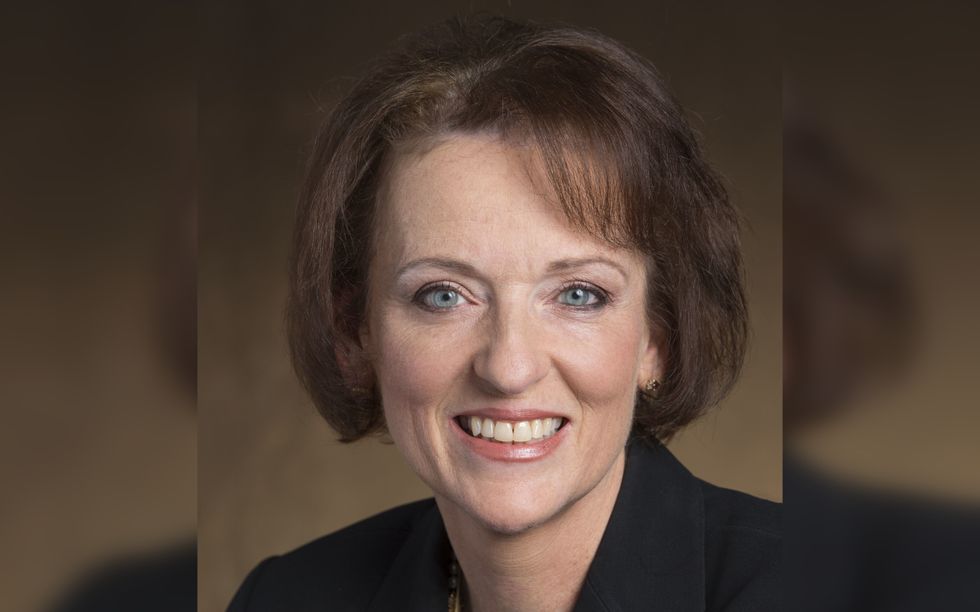
Barbara Burger leads Houston-based Chevron Technology Ventures as president. Courtesy of CTV

Meanwhile, a Dallas startup is emerging from stealth mode and announcing a $10 million series A round with contribution from CTV.

Worlds, a spin-off company from Hypergiant Sensory Sciences, is developing a technology for extended reality in a physical space. The spatial AI platform's round was led by Ohio-based Align Capital with support from Piva and Hypergiant Industries as well.

"We are creating one of the most powerful manifestations of AI yet, an AI-driven automation platform for physical environments," says Dave Copps, CEO of Worlds, in a news release.

The Worlds technology would be the first of its kind and would use deep learning combined with IoT to create a 4D environment, according to the release. The XR market has been estimated to grow to over $209 billion in the next few years, per a recent report, representing an 800 percent increase in market opportunity.

"Our investment in Worlds reflects our belief that digital innovation plays a critical role in accelerating business value at Chevron," says Burger in the release. "CTV evaluates digital technologies that can help Chevron make better and faster decisions to enable us to deliver on our mission to produce reliable, affordable, and ever-cleaner energy."

Ad Placement 300x100
Ad Placement 300x600

CultureMap Emails are Awesome

Houston quantum energy chip startup emerges from stealth with $12M round

seed funding

Houston-based Casimir has emerged from stealth with a $12 million seed round to commercialize its quantum energy chip.

The round was led by Austin-based Scout Ventures. Lavrock Ventures, Cottonwood Technology, Capital Factory, American Deep Tech, and Tim Draper of Draper Associates also participated in the round. The oversubscribed round exceeded the company’s original $8 million target, according to a news release.

Casimir’s semiconductor chips can generate power from quantum vacuum fields without the need for batteries or charging. The company plans to commercialize its first-generation MicroSparc chip by 2028.

The MicroSparc chip measures 5 millimeters by 5 millimeters and is designed to produce 1.5 volts at 25 microamps, comparable to a small rechargeable battery, without degradation and no replacement cycle.

“Casimir represents exactly the kind of breakthrough dual-use technology Scout Ventures was built to back,” Brad Harrison, founder and managing partner at Scout Ventures, said in the release. “This is based on 100 years of science and we’re finally approaching a commercial product … We’re proud to lead this round and support Casimir’s journey from applied science to deployed technology.”

Casimir says it aims to scale its technology across the ”full power spectrum,” including large-scale energy systems that can power homes, commercial infrastructures and electric vehicles.

Casimir's scientific work has been supported by DARPA-funded nanofabrication research and its technology was incubated at the Limitless Space Institute (LSI). LSI is a nonprofit that works to innovate interstellar travel and was founded by Kam Ghaffarian. Technology investor and serial entrepreneur Ghaffarian has been behind companies like X-energy, Intuitive Machines, Axiom Space and Quantum Space.

Harold “Sonny” White, founder and CEO of Casimir, believes the technology can power devices for years without replacements.

“Millions of devices will operate for years without a battery ever needing to be replaced or recharged because we have engineered a customized Casimir cavity into hardware capable of producing persistent electrical power,” White added in the release. “I spent nearly two decades at NASA studying how we power humanity’s future. That work led me to the Casimir effect and the quantum vacuum, where new tools have allowed us to build on a century of scientific knowledge and bring abundant power to the world.”

Houston-based Fervo Energy bumps up IPO target to $1.82 billion

IPO update

Houston-based geothermal power company Fervo Energy is now eyeing an IPO that would raise $1.75 billion to $1.82 billion, up from the previous target of $1.33 billion.

In paperwork filed Monday, May 11 with the U.S. Securities and Exchange Commission, Fervo says it plans to sell 70 million shares of Class A common stock at $25 to $26 per share.

In addition, Fervo expects to grant underwriters 30-day options to buy up to 8.33 million additional shares of Class A common stock. This could raise nearly $200 million.

When it announced the IPO on May 4, Fervo aimed to sell 55.56 million shares at $21 to $24 per share, which would have raised $1.17 billion to $1.33 billion. The initial valuation target was $6.5 billion.

A date for the IPO hasn’t been scheduled. Fervo’s stock will be listed on Nasdaq under the ticker symbol FRVO.

Fervo, founded in 2017, has attracted about $1.5 billion in funding from investors such as Bill Gates-founded Breakthrough Energy Ventures, Google, Mitsubishi Heavy Industries, Devon Energy (which is moving its headquarters to Houston), Tesla co-founder JB Straubel, CalSTRS, Liberty Mutual Investments, AllianceBernstein, JPMorgan, Bank of America and Sumitomo Mitsui Trust Bank.

Fervo’s marquee project is Cape Station in Beaver County, Utah, the world’s largest EGS (enhanced geothermal system) project. The first phase will deliver 100 megawatts of baseload clean power, with the second phase adding another 400 megawatts. The site can accommodate 2 gigawatts of geothermal energy. Fervo holds more than 595,000 leased acres for potential expansion.

Cape Station has secured power purchase agreements for the entire 500-megawatt capacity. Customers include Houston-based Shell Energy North America and Southern California Edison.

---

This article originally appeared on our sister site, EnergyCapitalHTX.com.