Amazon Dash Cart is now available at a Whole Foods in Texas. Courtesy Amazon

If being more efficient with your time is one of your new year's goals, a faster way to shop is on the horizon in 2023.

Amazon Dash Cart just arrived at one local San Antonio Whole Foods Market, allowing shoppers to skip the checkout line altogether.

Located at 18403 Blanco Road, the Vineyard Whole Foods Market store is one of the first three locations in the country to make Amazon Dash Carts available to customers.

The smart grocery carts lets you scan items as you go, place them directly into your grocery bags, and head straight to the car when you're done shopping. Shoppers log in through a QR code in the Whole Foods Market app, which prompts a quick sign in process before you can begin using the cart.

As you scan each item while shipping, the Amazon Dash Cart’s screen shows a real-time receipt of all items in the cart. When ready to check out, shoppers can skip the checkout line, exiting the store through the designated Amazon Dash Cart lane. Payment is then processed using the credit card associated with the shopper's Amazon account, and an automated receipt arrives at the associated email account after exiting the store.

While the carts have been in Amazon Fresh Stores across the country since 2020, they are now available in select Whole Foods Markets. Several 2022 updates included doubled capacity in the carts, new shelves for delicates and oversized items alike, weather-resistant features, and extended all-day batter life.

"As many of our customers return to their in-store grocery shopping routines, it's exciting to introduce new and unique ways for them to shop our stores," says Leandro Balbinot, chief technology officer for Whole Foods Market, in the 2022 announcement about the carts' new features.

Customers can find more detailed information on the technology here, along with a number of FAQs.

------

This article previously ran on CultureMap.
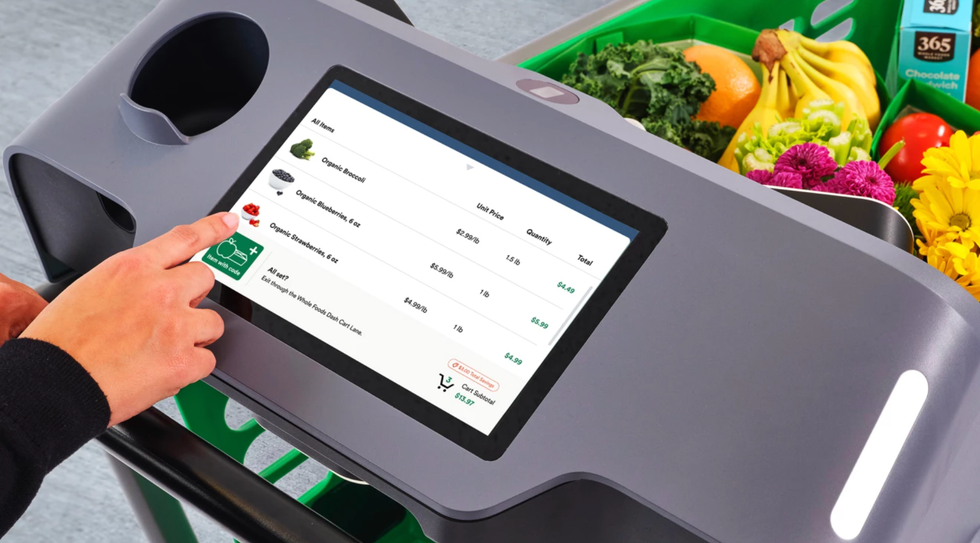
Shop smarter with these tech-enabled carts. Image via Amazon

Ad Placement 300x100
Ad Placement 300x600

CultureMap Emails are Awesome

Rice University lands $18M to revolutionize lymphatic disease detection

fresh funding

An arm of the U.S. Department of Health and Human Services has awarded $18 million to scientists at Rice University for research that has the potential to revolutionize how lymphatic diseases are detected and help increase survivability.

The lymphatic system is the network of vessels all over the body that help eliminate waste, absorb fat and maintain fluid balance. Diseases in this system are often difficult to detect early due to the small size of the vessels and the invasiveness of biopsy testing. Though survival rates of lymph disease have skyrocketed in the United States over the last five years, it still claims around 200,000 people in the country annually.

Early detection of complex lymphatic anomalies (CLAs) and lymphedema is essential in increasing successful treatment rates. That’s where Rice University’s SynthX Center, directed by Han Xiao and Lei Li, an assistant professor of electrical and computer engineering, comes in.

Aided by researchers from Texas Children’s Hospital, Baylor College of Medicine, the University of Texas at Dallas and the University of Texas Southwestern Medical Center, the center is pioneering two technologies: the Visual Imaging System for Tracing and Analyzing Lymphatics with Photoacoustics (VISTA-LYMPH) and Digital Plasmonic Nanobubble Detection for Protein (DIAMOND-P).

Simply put, VISTA-LYMPH uses photoacoustic tomography (PAT), a combination of light and sound, to more accurately map the tiny vessels of the lymphatic system. The process is more effective than diagnostic tools that use only light or sound, independent of one another. The research award is through the Advanced Research Projects Agency for Health (ARPA-H) Lymphatic Imaging, Genomics and pHenotyping Technologies (LIGHT) program, part of the U.S. HHS, which saw the potential of VISTA-LYMPH in animal tests that produced finely detailed diagnostic maps.

“Thanks to ARPA-H’s award, we will build the most advanced PAT system to image the body’s lymphatic network with unprecedented resolution and speed, enabling earlier and more accurate diagnosis,” Li said in a news release.

Meanwhile, DIAMOND-P could replace the older, less exact immunoassay. It uses laser-heated vapors of plasmonic nanoparticles to detect viruses without having to separate or amplify, and at room temperature, greatly simplifying the process. This is an important part of greater diagnosis because even with VISTA-LYMPH’s greater imaging accuracy, many lymphatic diseases still do not appear. Detecting biological markers is still necessary.

According to Rice, the efforts will help address lymphatic disorders, including Gorham-Stout disease, kaposiform lymphangiomatosis and generalized lymphatic anomaly. They also could help manage conditions associated with lymphatic dysfunction, including cancer metastasis, cardiovascular disease and neurodegeneration.

“By validating VISTA-LYMPH and DIAMOND-P in both preclinical and clinical settings, the team aims to establish a comprehensive diagnostic pipeline for lymphatic diseases and potentially beyond,” Xiao added in the release.

The ARPA-H award funds the project for up to five years.

Houston doctor wins NIH grant to test virtual reality for ICU delirium

Virtual healing

Think of it like a reverse version of The Matrix. A person wakes up in a hospital bed and gets plugged into a virtual reality game world in order to heal.

While it may sound far-fetched, Dr. Hina Faisal, a Houston Methodist critical care specialist in the Department of Surgery, was recently awarded a $242,000 grant from the National Institute of Health to test the effects of VR games on patients coming out of major surgery in the intensive care unit (ICU).

The five-year study will focus on older patients using mental stimulation techniques to reduce incidences of delirium. The award comes courtesy of the National Institute on Aging K76 Paul B. Beeson Emerging Leaders Career Development Award in Aging.

“As the population of older adults continues to grow, the need for effective, scalable interventions to prevent postoperative complications like delirium is more important than ever,” Faisal said in a news release.

ICU delirium is a serious condition that can lead to major complications and even death. Roughly 87 percent of patients who undergo major surgery involving intubation will experience some form of delirium coming out of anesthesia. Causes can range from infection to drug reactions. While many cases are mild, prolonged ICU delirium may prevent a patient from following medical advice or even cause them to hurt themselves.

Using VR games to treat delirium is a rapidly emerging and exciting branch of medicine. Studies show that VR games can help promote mental activity, memory and cognitive function. However, the full benefits are currently unknown as studies have been hampered by small patient populations.

Faisal believes that half of all ICU delirium cases are preventable through VR treatment. Currently, a general lack of knowledge and resources has been holding back the advancement of the treatment.

Hopefully, the work of Faisal in one of the busiest medical cities in the world can alleviate that problem as she spends the next half-decade plugging patients into games to aid in their healing.