


Post Houston will be site of one of the world's largest rooftop gardens. Photo courtesy of Lovett Commercial

Downtown Houston will soon have one of the largest rooftop gardens and farms in the world, thanks to the innovative reimagining of a forgotten structure. The Barbara Jordan Post Office, the massive government building nestled in the Theater District, will be transformed into a bustling, dynamic, mixed-use complex that's meant to become the city's new urban ecosystem.

At an official groundbreaking, Lovett Commercial revealed the plans for the more than 550,000-square-foot building, which was formerly the epicenter of the city's mail system from 1936 to 2014. The post office will fittingly become Post Houston and will house a concert venue, retail and office concepts, restaurants, bars, an international market hall, and a flexible co-working space.

What's sure to be a buzzworthy draw are the Buffalo Bayou and downtown views from Skylawn, the sprawling five-acre rooftop park and sustainable organic farm that calls to mind downtown rooftop green spaces in New York City. The park is designed by Hoerr Schaudt, the landscape architects behind McGovern Centennial Park in the Museum District.

Foodies, take note: The rooftop farms offer a chance for in-house restaurants to source ingredients and create a farm-to-table experience.
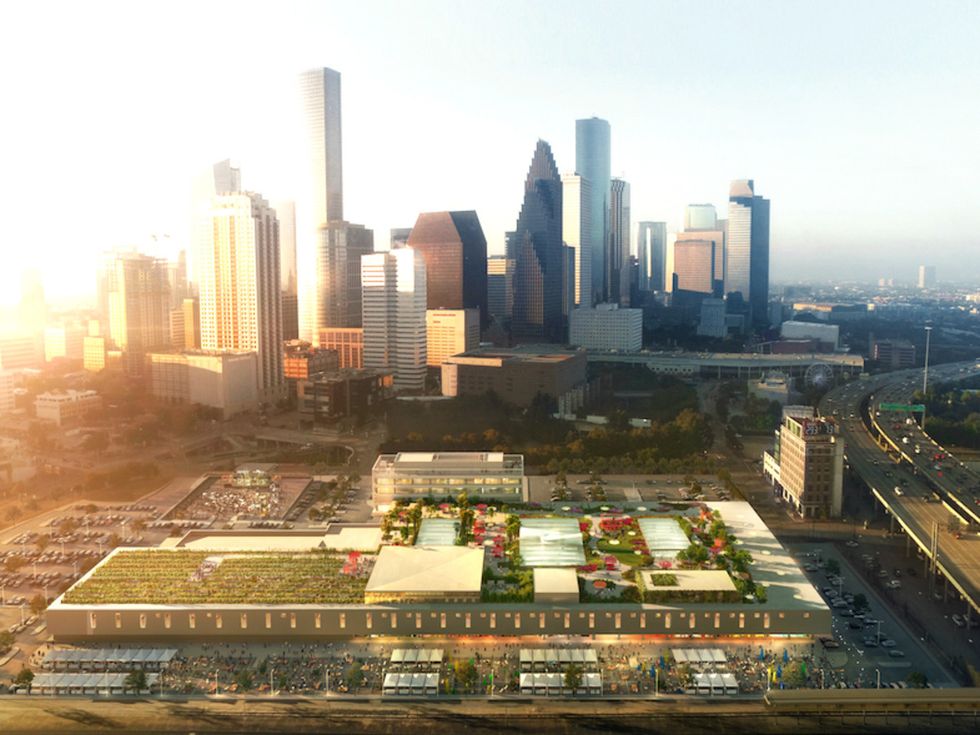
Photo courtesy of Lovett Commercial
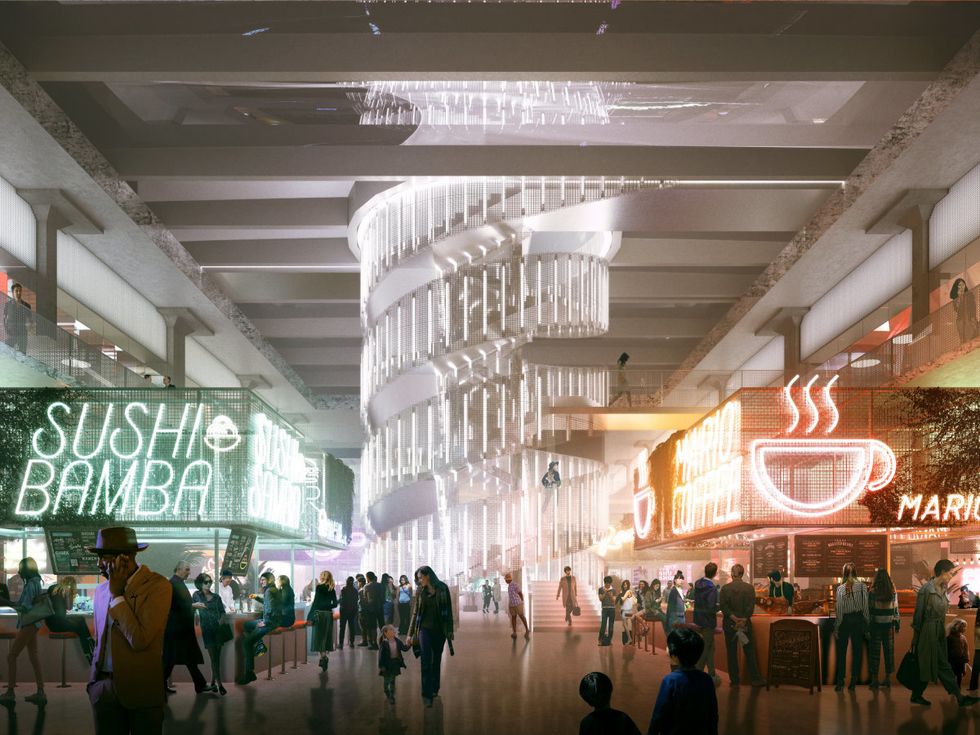
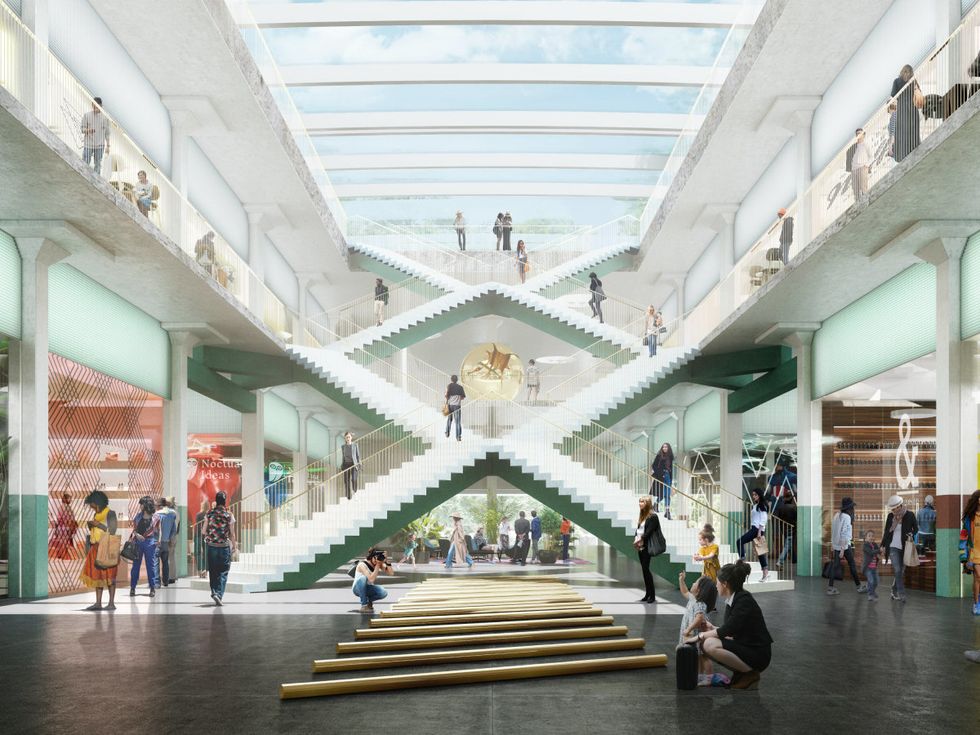
The roof promises striking downtown views.


Design-minded guests will delight in the three new atriums; the building will be surgically punctured to create the spaces to draw in existing light utilizing an ETFE roof system — the first in Houston. Each atrium will feature with a unique monumental staircase that will mark the space as coworking, culinary, or retail.

As a nod to Houston's booming arts and cultural scene, the building will house installations and exhibits by local and international artists and will host events, according to a release.

The complex is designed by the world-renowned architecture firm OMA along with partner Jason Long in collaboration with Houston-based Powers Brown Architecture. Diversity is a key theme, with myriad design elements and purposes — and it's apropos that the building is named for Barbara Jordan, Houston's beloved first African American modern-day state senator.

Other than the Day for Night festival, the site has been of interest to architecture and design circles, but has largely been an afterthought. But now, the shuttered post office could become one of Houston's most vibrant destinations with its ideal strategic location.

"This forward-thinking development is breaking away from the traditional model by creating a cultural epicenter that brings local and international cuisine, retail, art, music and innovation to our theatre district," said Mayor Sylvester Turner, in a statement.

------

This article originally ran on CultureMap.

Ad Placement 300x100
Ad Placement 300x600

CultureMap Emails are Awesome

Tech giant Apple opens Advanced Manufacturing Center at massive Houston facility

up and running

Cupertino, California-based Apple Inc. unveiled its Advanced Manufacturing Center in the Houston area last week, marking the completion of the second of three facilities the tech giant plans to launch in the city by the end of this year.

The 20,000-square-foot training center will welcome small- and medium-sized businesses for free training and educational sessions to "help accelerate smart manufacturing across America," according to a release from Apple. Apple opened a similar Apple Manufacturing Academy in Detroit last year.

The AMC is part of Apple's 500,000-square-foot site in northwest Harris County. It also features a massive manufacturing site for Apple’s advanced AI servers and Mac mini. The facility was originally slated to open in 2026, but Apple began producing its advanced AI servers ahead of schedule in 2025.

The company said it plans to begin manufacturing its Mac mini at the site this year. The move will bring production of the compact desktop computer to the U.S. for the first time.

“In less than nine months, we have invested hundreds of millions of dollars into this Houston facility. We stood up a factory, started production, and shipped the first advanced AI servers off the line. Today, we’re thrilled to open our new Advanced Manufacturing Center, a place where businesses, workers, and students can learn the same innovative processes that we use to make Apple’s most groundbreaking products. And we’re pleased to begin Mac mini production later this year,” Tim Cook, Apple’s CEO, said in the news release. “We believe in American workers and American ingenuity, and we are moving at an incredible pace because we want to build more than great products. We want to build the future of American manufacturing.”

Apple's Advanced Manufacturing Center. Photos courtesy Apple

Apple's Houston expansion is part of a $600 billion commitment the company made to the U.S. in 2025.

The company originally announced plans in February 2025 to open a 250,000-square-foot Houston factory, but doubled the facility's planned size about a year later. Apple has reported that the factory will employ thousands of workers.

“Houston is grateful to Apple for this significant investment in our city. The Advanced Manufacturing Center will create local jobs and will continue improving the quality of life of Houston residents," Houston Mayor John Whitmire added in the release. "The AMC also recognizes our city as a growing technology hub and solidifies Houston’s leadership in the manufacturing sector of the United States.”

The opening comes on the heels of New Jersey-based pharmaceutical giant Bristol Myers Squibb Co. officially naming Houston home of its new $2.3 billion, state-of-the-art manufacturing site. Read more here.

Nominations for the 2026 Houston Innovation Awards are due by Aug. 27

Calling All Innovators

Calling all Houston innovators: The 2026 Houston Innovation Awards, presented by InnovationMap, return this fall to celebrate the best and brightest in the Houston innovation ecosystem right now.

We're asking you to nominate Houston's top innovators and startups for this year's awards. Nominations are open now through August 27 and can be made on behalf of yourself, your organization, and other influential leaders in the local innovation scene.

The annual awards program recognizes the most innovative individuals and companies in Houston across 10 prestigious categories.

This year's awards will honor the following categories:

  • Minority-founded Business, honoring an innovative startup founded or co-founded by BIPOC or LGBTQ+ representation.
  • Female-founded Business, honoring an innovative startup founded or co-founded by a woman.
  • Energy Transition Business, honoring an innovative startup providing a solution within renewables, climatetech, clean energy, alternative materials, circular economy, and beyond.
  • Health Tech Business, honoring an innovative startup within the health and medical technology sectors.
  • Deep Tech Business, honoring an innovative startup providing technology solutions based on substantial scientific or engineering challenges, including those in the AI, robotics, and space sectors.
  • Startup of the Year (People's Choice), honoring a startup celebrating a recent milestone or success. The winner will be selected by the community via an interactive voting experience.
  • Scaleup of the Year, honoring an innovative later-stage startup that's recently reached a significant milestone in company growth.
  • Incubator/Accelerator of the Year, honoring a local incubator or accelerator that is championing and fueling the growth of Houston startups.
  • Mentor of the Year, honoring an individual who dedicates their time and expertise to guide and support budding entrepreneurs.
  • Trailblazer, honoring an innovator who's made a lasting impact on the Houston innovation community.

You have three weeks to submit nominees, so don't delay — nominate today at this link or fill out the form below. Qualified nominees will receive a formal application to complete, which will be reviewed by our esteemed panel of judges to determine the finalists and winners.

More announcements about the 2026 Houston Innovation Awards are coming soon, including an introduction to this year's panel of judges. Interested in sponsoring the 2026 Houston Innovation Awards? Please contact sales@innovationmap.com.

$5B MD Anderson-anchored Austin medical center to break ground this fall

moving forward

Construction on the $1 billion first phase of the AI-native University of Texas Dell Medical Center in Austin—which will feature a hospital operated by Houston’s UT MD Anderson Cancer Center—is set to start this fall.

The UT System Board of Regents approved funding for first-phase construction on Aug. 12.

The medical center—now expected to cost $5 billion, up from the initial $2.9 billion estimate—will span about 2.5 million square feet. It will include 300 to 500 patient beds, outpatient facilities, an emergency department and specialized care for cancer patients.

MD Anderson will bring its world-renowned oncology programs to the center’s integrated health care model, Dr. Claudia Lucchinetti, senior vice president of medical affairs at UT Austin and dean of the university’s Dell Medical School, tells Health Leaders.

Earlier this year, Austin tech billionaire Michael Dell and his wife, Susan, pledged $750 million for development of the medical center. The medical center, scheduled for completion in December 2030, will be a cornerstone of the new 300-acre UT Dell Campus for Advanced Research, a medical education and research hub.

“Through this new campus and medical center, Texas will lead America in health care innovation,” Gov. Greg Abbott said when the research campus was announced in April. “The next generation of medical breakthroughs will take place in Central Texas.”

The medical center will fold AI tools and other technology into the infrastructure, rather than having them added after it’s built. Among other capabilities, the technology will monitor real-time medical data, automate data entry, and help health care professionals quickly predict and identify risks to patients, according to Health Leaders.

“We are not just building a new medical center,” Lucchinetti says. “We are building a fundamentally new model of health. It’s not just a new facility. It’s not just a new collaboration. It is a convergence of capabilities that rarely come together at the same time.”