


A new Houston-based edtech platform is being piloted with 35 educators and more than 200 students in Texas and Arizona. Photo via Pexels

Early detection. It sounds simple enough: identify a problem before it has the chance to become a bigger one.

But in practice, early detection is much more difficult to navigate, especially in education, when it comes to identifying the reasons behind a student's academic struggles.

That’s why co-founders Alapati “Al” Ware and Estela Montanez launched Progress Report, a Houston-built K-12 learning-intelligence platform designed to go beyond identifying that a student is struggling.

The platform recently began its pilot program with 35 educators and more than 200 students in Texas and Arizona.

“It’s a micro-learning school that works with children with disabilities, primarily dyslexia and nonverbal students,” Ware tells InnovationMap.

The platform is also being used by homeschool parents, home teachers and Houston educators, including those at SWPS College & Career Preparatory Academy, a Houston charter school.

Ware says Progress Report was designed to fill a gap he and Montanez saw in existing edtech. Some platforms cater almost entirely to students, leaving teachers with little insight into if and how a child is learning. Others focus heavily on district data, where “the student is just a number,” leaving teachers to navigate disconnected tools.

“Our goal was [to] focus purely on the teacher because the teacher is the backbone,” Ware says.

Progress Report traces student performance to learning gaps and prerequisite skills, helping educators understand not only where a student is struggling, but what may be causing it.

The platform then helps teachers build individualized instruction for general education students, students with special education and Individualized Education Program (IEP) needs, and Spanish-speaking learners—all within one educator-controlled system.

The goal is to reduce the guesswork and hours of manual work educators can spend developing individualized lesson plans.
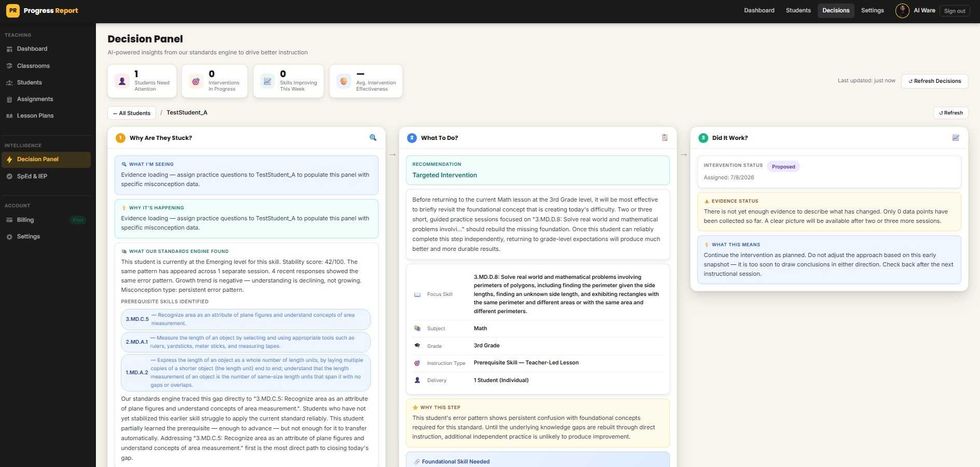
Progress Report helps idenitify learning gaps and common roadblocks for each student. Image courtesy Progress Report

For Ware and Montanez, the mission is also personal.

The concept dates back to around 2023, when the co-founders first had to navigate and address their children’s educational needs.

Ware, Progress Report’s CEO and CTO with a background in edtech, built the platform end-to-end after watching his daughter, who had an IEP related to speech, struggle to get the support she needed.

Montanez, the company’s COO, brought another perspective. Her son is on the autism spectrum. She now leads Progress Report’s operations, partnerships and pilot execution while helping carry its focus on bilingual families from Puerto Rico to Houston.

Together, they began researching ways to personalize their children’s learning and help them progress academically. Montanez’s son went on to become an AP student and high school athlete, while Ware’s daughter began reading more than two grade levels above her grade, they tell InnovationMap.

But Progress Report isn’t designed simply to give a struggling student more work.

Take a student who appears to have difficulty with math.

The problem may not actually be math, the founders share. The student could understand the calculations but struggle to comprehend complex words used in a math problem.

Progress Report is designed to trace those performance patterns back to learning gaps, prerequisite skills or other instructional barriers. From there, it can recommend a next instructional step while leaving the educator in control.

The same concept applies to accommodations.

The system can read IEPs, 504 Plans, Present Levels of Academic Achievement and Functional Performance (PLAAFPs), evaluations and other special education records. Approved IEP goals can then be mapped into the student’s learning graph, while accommodations can carry over into lesson planning and question delivery.

The founders say that approach separates Progress Report from simply adding another artificial intelligence chatbot to a classroom. And still, they believe teachers have to remain at the center.

Teachers, in fact, helped build Progress Report.

The founders began meeting with Houston-area educators months before the pilot. Their feedback helped shape the platform before testing began.

“We’ve been building alongside these educators,” Ware says.

Parents are another piece.

Progress Report can give parents access to their child’s learning record so they can see learning gaps as they develop. Teachers can also see information on work being completed at home when the parent and educator are working together.

After the pilot wraps, Ware and Montanez plan to introduce a $29.99 monthly subscription for homeschool parents, teachers and other educators. They say the price was intentionally kept relatively low to help make the tools more accessible.

They are also exploring ways to work with organizations that could help families who can’t afford the platform.

Moving forward, the goal is considerably bigger.

Over the next five years, Ware and Montanez want Progress Report to become what they describe as a “gold standard” in every state. They know getting there will require building relationships with educators, technology leaders, policymakers and school board members.

For now, they’re starting with a few hundred students and a question that sounds simple but can be remarkably difficult to answer: Why is this student struggling?

If Progress Report works the way its founders envision, teachers and parents will have a clearer answer.

Ad Placement 300x100
Ad Placement 300x600

CultureMap Emails are Awesome

UH lands $3M grant to expand opioid overdose training

Overdose Response

The University of Houston has received a $3 million federal grant to expand its potentially life-saving overdose response training program.

The grant will support the Houston Health Department’s FRONTLINES program that trains first responders in Harris and Fort Bend counties to recognize opioid overdoses and administer the drug naloxone, which can counter the effects of an opioid overdose. The four-year grant comes from the Substance Abuse and Mental Health Services Administration within the Department of Health and Human Services, and it builds on eight years of work at UH, according to a release from the university.

As part of the expansion, UH medical, social work and psychology students will now also be able to take part in FRONTLINES’ overdose-response training. Some of the students will also be selected to help train community members, ultimately passing along the life-saving skills throughout Houston.

FRONTLINES is a collaboration with the City of Houston, the Fertitta College of Medicine, Baylor College of Medicine and the Houston Recovery Center. It was co-founded by Dr. James Bray, chair of the Department of Behavioral and Social Sciences at the University of Houston’s Tilman J. Fertitta Family College of Medicine, in 2018.

“When someone experiencing an opioid overdose is reached in time, naloxone can save their life,” Bray said in a news release. “We’ve seen the impact this training can have in Houston, and now we have an opportunity to extend that reach across Harris and Fort Bend counties, putting lifesaving knowledge and tools into the hands of more first responders.”

In 2024, around 450 residents of Harris County died from opioid overdoses, according to a Texas Department of State Health Services report. The report found that fentanyl was involved in about three-quarters of the deaths.

In 2025, UH also received a $2.6 million gift from the estate of Dr. William A. Gibson to expand its opioid research and develop a vaccine to help block fentanyl's effectiveness in entering the brain. The vaccine research is part of the Michael C. Gibson Addiction Research Program led by UH professor of psychology Therese Kosten and founding member of the UH Drug Discovery Institute Colin Haile. Read more about the grant and the vaccine’s development here.

Texas public libraries drive billions in economic impact, report finds

Beyond the Stacks

A new statewide study examining the economic impacts of public libraries has revealed they have generated over $3.8 billion in value to local communities — a return of $4.74 for every $1 invested.

The report, "Beyond the Stacks: Measuring the Economic and Community Value of Texas Public Libraries" was conducted by third-party consultancy JBK Economics Group in partnership with the Texas Library Association. About 300 of the total 513 public libraries in Texas participated in a survey for the report.

A major finding from the survey revealed that public libraries create billions in economic value for the communities they serve at a fraction of what it costs to pay employee wages and benefits, operating expenditures, and capital expenditures. About 11,200 jobs were directly and indirectly supported by public libraries, the report found.

The report found its $4.74 to $1 ratio by adding up the total value of the services provided by these institutions (an estimated $2.48 billion), and comparing it to total expenditures ($808.6 million).

"Public libraries had about the same economic footprint as the Texas motion picture and sound recording industry ($2.9 billion in Gross Domestic Product in 2024) or the Texas paper manufacturing industry ($4.0 billion in Gross Domestic Product in 2024)," the report said.

Many Houstonians are already familiar with Houston Public Library's expansive catalog and programming, but there are many more services the library provides that might fly under the radar. A few examples include access to subscription-based research databases and news outlets, and the Library of Things, a collection of cookware and bake ware, musical instruments, craft kits, and other tools or activity materials that are available for cardholders to borrow. Individual branches also provide free Wi-Fi, computer access, and meeting spaces.

Houston-area residents also have access to services at several other local libraries depending on their address, such as the Harris County Public Library, Montgomery County Memorial Library System, or Fort Bend County Libraries, just to name a few.

These are additional services and partnerships that Texas public libraries commonly provide, per the survey results:

  • 93 percent provide voter registration and/or serve as voting locations
  • 84 percent provide partnerships with local social services agencies
  • 82 percent provide job application assistance
  • 68 percent facilitate applications for government benefits
  • 38 percent provide on-site social services
  • 30 percent provide telehealth rooms and/or resources
"Public libraries are practical, welcoming and rooted in the communities they serve — they are unmistakably Texan," said Texas Library Association executive director Shirley Robinson in a press release. "This study puts a dollar value on the opportunities libraries create every day. Whether someone visits a library to apply for a job, access the internet, learn a new skill or simply find a new favorite book, those services create real value for Texans and their communities."

------

This article first appeared on CultureMap.com.

Rice University launches new venture fund for university-affiliated startups

startup support

Rice University has launched its new One Giant Leap Ventures Fund I, which will invest in the university’s spinouts and alumni-founded startups.

The early-stage institutional venture fund will function with a hybrid structure that allows for participation from traditional equity investors and philanthropic investors. According to the university, the fund will invest up to $500,000 per Rice-affiliated company.

To be considered eligible for funds, companies must use intellectual property licensed by the university or be led or founded by alumni.

One Giant Leap will draw on support and mentorship from Rice’s pool of 60,000 alumni and aims to create educational opportunities within the investment phases, work with graduate and undergraduate venture students, explore the scaling and commercialization of their ideas, and help investigate all the facets of venture capital.

“Rice alumni bring an extraordinary depth of experience as entrepreneurs, investors and industry leaders, and One Giant Leap creates new ways to put that expertise to work for the next generation of Rice innovators,” Stephen Bayer, vice president for development and alumni relations, said in a news release. “It strengthens the connection between our alumni and the university while giving them meaningful opportunities to mentor, advise and support Rice-affiliated companies as they grow.”

The fund held its first close in August and made its first investment into Rice brain health spinout Motif Neurotech. Led by Rice faculty member Jacob Robinson, Motif is working to commercialize a minimally invasive neurostimulator that targets treatment-resistant depression. In May, the FDA approved the company to move forward with its first clinical trial.

“Research produces breakthrough technologies and our academic environment forms outstanding entrepreneurs,” said Adrian Trömel, the fund’s managing director, a Rice alumnus and a startup founder who also serves as Rice’s interim chief innovation officer.

One Giant Leap joins the already long list of Rice-led programs that foster innovation, including the Liu Idea Labs for Innovation and Entrepreneurship’s Innovation Fellows and Summer Venture Studio, the Rice Alliance’s Business Plan Competition, the Ion District, Woodside Rice Decarbonization Accelerator, Rice Nexus, the Biotech Launchpad and RBL Ventures and its upcoming 200,000 square-foot research lab the Arc.

“With One Giant Leap, I am excited that we are creating a unique structure that brings together traditional investment and philanthropic participation to invest in and help catalyze our startups, engage the deep expertise within the Rice ecosystem and transform those strengths into real-world impact,” Trömel added in the release.