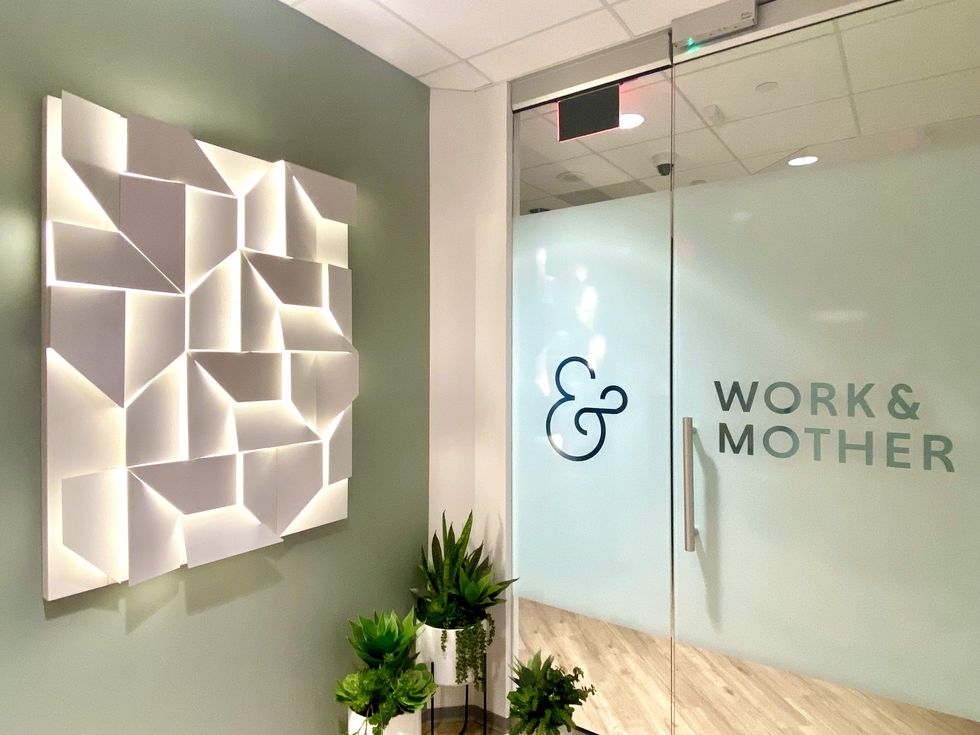
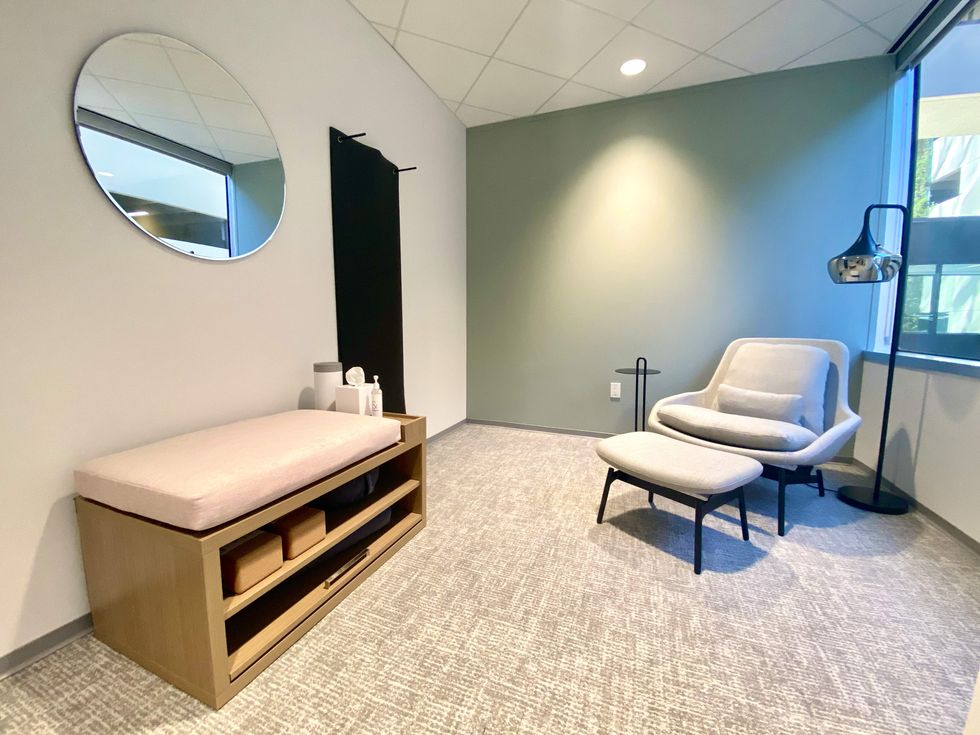
After a recent rebrand, Work& (previously Work&Mother) has introduced its first employee wellness space at a major Houston office plaza. Photos courtesy MetroNational

Houston-based femtech company Work&, previously Work&Mother, debuted new lactation suites and its first employee wellness space at MetroNational’s Memorial City Plazas this month.

The 1,457-square-foot Work& space features three lactation rooms and five wellness suites, the latter of which are intended to offer employees a private space and time for telehealth appointments, meditation, prayer, and other needs. The hybrid space, designed by Houston-based Inventure, represents Work&'s shift to offer an array of holistic health and wellness solutions to landlords for tenants.

Work& rebranded from Work&Mother earlier this year. The company was previously focused on outfitting commercial buildings with lactation accommodations for working parents, equipped with a hospital-grade pump, milk storage bags, sanitizing wipes, and other supplies. While Work& will still offer these services through its Work&Mother branch, the addition of its Work&Wellbeing arm allows the company to also "address the broader wellness needs of all employees," according to an announcement made on LinkedIn.

"We are thrilled to bring Work&Mother and Work&Wellbeing to The Plazas," Jules Lairson, co-founder and COO of Work&, said in a news release. “This partnership brings every stakeholder together – employees, employers and landlords all benefit from this kind of forward-thinking tenant experience. We are excited to launch our Work&Wellbeing concept with MetroNational to ensure that all employees have their wellness needs met with private, clean, quiet spaces for use during the workday.”

The new space is available to all tenants across Memorial City Plazas, comprised of three office towers totaling 1 million square feet of Class A office space. In addition to the lactation and wellness suites, the space also features custom banquettes, private lounge seating and phone booths.

“As a family-owned and operated company, MetroNational is deeply committed to fostering a workplace that supports both productivity and the well-being of all our tenants,” Anne Marie Ratliff, vice president of asset management for MetroNational, added in the release. “Partnering with Work& reinforces this commitment, enhancing our workplace experience and setting a new standard for tenant amenities.”

Work& has five Houston locations and several others in major metros, including New York, Austin, D.C., Boston, Chicago, San Francisco, and Miami. According to its website, the company will also introduce a Work&Wellbeing suite in New York.

Abbey Donnell spoke with InnovationMap on the Houston Innovators Podcast about why she founded the company and its plans for growth in 2021. Click here to learn more.


Ad Placement 300x100
Ad Placement 300x600

CultureMap Emails are Awesome

MD Anderson makes AI partnership to advance precision oncology

AI Oncology

Few experts will disagree that data-driven medicine is one of the most certain ways forward for our health. However, actually adopting it comes at a steep curve. But what if using the technology were democratized?

This is the question that SOPHiA GENETICS has been seeking to answer since 2011 with its universal AI platform, SOPHiA DDM. The cloud-native system analyzes and interprets complex health care data across technologies and institutions, allowing hospitals and clinicians to gain clinically actionable insights faster and at scale.

The University of Texas MD Anderson Cancer Center has just announced its official collaboration with SOPHiA GENETICS to accelerate breakthroughs in precision oncology. Together, they are developing a novel sequencing oncology test, as well as creating several programs targeted at the research and development of additional technology.

That technology will allow the hospital to develop new ways to chart the growth and changes of tumors in real time, pick the best clinical trials and medications for patients and make genomic testing more reliable. Shashikant Kulkarni, deputy division head for Molecular Pathology, and Dr. J. Bryan, assistant professor, will lead the collaboration on MD Anderson’s end.

“Cancer research has evolved rapidly, and we have more health data available than ever before. Our collaboration with SOPHiA GENETICS reflects how our lab is evolving and integrating advanced analytics and AI to better interpret complex molecular information,” Dr. Donna Hansel, division head of Pathology and Laboratory Medicine at MD Anderson, said in a press release. “This collaboration will expand our ability to translate high-dimensional data into insights that can meaningfully advance research and precision oncology.”

SOPHiA GENETICS is based in Switzerland and France, and has its U.S. offices in Boston.

“This collaboration with MD Anderson amplifies our shared ambition to push the boundaries of what is possible in cancer research,” Dr. Philippe Menu, chief product officer and chief medical officer at SOPHiA GENETICS, added in the release. “With SOPHiA DDM as a unifying analytical layer, we are enabling new discoveries, accelerating breakthroughs in precision oncology and, most importantly, enabling patients around the globe to benefit from these innovations by bringing leading technologies to all geographies quickly and at scale.”

Houston company plans lunar mission to test clean energy resource

lunar power

Houston-based natural resource and lunar development company Black Moon Energy Corporation (BMEC) announced that it is planning a robotic mission to the surface of the moon within the next five years.

The company has engaged NASA’s Jet Propulsion Laboratory (JPL) and Caltech to carry out the mission’s robotic systems, scientific instrumentation, data acquisition and mission operations. Black Moon will lead mission management, resource-assessment strategy and large-scale operations planning.

The goal of the year-long expedition will be to gather data and perform operations to determine the feasibility of a lunar Helium-3 supply chain. Helium-3 is abundant on the surface of the moon, but extremely rare on Earth. BMEC believes it could be a solution to the world's accelerating energy challenges.

Helium-3 fusion releases 4 million times more energy than the combustion of fossil fuels and four times more energy than traditional nuclear fission in a “clean” manner with no primary radioactive products or environmental issues, according to BMEC. Additionally, the company estimates that there is enough lunar Helium-3 to power humanity for thousands of years.

"By combining Black Moon's expertise in resource development with JPL and Caltech's renowned scientific and engineering capabilities, we are building the knowledge base required to power a new era of clean, abundant, and affordable energy for the entire planet," David Warden, CEO of BMEC, said in a news release.

The company says that information gathered from the planned lunar mission will support potential applications in fusion power generation, national security systems, quantum computing, radiation detection, medical imaging and cryogenic technologies.

Black Moon Energy was founded in 2022 by David Warden, Leroy Chiao, Peter Jones and Dan Warden. Chiao served as a NASA astronaut for 15 years. The other founders have held positions at Rice University, Schlumberger, BP and other major energy space organizations.

Houston co. makes breakthrough in clean carbon fiber manufacturing

Future of Fiber

Houston-based Mars Materials has made a breakthrough in turning stored carbon dioxide into everyday products.

In partnership with the Textile Innovation Engine of North Carolina and North Carolina State University, Mars Materials turned its CO2-derived product into a high-quality raw material for producing carbon fiber, according to a news release. According to the company, the product works "exactly like" the traditional chemical used to create carbon fiber that is derived from oil and coal.

Testing showed the end product met the high standards required for high-performance carbon fiber. Carbon fiber finds its way into aircraft, missile components, drones, racecars, golf clubs, snowboards, bridges, X-ray equipment, prosthetics, wind turbine blades and more.

The successful test “keeps a promise we made to our investors and the industry,” Aaron Fitzgerald, co-founder and CEO of Mars Materials, said in the release. “We proved we can make carbon fiber from the air without losing any quality.”

“Just as we did with our water-soluble polymers, getting it right on the first try allows us to move faster,” Fitzgerald adds. “We can now focus on scaling up production to accelerate bringing manufacturing of this critical material back to the U.S.”

Mars Materials, founded in 2019, converts captured carbon into resources, such as carbon fiber and wastewater treatment chemicals. Investors include Untapped Capital, Prithvi Ventures, Climate Capital Collective, Overlap Holdings, BlackTech Capital, Jonathan Azoff, Nate Salpeter and Brian Andrés Helmick.

---

This article originally appeared on our sister site, EnergyCapitalHTX.com.