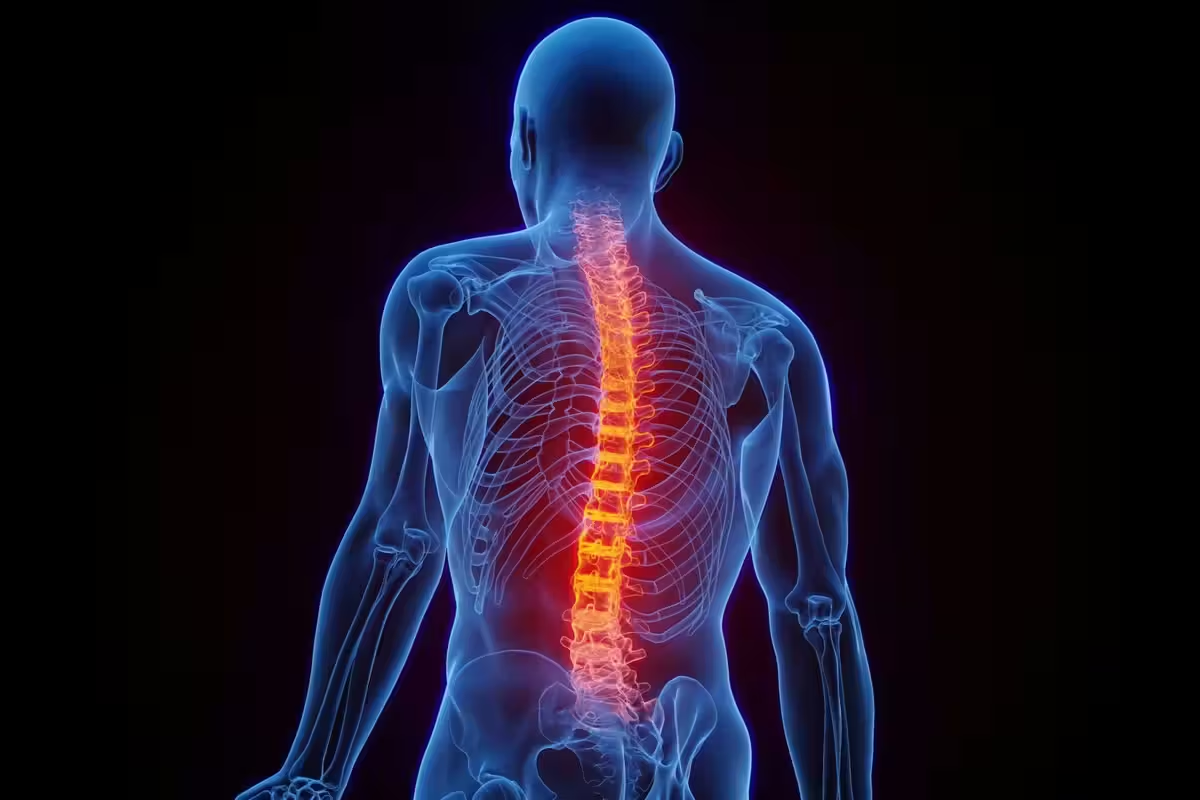
The new Rice Brain Institute brings together engineering, natural sciences and social sciences to better understand the brain. Photo courtesy Rice University.

Rice University has announced the creation of a new interdisciplinary center known as the Rice Brain Institute (RBI).

The new hub will aim to use engineering, natural sciences and social sciences to research the brain and reduce the burden of neurodegenerative, neurodevelopmental and mental health disorders.

“The Rice Brain Institute reflects Rice’s strength in collaboration without boundaries,” Rachel Kimbro, dean of the School of Social Sciences, said in a news release. “Our researchers are not only advancing fundamental science but they’re also ensuring that knowledge reaches society in ways that promote human flourishing.”

RBI researchers will work in thematic clusters focusing on neurodegeneration, mental health, brain injury and neurodevelopment. The clusters will work toward goals such as significantly improving key brain health outcomes, reducing mortality and mental health disorders and improving quality of life for patients living with brain injuries and neurodevelopmental disorders, according to Rice.

The institute will focus on “engineering-driven innovation,” rather than traditional neuroscience, to design tools that can measure, model and modulate brain activity based around Rice’s expertise in soft robotics, neuroimaging, data science and artificial intelligence—making it unique among peer organizations, according to Rice.

Additionally, RBI will be structured around three collaborative Rice “pillars”:

  • The Neuroengineering Initiative, launched in 2018, brings together neuroscience, engineering, and related fields experts
  • The Neuroscience Initiative, a new initiative that brings together cell biologists, neurobiologists, biochemists, chemists and physicists to explore fundamental mechanisms of the brain and nervous system
  • The Brain and Society Initiative, also a new initiative, considers brain research within the broader social and policy landscape

Rice’s Neuroengineering Initiative has already garnered more than $78 million in research funding, according to Rice, and has established major partnerships, like the Rice-Houston Methodist Center for Neural Systems Restoration.

“Rice is uniquely equipped to bridge and connect scientific understanding of the brain and behavior sciences with the technologies and policies that shape our world,” Amy Dittmar, the Howard R. Hughes Provost and executive vice president for academic affairs, added in the news release. “By uniting faculty in neuroengineering, neuroscience and psychological sciences, this interdisciplinary hub embodies the kind of bold, nimble collaboration that allows Rice to turn discovery into societal impact to save lives and enhance human flourishing.”

The formation of the RBI coincides with recent support of the Dementia Prevention Research Institute of Texas (DPRIT), which landed voter approval earlier this week and aims to make Texas the center for dementia research via brain-health tech. According to the World Economic Forum, brain disorders and mental health disorders cost the global economy an estimated $5 trillion per year and could be as high as $16 trillion by 2030.

“Few areas of research have as direct and profound an impact on human well-being as brain health,” Rice President Reginald DesRoches added in the news release. “As rates of Alzheimer’s, dementia and other neurological diseases rise in our country and around the world, universities have a responsibility to lead the discovery of solutions that preserve memory, movement and quality of life. We all know someone who has been affected by a brain-related health issue, so this research is personal to all of us.”

Ad Placement 300x100
Ad Placement 300x600

CultureMap Emails are Awesome

Intuitive Machines forms partnership with Italian companies for lunar exploration services

to the moon

Houston-based space technology, infrastructure and services company Intuitive Machines has forged a partnership with two Italian companies to offer infrastructure, communication and navigation services for exploration of the moon.

Intuitive Machines’ agreement with the two companies, Leonardo and Telespazio, paves the way for collaboration on satellite services for NASA, a customer of Intuitive Machines, and the European Space Agency, a customer of Leonardo and Telespazio. Leonardo, an aerospace, defense and security company, is the majority owner of Telespazio, a provider of satellite technology and services.

“Resilient, secure, and scalable space infrastructure and space data networks are vital to customers who want to push farther on the lunar surface and beyond to Mars,” Steve Altemus, co-founder and CEO of Intuitive Machine, said in a news release.

Massimo Claudio Comparini, managing director of Leonardo’s space division, added that the partnership with Intuitive Machines is a big step toward enabling human and robotic missions from the U.S., Europe and other places “to access a robust communications network and high-precision navigation services while operating in the lunar environment.”

Intuitive Machines recently expanded its Houston Spaceport facilities to ramp up in-house production of satellites. The company’s first satellite will launch with its upcoming IM‑3 lunar mission.

Intuitive Machines says it ultimately wants to establish a “center of space excellence” at Houston Spaceport to support missions to the moon, Mars and the region between Earth and the moon.

Houston hospitals win $50M grant for ibogaine addiction treatment research

ibogaine funding

The Texas Health and Human Services Commission has awarded $50 million to UTHealth Houston in collaboration with The University of Texas Medical Branch at Galveston (UTMB Health) to co-lead a multicenter research trial to evaluate the effect of ibogaine, a powerful psychoactive compound, on patients suffering from addiction, traumatic brain injury and other behavioral health conditions.

The funding will establish a two-year initiative—known as Ibogaine Medicine for PTSD, Addiction, and Cognitive Trauma (IMPACT)—and a consortium of Texas health institutions focused on clinical trials and working toward potential FDA-approved treatments.

The consoritum will also include Texas Tech University, Texas Tech University Health Sciences Center El Paso, The University of Texas at Austin, The University of Texas Health Science Center at San Antonio, The University of Texas at Tyler, The University of Texas Rio Grande Valley, Texas A&M University, The University of North Texas Health Science Center, Baylor College of Medicine and JPS Health Network in Dallas.

Ibogaine is a plant-based, psychoactive substance derived from the iboga shrub. Research suggests that the substance could be used for potential treatment for patients with traumatic brain injuries, which is a leading cause of post-traumatic stress disorders. Ibogaine has also shown potential as a treatment for addiction and other neurological conditions.

UTHealth and partners will focus on ways that ibogaine can treat addiction and associated conditions. Meanwhile, UT Austin and Baylor College of Medicine will concentrate on using it to treat traumatic brain injury, especially in veterans, according to a news release from the institutions.

The consortium will also support drug developers and teaching hospitals to conduct FDA-approved clinical trials. The Texas Health and Human Services Commission will oversee the grant program.

“This landmark clinical trial reflects our unwavering commitment to advancing research that improves lives and delivers the highest standards of care,” Dr. Melina Kibbe, UTHealth Houston president and the Alkek-Williams Distinguished Chair, said in the news release. “By joining forces with outstanding partners across our state, we are building on Texas’ tradition of innovation to ensure patients struggling with addiction and behavioral health conditions have access to the best possible outcomes. Together, we are shaping discoveries that will serve Texans and set a model for the nation.”

The consortium was authorized by the passage of Senate Bill 2308. The bill provides $50 million in state-matching funds for an ibogaine clinical trial managed by a public university in partnership with a drug company and a hospital.

“This is the first major step towards the legislature’s goal of obtaining FDA approval through clinical trials of ibogaine — a potential breakthrough medication that has brought thousands of America’s war-fighters back from the darkest parts of depression, anxiety, PTSD, and chronic addiction,” Texas Rep. Cody Harris added in the release. “I am excited to walk alongside UTHealth Houston and UTMB as these stellar institutions lead the nation in a first-of-its-kind clinical trial in the U.S.”

Recently, the University of Houston also received a $2.6 million gift from the estate of Dr. William A. Gibson to support and expand its opioid addiction research, which includes the development of a fentanyl vaccine that could block the drug's ability to enter the brain. Read more here.

Tesla no longer world's biggest EV maker as sales fall for second year

Tesla Talk

Tesla lost its crown as the world’s bestselling electric vehicle maker as a customer revolt over Elon Musk’s right-wing politics, expiring U.S. tax breaks for buyers and stiff overseas competition pushed sales down for a second year in a row.

Tesla said that it delivered 1.64 million vehicles in 2025, down 9% from a year earlier.

Chinese rival BYD, which sold 2.26 million vehicles last year, is now the biggest EV maker.

It's a stunning reversal for a car company whose rise once seemed unstoppable as it overtook traditional automakers with far more resources and helped make Musk the world's richest man. The sales drop came despite President Donald Trump's marketing effort early last year when he called a press conference to praise Musk as a “patriot” in front of Teslas lined up on the White House driveway, then announced he would be buying one, bucking presidential precedent to not endorse private company products.

For the fourth quarter, Tesla sales totaled 418,227, falling short of even the much reduced 440,000 target that analysts recently polled by FactSet had expected. Sales were hit hard by the expiration of a $7,500 tax credit for electric vehicle purchases that was phased out by the Trump administration at the end of September.

Tesla stock fell 2.6% to $438.07 on Friday.

Even with multiple issues buffeting the company, investors are betting that Tesla CEO Musk can deliver on his ambitions to make Tesla a leader in robotaxi services and get consumers to embrace humanoid robots that can perform basic tasks in homes and offices. Reflecting that optimism, the stock finished 2025 with a gain of approximately 11%.

The latest quarter was the first with sales of stripped-down versions of the Model Y and Model 3 that Musk unveiled in early October as part of an effort to revive sales. The new Model Y costs just under $40,000 while customers can buy the cheaper Model 3 for under $37,000. Those versions are expected to help Tesla compete with Chinese models in Europe and Asia.

For fourth-quarter earnings coming out in late January, analysts are expecting the company to post a 3% drop in sales and a nearly 40% drop in earnings per share, according to FactSet. Analysts expect the downward trend in sales and profits to eventually reverse itself as 2026 rolls along.

Musk said earlier last year that a “major rebound” in sales was underway, but investors were unruffled when that didn't pan out, choosing instead to focus on Musk's pivot to different parts of business. He has has been saying the future of the company lies with its driverless robotaxis service, its energy storage business and building robots for the home and factory — and much less with car sales.

Tesla started rolling out its robotaxi service in Austin in June, first with safety monitors in the cars to take over in case of trouble, then testing without them. The company hopes to roll out the service in several cities this year.

To do that successfully, it needs to take on rival Waymo, which has been operating autonomous taxis for years and has far more customers. It also will also have to contend with regulatory challenges. The company is under several federal safety investigations and other probes. In California, Tesla is at risk of temporarily losing its license to sell cars in the state after a judge there ruled it had misled customers about their safety.

“Regulatory is going to be a big issue,” said Wedbush Securities analyst Dan Ives, a well-known bull on the stock. “We're dealing with people's lives.”

Still, Ives said he expects Tesla's autonomous offerings will soon overcome any setbacks.

Musk has said he hopes software updates to his cars will enable hundreds of thousands of Tesla vehicles to operate autonomously with zero human intervention by the end of this year. The company is also planning to begin production of its AI-powered Cybercab with no steering wheel or pedals in 2026.

To keep Musk focused on the company, Tesla’s directors awarded Musk a potentially enormous new pay package that shareholders backed at the annual meeting in November.

Musk scored another huge windfall two weeks ago when the Delaware Supreme Court reversed a decision that deprived him of a $55 billion pay package that Tesla doled out in 2018.

Musk could become the world's first trillionaire later this year when he sells shares of his rocket company SpaceX to the public for the first time in what analysts expect would be a blockbuster initial public offering.