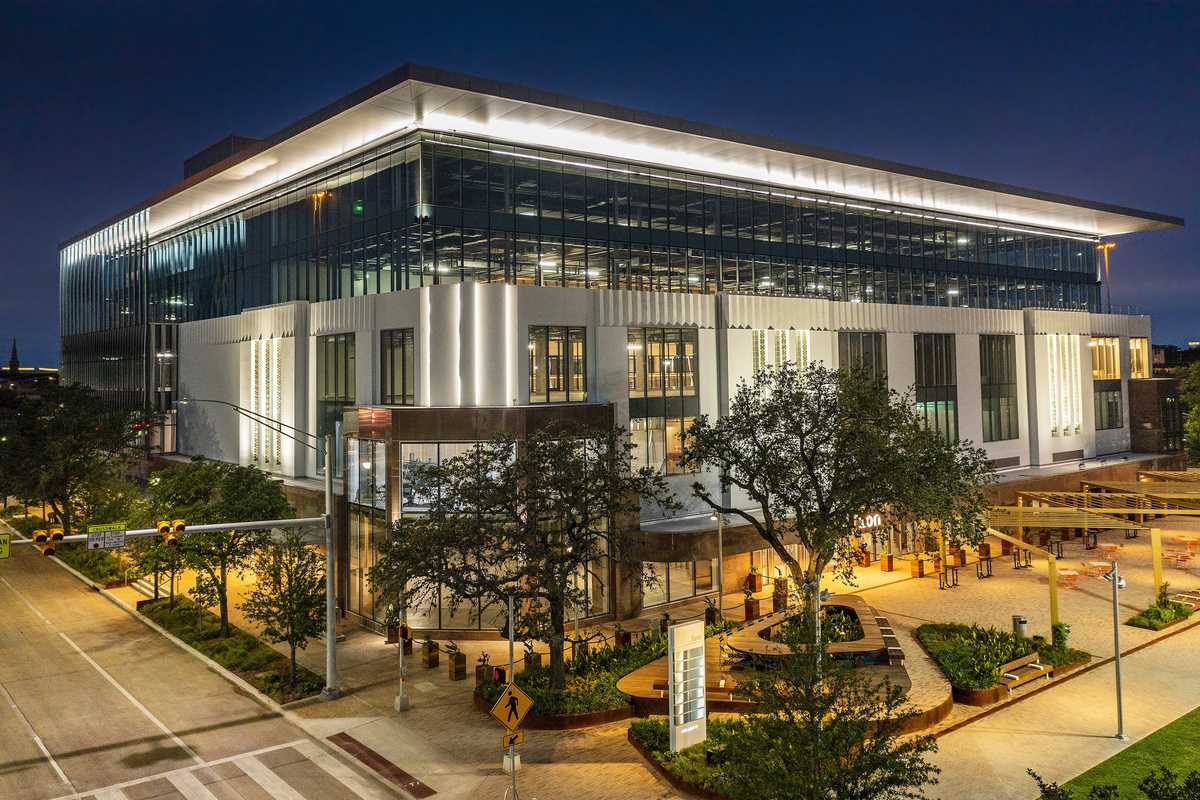
The Arc will feature office and lab space, a gym, an amenity lounge, conference and meeting spaces, outdoor plazas and more. Rendering by Neoscape. Courtesy HKS.

Houston's Ion District is set to expand with the addition of a nearly 200,000-square-foot research and technology facility, The Arc at the Ion District.

Rice Real Estate Company and Lincoln Property Company are expected to break ground on the state-of-the-art facility in Q2 2026 with a completion target set for Q1 2028, according to a news release.

Rice University, the new facility's lead tenant, will occupy almost 30,000 square feet of office and lab space in The Arc, which will share a plaza with the Ion and is intended to "extend the district’s success as a hub for innovative ideas and collaboration." Rice research at The Arc will focus on energy, artificial intelligence, data science, robotics and computational engineering, according to the release.

“The Arc will offer Rice the opportunity to deepen its commitment to fostering world-changing innovation by bringing our leading minds and breakthrough discoveries into direct engagement with Houston’s thriving entrepreneurial ecosystem,” Rice President Reginald DesRoches said in the release. “Working side by side with industry experts and actual end users at the Ion District uniquely positions our faculty and students to form partnerships and collaborations that might not be possible elsewhere.”

Developers of the project are targeting LEED Gold certification by incorporating smart building automation and energy-saving features into The Arc's design. Tenants will have the opportunity to lease flexible floor plans ranging from 28,000 to 31,000 square feet with 15-foot-high ceilings. The property will also feature a gym, an amenity lounge, conference and meeting spaces, outdoor plazas, underground parking and on-site retail and dining.

Preleasing has begun for organizations interested in joining Rice in the building.

“The Arc at the Ion District will be more than a building—it will be a catalyst for the partnerships, innovations and discoveries that will define Houston’s future in science and technology,” Ken Jett, president of Rice Real Estate Company, added in the release. “By expanding our urban innovation ecosystem, The Arc will attract leading organizations and talent to Houston, further strengthening our city’s position as a hub for scientific and entrepreneurial progress.”

Ad Placement 300x100
Ad Placement 300x600

CultureMap Emails are Awesome

Johnson Space Center and UT partner to expand research, workforce development

onward and upward

NASA’s Johnson Space Center in Houston has forged a partnership with the University of Texas System to expand collaboration on research, workforce development and education that supports space exploration and national security.

“It’s an exciting time for the UT System and NASA to come together in new ways because Texas is at the epicenter of America’s space future. It’s an area where America is dominant, and we are committed as a university system to maintaining and growing that dominance,” Dr. John Zerwas, chancellor of the UT System, said in a news release.

Vanessa Wyche, director of Johnson Space Center, added that the partnership with the UT System “will enable us to meet our nation’s exploration goals and advance the future of space exploration.”

The news release noted that UT Health Houston and the UT Medical Branch in Galveston already collaborate with NASA. The UT Medical Branch’s aerospace medicine residency program and UT Health Houston’s space medicine program train NASA astronauts.

“We’re living through a unique moment where aerospace innovation, national security, economic transformation, and scientific discovery are converging like never before in Texas," Zerwas said. “UT institutions are uniquely positioned to partner with NASA in building a stronger and safer Texas.”

Zerwas became chancellor of the UT System in 2025. He joined the system in 2019 as executive vice chancellor for health affairs. Zerwas represented northwestern Ford Bend County in the Texas House from 2007 to 2019.

In 1996, he co-founded a Houston-area medical practice that became part of US Anesthesia Partners in 2012. He remained active in the practice until joining the UT System. Zerwas was chief medical officer of the Memorial Hermann Hospital System from 2003 to 2008 and was its chief physician integration officer until 2009.

Zerwas, a 1973 graduate of the Houston area’s Bellaire High School, is an alumnus of the University of Houston and Baylor College of Medicine.

Texas booms as No. 3 best state to start a business right now

Innovation Starts Here

High employment growth and advantageous entrepreneurship rates have led Texas into a triumphant No. 3 spot in WalletHub's ranking of "Best and Worst States to Start a Business" for 2026.

Texas bounced back into the No. 3 spot nationally for the first time since 2023. After dropping into 8th place in 2024, the state hustled into No. 4 last year.

Ever year, WalletHub compares all 50 states based on their business environment, costs, and access to financial resources to determine the best places for starting a business. The study analyzes 25 relevant metrics to determine the rankings, such as labor costs, office space affordability, financial accessibility, the number of startups per capita, and more.

When about half of all new businesses don't last more than five years, finding the right environment for a startup is vital for long-term success, the report says.

Here's how Texas ranked across the three main categories in the study:

  • No. 1 – Business environment
  • No. 11 – Access to resources
  • No. 34 – Business costs

The state boasts the 10th highest entrepreneurship rates nationwide, and it has the 11th-highest share of fast-growing firms. WalletHub also noted that more than half (53 percent) of all Texas businesses are located in "strong clusters," which suggests they are more likely to be successful long-term.

"Clusters are interconnected businesses that specialize in the same field, and 'strong clusters' are ones that are in the top 25 percent of all regions for their particular specialization," the report said. "If businesses fit into one of these clusters, they will have an easier time getting the materials they need, and can tap into an existing customer base. To some degree, it might mean more competition, though."

Texas business owners should also keep their eye on Houston, which was recently ranked the 7th best U.S. city for starting a new business, and it was dubbed one of the top-10 tech hubs in North America. Workers in Texas are the "third-most engaged" in the country, the study added, a promising attribute for employers searching for the right place to begin their next business venture.

"Business owners in Texas benefit from favorable conditions, as the state has the third-highest growth in working-age population and the third-highest employment growth in the country, too," the report said.

The top 10 best states for starting a business in 2026 are:

  • No. 1 – Florida
  • No. 2 – Utah
  • No. 3 – Texas
  • No. 4 – Oklahoma
  • No. 5 – Idaho
  • No. 6 – Mississippi
  • No. 7 – Georgia
  • No. 8 – Indiana
  • No. 9 – Nevada
  • No. 10 – California
---

This article originally appeared on CultureMap.com.