


A new Houston-based edtech platform is being piloted with 35 educators and more than 200 students in Texas and Arizona. Photo via Pexels

Early detection. It sounds simple enough: identify a problem before it has the chance to become a bigger one.

But in practice, early detection is much more difficult to navigate, especially in education, when it comes to identifying the reasons behind a student's academic struggles.

That’s why co-founders Alapati “Al” Ware and Estela Montanez launched Progress Report, a Houston-built K-12 learning-intelligence platform designed to go beyond identifying that a student is struggling.

The platform recently began its pilot program with 35 educators and more than 200 students in Texas and Arizona.

“It’s a micro-learning school that works with children with disabilities, primarily dyslexia and nonverbal students,” Ware tells InnovationMap.

The platform is also being used by homeschool parents, home teachers and Houston educators, including those at SWPS College & Career Preparatory Academy, a Houston charter school.

Ware says Progress Report was designed to fill a gap he and Montanez saw in existing edtech. Some platforms cater almost entirely to students, leaving teachers with little insight into if and how a child is learning. Others focus heavily on district data, where “the student is just a number,” leaving teachers to navigate disconnected tools.

“Our goal was [to] focus purely on the teacher because the teacher is the backbone,” Ware says.

Progress Report traces student performance to learning gaps and prerequisite skills, helping educators understand not only where a student is struggling, but what may be causing it.

The platform then helps teachers build individualized instruction for general education students, students with special education and Individualized Education Program (IEP) needs, and Spanish-speaking learners—all within one educator-controlled system.

The goal is to reduce the guesswork and hours of manual work educators can spend developing individualized lesson plans.
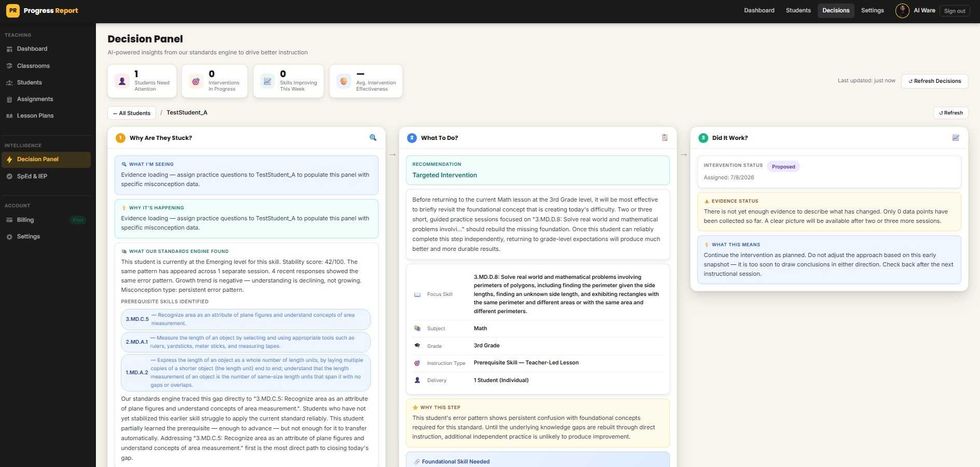
Progress Report helps idenitify learning gaps and common roadblocks for each student. Image courtesy Progress Report

For Ware and Montanez, the mission is also personal.

The concept dates back to around 2023, when the co-founders first had to navigate and address their children’s educational needs.

Ware, Progress Report’s CEO and CTO with a background in edtech, built the platform end-to-end after watching his daughter, who had an IEP related to speech, struggle to get the support she needed.

Montanez, the company’s COO, brought another perspective. Her son is on the autism spectrum. She now leads Progress Report’s operations, partnerships and pilot execution while helping carry its focus on bilingual families from Puerto Rico to Houston.

Together, they began researching ways to personalize their children’s learning and help them progress academically. Montanez’s son went on to become an AP student and high school athlete, while Ware’s daughter began reading more than two grade levels above her grade, they tell InnovationMap.

But Progress Report isn’t designed simply to give a struggling student more work.

Take a student who appears to have difficulty with math.

The problem may not actually be math, the founders share. The student could understand the calculations but struggle to comprehend complex words used in a math problem.

Progress Report is designed to trace those performance patterns back to learning gaps, prerequisite skills or other instructional barriers. From there, it can recommend a next instructional step while leaving the educator in control.

The same concept applies to accommodations.

The system can read IEPs, 504 Plans, Present Levels of Academic Achievement and Functional Performance (PLAAFPs), evaluations and other special education records. Approved IEP goals can then be mapped into the student’s learning graph, while accommodations can carry over into lesson planning and question delivery.

The founders say that approach separates Progress Report from simply adding another artificial intelligence chatbot to a classroom. And still, they believe teachers have to remain at the center.

Teachers, in fact, helped build Progress Report.

The founders began meeting with Houston-area educators months before the pilot. Their feedback helped shape the platform before testing began.

“We’ve been building alongside these educators,” Ware says.

Parents are another piece.

Progress Report can give parents access to their child’s learning record so they can see learning gaps as they develop. Teachers can also see information on work being completed at home when the parent and educator are working together.

After the pilot wraps, Ware and Montanez plan to introduce a $29.99 monthly subscription for homeschool parents, teachers and other educators. They say the price was intentionally kept relatively low to help make the tools more accessible.

They are also exploring ways to work with organizations that could help families who can’t afford the platform.

Moving forward, the goal is considerably bigger.

Over the next five years, Ware and Montanez want Progress Report to become what they describe as a “gold standard” in every state. They know getting there will require building relationships with educators, technology leaders, policymakers and school board members.

For now, they’re starting with a few hundred students and a question that sounds simple but can be remarkably difficult to answer: Why is this student struggling?

If Progress Report works the way its founders envision, teachers and parents will have a clearer answer.

Ad Placement 300x100
Ad Placement 300x600

CultureMap Emails are Awesome

Rice University launches AI initiative, plans to hire 75 faculty

ai expansion

Houston’s Rice University announced a university-wide artificial intelligence initiative this week that includes hiring 75 new AI-focused faculty. It also shared new details about its planned state-of-the-art facility, The Arc.

Fresh off the announcement of Rice’s new Master of Artificial Intelligence (MAI) coming next fall, the university shared that it plans to expand its AI-related courses and be a “global leader in advanced computing and responsible AI.”

Rice reports that it has already hired 35 faculty members to deepen expertise across schools and departments regarding AI, and plans to recruit 40 more across disciplines including engineering, computing, health, energy, environmental resilience, business, humanities and the arts.

Rice's schools and departments have identified the four cluster areas to guide its hiring:

  • Foundational AI
  • AI for Health
  • AI for Energy, the Environment and Resiliency
  • Responsible AI: Society and Ethics

“Hiring exceptional faculty is essential, but it is only one part of the equation,” Amy Dittmar, Rice’s Howard R. Hughes Provost and executive vice president for academic affairs, said in a news release. “We are building the people, places and partnerships needed to advance AI from foundational discovery to societal impact.”

Another major component of the effort is the planned 200,000-square-foot facility, The Arc, which Rice announced will break ground this fall. Rice will occupy nearly 80,000 square feet of office and laboratory space dedicated to topics including AI, data science, robotics, computational engineering and energy. The university previously announced that The Arc would be completed in Q1 2028.

The Arc will also house the AI Foundry, which is being developed as a collaborative space for industry partners, scientists and students.

“As Rice grows, we are being intentional about where we invest and how we build,” Rice President Reginald DesRoches added in the release. “By bringing together exceptional faculty, a strong interdisciplinary research community, world-class facilities and Houston’s extraordinary innovation ecosystem, Rice has an opportunity not simply to participate in the AI revolution but to help define its future.”

5 minority-founded startups shaping the future of Houston innovation

meet the finalists

Houston’s startup ecosystem reflects the diversity of the city itself.

As part of the 2026 Houston Innovation Awards, our Minority-founded Businesses category will honor an innovative Houston startup founded or co-founded by BIPOC or LGBTQ+ representation.

Five minority-founded businesses have been named finalists for the 2026 award. The finalists, selected by our esteemed panel of judges, range from an AI edtech startup to a company operating in the floating offshore energy infrastructure sector.

Read more about these innovative businesses, their initiatives, and their inspirational founders below. The 2026 winners will be announced on InnovationMap.com in mid-November.

AI Made Fun

Edtech startup AI Made Fun is working to close the gap in AI education by teaching K-12 students how to understand and responsibly use artificial intelligence. The company has developed a comprehensive AI literacy curriculum with 60 modules, animated videos, interactive activities, teacher guides and family resources. Its curriculum covers how AI works, misinformation, algorithmic bias, data privacy, online safety and academic integrity.

AI Made Fun was founded in 2025 by Devshree Golecha. It launched in classrooms this school year with five licensed schools serving more than 800 students. The company is pursuing partnerships with Houston-area school districts, including Houston ISD and Alief ISD, and has pledged free and subsidized access for underserved communities.

Deep Anchor Solutions

Offshore energy consulting and design company Deep Anchor Solutions wants to help scale floating offshore energy infrastructure by removing anchoring as a barrier. Its deeply embedded ring anchor (DERA) technology can be installed quietly without heavy-lift vessels, reducing anchor-related costs by up to 75 percent and lifecycle CO2 emissions by up to 80 percent.

The company was founded in 2023 by CEO Junho Lee and technical advisor Charles Aubeny. Lee earned his Ph.D. in geotechnical engineering from Texas A&M University, where Aubeny is a professor of civil and environmental engineering. The company has participated in numerous accelerators and incubators, including Greentown Labs, MassChallenge, EnergyTechNexus LiftOff and others. Lee was an Activate 2025 fellow.

HEXAspec

Rice University spinout HEXASpec is working to improve the sustainability and thermal conductivity of semiconductor chips. The company has developed breakthrough inorganic fillers that allow graphic processing units (GPUs) to use less water and electricity and generate less heat.

HEXASpec was founded in 2025 by CEO Tianshu Zhai, CTO Jing Zhang and chief product officer Chen-Yang Lin. It has raised $800,000 in pre-seed funding and another $1.5 million in non-dilutive grants, according to the company's application. The startup won the Liu Idea Lab for Innovation and Entrepreneurship's H. Albert Napier Rice Launch Challenge in 2024 and the 2025 Energy Venture Day and Pitch Competition during CERAWeek in the TEX-E student track in 2025. It was awarded a $500,000 National Science Foundation Partnership for Innovation grant last summer.

Prana Surgical

Health tech company Prana Surgical is developing a minimally invasive surgical platform for small, hard-to-reach lung nodules that may be cancerous. The company's Prana System cleared U.S. Food and Drug Administration (FDA) approval earlier this year.

Prana Surgical was originally founded as Prana Thoracic in 2022. It has participated in numerous accelerators, including the Texas Medical Center Innovation Accelerator in 2023 and the IGNITE Health accelerator in 2022. It raised $6 million in Series A funding rounds in 2023 and 2024 , with a Series B currently ongoing. The company said in its application that it is currently moving into the next stage of clinical validation and revenue generation in the U.S., in addition to preparing its manufacturing and commercial infrastructure for broader use.

Torres Orbital Mining Inc.

Space tech company Torres Orbital Mining is developing autonomous excavation and material preprocessing systems to move and process granular materials while reducing workers’ exposure to hazardous dust. The company is initially commercializing its technology for Earth-bound applications—including silica sand, recycled glass and mine tailings—though the technology is also designed to support future lunar mining operations. The company aims to accelerate a permanent and ethical human presence on the Moon.

CEO Luis Torres founded Torres Orbital Mining in 2025. The company is a member of Greentown Labs and has participated in accelerators like the ESRIC Space Resources Startup Program and Capital Factory All Access Fund. The company received a six-month, $225,000 SBIR Phase I contract from NASA in August.

Italian aerospace company sets up first U.S. office at Houston Spaceport

welcome to houston

Como, Italy-based aerospace company Involve Space recently made the Houston Spaceport the site of its first U.S. office.

Involve Space develops high-altitude balloon platforms for Earth observation, scientific research and hardware testing. The balloons carry instruments into the stratosphere (a layer of the upper atmosphere) to collect images and data, conduct experiments and test technology.

The company plans to launch its first commercial missions from Houston by the end of this year, according to a news release.

“Houston is the global center of aerospace, and our presence at Houston Spaceport strengthens our international growth trajectory,” Jonathan Polotto, founder and CEO of Involve Space, said in the release.

Founded in 2021, Involve Space incorporates aerospace hardware, AI and geospatial tools into its offerings. Its proprietary CLEAR platform uses conversational AI to help customers interpret data and support decision-making.

Located at Ellington Airport, the Houston Spaceport provides a base for Involve Space’s North American operations, including business development and partnerships with aerospace companies and researchers.

Other tenants at the Houston Spaceport include NASA, Axiom Space, Venus Aerospace and Intuitive Machines.

Involve Space’s relationship with the Houston Spaceport began in January 2025, when it conducted its first U.S. pilot launch. During the five-hour mission, the balloon reached an altitude of about 85,000 feet and traveled about 250 miles across Texas.

One of Involve Space’s first U.S. customers is Houston-based Rhodium Scientific, a space biotech company. Polotto and Rhodium Scientific founder and CEO Olivia Gamez Holzhaus signed a deal to conduct biotech experiments aboard Involve Space’s stratospheric balloon platforms before planned missions to orbit.

“The presence of innovative platforms like those developed by Involve strengthens the Spaceport’s role as a site for testing, validating, and deploying advanced technologies between aeronautics and space,” Jim Szczesniak, director of aviation for Houston Airports, added in the release.