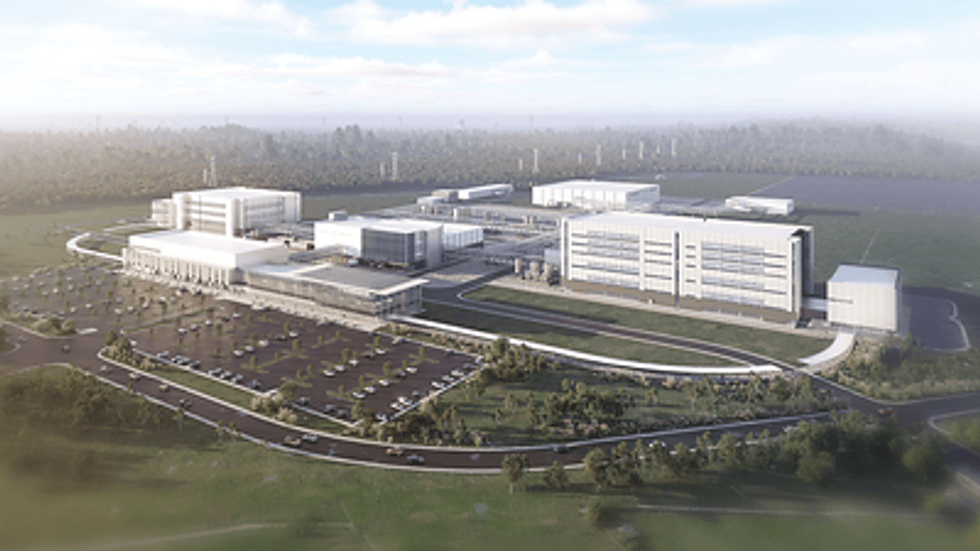
Persona AI is partnering up with Under Armour to protect its humanoid robots from hazardous environments. Image courtesy Persona AI

Houston-based Persona AI has cemented a partnership with sportswear manufacturer Under Armour to provide materials to protect future robots operating in dangerous conditions.

Through the partnership, Persona AI and Under Armour will launch a research initiative to explore whether advanced performance textiles can improve the durability and resilience of humanoid robots operating in harsh industrial environments.

“This is an opportunity to apply our innovation expertise in a new context,” Kyle Blakely, senior vice president of innovation, design studio, development, and testing at Under Armour, said in a news release. “Robotics presents a fascinating new design challenge, and we aim to play a leading role in shaping performance solutions for these environments. As humanoid systems take on more physically demanding roles, we see real potential to create new market opportunities, and we’re exploring how concepts like thermal management, abrasion resistance, and flexibility translate beyond sport."

Founded in June 2024 by former NASA engineer Nicolaus Radford and former Figure AI CTO Jerry Pratt, Persona AI has quickly risen to be a top name in the development of humanoid robotic systems. Radford previously was the principal investigator at NASA’s Dexterous Robotics Lab before becoming CEO of Nauticus Robotics. While at NASA, he was the chief engineer behind Robotnaut 2, the first humanoid robot on the International Space Station.

Persona AI raised preseed funding to develop humanoid robots designed to operate in shipyards and other industrial sites. The company has inked partnerships with HD Korea Shipbuilding & Offshore Engineering, HD Hyundai Robotic, and Korean manufacturing firm Vazil Company to create and deploy humanoid robots for complex welding tasks in shipyards.

These environments often involve exposure to dangerous chemicals, harsh weather and other potential hazards. The partnership between Persona AI and Under Armour will combine the clothing manufacturer’s development of resilient but flexible materials with the humanoid design of Persona AI.

Though best known for its sportswear, Under Armour produces a wide range of specialist fabrics and clothing, including an entire line used by the U.S. military. The company’s track record of developing high-performance fabrics built to withstand war zones and desert conditions makes it a strong partner in Persona AI’s latest endeavor.

“We chose to work with Under Armour because of their track record of innovation with these types of performance materials,” Radford said. “As we develop humanoids for intense and potentially hazardous environments, this collaboration helps us understand how advanced materials can enhance long-term reliability, thereby informing solutions to better protect workers in the field.”

Ad Placement 300x100
Ad Placement 300x600

CultureMap Emails are Awesome

$5B Austin medical center, anchored by MD Anderson, to break ground this fall

moving forward

Construction on the $1 billion first phase of the AI-native University of Texas Dell Medical Center in Austin—which will feature a hospital operated by Houston’s UT MD Anderson Cancer Center—is set to start this fall.

The UT System Board of Regents approved funding for first-phase construction on Aug. 12.

The medical center—now expected to cost $5 billion, up from the initial $2.9 billion estimate—will span about 2.5 million square feet. It will include 300 to 500 patient beds, outpatient facilities, an emergency department and specialized care for cancer patients.

MD Anderson will bring its world-renowned oncology programs to the center’s integrated health care model, Dr. Claudia Lucchinetti, senior vice president of medical affairs at UT Austin and dean of the university’s Dell Medical School, tells Health Leaders.

Earlier this year, Austin tech billionaire Michael Dell and his wife, Susan, pledged $750 million for development of the medical center. The medical center, scheduled for completion in December 2030, will be a cornerstone of the new 300-acre UT Dell Campus for Advanced Research, a medical education and research hub.

“Through this new campus and medical center, Texas will lead America in health care innovation,” Gov. Greg Abbott said when the research campus was announced in April. “The next generation of medical breakthroughs will take place in Central Texas.”

The medical center will fold AI tools and other technology into the infrastructure, rather than having them added after it’s built. Among other capabilities, the technology will monitor real-time medical data, automate data entry, and help health care professionals quickly predict and identify risks to patients, according to Health Leaders.

“We are not just building a new medical center,” Lucchinetti says. “We are building a fundamentally new model of health. It’s not just a new facility. It’s not just a new collaboration. It is a convergence of capabilities that rarely come together at the same time.”

Rice lands $15M U.S. Army award to launch next-gen wireless research center

defense funding

The U.S. Army Research Office has awarded Rice University $15 million to establish a new center for next-generation sensing and communications.

The five-year research center—dubbed the Center for Large Aperture Secure Sensing, Imaging and Communications (CLASSIC)—will unite researchers from universities and national laboratories to develop advanced antenna technologies for future wireless systems. Edward Knightly, the Sheafor-Lindsay Professor of Electrical and Computer Engineering at Rice, will lead the center that “combines expertise in wireless networking, antennas, radar, artificial intelligence, circuits and physics to address growing demands on wireless systems,” according to Rice.

“The challenges we’re tackling require advances that span physics, hardware, communications and computing," Knightly said in a news release. “By combining those strengths in a single center, we can accelerate the development and demonstration of technologies that would not be possible through individual efforts alone.”

Joining Knightly will be Ashutosh Sabharwal of Rice, Sensen Li of the University of Texas at Austin, Hou-Tong Chen of Los Alamos National Laboratory, Danijela Cabric of UCLA, Josep M. Jornet and Tommaso Melodia of Northeastern University, Daniel M. Mittleman of Brown University, and Willie Padilla of Duke University.

Industry partners include Booz Allen Hamilton, Intel, Keysight, Lockheed Martin, MITRE, Northrop Grumman, Qualcomm and Raytheon.

CLASSIC researchers will investigate how large-scale antenna arrays (ELSAAs) can expand the capabilities of wireless systems where technology is limited.

ELSAAs use thousands of coordinated antenna elements to direct radio waves. Researchers aim to develop ways to use the technology to help maintain steady communication when signals are blocked or disrupted and to detect and generate detailed images of concealed objects.

Along with ELSAAs, the center will work to develop sensing techniques for threat detection, study wireless jamming and build resilient high-speed wireless networks. Researchers will ultimately validate the technology in labs and via drone-based field trials.

CLASSIC will also work on developing an AI-driven modeling framework that will simulate complex electromagnetic environments in real time.

“This award demonstrates Rice’s leadership in tackling complex national research challenges through collaboration across disciplines and institutions,” David Sholl, executive vice president for research at Rice, added in the release.