


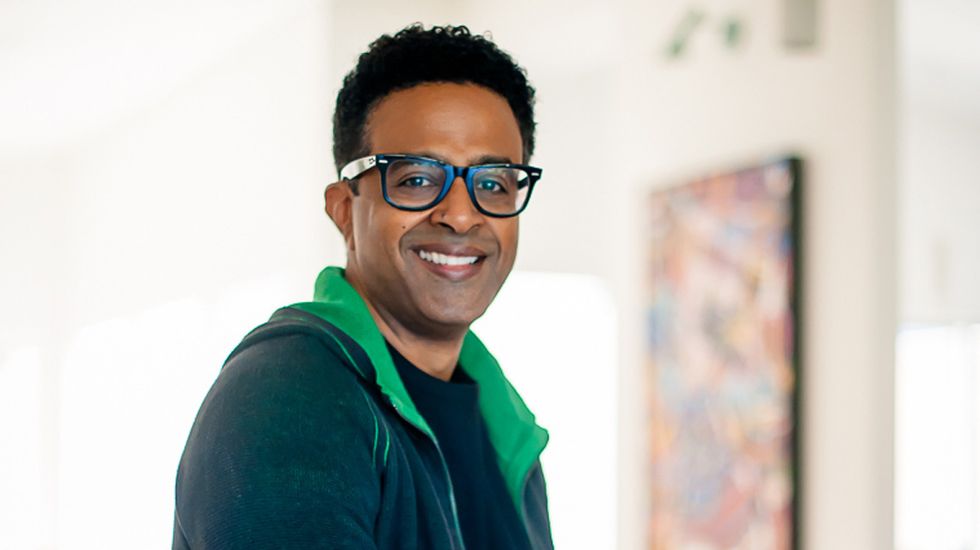
Houston — much like the rest of the world — has a growing freelance economy. A local innovator has created a platform for freelancers to find work. Photo courtesy of Common Desk

By 2027, freelancers will account for the majority of the American workforce — and Houston is already well represented by the freelance space.

According to a recent study, Houston is home to 117,260 skilled freelancers who generated more than $4.1 billion in revenue in 2018. This burgeoning environment for freelancers presents many opportunities for innovations in the tech world, as one Houston entrepreneur has already discovered.

Yared Akalou, founder-and-CEO of Alcove Group and self-described designer-focused entrepreneur, released his third innovation catering to freelancers of the Houston area. His digital solutions platform, IAmOther50, assists freelancers with securing new clients by sharing their personal stories rather than just submitting their professional experience, it uses videos and articles to promote the work of a freelancer and connect them to their next client.

"I am really on a mission," Akalou tells InnovationMap. "I have been talking about the future of work for over a decade now. The paradigm will change to viewing work as a service, so it is important to tell a freelancer's story through a more engaging and novel way."

At first glance, the digital platform seems like a departure for Akalou who in 2017 founded Alcove, a portable laptop case that serves as a private workspace for freelancers to use amid coffee shops or coworking spaces. However, IAmOther50 serves as a distinctly separate yet integral part of his innovation landscape.

"These projects have been a combination of my focus and research," says Akalou. "My new platform works hand in hand with Alcove, supporting the mission to help people stay productive from anywhere."

The digital platform serves to capture the brand of the freelancer along with their personality and experience. It lives at the intersection of popular social media platforms and professional platforms such as LinkedIn, except just for freelancers in the Houston area. Currently, any freelancing professional in the Houston area can join for free by filling out a survey that customizes their goals for their profile.

"IAmOther50 provides information in a contextual way," says Akalou. "We have this guiding principle of delivering value even before the prospective client contacts the freelancer for an interview or potential position. It's about going beyond just a resume of what you've done and showcasing how you add value right now."

Akalou, who is also one of the mentors in The Ion Smart and Resilient Cities Accelerator, is focused on elevating the professional profiles of many freelancers, including those outside the Houston area. He is aiming to grow the platform to a self-service platform that can connect freelancers to clients all over the biggest metropolitan areas soon.

Ad Placement 300x100
Ad Placement 300x600

CultureMap Emails are Awesome

Houston quantum energy chip startup emerges from stealth with $12M round

seed funding

Houston-based Casimir has emerged from stealth with a $12 million seed round to commercialize its quantum energy chip.

The round was led by Austin-based Scout Ventures. Lavrock Ventures, Cottonwood Technology, Capital Factory, American Deep Tech, and Tim Draper of Draper Associates also participated in the round. The oversubscribed round exceeded the company’s original $8 million target, according to a news release.

Casimir’s semiconductor chips can generate power from quantum vacuum fields without the need for batteries or charging. The company plans to commercialize its first-generation MicroSparc chip by 2028.

The MicroSparc chip measures 5 millimeters by 5 millimeters and is designed to produce 1.5 volts at 25 microamps, comparable to a small rechargeable battery, without degradation and no replacement cycle.

“Casimir represents exactly the kind of breakthrough dual-use technology Scout Ventures was built to back,” Brad Harrison, founder and managing partner at Scout Ventures, said in the release. “This is based on 100 years of science and we’re finally approaching a commercial product … We’re proud to lead this round and support Casimir’s journey from applied science to deployed technology.”

Casimir says it aims to scale its technology across the ”full power spectrum,” including large-scale energy systems that can power homes, commercial infrastructures and electric vehicles.

Casimir's scientific work has been supported by DARPA-funded nanofabrication research and its technology was incubated at the Limitless Space Institute (LSI). LSI is a nonprofit that works to innovate interstellar travel and was founded by Kam Ghaffarian. Technology investor and serial entrepreneur Ghaffarian has been behind companies like X-energy, Intuitive Machines, Axiom Space and Quantum Space.

Harold “Sonny” White, founder and CEO of Casimir, believes the technology can power devices for years without replacements.

“Millions of devices will operate for years without a battery ever needing to be replaced or recharged because we have engineered a customized Casimir cavity into hardware capable of producing persistent electrical power,” White added in the release. “I spent nearly two decades at NASA studying how we power humanity’s future. That work led me to the Casimir effect and the quantum vacuum, where new tools have allowed us to build on a century of scientific knowledge and bring abundant power to the world.”

Houston-based Fervo Energy bumps up IPO target to $1.82 billion

IPO update

Houston-based geothermal power company Fervo Energy is now eyeing an IPO that would raise $1.75 billion to $1.82 billion, up from the previous target of $1.33 billion.

In paperwork filed Monday, May 11 with the U.S. Securities and Exchange Commission, Fervo says it plans to sell 70 million shares of Class A common stock at $25 to $26 per share.

In addition, Fervo expects to grant underwriters 30-day options to buy up to 8.33 million additional shares of Class A common stock. This could raise nearly $200 million.

When it announced the IPO on May 4, Fervo aimed to sell 55.56 million shares at $21 to $24 per share, which would have raised $1.17 billion to $1.33 billion. The initial valuation target was $6.5 billion.

A date for the IPO hasn’t been scheduled. Fervo’s stock will be listed on Nasdaq under the ticker symbol FRVO.

Fervo, founded in 2017, has attracted about $1.5 billion in funding from investors such as Bill Gates-founded Breakthrough Energy Ventures, Google, Mitsubishi Heavy Industries, Devon Energy (which is moving its headquarters to Houston), Tesla co-founder JB Straubel, CalSTRS, Liberty Mutual Investments, AllianceBernstein, JPMorgan, Bank of America and Sumitomo Mitsui Trust Bank.

Fervo’s marquee project is Cape Station in Beaver County, Utah, the world’s largest EGS (enhanced geothermal system) project. The first phase will deliver 100 megawatts of baseload clean power, with the second phase adding another 400 megawatts. The site can accommodate 2 gigawatts of geothermal energy. Fervo holds more than 595,000 leased acres for potential expansion.

Cape Station has secured power purchase agreements for the entire 500-megawatt capacity. Customers include Houston-based Shell Energy North America and Southern California Edison.

---

This article originally appeared on our sister site, EnergyCapitalHTX.com.