A Houston company has raised funding. Photo via Getty Images

A Houston company has closed its series B extension at $25 million.

MetOx International, which develops and manufactures high-temperature superconducting (HTS) wire, announced it closed a $25 million series B extension. Centaurus Capital, an energy-focused family office, and New System Ventures, a climate and energy transition-focused venture firm, led the round with participation from other investors.

"MetOx has developed a robust and highly scalable operation, and we are thrilled to partner with the Company as it enters this pivotal growth stage," says John Arnold, founder of Centaurus, in a news release. "The market for HTS is expanding at an unprecedented pace, with demand for HTS far outweighing supply. MetOx is poised to be the leading U.S. HTS producer, closing the supply gap and bringing dramatic capacity to high power innovations and applications. Their progress and potential are unmatched in the field, and we are proud to support their growth."

The fresh funding will go toward advancing the company's Xeus HTS wire technology for key energy transition applications by expanding MetOx's U.S.-based manufacturing capabilities to meet demand.

"This funding marks a pivotal step in our mission to revolutionize the energy and technology sectors with our advanced power delivery technology and accelerate delivery for our customers and partners. HTS is critical to enhancing the efficiency of our electric grid and enabling technological developments that, in many cases, would not be viable or even possible without superconductor technology," adds Bud Vos, CEO of MetOx. "Support from investors such as Centaurus and NSV not only provides the financial resources and strategic support required for accelerated scaleup, but also validates the broad reach of our technology across energy, data center, medical, and defense industries."

HTS wire technology is critical for the energy transition, especially amid rising data center growth, and for next generation wind turbines and interconnections.

MetOx's technology originated out of the University of Houston and was founded in 1998 by Alex Ignatiev, UH professor emeritus of physics and a fellow of the National Academy of Inventors. Last year, the company secured $3 million in funding from the U.S. Department of Energy to support the advancement of its proprietary manufacturing technology for its HTS wire.

"MetOx's HTS technology aligns with our systems-level research and offers a unique opportunity to dramatically accelerate the energy transition," says Ian Samuels, founder and managing partner at NSV. "MetOx's Xeus wire stands to be a force multiplier in clean energy generation and high-power transmission and distribution, enabling load growth and the deployment of power-dense data centers. NSV is excited to support MetOx as it scales domestic manufacturing capacity."

The fresh funding will go toward advancing the company's Xeus HTS wire technology. Photo via metoxtech.com
Ad Placement 300x100
Ad Placement 300x600

CultureMap Emails are Awesome

Nominations for the 2026 Houston Innovation Awards are due by Aug. 27

Calling All Innovators

Calling all Houston innovators: The 2026 Houston Innovation Awards, presented by InnovationMap, return this fall to celebrate the best and brightest in the Houston innovation ecosystem right now.

We're asking you to nominate Houston's top innovators and startups for this year's awards. Nominations are open now through August 27 and can be made on behalf of yourself, your organization, and other influential leaders in the local innovation scene.

The annual awards program recognizes the most innovative individuals and companies in Houston across 10 prestigious categories.

This year's awards will honor the following categories:

  • Minority-founded Business, honoring an innovative startup founded or co-founded by BIPOC or LGBTQ+ representation.
  • Female-founded Business, honoring an innovative startup founded or co-founded by a woman.
  • Energy Transition Business, honoring an innovative startup providing a solution within renewables, climatetech, clean energy, alternative materials, circular economy, and beyond.
  • Health Tech Business, honoring an innovative startup within the health and medical technology sectors.
  • Deep Tech Business, honoring an innovative startup providing technology solutions based on substantial scientific or engineering challenges, including those in the AI, robotics, and space sectors.
  • Startup of the Year (People's Choice), honoring a startup celebrating a recent milestone or success. The winner will be selected by the community via an interactive voting experience.
  • Scaleup of the Year, honoring an innovative later-stage startup that's recently reached a significant milestone in company growth.
  • Incubator/Accelerator of the Year, honoring a local incubator or accelerator that is championing and fueling the growth of Houston startups.
  • Mentor of the Year, honoring an individual who dedicates their time and expertise to guide and support budding entrepreneurs.
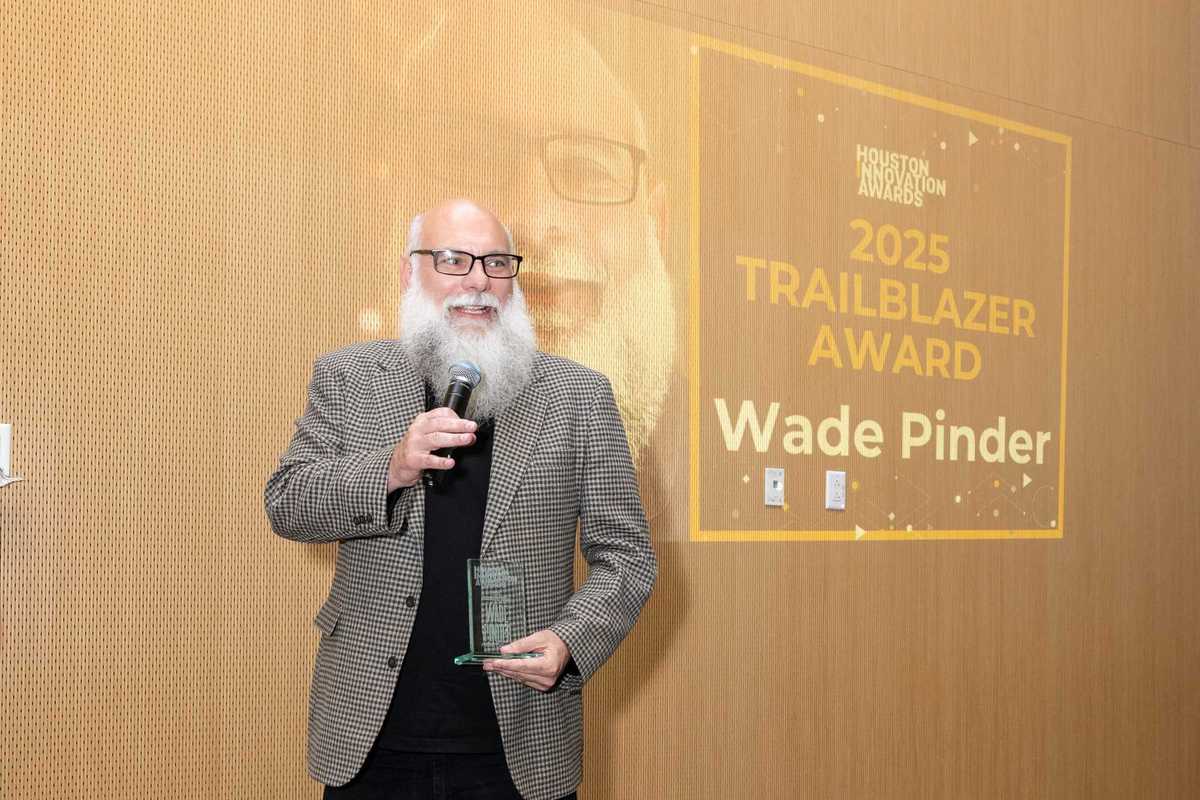
  • Trailblazer, honoring an innovator who's made a lasting impact on the Houston innovation community.

You have three weeks to submit nominees, so don't delay — nominate today at this link or fill out the form below. Qualified nominees will receive a formal application to complete, which will be reviewed by our esteemed panel of judges to determine the finalists and winners.

More announcements about the 2026 Houston Innovation Awards are coming soon, including an introduction to this year's panel of judges. Interested in sponsoring the 2026 Houston Innovation Awards? Please contact sales@innovationmap.com.

$5B Austin medical center, anchored by MD Anderson, to break ground this fall

moving forward

Construction on the $1 billion first phase of the AI-native University of Texas Dell Medical Center in Austin—which will feature a hospital operated by Houston’s UT MD Anderson Cancer Center—is set to start this fall.

The UT System Board of Regents approved funding for first-phase construction on Aug. 12.

The medical center—now expected to cost $5 billion, up from the initial $2.9 billion estimate—will span about 2.5 million square feet. It will include 300 to 500 patient beds, outpatient facilities, an emergency department and specialized care for cancer patients.

MD Anderson will bring its world-renowned oncology programs to the center’s integrated health care model, Dr. Claudia Lucchinetti, senior vice president of medical affairs at UT Austin and dean of the university’s Dell Medical School, tells Health Leaders.

Earlier this year, Austin tech billionaire Michael Dell and his wife, Susan, pledged $750 million for development of the medical center. The medical center, scheduled for completion in December 2030, will be a cornerstone of the new 300-acre UT Dell Campus for Advanced Research, a medical education and research hub.

“Through this new campus and medical center, Texas will lead America in health care innovation,” Gov. Greg Abbott said when the research campus was announced in April. “The next generation of medical breakthroughs will take place in Central Texas.”

The medical center will fold AI tools and other technology into the infrastructure, rather than having them added after it’s built. Among other capabilities, the technology will monitor real-time medical data, automate data entry, and help health care professionals quickly predict and identify risks to patients, according to Health Leaders.

“We are not just building a new medical center,” Lucchinetti says. “We are building a fundamentally new model of health. It’s not just a new facility. It’s not just a new collaboration. It is a convergence of capabilities that rarely come together at the same time.”