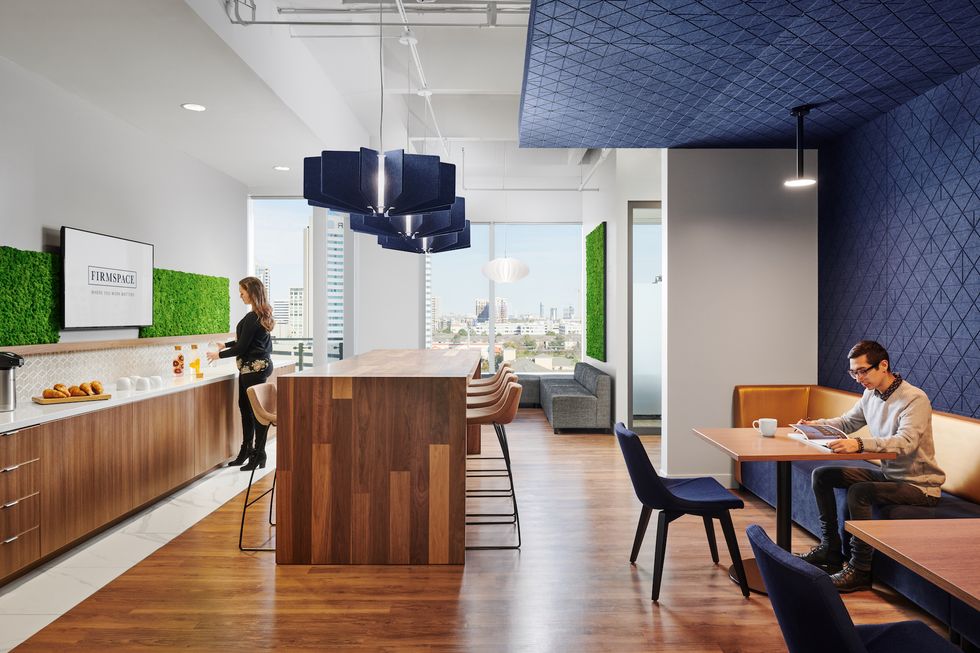
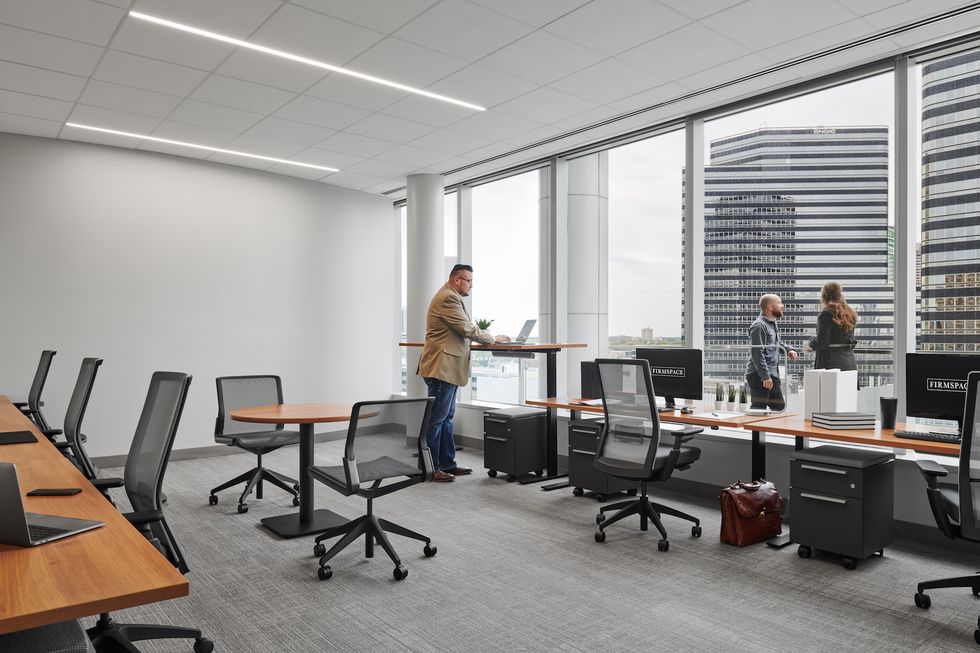
Austin-based FIRMSPACE has opened its third location in Houston with a 32,000-square-foot space in BBVA Compass Plaza. Courtesy of FIRMSPACE

Houston's getting another high-end coworking space. FIRMSPACE, an Austin-based company, selected Houston as its third location.

With 32,000 square feet of space, FIRMSPACE Houston is open for business in BBVA Compass Plaza (2200 Post Oak Boulevard) on the 10th and 11th floors of the 22-story building. The company opened its first location in Austin, followed by a Denver location last December.

"This opening is particularly close to my heart given that I'm from here," says co-founder and CEO, Matt Ferstler, in a release. "We launched FIRMSPACE to serve an unmet need in the coworking market, and our Houston site is unlike anything we've ever done. I think it will exceed our members' expectations."

The space has the normal coworking office offerings — high-speed internet, standing desks, shared conference rooms and common areas — but takes the perks a step further with onsite dry cleaning, catered lunches, evening programing, and more. FIRMSPACE caters to lawyers, financial services firms, and remote corporate executives, according to the release, and members have access to the firm's other locations, which soon should include Atlanta, Dallas, Miami, New York City, Salt Lake City, and Washington D.C.

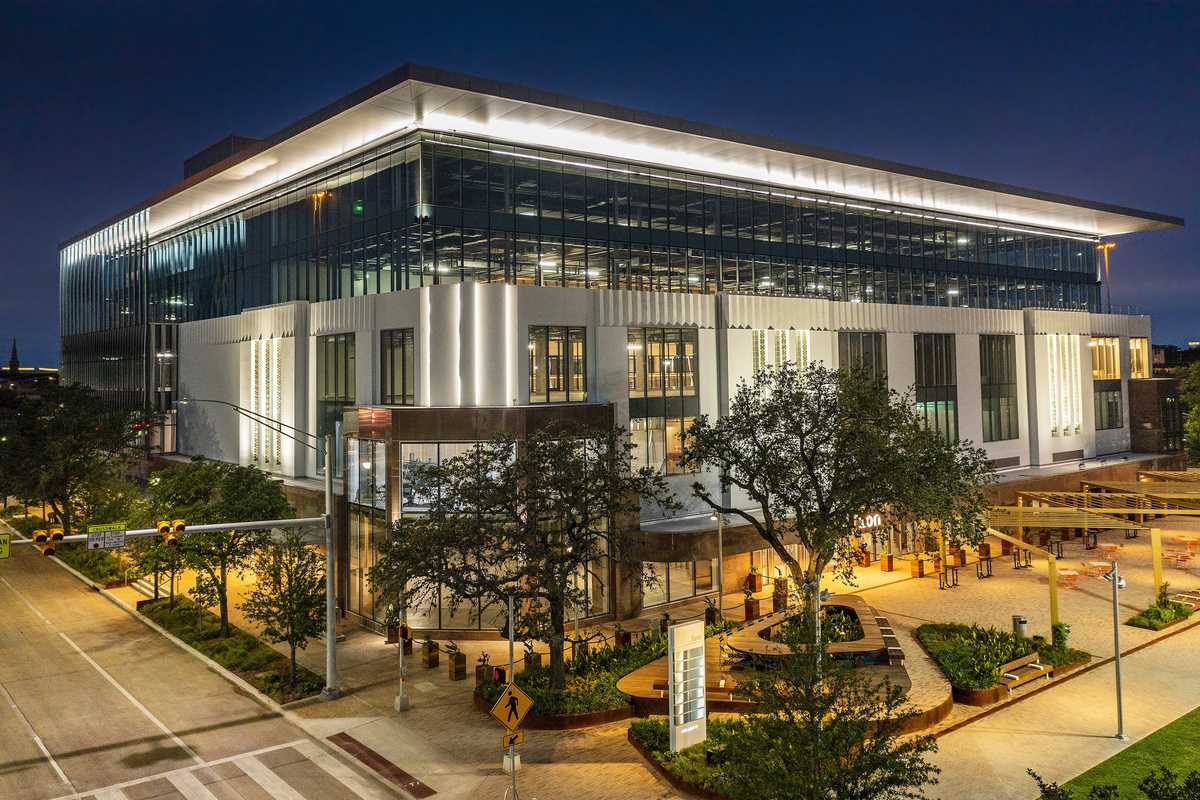
The building was designed by Houston-based architecture firm, Page, and was completed in 2014. Page design director, Jen Bussinger, oversaw FIRMSPACE's integration into the building.

"Since we're in the Energy Capital of the World, we drew our inspiration from curves and fractal shapes found within a geode stone for texture and natural rock formations for the color palette," says Bussinger in a release. "In the age of biophilia – the hypothesis that humans possess an innate tendency to seek connections with nature – we go out of our way to feature different representations of nature."

Uptown views

Courtesy of FIRMSPACE
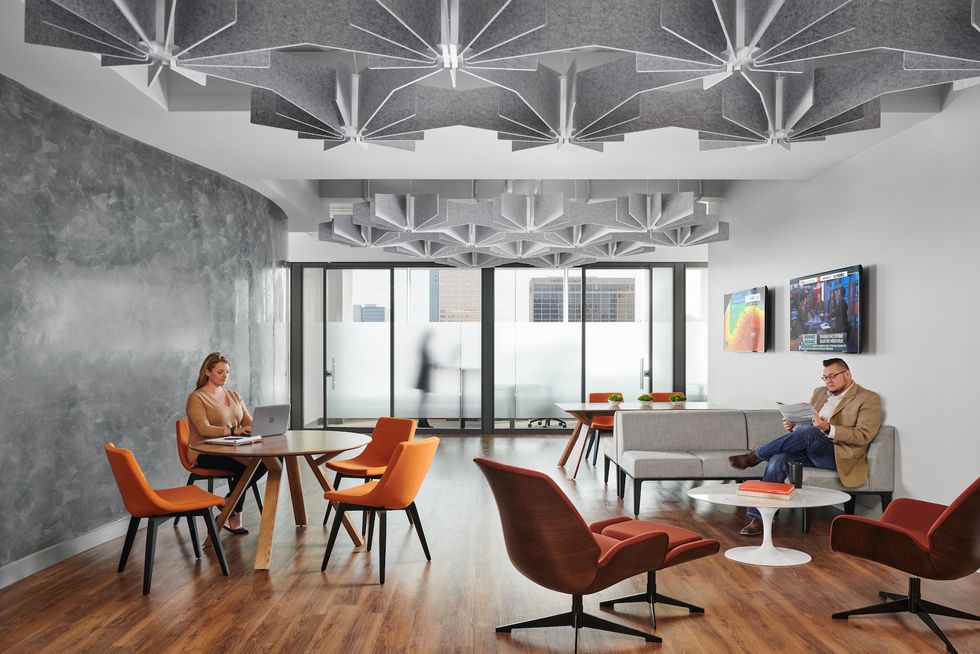
The new FIRMSPACE Houston resides in BBVA Compass Plaza, which opened in 2014.

Ad Placement 300x100
Ad Placement 300x600

CultureMap Emails are Awesome

Austin company to bring AI-powered school to The Woodlands

AI education

Austin-based Alpha School, which operates AI-powered private schools, is opening its first Houston-area location in The Woodlands.

The 8,000-square-foot school, scheduled to be ready for the 2026-27 academic year, initially will serve students in kindergarten through eighth grade. Alpha says the school will offer “open workshop spaces and innovative classrooms that support personalized instruction, core academics, leadership development, and real-world life skills.”

Alpha sets aside two hours each school day for the AI-driven, self-paced study of core subjects like math, reading and science. The rest of each school day consists of life-skills workshops focusing on topics such as leadership and financial literacy.

Alpha’s school in The Woodlands has begun accepting applications for the 2026-27 school year. Annual tuition costs $40,000.

“The Woodlands is one of the most dynamic, forward-thinking communities in Texas, and Alpha is proud to bring

an innovative educational model that complements its strong academic foundation,” says Rachel Goodlad, head

of expansion for Alpha.

Founded in 2014, Alpha School combines adaptive technology-driven instruction with immersive life-skills workshops. Its model emphasizes mastery-based learning in core subjects alongside development of communication, critical thinking, financial literacy and leadership skills. It operates more than 15 schools across the country.

Elsewhere in Texas, Alpha operates schools in Austin, Brownsville, Fort Worth and Plano. Alpha also operates 12 Texas Sports Academy campuses in Texas, including locations in Houston, Pearland and Richmond, along with a NextGen Academy esports school in Austin, a school for gifted students in Georgetown, and lower-cost Nova Academy campuses in Austin and Bastrop.

Alpha has fans and critics. While supporters tout students’ high achievement rates, detractors complain about the high tuition and the AI-influenced depersonalization of education.

“Students and our country need to be in relationship with other human beings,” Randi Weingarten, president of the American Federation of Teachers, a teachers union, tells The New York Times. “When you have a school that is strictly AI, it is violating that core precept of the human endeavor and of education.”

Alpha co-founder MacKenzie Price, a podcaster and social media influencer, doesn’t share Weingarten’s views.

“Parents and teachers: We need to embrace this change,” Price wrote after President Trump signed an executive order promoting AI in schools.

The Times notes that Alpha doesn’t employ AI as a tutor or a supplement. Rather, the newspaper says, AI is “the school’s primary educational driver to move students through academic content.”

Houston researcher secures $1.7M to develop drug for aggressive form of breast cancer

cancer research

A University of Houston researcher has joined a $3.2 million effort to develop a new drug designed to attack a cancer-driving protein commonly found in triple-negative breast cancer.

Triple-negative breast cancer (TNBC) is one of the most difficult-to-treat forms of cancer and accounts for 10 percent to 15 percent of all breast cancer cases. The disease gets its name because tumors associated with it test negative for estrogen receptors, progesterone receptors and excess HER2 protein, making it difficult to target. Due to this, TNBC is often treated with general chemotherapy, which can come with negative side effects and drug resistance, according to UH.

UH College of Pharmacy research associate professor Wei Wang is developing a drug that can target the disease more specifically. The drug will target MDM2, a protein often overproduced in TNBC that also contributes to faster tumor growth.

Wang is working on a team led by Wei Li, director of the University of Tennessee Health Science Center College of Pharmacy’s Drug Discovery Center. She has received $1.7 million to support the research.

Wang and UH professor of pharmacology and toxicology Ruiwen Zhang have discovered a compound that can break down MDM2. In early laboratory models, the compound has shown the ability to shrink tumors.

Wang and Zhang will focus on understanding how the treatment works and monitoring its effectiveness in models that closely mirror human disease.

“We will study how the drug targets MDM2 and evaluate the most promising drug candidates to determine effective dosing, understand how the drug behaves in the body, compare it with existing treatments and assess early safety,” Wang said in a news release.

Li’s team at the University of Tennessee will be working on the chemistry and drug design end of the project.

“This work could lead to an entirely new class of therapies for triple-negative breast cancer,” Li added in the release. “We’re hopeful that by directly removing the MDM2 protein from cancer cells, we can help more patients respond to treatment regardless of their tumor type.”