


DivInc has launched its new female-focused accelerator and named its first cohort. Photo via Getty Images

DivInc, an Austin-based accelerator for women and people of color, announced today that it has launched its first Women in Tech HTX cohort in partnership with female-focused co-working space SheSpace.

The nine women-led companies will join DivInc's 11th cohort and the first to operate out of Houston. Founders will receive $10,000 in non-dilutive funding upon completion of a 12-week curriculum, which includes in-depth workshops that aim to help the founders "make a year's worth of progress in just three months," Amanda Moya, DivInc’s Houston program director, said in a statement.

According to DivInc, the aim of the accelerator is to support more female-led startups in the Houston area (which the company says it has seen an emergence of in the last two years) and connect them with its network of VCs.

Founders will be paired with mentors from Microsoft and Google to support their next phases of development. DivInc and SheSpace will also provide stipends for founders in need of childcare assistance.

A committee consisting of representatives from Mercury, Artemis Fund, Microsoft, and several other partners helped select the group of founders considering market size, scalability, industry need, and other factors.

Members of the fall cohort include:

Weekly workshops will take place at SheSpace, an all-women coworking space developed by Stephanie Tsuru that opened in the Heights in 2020. The accelerator is also supported by Houston Houston partners J.P. Morgan Chase & Co., Verizon, The Ion and Mercury.

DivInc will introduce the accepted companies at a happy hour on Thursday, Sept. 22 at The Ion. Those interested in attending can RSVP online.

"With several of these companies coming from outside of Texas, we’re looking forward to the founders making organic connections and learning more about what Houston has to offer," Moya added.
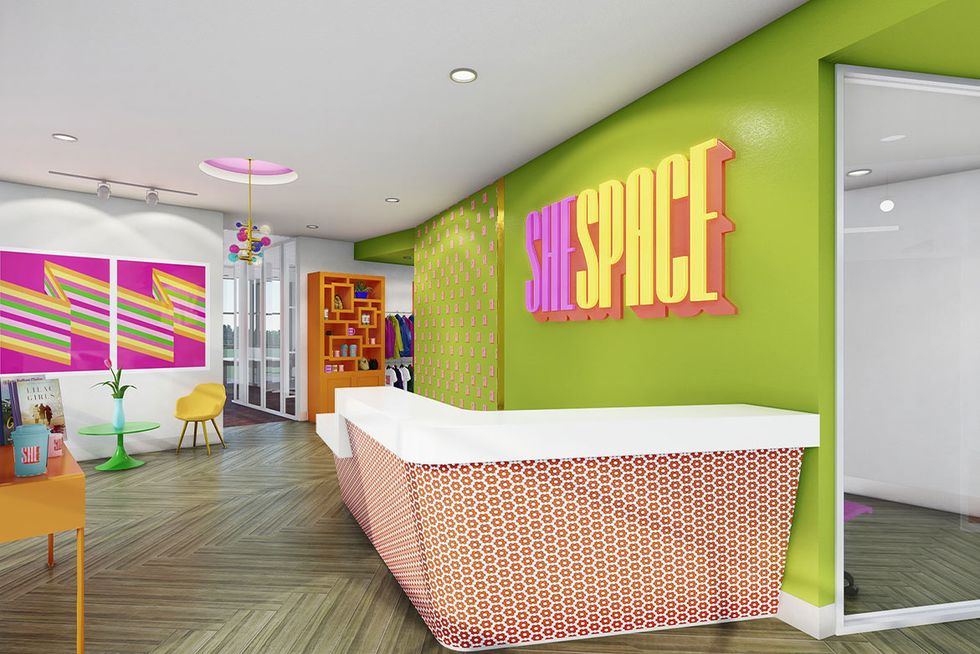
SheSpace will host the accelerator. Image via shespacehtx.com

Ad Placement 300x100
Ad Placement 300x600

CultureMap Emails are Awesome

$5B Austin medical center, anchored by MD Anderson, to break ground this fall

moving forward

Construction on the $1 billion first phase of the AI-native University of Texas Dell Medical Center in Austin—which will feature a hospital operated by Houston’s UT MD Anderson Cancer Center—is set to start this fall.

The UT System Board of Regents approved funding for first-phase construction on Aug. 12.

The medical center—now expected to cost $5 billion, up from the initial $2.9 billion estimate—will span about 2.5 million square feet. It will include 300 to 500 patient beds, outpatient facilities, an emergency department and specialized care for cancer patients.

MD Anderson will bring its world-renowned oncology programs to the center’s integrated health care model, Dr. Claudia Lucchinetti, senior vice president of medical affairs at UT Austin and dean of the university’s Dell Medical School, tells Health Leaders.

Earlier this year, Austin tech billionaire Michael Dell and his wife, Susan, pledged $750 million for development of the medical center. The medical center, scheduled for completion in December 2030, will be a cornerstone of the new 300-acre UT Dell Campus for Advanced Research, a medical education and research hub.

“Through this new campus and medical center, Texas will lead America in health care innovation,” Gov. Greg Abbott said when the research campus was announced in April. “The next generation of medical breakthroughs will take place in Central Texas.”

The medical center will fold AI tools and other technology into the infrastructure, rather than having them added after it’s built. Among other capabilities, the technology will monitor real-time medical data, automate data entry, and help health care professionals quickly predict and identify risks to patients, according to Health Leaders.

“We are not just building a new medical center,” Lucchinetti says. “We are building a fundamentally new model of health. It’s not just a new facility. It’s not just a new collaboration. It is a convergence of capabilities that rarely come together at the same time.”

Rice lands $15M U.S. Army award to launch next-gen wireless research center

defense funding

The U.S. Army Research Office has awarded Rice University $15 million to establish a new center for next-generation sensing and communications.

The five-year research center—dubbed the Center for Large Aperture Secure Sensing, Imaging and Communications (CLASSIC)—will unite researchers from universities and national laboratories to develop advanced antenna technologies for future wireless systems. Edward Knightly, the Sheafor-Lindsay Professor of Electrical and Computer Engineering at Rice, will lead the center that “combines expertise in wireless networking, antennas, radar, artificial intelligence, circuits and physics to address growing demands on wireless systems,” according to Rice.

“The challenges we’re tackling require advances that span physics, hardware, communications and computing," Knightly said in a news release. “By combining those strengths in a single center, we can accelerate the development and demonstration of technologies that would not be possible through individual efforts alone.”

Joining Knightly will be Ashutosh Sabharwal of Rice, Sensen Li of the University of Texas at Austin, Hou-Tong Chen of Los Alamos National Laboratory, Danijela Cabric of UCLA, Josep M. Jornet and Tommaso Melodia of Northeastern University, Daniel M. Mittleman of Brown University, and Willie Padilla of Duke University.

Industry partners include Booz Allen Hamilton, Intel, Keysight, Lockheed Martin, MITRE, Northrop Grumman, Qualcomm and Raytheon.

CLASSIC researchers will investigate how large-scale antenna arrays (ELSAAs) can expand the capabilities of wireless systems where technology is limited.

ELSAAs use thousands of coordinated antenna elements to direct radio waves. Researchers aim to develop ways to use the technology to help maintain steady communication when signals are blocked or disrupted and to detect and generate detailed images of concealed objects.

Along with ELSAAs, the center will work to develop sensing techniques for threat detection, study wireless jamming and build resilient high-speed wireless networks. Researchers will ultimately validate the technology in labs and via drone-based field trials.

CLASSIC will also work on developing an AI-driven modeling framework that will simulate complex electromagnetic environments in real time.

“This award demonstrates Rice’s leadership in tackling complex national research challenges through collaboration across disciplines and institutions,” David Sholl, executive vice president for research at Rice, added in the release.