


Volunteers pictured at the Columbia Tap Trail in Third Ward. Photo by Cindy Torres

The FIFA World Cup 2026 Houston Host Committee has announced new details about its massive Green Corridor project, including the many improvements that will outlast the iconic sporting event taking place in Houston this summer.

The Green Corridor will be a 14-mile long verdant artery connecting multiple major landmarks in Houston through safe, walkable paths that include shade trees and other improvements. First conceived in 2024 by the Sustainability Subcommittee led by Elizabeth Carlson, it will unite East Downtown, Downtown, Midtown, the Museum District, and Third Ward through a hike and bike trail as well as METRO Rail stops. Though the Green Corridor is beginning its life as a showcase for the city to visitors attending the FIFA World Cup June 14 -July 4, it will remain a permanent installation for Houstonians to travel the city without cars.

Management of the project is being handled by Impact Houston 26, a portion of the Host Committee empowered by the Harris County-Houston Sports Authority’s Sports Authority Foundation to promote long-term benefits to the city after the World Cup. Funding partners include private corporations as well as civic organizations such as the City of Sugar Land and Rice University.

“The Green Corridor reflects what Impact Houston 26 is all about, using the FIFA World Cup as a catalyst to deliver lasting environmental benefits for our city,” Carlson said in a statement. “Through Impact Houston’s pillar on sustainability, we’re able to collaborate with local stakeholders to create not just demonstrations of resilience and innovation but education and engagement in the community, a meaningful legacy long after 2026.”

The corridor will provide access to both Houston Stadium (also known as NRG Stadium) and the FIFA Fan Festival, as well as improve existing paths like the Columbia Tap Trail in Third Ward. These improvements include the installation of shade structures, native plantings, expanding the tree canopy, air quality monitoring devices, and water and bike repair stations.

Impact Houston 26 is also working with local institutions like the Houston Zoo, Greentown Labs, and Discovery Green to install various educational materials along the Green Corridor.
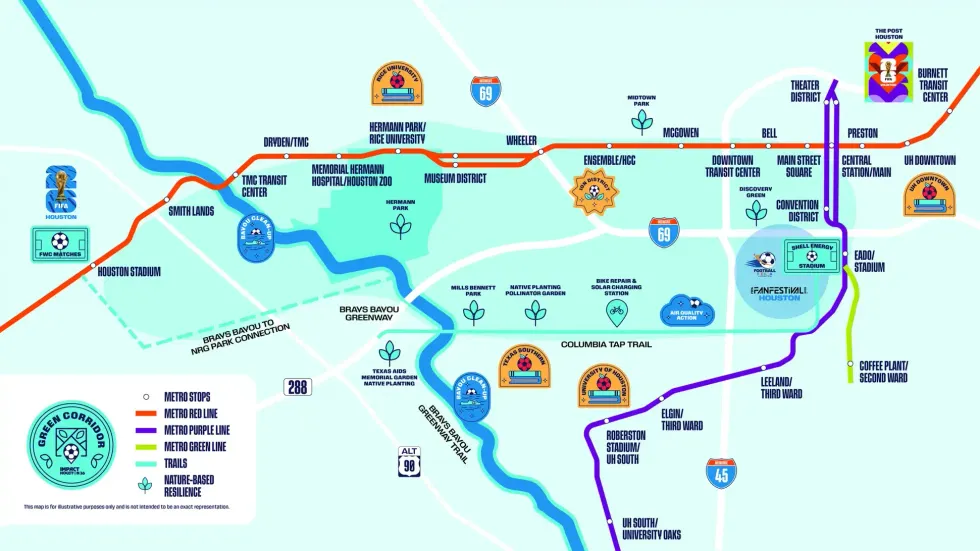
The Green Corridor initiative.Courtesy rendering

Below is a breakdown of other improvements planned or completed as part of the Green Corridor.

  • Downtown Houston Main Street Promenade: Four permanent shade structures, native plants, and expanding the tree canopy by 154% to be implemented by May 2026. Further shade structures and plantings planned for Texas Avenue.
  • East Downtown Management District: Native tree plantings and landscaping in and around the FIFA Fan Festival site to improve first/last mile connectivity around the Green Corridor.
  • Columbia Tap Trail: Installation of 325 solar lights.
  • Stadium Park/Astrodome and TMC/Dryden plus Fannin South Transit Center: Various landscaping and safety enhancements.
  • Midtown Houston: $1.5 million in landscaping and beautification along the Red Line, including over 80 trees, native plantings, water stations, waste receptacles, crosswalk improvements, and public art installations.

The Green Corridor is only one of the World Cup Host Committee's sustainability initiatives. In January, it announced the "New Year, New Hou" program that provides hospitality businesses such as restaurants and hotels with one of three certifications.

---

This article originally appeared on CultureMap.com.

Ad Placement 300x100
Ad Placement 300x600

CultureMap Emails are Awesome

Houston legacy planning platform secures $2.5M investment, adds to board

fresh funding

Houston-based Paige, a comprehensive life planning and succession software company, has secured a $2.5 million investment to expand the AI-driven tools on its platform.

The funding comes from Alabama-based 22nd State Banking Company, according to a news release. Paige says it will use the funding to expand automation, AI-driven onboarding and self-service tools, as well as add to its sales and customer success teams.

The company was originally founded by CEO Emily Cisek in 2020 as The Postage and rebranded to Paige last year. It helps users navigate and organize end-of-life planning with features like document storage and organization, password management, and funeral and last wishes planning.

“Too many families are left trying to piece together important information during some of the hardest moments of their lives,” Cisek said in the news release. “This investment allows us to accelerate the next phase of growth for Paige by improving the product and expanding support for our members, our financial institution partners and the communities they serve,”

In addition to the funding news, the company also announced that 22nd State Banking CEO and President Steve Smith will join Paige's board of directors.

“We believe banking should be grounded in relationships and built around the real needs of the people and communities we serve. Paige brings something deeply relevant to that mission," Smith added in the release. "It helps families prepare for the future in a practical and meaningful way, and it gives the banking community new pathways to support customers through important life transitions.”

Paige estimates that $124 trillion in assets will change hands through 2048. Yet about 56 percent of Americans do not have an estate plan.

Read more on the topic from Cisek in a recent op-ed here; or listen to InnovationMap's 2021 interview with her here.

Houston digital health platform Koda lands strategic investment

money moves

Houston-based advance care planning platform Koda Health has added another investor to the lineup.

The company secured a strategic investment for an undisclosed amount from UPMC Enterprises, the commercialization arm of the University of Pittsburgh Medical Center. The funding is part of Koda's oversubscribed series A funding round that closed in October, according to a release.

"UPMC Enterprises’ investment is a meaningful signal, not just to Koda, but to the broader market," Dr. Desh Mohan, chief medical officer and co-founder of Koda Health, said in the news release. "It validates that health systems are ready to invest in infrastructure that makes advance care planning work the way it should: proactively, at scale, and with the human support that these conversations require. Having UPMC Enterprises as a strategic investor puts us in a unique position to prove what's possible."

Koda has raised $14 million to date, according to a representative from the company. Its series A round was led by Evidenced, with participation from Mudita Venture Partners, Techstars and the Texas Medical Center last year. At the time, the company said the funding would allow it to scale operations and expand engineering, clinical strategy and customer success. The company described the round as a "pivotal moment," as it had secured investments from influential leaders in the healthcare and venture capital space.

Koda Health, which was born out of the TMC's Biodesign Fellowship in 2020, saw major growth last year, as well, and now supports more than 1 million patients nationwide through partnerships with Cigna Healthcare, Privia Health, Guidehealth, Sentara, UPMC and Memorial Hermann Health System.

The company integrated its end-of-life care planning platform with Dallas-based Guidehealth in April 2025 and with Epic Systems in July 2025. It also won the 2025 Houston Innovation Award in the Health Tech Business category. Read more here.