Volunteers pictured at the Columbia Tap Trail in Third Ward. Photo by Cindy Torres

The FIFA World Cup 2026 Houston Host Committee has announced new details about its massive Green Corridor project, including the many improvements that will outlast the iconic sporting event taking place in Houston this summer.

The Green Corridor will be a 14-mile long verdant artery connecting multiple major landmarks in Houston through safe, walkable paths that include shade trees and other improvements. First conceived in 2024 by the Sustainability Subcommittee led by Elizabeth Carlson, it will unite East Downtown, Downtown, Midtown, the Museum District, and Third Ward through a hike and bike trail as well as METRO Rail stops. Though the Green Corridor is beginning its life as a showcase for the city to visitors attending the FIFA World Cup June 14 -July 4, it will remain a permanent installation for Houstonians to travel the city without cars.

Management of the project is being handled by Impact Houston 26, a portion of the Host Committee empowered by the Harris County-Houston Sports Authority’s Sports Authority Foundation to promote long-term benefits to the city after the World Cup. Funding partners include private corporations as well as civic organizations such as the City of Sugar Land and Rice University.

“The Green Corridor reflects what Impact Houston 26 is all about, using the FIFA World Cup as a catalyst to deliver lasting environmental benefits for our city,” Carlson said in a statement. “Through Impact Houston’s pillar on sustainability, we’re able to collaborate with local stakeholders to create not just demonstrations of resilience and innovation but education and engagement in the community, a meaningful legacy long after 2026.”

The corridor will provide access to both Houston Stadium (also known as NRG Stadium) and the FIFA Fan Festival, as well as improve existing paths like the Columbia Tap Trail in Third Ward. These improvements include the installation of shade structures, native plantings, expanding the tree canopy, air quality monitoring devices, and water and bike repair stations.

Impact Houston 26 is also working with local institutions like the Houston Zoo, Greentown Labs, and Discovery Green to install various educational materials along the Green Corridor.
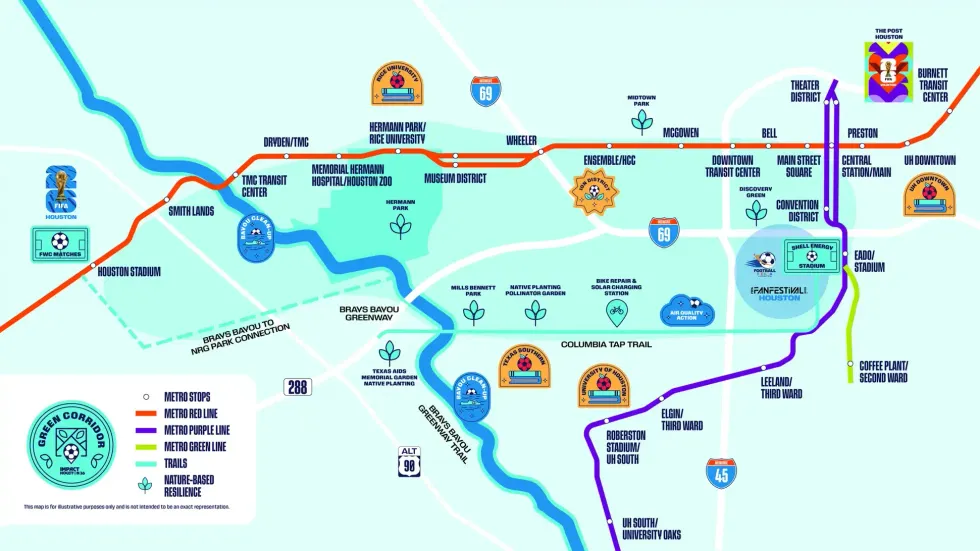
The Green Corridor initiative.Courtesy rendering

Below is a breakdown of other improvements planned or completed as part of the Green Corridor.

  • Downtown Houston Main Street Promenade: Four permanent shade structures, native plants, and expanding the tree canopy by 154% to be implemented by May 2026. Further shade structures and plantings planned for Texas Avenue.
  • East Downtown Management District: Native tree plantings and landscaping in and around the FIFA Fan Festival site to improve first/last mile connectivity around the Green Corridor.
  • Columbia Tap Trail: Installation of 325 solar lights.
  • Stadium Park/Astrodome and TMC/Dryden plus Fannin South Transit Center: Various landscaping and safety enhancements.
  • Midtown Houston: $1.5 million in landscaping and beautification along the Red Line, including over 80 trees, native plantings, water stations, waste receptacles, crosswalk improvements, and public art installations.

The Green Corridor is only one of the World Cup Host Committee's sustainability initiatives. In January, it announced the "New Year, New Hou" program that provides hospitality businesses such as restaurants and hotels with one of three certifications.

---

This article originally appeared on CultureMap.com.
Ad Placement 300x100
Ad Placement 300x600

CultureMap Emails are Awesome

Houston digital health platform Koda lands strategic investment

money moves

Houston-based advance care planning platform Koda Health has added another investor to the lineup.

The company secured a strategic investment for an undisclosed amount from UPMC Enterprises, the commercialization arm of the University of Pittsburgh Medical Center. The funding is part of Koda's oversubscribed series A funding round that closed in October, according to a release.

"UPMC Enterprises’ investment is a meaningful signal, not just to Koda, but to the broader market," Dr. Desh Mohan, chief medical officer and co-founder of Koda Health, said in the news release. "It validates that health systems are ready to invest in infrastructure that makes advance care planning work the way it should: proactively, at scale, and with the human support that these conversations require. Having UPMC Enterprises as a strategic investor puts us in a unique position to prove what's possible."

Koda has raised $14 million to date, according to a representative from the company. Its series A round was led by Evidenced, with participation from Mudita Venture Partners, Techstars and the Texas Medical Center last year. At the time, the company said the funding would allow it to scale operations and expand engineering, clinical strategy and customer success. The company described the round as a "pivotal moment," as it had secured investments from influential leaders in the healthcare and venture capital space.

Koda Health, which was born out of the TMC's Biodesign Fellowship in 2020, saw major growth last year, as well, and now supports more than 1 million patients nationwide through partnerships with Cigna Healthcare, Privia Health, Guidehealth, Sentara, UPMC and Memorial Hermann Health System.

The company integrated its end-of-life care planning platform with Dallas-based Guidehealth in April 2025 and with Epic Systems in July 2025. It also won the 2025 Houston Innovation Award in the Health Tech Business category. Read more here.

New 'living pharmacy' biotech company launches out of Rice venture studio

fighting cancer

Rice University’s biotech venture studio RBL LLC has launched a new “living pharmacy” company, Duracyte, designed to make cancer treatment easier on patients.

Backed by an up to $45 million Advanced Research Projects Agency for Health (ARPA-H) award, Duracyte aims to commercialize implantable biohybrid pharmacy devices that are designed to produce therapeutic proteins inside the human body around the clock, replacing the need for regular injections and infusions for some cancer patients.

The company’s main platform is its Hybrid Advanced Molecular Manufacturing Regulator (HAMMR), a rechargeable, implantable device that can sense biological signals, monitor tumor environments and adjust therapeutic output in real time. HAMMR has wireless communication capabilities, which allow patients and clinicians to remotely monitor results through an app every five minutes and make changes to treatment plans without a hosptial visit. Additionally, the device can generate its own oxygen supply, which is key for the therapeutic cells’ survival.

“Biologic medicines such as monoclonal antibodies, cytokines and metabolic regulators already account for a significant share of modern therapeutics, but the way we deliver them today often requires frequent injections or infusions that can be demanding for patients and lead to inconsistent drug levels,” Daniel Anderson, MIT professor and co-founder of Duracyte, said in a news release. “Our vision is to enable a continuous, stable therapy by producing these medicines directly inside the body, which could improve treatment consistency, reduce side effects and ultimately transform how biologic therapies are delivered across many diseases.”

Duracyte’s first clinical trial is slated to begin by the end of 2026 and will focus on recurrent ovarian cancer. The Phase I study will build upon existing work on encapsulated cytokine pharmacy technology, and the company hopes that within a few years this treatment can reach clinical application.

The development of Duracyte is supported by ARPA-H's Targeted Hybrid Oncotherapeutic Regulation (THOR) project, which supports a multidisciplinary research consortium co-led by Omid Veiseh, a professor of bioengineering at Rice. The consortium also includes others at Rice, The University of Texas MD Anderson Cancer Center, Stanford University, Carnegie Mellon University, Northwestern University and the University of Houston, plus industry collaborators like Chicago-based CellTrans.

“What we are building is the culmination of years of progress in cell engineering, biomaterials and implantable device technology,” Veiseh added in the release. “By combining these advances with real-time sensing and adaptive drug delivery, we are working with the support of RBL to create a true ‘living pharmacy’ that can deliver continuous, precisely controlled biologic therapies and fundamentally change how these treatments reach patients.”

RBL launched in 2024 and is based out of Houston’s Texas Medical Center Helix Park. Duracyte is the third company launched by RBL, including Sentinel BioTherapeutics, a clinical-stage immunotherapy company developing localized cytokine therapies for solid tumors, and SteerBio, a regenerative medicine company targeting lymphedema.

“Duracyte exemplifies the kind of breakthrough that Houston’s ecosystem is built to produce,” Paul Wotton, managing partner of RBL LLC and co-founder of Duracyte, added in the release. “With world-class clinical infrastructure, exceptional engineering talent and initiatives like the Texas Biotech Task Force driving alignment across industry, investment and talent, this region is uniquely positioned to move the most ambitious ideas in medicine from concept to patient, faster than anywhere else.”