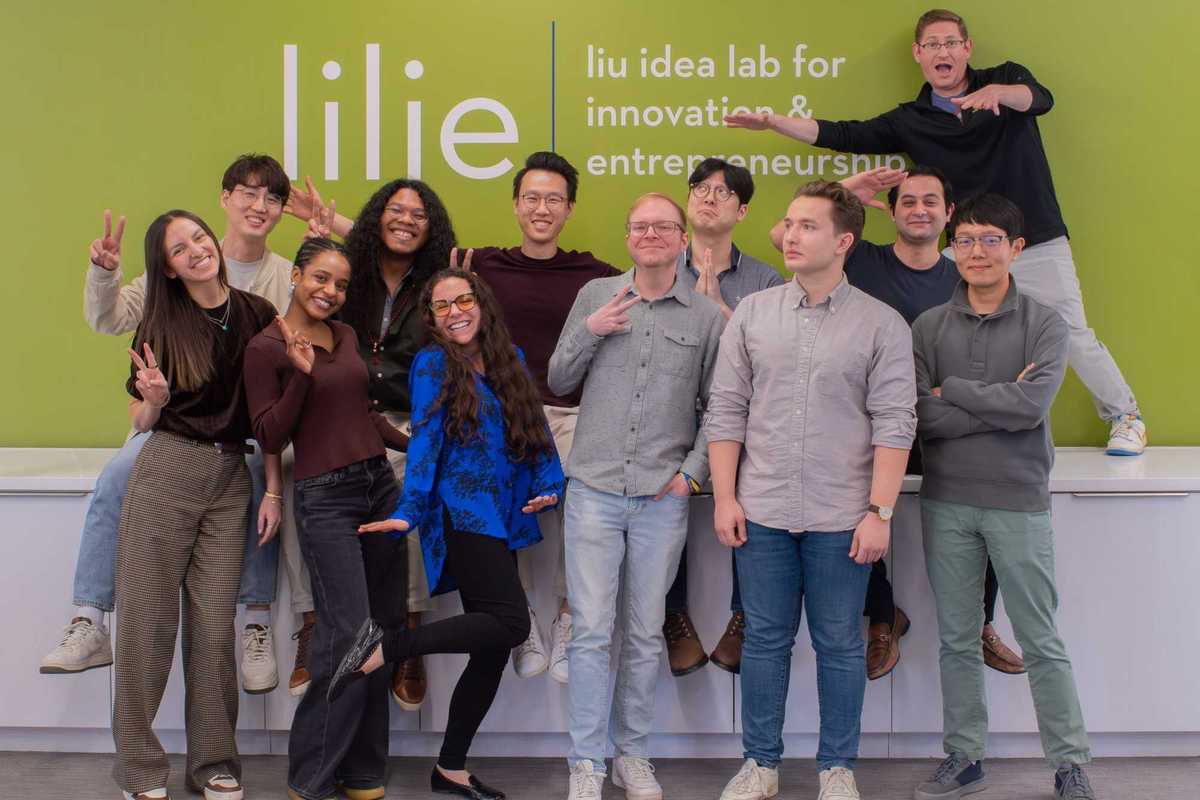
Join us at the Houston Innovation Awards Nov. 13. Courtesy photo

Editor's note: Houston’s innovation calendar is packed this November, with opportunities to connect across climatetech, health care and entrepreneurship. From Greentown Labs’ flagship summit and veteran-led showcases to discussions on medical innovation and startup growth, here's what not to miss and how to register. Please note: this article may be updated to include additional event listings.

Nov. 4 – Greentown Climatetech Summit

Greentown Labs' Climatetech Summit Houston will bring together philanthropists, executives and innovators in the energy transition space. Expect to hear from John Arnold, co-founder and co-chair of Arnold Ventures, and Greentown CEO Georgina Campbell Flatter, who will participate in the day-long event’s keynote fireside chat, along with remarks from Houston Mayor John Whitmire, a course led by TEX-E Executive Director Sandy Guitar and more. Ten Greentown Labs startups will present pitches, and attendees will also be able to meet founders and Greentown members during the afternoon startup showcase.

This event is Tuesday, Nov. 4, from 8 a.m.-4:30 p.m. at Greentown Labs. A networking reception follows from 5-7:30 p.m. at Axelrad Houston. Learn more here.

Nov. 11 – Veterans & Visionaries

Houston Veteran Network will celebrate the entrepreneurial spirit of veterans at its Veterans & Visionaries event. Veteran business owners will have the opportunity to showcase their businesses, connect with investors and participate in speed networking.

This event is Tuesday, Nov. 11, from 2-7 p.m. at the Ion. Find more information here.

Nov. 12 – Energy Drone and Robotics Forum

The Energy Drone + Robotics Coalition will offer a chance for industry leaders, operators and engineers to connect. Attendees will explore real-world uses, hear lessons from successful deployments, and gain practical insights and tools for scaling through various workshops, keynote addresses, Q&As and more.

This event is Wednesday, Nov. 12, from 8 a.m.-5:30 p.m. at the Ion. A Bots & Brews / Industrial AI Connect Reception will be held at Second Daught from 5:30-7:30 p.m. Find more information here.

Nov. 12 – TMC Envision 2025: Showcasing Healthcare Innovation

Celebrate 10 years of TMC Innovation at Envision, which shines a light on how TMC’s health tech companies are shaping the future. The event will feature talks from TMC’s Devin Dunn, Jason Sakamoto and Tom Luby that will focus on hospital innovation, health care policies, Texas-specific funding and regulatory dynamics and more.

This event is Wednesday, Nov. 12, from 3:30-6:30 p.m. at TMC Innovation Factory. Find more information here.

Nov. 13 — 2025 Houston Innovation Awards

Join InnovationMap at Greentown Labs on Nov. 13 for the fifth annual Houston Innovation Awards. Our annual celebration of all things Houston innovation offers an exclusive opportunity to network with leaders in the innovation ecosystem and culminates in the awards ceremony, where this year's winners across 10 prestigious categories will be unveiled. Individual tickets and corporate 10-packs with reserved seating are still available.

This event is Thursday, Nov. 13 at 7 p.m. at Greentown Labs. Get your tickets here.

Nov. 13 – Houston Methodist Leadership Speaker series

Head to the Houston Methodist Tech Hub at Ion to hear the latest installment of the Houston Methodist Leadership Speaker Series. The month’s event will feature Dr. Shlomit Schaal, executive vice president and chief physician executive at Houston Methodist. She is also the president and CEO of the Houston Methodist Physician Organization. Schaal will focus on physician group innovation.

This event is Thursday, Nov. 13, from 4:45-6 p.m. at the Ion. Find more information here.

Nov. 18 – Rice Customer-based Strategy Symposium

Rice University’s Jones Graduate School of Business will present this recurring forum for exchanging innovative ideas on customer-centered strategy planning and execution. The symposium features peer-reviewed research from leading academics with industry trends and insights from executives. Hear from Jones School Dean Peter Rodriguez, Harris County Sheriff Ed Gonzalez, Laura Lopez, SVP of marketing, communications and public relations at Houston Methodist; Farid Virani, CEO of Prime Communications; and several Rice MBA graduates and executives.

This event is Tuesday, Nov. 18, 2025, from 7:30 a.m.-3:00 p.m. at the Ion. Learn more here.

Nov. 20 – Houston Startup Speedrun

Wade Pinder, founder of Product Houston, will host the Houston Startup Speedrun. This intensive and fast-paced program is designed to provide early-stage founders and aspiring entrepreneurs with a comprehensive understanding of the “Startup Founder's Journey” and the Houston startup ecosystem. The event is broken up into 10 consecutive 50-minute sessions, including topics such as “Creating a Compelling Business Plan,” “Operations and Scaling” and others.

This event is Thursday, Nov. 20, from 9 a.m.-7 p.m. at the Ion. Find more information here.

Nov. 20 – State of the Texas Medical Center

The Greater Houston Partnership will present the State of the Texas Medical Center. Hear from William F. McKeon, president and CEO of TMC, and GHP president and CEO Steve Kean as they discuss “the tremendous progress happening in health care delivery and life sciences in the world’s largest medical center.”

This event is Thursday, Nov. 20, from 4-6:30 p.m. at Helix Park. Find more information here.

Ad Placement 300x100
Ad Placement 300x600

CultureMap Emails are Awesome

Houston health tech co. lands NIH grant for AI cancer prediction tool

fresh funding

Houston-based CellChorus and Stanford Medicine were recently awarded a Phase I Small Business Innovation Research grant for the company's AI platform to test how certain cancer patients will respond to therapies.

The funding comes from the National Cancer Institute of the National Institutes of Health. According to a filing, the grant totaled just under $400,000.

CellChorus, which spun out from the University of Houston’s Technology Bridge, has developed TIMING (Time-lapse Imaging Microscopy In Nanowell Grids), which analyzes the behavior of thousands of individual immune cells over time and can identify early indicators of treatment success or failure.

The company will work with Stanford's Dr. David Miklos and Dr. Saurabh Dahiya, who have built the Bone Marrow Transplantation and Cell Therapy Biobank. The biobank manages and stores biological samples from patients treated at their clinic and in clinical trials.

"Predicting which patients will achieve durable responses after CAR-T therapy remains one of the most important challenges in the field,” Miklos said in a news release. “We aim to uncover functional cellular signatures that can guide treatment decisions and improve patient outcomes.”

The project will specifically profile cells from patients with relapsed/refractory large B-cell lymphoma (r/rLBCL). According to CellChorus, only about half of r/rLBCL patients who receive CAR-T therapy "achieve a durable, long-term remission." Others do not respond to therapy or experience relapse.

“The sooner we know whether a cancer therapy is working, the better. To maximize patient benefit, we need technology that can provide a robust and early prediction of response to therapy. The technology needs to be scalable, cost-efficient, and capable of rapid turnaround times,” Rebecca Berdeaux, chief scientific officer of CellChorus, added in the release. “We are excited to work with Drs. David Miklos and Saurabh Dahiya and their colleagues on this very important project.”

CellChorus has previously received SBIR grants from federal agencies, including a $2.5 million award in 2024 from its National Center for Advancing Translational Sciences (NCATS) and a $2.3 million SBIR Fast-Track award from the National Institute of General Medical Sciences in 2023.

Houston museum showcases America's founding documents in rare exhibit

Experience History

As the United States prepares to celebrate its 250th birthday, Houstonians have a chance to see rare documents from the founding of the nation. Freedom Plane National Tour: Documents That Forged a Nation, presented by the National Archives Foundation, will be on display at the Houston Museum of Natural Science through Monday, May 25.

The collection includes a rare engraving of the original Declaration of Independence; official Oaths of Allegiance signed by George Washington, Aaron Burr, and Alexander Hamilton; a draft of the Bill of Rights; the Treaty of Paris, the documented that recognized America's independence from Great Britain; and the tally of votes approving the Constitution.

The National Archives specifically chose Houston as one of only eight cities in the country to host the exhibit as a means to help the documents reach a wider audience outside of the main hub of semiquincentennial events in New England and the Washington, D.C. area.

"One of the things we decided when we put the tour together because we wanted to be off the East Coast," said Patrick Madden, CEO of the National Archives Foundation, who was onsite for the exhibit's opening in Houston. "There's a lot of 250th celebration stuff happening in the original 13 colonies. How do we get it to major markets where larger numbers of people can see it? So in the case of Houston, obviously, [is a] major market in this part of the country, but also we've partnered with the museum twice before with National Archives exhibits, so we knew that they would be up to the task of handling the exhibit and the crowds."

The star of the collection is a rare engraving of the original Declaration of Independence. Secretary of State and future president John Quincy Adams commissioned 200 exact replicas of the document from engraver William J. Stone in 1823. Less than 50 now remain. Madden joyfully pointed out that there are errors in this document, a potent reminder that the men who forged a nation made mistakes.

"There's a couple of typos in it where they had to make corrections," said Madden. "So even the founders, you know, they're all human. That resonates because here these people are making this move against the most powerful nation in the world and putting their lives on the line for a country based on ideas."

Other impressive parts of the collection include official Oaths of Allegiance signed by George Washington, Aaron Burr, and Alexander Hamilton, as well as one of the drafts of the Bill of Rights. Many states would not ratify the Constitution until certain rights were included in the document, leading to Washington going on a national tour assuring state leaders enshrining protections was first on the list. The draft copy on display specifically shows the First Amendment in progress.

Houston is the fourth stop on the exhibition's tour, which will take the documents to Denver, Miami, Dearborn, and Seattle through the summer. Freedom Plane is just one part of a larger patriotic celebration at the HMNS, which includes a film series celebrating American science and culture and general Americana decoration throughout the main hall.

Admission to Freedom Plane is free to the public, but separate from general admission to the museum. Space is limited, and passes are available on a first-come, first-serve basis. Non-members should expect long waits or the possibility that the day's passes are sold out. Only museum members can reserve passes for specific times. Flash photography is prohibited due to the fragile nature of the documents.

---

This article originally appeared on CultureMap.com.

Houston quantum energy chip startup emerges from stealth with $12M round

seed funding

Houston-based Casimir has emerged from stealth with a $12 million seed round to commercialize its quantum energy chip.

The round was led by Austin-based Scout Ventures. Lavrock Ventures, Cottonwood Technology, Capital Factory, American Deep Tech, and Tim Draper of Draper Associates also participated in the round. The oversubscribed round exceeded the company’s original $8 million target, according to a news release.

Casimir’s semiconductor chips can generate power from quantum vacuum fields without the need for batteries or charging. The company plans to commercialize its first-generation MicroSparc chip by 2028.

The MicroSparc chip measures 5 millimeters by 5 millimeters and is designed to produce 1.5 volts at 25 microamps, comparable to a small rechargeable battery, without degradation and no replacement cycle.

“Casimir represents exactly the kind of breakthrough dual-use technology Scout Ventures was built to back,” Brad Harrison, founder and managing partner at Scout Ventures, said in the release. “This is based on 100 years of science and we’re finally approaching a commercial product … We’re proud to lead this round and support Casimir’s journey from applied science to deployed technology.”

Casimir says it aims to scale its technology across the ”full power spectrum,” including large-scale energy systems that can power homes, commercial infrastructures and electric vehicles.

Casimir's scientific work has been supported by DARPA-funded nanofabrication research and its technology was incubated at the Limitless Space Institute (LSI). LSI is a nonprofit that works to innovate interstellar travel and was founded by Kam Ghaffarian. Technology investor and serial entrepreneur Ghaffarian has been behind companies like X-energy, Intuitive Machines, Axiom Space and Quantum Space.

Harold “Sonny” White, founder and CEO of Casimir, believes the technology can power devices for years without replacements.

“Millions of devices will operate for years without a battery ever needing to be replaced or recharged because we have engineered a customized Casimir cavity into hardware capable of producing persistent electrical power,” White added in the release. “I spent nearly two decades at NASA studying how we power humanity’s future. That work led me to the Casimir effect and the quantum vacuum, where new tools have allowed us to build on a century of scientific knowledge and bring abundant power to the world.”