Rheom Materials turned heads in Milan this month with a collection centered around Shorai, its sugar-based leather alternative. Photo courtesy Rheom Materials.

Earlier this month, Houston-based Rheom Materials and India’s conscious design studio Econock unveiled a collaborative capsule collection that signaled more than just a product launch.

Hosted at Lineapelle—long considered the global epicenter of the world's premier leather supply chain—in the vaulted exhibition halls of Rho-Fiera Milano, the collection centered around Rheom’s 91 percent bio-based leather alternative, Shorai.

It was a bold move, one that shifted sustainability from a concept discussed in panel sessions to garments that buyers could touch and wear.

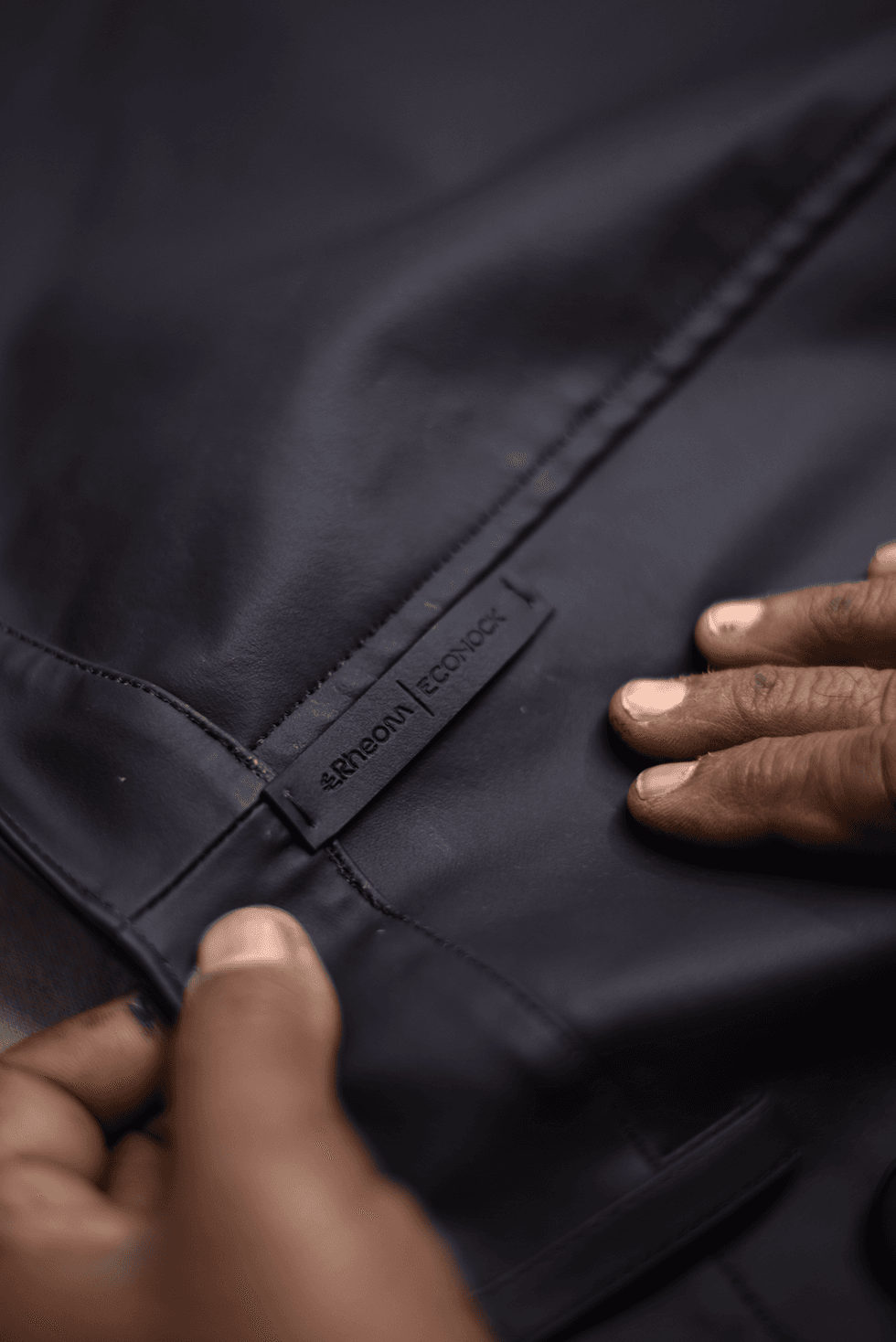
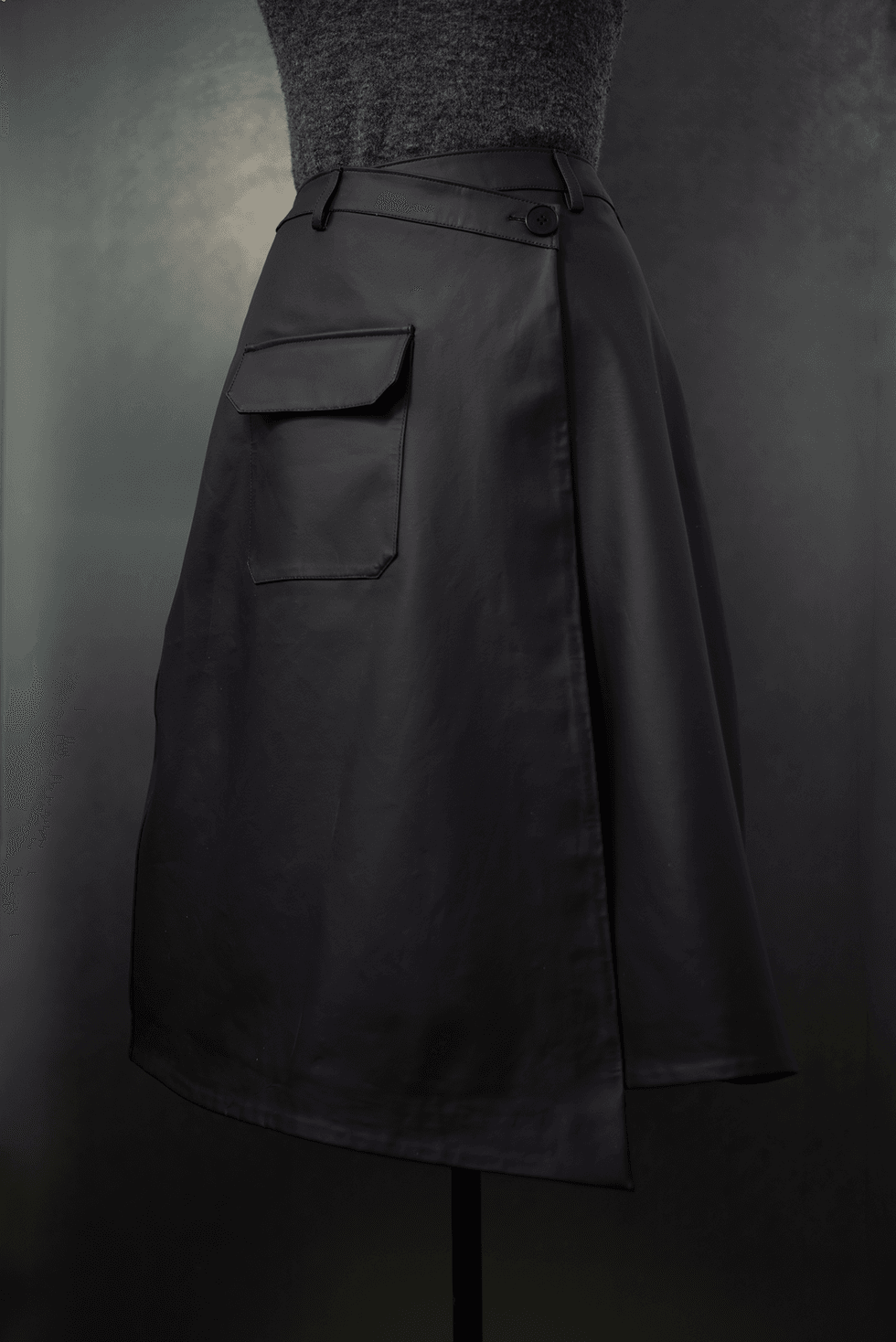
The collection featured a bomber-style jacket, an asymmetrical skirt and a suite of accessories—all fabricated from Shorai.

The standout piece, a sculptural jacket featuring a funnel neck and dual-zip closure, was designed for movement, challenging assumptions about performance limitations in bio-based materials. The design of the asymmetrical skirt was drawn from Indian armored warrior traditions, according to Rheom, with biodegradable corozo fasteners.

Built as a modular wardrobe rather than isolated pieces, the collection reflects a shared belief between Rheom and Econock in designing objects that adapt to daily life, according to the companies.

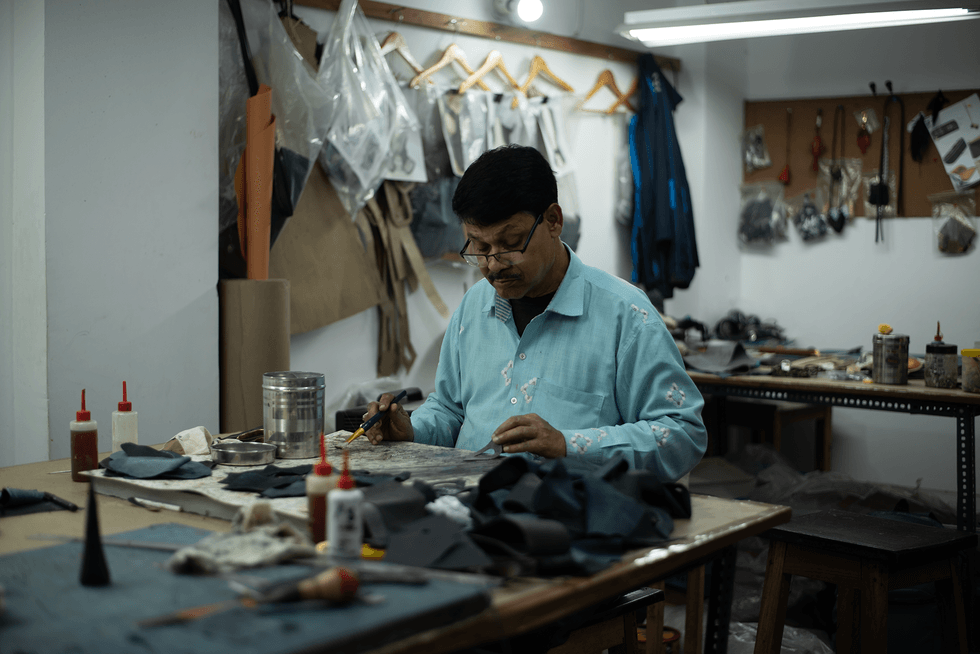
The collection was born out of a new partnership between Rheom and Econock, focused on bringing biobased materials to the market. According to Rheom, the partnership solves a problem that has stalled the adoption of many next-gen textiles: supply chain friction.

While Rheom focuses on engineering scalable bio-based materials, New Delhi-based Econock brings the complementary design and manufacturing ecosystem that integrates artisans, circular materials and production expertise to translate the innovative material into finished goods.

"This partnership removes one of the biggest barriers brands face when adopting next-generation materials,” Megan Beck, Rheom’s director of product, shared in a news release. “By reducing friction across the supply chain, Rheom can connect brands directly with manufacturers who already know how to work with Shorai, making the transition to more sustainable materials far more accessible.”

Sanyam Kapur, advisor of growth and impact at Econock, added: “Our partnership with Rheom Materials represents the benchmark of responsible design where next-gen materials meet craft, creativity, and real-world scalability.”

Rheom, formerly known as Bucha Bio, has developed Shorai, a sustainable leather alternative that can be used for apparel, accessories, car interiors and more; and Benree, an alternative to plastic without the carbon footprint. In 2025, Rheom was a finalist for Startup of the Year in the Houston Innovation Awards.

Shorai is already used by fashion lines like Wuxly and LuckyNelly, according to Rheom. The company scaled production of the sugar-based material last year and says it is now produced in rolls that brands can take to market with the right manufacturer.
Houston startup debuts leather alternative fashion collection in Milan
Ad Placement 300x100
Ad Placement 300x600

CultureMap Emails are Awesome

Houston quantum energy chip startup emerges from stealth with $12M round

seed funding

Houston-based Casimir has emerged from stealth with a $12 million seed round to commercialize its quantum energy chip.

The round was led by Austin-based Scout Ventures. Lavrock Ventures, Cottonwood Technology, Capital Factory, American Deep Tech, and Tim Draper of Draper Associates also participated in the round. The oversubscribed round exceeded the company’s original $8 million target, according to a news release.

Casimir’s semiconductor chips can generate power from quantum vacuum fields without the need for batteries or charging. The company plans to commercialize its first-generation MicroSparc chip by 2028.

The MicroSparc chip measures 5 millimeters by 5 millimeters and is designed to produce 1.5 volts at 25 microamps, comparable to a small rechargeable battery, without degradation and no replacement cycle.

“Casimir represents exactly the kind of breakthrough dual-use technology Scout Ventures was built to back,” Brad Harrison, founder and managing partner at Scout Ventures, said in the release. “This is based on 100 years of science and we’re finally approaching a commercial product … We’re proud to lead this round and support Casimir’s journey from applied science to deployed technology.”

Casimir says it aims to scale its technology across the ”full power spectrum,” including large-scale energy systems that can power homes, commercial infrastructures and electric vehicles.

Casimir's scientific work has been supported by DARPA-funded nanofabrication research and its technology was incubated at the Limitless Space Institute (LSI). LSI is a nonprofit that works to innovate interstellar travel and was founded by Kam Ghaffarian. Technology investor and serial entrepreneur Ghaffarian has been behind companies like X-energy, Intuitive Machines, Axiom Space and Quantum Space.

Harold “Sonny” White, founder and CEO of Casimir, believes the technology can power devices for years without replacements.

“Millions of devices will operate for years without a battery ever needing to be replaced or recharged because we have engineered a customized Casimir cavity into hardware capable of producing persistent electrical power,” White added in the release. “I spent nearly two decades at NASA studying how we power humanity’s future. That work led me to the Casimir effect and the quantum vacuum, where new tools have allowed us to build on a century of scientific knowledge and bring abundant power to the world.”

Houston-based Fervo Energy bumps up IPO target to $1.82 billion

IPO update

Houston-based geothermal power company Fervo Energy is now eyeing an IPO that would raise $1.75 billion to $1.82 billion, up from the previous target of $1.33 billion.

In paperwork filed Monday, May 11 with the U.S. Securities and Exchange Commission, Fervo says it plans to sell 70 million shares of Class A common stock at $25 to $26 per share.

In addition, Fervo expects to grant underwriters 30-day options to buy up to 8.33 million additional shares of Class A common stock. This could raise nearly $200 million.

When it announced the IPO on May 4, Fervo aimed to sell 55.56 million shares at $21 to $24 per share, which would have raised $1.17 billion to $1.33 billion. The initial valuation target was $6.5 billion.

A date for the IPO hasn’t been scheduled. Fervo’s stock will be listed on Nasdaq under the ticker symbol FRVO.

Fervo, founded in 2017, has attracted about $1.5 billion in funding from investors such as Bill Gates-founded Breakthrough Energy Ventures, Google, Mitsubishi Heavy Industries, Devon Energy (which is moving its headquarters to Houston), Tesla co-founder JB Straubel, CalSTRS, Liberty Mutual Investments, AllianceBernstein, JPMorgan, Bank of America and Sumitomo Mitsui Trust Bank.

Fervo’s marquee project is Cape Station in Beaver County, Utah, the world’s largest EGS (enhanced geothermal system) project. The first phase will deliver 100 megawatts of baseload clean power, with the second phase adding another 400 megawatts. The site can accommodate 2 gigawatts of geothermal energy. Fervo holds more than 595,000 leased acres for potential expansion.

Cape Station has secured power purchase agreements for the entire 500-megawatt capacity. Customers include Houston-based Shell Energy North America and Southern California Edison.

---

This article originally appeared on our sister site, EnergyCapitalHTX.com.