Houston tied with Dallas-Fort Worth to produce the highest number of top-rated employers in Texas. Photo by Thaddious Thomas on Unsplash

More than a dozen Houston-based companies are sharing the spotlight in U.S. News and World Report's collection of the "Best Companies to Work For" in 2024-2025.

The annual report examines publicly-traded companies around the world to determine the best employers based on six metrics including work-life balance and flexibility; quality of pay and benefits; job and company stability; career opportunities and professional development; and more. The companies were not ranked, but included based on reader surveys and publicly available data about each workplace.

New for the 2024-2025 report, U.S. News analyzed549 companies across 29 different lists, including the overall best companies list — which includes the best 300 companies across the U.S., the United Kingdom, Ireland, Switzerland, Luxembourg, and Bermuda — 24 industry-specific lists, and four regional lists.

There were 16 total companies based around Houston that made the lists, with the majority being based in the city, while one each were located in Spring and The Woodlands.

Leading the pack in Houston is construction company Comfort Systems USA, which provides HVAC, plumbing, and electrical services. Comfort Systems employs 15,800 people, brings in $5.57 billion in annual revenue, and has a market cap of $11.21 billion. The company earned high ratings for its job stability, "belongingness," and professional development opportunities, according to U.S. News.

Comfort Systems also made appearances on U.S. News' industry-specific "Best in Construction" list, and the "Best Companies in the South" list.

Independent energy company Marathon Oil was another top-rated Houston employer, with nearly 1,700 employees, an annual revenue stream of $6.38 billion, and a $15.4 billion market cap. The company was specifically highlighted with a "Top Quality of Pay" label, but also boasts high ratings for its employees' work-life balance, job stability, and belongingness.

In addition to being included in the overall "Best Companies" list, Marathon Oil earned recognition in the industry-specific "Best in Energy" list and the "Best Companies in the South" list.

A second Houston-based energy company earning a spot among the top employers is Occidental (also known as Oxy). The petroleum corporation, which has been in operation since 1920, has nearly 12,600 employees and brings in $27,43 billion in revenue every year.

According to U.S. News, Occidental offers many financial, health and wellness, and workplace benefits including 401k matching, tuition assistance, an employee assistance program, flexible work arrangements, and much more. The company was also given a "Top Quality of Pay" designation.

Occidental appeared in U.S. News' "Best in Mining and Raw Materials," the overall "Best Companies," and "Best Companies in the South" lists.

Other top companies to work for in Houston include:

  • Insperity, Kingwood – Best in Professional Services; Best Companies (overall); Best Companies in the South
  • Southwestern Energy Company, Spring – Best in Energy; Best Companies (overall); Best Companies in the South
  • PROS – Best in IT, Software and Services; Best Companies (overall); Best Companies in the South
  • Powell Industries – Best in Manufacturing; Best Companies (overall); Best Companies in the South
  • Stewart – Best in Insurance; Best Companies (overall); Best Companies in the South
  • ConocoPhillips – Best in Energy, Best Companies in the South
  • LGI Homes, The Woodlands – Best in Construction; Best Companies in the South
  • Service Corporation International – Best in Consumer Products and Services; Best Companies in the South
  • Skyward Specialty Insurance – Best Companies in the South
  • Camden Property Trust – Best in Real Estate; Best Companies in the South
  • Cheniere – Best in Energy
  • EOG Resources – Best in Energy
  • Murphy Oil Corporation – Best in Energy

"Prospective and current employees understand the significant impact their employer has on their quality of life," said Carly Chase, vice president of careers at U.S. News and World Report, in a release. "Whether a new grad seeking a company to launch their career, an established professional looking for a change or an HR professional researching the strengths of their company and others, Best Companies to Work For provides a central space to see which companies are meeting their employees' needs best.

Top workplaces around Texas
In all, 42 different employers headquartered in the Lone Star State made it onto U.S. News' 2024-2025 "Best Places to Work For" lists. The Houston metro area tied with Dallas-Fort Worth with the highest number of top-rated employers, at 16 each. Only one company from West Texas made it onto the list: Diamondback Energy in Midland.

The top companies to work for in Austin are:

  • Cirrus Logic
  • CrowdStrike
  • Digital Realty
  • Silicon Labs
  • E2open
  • Q2

The top companies to work for in San Antonio are:

  • Frost Bank
  • iHeartMedia
  • Rush Enterprises, Inc., New Braunfels

The best places to work for across Dallas-Fort Worth are:

  • Thryv Holdings, Inc., Dallas
  • Comerica, Dallas
  • Veritex Community Bank, Dallas
  • Charles Schwab, Westlake
  • Southwest Airlines, Dallas
  • CMC, Irving
  • Sabre, Southlake
  • Texas Instrument, Dallas
  • Omnicell, Fort Worth
  • Enhabit, Dallas
  • Builders FirstSource, Irving
  • Invitation Homes, Dallas
  • Celanese, Irving
  • Atmos Energy, Dallas
  • Lennox, Richardson
  • Caterpillar, Irving
The full list of the best companies to work for can be found at usnews.com

------

This article originally ran on CultureMap.

Ad Placement 300x100
Ad Placement 300x600

CultureMap Emails are Awesome

Houston founders launch edtech startup, pilot to pinpoint why students are struggling

learning gaps

Early detection. It sounds simple enough: identify a problem before it has the chance to become a bigger one.

But in practice, early detection is much more difficult to navigate, especially in education, when it comes to identifying the reasons behind a student's academic struggles.

That’s why co-founders Alapati “Al” Ware and Estela Montanez launched Progress Report, a Houston-built K-12 learning-intelligence platform designed to go beyond identifying that a student is struggling.

The platform recently began its pilot program with 35 educators and more than 200 students in Texas and Arizona.

“It’s a micro-learning school that works with children with disabilities, primarily dyslexia and nonverbal students,” Ware tells InnovationMap.

The platform is also being used by homeschool parents, home teachers and Houston educators, including those at SWPS College & Career Preparatory Academy, a Houston charter school.

Ware says Progress Report was designed to fill a gap he and Montanez saw in existing edtech. Some platforms cater almost entirely to students, leaving teachers with little insight into if and how a child is learning. Others focus heavily on district data, where “the student is just a number,” leaving teachers to navigate disconnected tools.

“Our goal was [to] focus purely on the teacher because the teacher is the backbone,” Ware says.

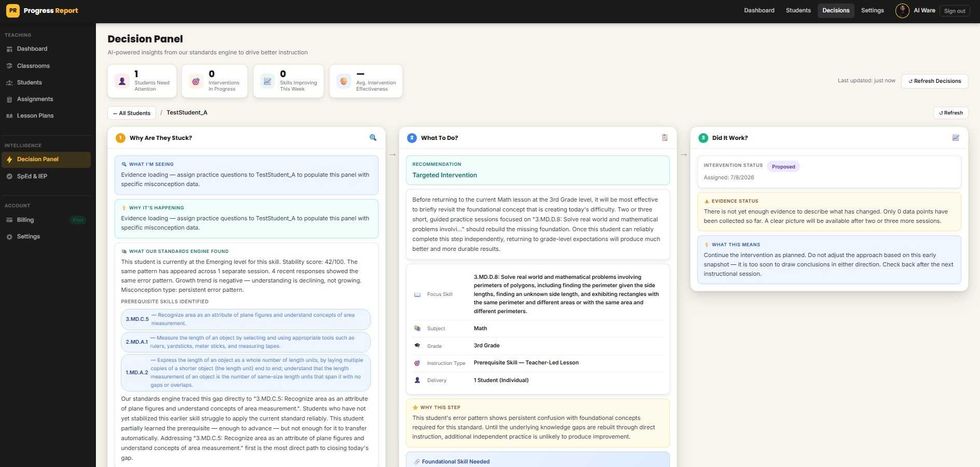
Progress Report traces student performance to learning gaps and prerequisite skills, helping educators understand not only where a student is struggling, but what may be causing it.

The platform then helps teachers build individualized instruction for general education students, students with special education and Individualized Education Program (IEP) needs, and Spanish-speaking learners—all within one educator-controlled system.

The goal is to reduce the guesswork and hours of manual work educators can spend developing individualized lesson plans.

Progress Report helps idenitify learning gaps and common roadblocks for each student. Image courtesy Progress Report

For Ware and Montanez, the mission is also personal.

The concept dates back to around 2023, when the co-founders first had to navigate and address their children’s educational needs.

Ware, Progress Report’s CEO and CTO with a background in edtech, built the platform end-to-end after watching his daughter, who had an IEP related to speech, struggle to get the support she needed.

Montanez, the company’s COO, brought another perspective. Her son is on the autism spectrum. She now leads Progress Report’s operations, partnerships and pilot execution while helping carry its focus on bilingual families from Puerto Rico to Houston.

Together, they began researching ways to personalize their children’s learning and help them progress academically. Montanez’s son went on to become an AP student and high school athlete, while Ware’s daughter began reading more than two grade levels above her grade, they tell InnovationMap.

But Progress Report isn’t designed simply to give a struggling student more work.

Take a student who appears to have difficulty with math.

The problem may not actually be math, the founders share. The student could understand the calculations but struggle to comprehend complex words used in a math problem.

Progress Report is designed to trace those performance patterns back to learning gaps, prerequisite skills or other instructional barriers. From there, it can recommend a next instructional step while leaving the educator in control.

The same concept applies to accommodations.

The system can read IEPs, 504 Plans, Present Levels of Academic Achievement and Functional Performance (PLAAFPs), evaluations and other special education records. Approved IEP goals can then be mapped into the student’s learning graph, while accommodations can carry over into lesson planning and question delivery.

The founders say that approach separates Progress Report from simply adding another artificial intelligence chatbot to a classroom. And still, they believe teachers have to remain at the center.

Teachers, in fact, helped build Progress Report.

The founders began meeting with Houston-area educators months before the pilot. Their feedback helped shape the platform before testing began.

“We’ve been building alongside these educators,” Ware says.

Parents are another piece.

Progress Report can give parents access to their child’s learning record so they can see learning gaps as they develop. Teachers can also see information on work being completed at home when the parent and educator are working together.

After the pilot wraps, Ware and Montanez plan to introduce a $29.99 monthly subscription for homeschool parents, teachers and other educators. They say the price was intentionally kept relatively low to help make the tools more accessible.

They are also exploring ways to work with organizations that could help families who can’t afford the platform.

Moving forward, the goal is considerably bigger.

Over the next five years, Ware and Montanez want Progress Report to become what they describe as a “gold standard” in every state. They know getting there will require building relationships with educators, technology leaders, policymakers and school board members.

For now, they’re starting with a few hundred students and a question that sounds simple but can be remarkably difficult to answer: Why is this student struggling?

If Progress Report works the way its founders envision, teachers and parents will have a clearer answer.

Pioneering cohousing development opens in Houston's historic 2nd Ward

Housing in Hou

An experimental, multi-generational building in the East End is now open and accepting residents. Only 10 of the 33 units remain available at East End Commons, the first project from CoHousing Houston.

Located at 115 Lenox, East End Commons was first conceived in 2017 and is designed to combine the security of home ownership with the community aspect of apartment life, essentially a condominium but with added focus on bringing neighbors together.

Units range from 900-2,000 square feet, offering ample private home space, but with a large Common House area and central courtyard for gatherings, working, and interaction. Large front porches encourage people to spend time outside where they can meet their neighbors, as do extensive foot paths for casual meetings.

"At East End Commons, you know your neighbors before you move in — so you have a network of people and spaces that are immediately there for you," said founding resident Kelli Soika. "We designed for larger shared spaces versus larger personal spaces in order to foster the breakdown of the barriers that lead to loneliness."

Combating loneliness and isolation is certainly necessary. A 2025 survey conducted by the American Psychological Association shows that most Americans feel a sense of societal division and lonely. A loss of "third spaces," where people gather outside the home or work, is a prime factor. East End Commons aims to alleviate some of that disconnectedness.

"I wanted to live in a neighborhood that is imbued with a sense of community above the individual, like we have all experienced in Houston during times of disaster recovery," said Lynn Morstead, one of East End Commons‘ founding residents. "In those instances, such as Hurricane Harvey, we surface from our separateness and come together in new and unexpected ways. With East End Commons, the goal is to translate that notion beyond a set period of time and make it a fixture of everyday life. I call it 'disaster-free neighborliness.'"

East End Commons was designed by Kathleen English of English + Associates. Sustainability is part of the project's design, with amenities such as geothermal heating and cooling exchange HVAC, pre-heated water systems, low-energy use air conditioning and heating, and native landscaping.

Prices for units range from $300,000 to the $900,000s, which can be more than double the home price in the rapidly gentrifying East End. HOA fees not only help maintain communal areas, they also cover shared internet, water, and other communal expenses. Similarly, government of the building is handled democratically via a community board that aims to make decisions by building consensus.

For more information, email info@cohousinghouston.com or call 832-900-2919.