The winners have been revealed.

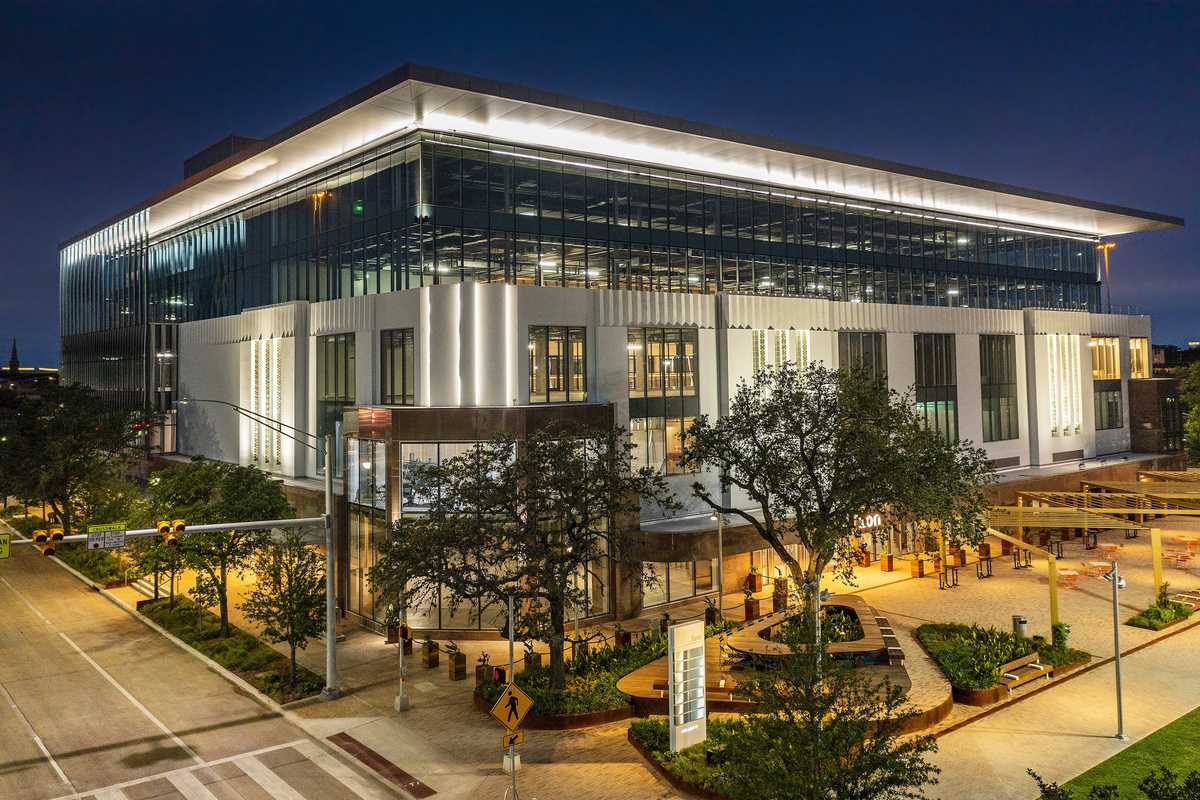
After weeks of anticipation, the 2025 Houston Innovation Awards winners have been revealed. Finalists, judges, and VIPs from Houston's vibrant innovation community gathered on Nov. 13 at Greentown Labs for the fifth annual event.

This year, the Houston Innovation Awards recognized more than 40 finalists, with winners unveiled in 10 categories.

Finalists and winners were determined by our esteemed panel of judges, comprised of 2024 winners who represent various Houston industries, as well as InnovationMap editorial leadership. One winner was determined by the public via an online competition: Startup of the Year.

The program was emceed by Lawson Gow, Head of Houston for Greentown Labs. Sponsors included Houston City College Northwest, Houston Powder Coaters, FLIGHT by Yuengling, and more.

Without further adieu, meet the 2025 Houston Innovation Awards winners:
Minority-founded Business: Mars Materials

Clean chemical manufacturing business Mars Materials is working to convert captured carbon into resources, such as carbon fiber and wastewater treatment chemicals. The company develops and produces its drop-in chemical products in Houston and uses an in-licensed process for the National Renewable Energy Lab to produce acrylonitrile, which is used to produce plastics, synthetic fibers and rubbers. The company reports that it plans to open its first commercial plant in the next 18 months.


Female-founded Business, presented by Houston Powder Coaters: March Biosciences

Houston cell therapy company March Biosciences aims to treat unaddressed challenging cancers, with its MB-105, a CD5-targeted CAR-T cell therapy for patients with relapsed or refractory CD5-positive T-cell lymphoma, currently in Phase 2 clinical trials. The company was founded in 2021 by CEO Sarah Hein, Max Mamonkin and Malcolm Brenner and was born out of the TMC Accelerator for Cancer Therapeutics.
Energy Transition Business: Eclipse Energy

Previously known as Gold H2, Eclipse Energy converts end-of-life oil fields into low-cost, sustainable hydrogen sources. It completed its first field trial this summer, which demonstrated subsurface bio-stimulated hydrogen production. According to the company, its technology could yield up to 250 billion kilograms of low-carbon hydrogen.

Health Tech Business: Koda Health

Koda Health has developed an advance care planning platform (ACP) that allows users to document and share their care preferences, goals and advance directives for health systems. The web-based platform guides patients through values-based decisions with interactive tools and generates state-specific, legally compliant documents that integrate seamlessly with electronic health record systems. Last year, the company also added kidney action planning to its suite of services for patients with serious illnesses. In 2025, it announced major partnerships and integrations with Epic, Guidehealth, and others, and raised a $7 million series A.
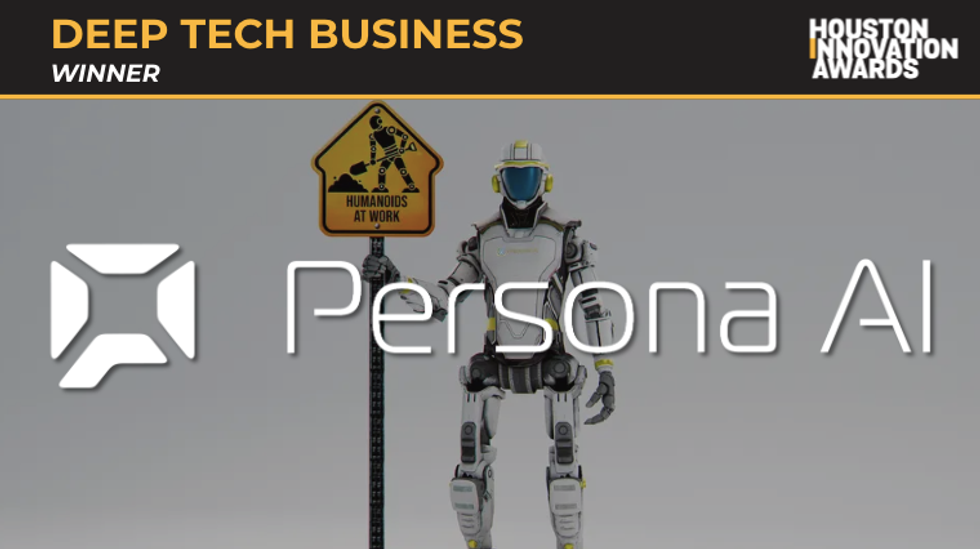
Deep Tech Business: Persona AI

Persona AI is building modularized humanoid robots that aim to deliver continuous, round-the-clock productivity and skilled labor for "dull, dirty, dangerous, and declining" jobs. The company was founded by Houston entrepreneur Nicolaus Radford, who serves as CEO, along with CTO Jerry Pratt and COO Jide Akinyode. It raised eight figures in pre-seed funding this year and is developing its prototype of a robot-welder for Hyundai's shipbuilding division, which it plans to unveil in 2026.
Scaleup of the Year: Fervo Energy

Houston-based Fervo Energy is working to provide 24/7 carbon-free energy through the development of cost-competitive geothermal power. The company is developing its flagship Cape Station geothermal power project in Utah, which is expected to generate 400 megawatts of clean energy for the grid. The company raised $205.6 million in capital to help finance the project earlier this year and fully contracted the project's capacity with the addition of a major power purchase agreement from Shell.
Incubator/Accelerator of the Year: Greentown Labs

Climatetech incubator Greentown Labs offers its community resources and a network to climate and energy innovation startups looking to grow. The collaborative community offers members state-of-the-art prototyping labs, business resources and access to investors and corporate partners. The co-located incubator was first launched in Boston in 2011 before opening in Houston in 2021.
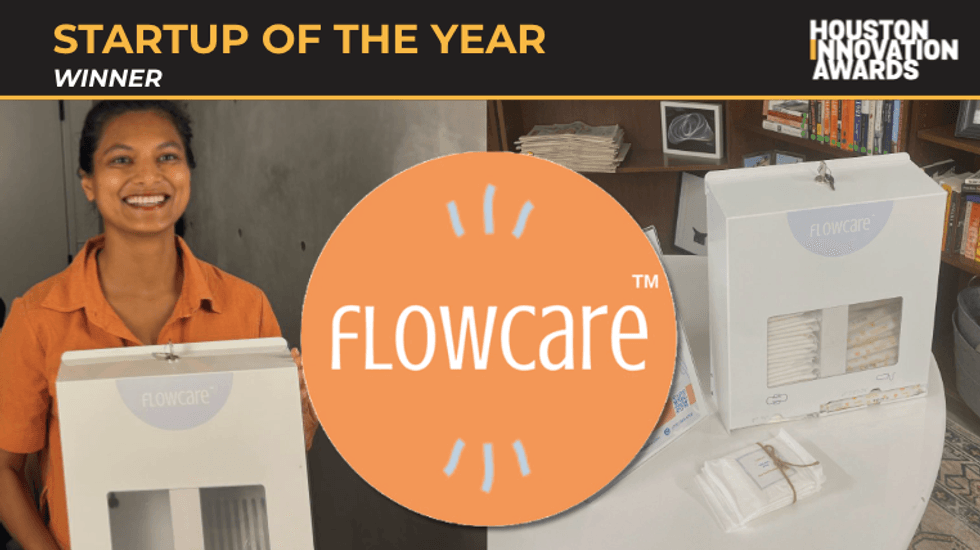
Startup of the Year (People's Choice): FlowCare

FlowCare is developing a period health platform that integrates smart dispensers, education, and healthcare into one system to make free, high-quality, organic period products more accessible. FlowCare is live at prominent Houston venues, including Discovery Green, Texas Medical Center, The Ion, and, most recently, Space Center Houston, helping make Houston a “period positivity” city.
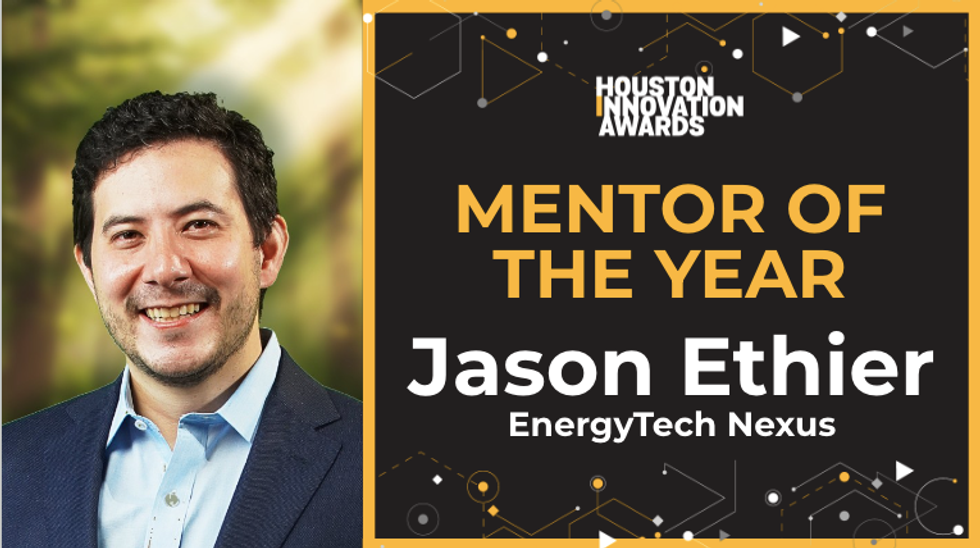
Mentor of the Year, presented by Houston City College Northwest: Jason Ethier, EnergyTech Nexus

Jason Ethier is the founding partner of EnergyTech Nexus, through which he has mentored numerous startups and Innovation Awards finalists, including Geokiln, Energy AI Solutions, Capwell Services and Corrolytics. He founded Dynamo Micropower in 2011 and served as its president and CEO. He later co-founded Greentown Labs in Massachusetts and helped bring the accelerator to Houston.
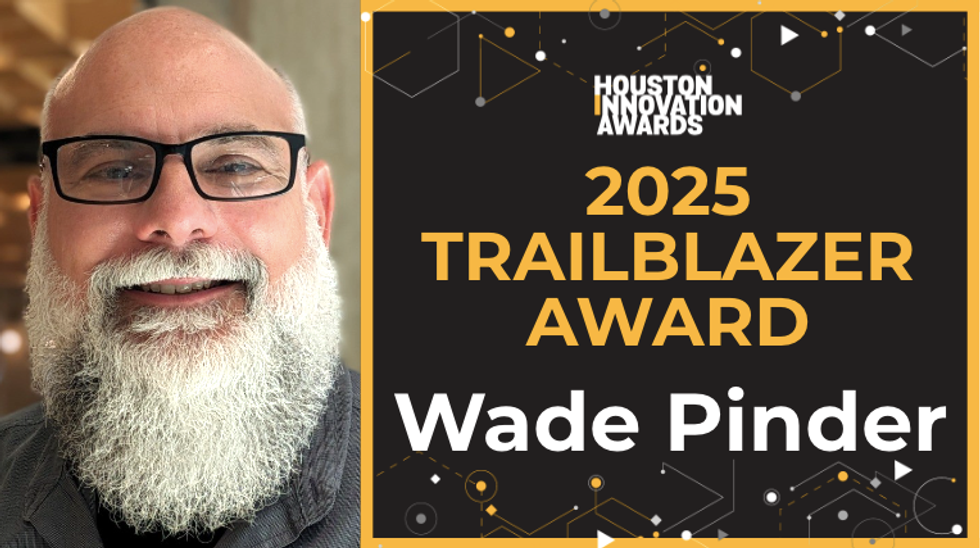
2025 Trailblazer Award: Wade Pinder

Wade Pinder, founder of Product Houston, identifies as an "Ecosystem Wayseeker" and is the founder of Product Houston. A former product manager at Blinds.com, he has been deeply engaged in Houston’s startup and innovation scene since 2012. Over the years, he has supported hundreds of founders, product leaders, and community builders across the Houston area. In 2023, he was honored as Mentor of the Year in the Houston Innovation Awards.

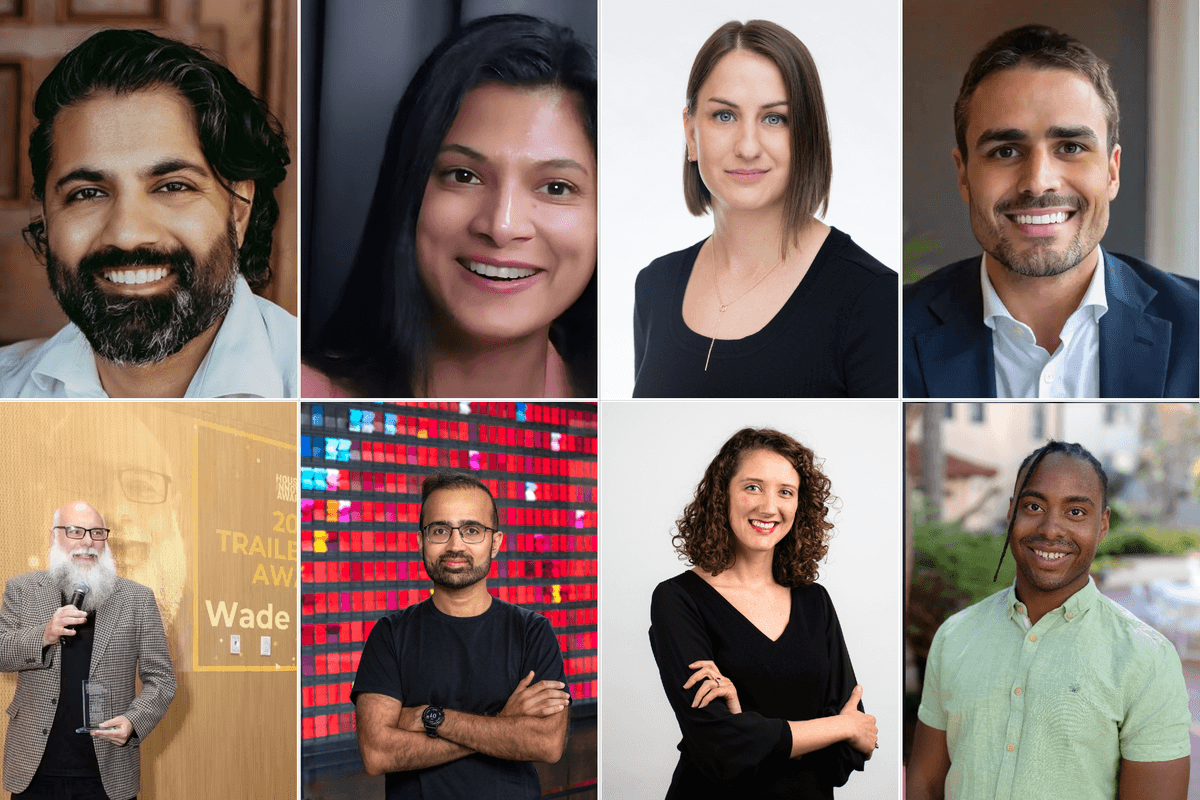
A concept design rendering of Persona AI's humanoid robot. The company is one of the finalists for the 2025 Houston Innovation Awards in the Deep Tech Business category. Rendering courtesy Persona AI.

6 Houston startups disrupting industries with innovative technology

meet the finalists

Houston is no stranger to technology that's shaping the future. As the longtime location of NASA Johnson Space Center to home base for new ventures disrupting industries with their technology, the Bayou City has had its finger on the pulse of what's new and next for decades.

The Deep Tech Business category in our 2025 Houston Innovation Awards will honor an innovative startup providing technology solutions based on substantial scientific or engineering challenges, including those in the AI, robotics and space sectors.

Six deep tech companies have been named finalists for the 2025 award. They range from a company developing predictive software to accelerate the energy transition to a new venture that's developing humanoid robots.

Read more about these businesses, their founders and their breakthrough technologies below. Then join us at the Houston Innovation Awards on Nov. 13 at Greentown Labs, when the winner will be unveiled.

Tickets are now on sale for this exclusive event celebrating Houston Innovation.

ARIX Technologies

Industrial and robotics company ARIX Technologies is an integrated robotics and data analytics company that delivers inspection services. Its ARIX VENUS robot combines aerospace-grade engineering, advanced non-destructive testing (NDT) and AI-powered analytics to detect hidden corrosion under insulation for the downstream energy, petrochemical, and chemical processing sectors.

ARIX was founded in 2017 by Dianna Liu, a former ExxonMobil engineer. Craig Mallory serves as CEO. The company reports that it is scaling deployments with major Gulf Coast refineries, expanding its analytics platform to include predictive corrosion modeling and growing a global partner program.

Little Place Labs

Space tech company Little Place Labs is developing an AI, machine-learning software across a network of satellites that can provide insights from space in under seven minutes.

The company was founded in 2022 by CEO Bosco Lai and CTO Gaurav Bajaj. The company recently received an award from the U.S. Space Force that will support it in deploying multiple applications and products onto more than 55 satellites over the next 36 months for both national security and commercial use cases. The company won the Security, GovTech & Space competition at the SXSW Pitch showcase last year.

Newfound Materials

Newfound Materials has developed a predictive synthesis software platform for accelerating the discovery of novel materials for critical energy applications, such as batteries, magnets, catalysts, and more. It guides users on the best experiments to try in the lab to optimize the synthesis of their materials.

Newfound Materials was founded in 2024 by CEO Matthew McDermott and participated in the inaugural Activate cohort. The company plans to release a public web app soon. It also has plans to raise a pre-seed or angel round.

Paladin Drones

Paladian develops drone-as-first-responder (DFR) systems for public safety. Its technology gives first responders live aerial video before teams arrive, enabling quicker decisions, better resource allocation and reduced false alarms.

The company was founded in 2018 by Divyaditya Shrivastava and participated in the Y Combinator accelerator that year. The company raised a $5.2 million seed round in 2024 and another round for an undisclosed amount earlier this year. In the future, it plans to expand its DFR deployments into more cities, offer new payload delivery capabilities (like delivering Narcan and life vests), and enhance deconfliction features.

Persona AI

Persona AI is building modularized humanoid robots that aim to deliver continuous, round-the-clock productivity and skilled labor for "dull, dirty, dangerous, and declining" jobs.

The company was founded by Houston entrepreneur Nicolaus Radford, who serves as CEO, along with CTO Jerry Pratt and COO Jide Akinyode. It raised eight figures in pre-seed funding this year and also expanded its operations at the Ion. The company is developing its prototype of a robot-welder for Hyundai's shipbuilding division, which it plans to unveil in 2026.

Tempest Droneworx

Tempest Droneworx provides real-time intelligence collected through drones, robots and sensors. Its Harbinger software platform shares data through a video game engine and aims to provide teams with early warning and insight to help them make decisions faster.

The company was founded in 2021 by CEO Ty Audronis and COO Dana Abramovitz. It participated in the Mass Challenge Air Force Labs and won the Best Speed Pitch at SXSW earlier this year. The company is currently raising a $2.5M seed round.

---

The Houston Innovation Awards program is sponsored by Houston City College Northwest, Houston Powder Coaters, FLIGHT by Yuengling, and more to be announced soon. For sponsorship opportunities, please contact sales@innovationmap.com.


Ad Placement 300x100
Ad Placement 300x600

CultureMap Emails are Awesome

Houston hailed as one of America's 10 best cities for startups

Startup Report

Houston's favorable economic climate is enticing new opportunities for entrepreneurship and growth, and now the city is being hailed as the 7th-best U.S. city for starting a business.

The recognition comes in CommercialCafe's recent "Best Cities for Startups" report, published December 10. The study analyzed large U.S. cities across two population categories – cities with more than 1 million residents and cities with populations between 500,000 and 1 million residents. The report analyzed relevant metrics such as office or coworking costs, Kickstarter funding success, startup density, and survival rates, among others.

Across the biggest U.S. cities with over a million residents, Phoenix, Arizona landed on top as the No. 1 best place to start a new business.

The report's findings revealed 10.6 percent of all businesses in Houston are startups that have been active for less than a year. These new businesses have a survival rate of 64.5 percent, meaning just under two-thirds of all startups in the city will still be running up to five years after they were first established.

Over the last five years, the number of new businesses established in Houston has grown nearly 15 percent. CommercialCafe said new businesses in cities with high startup growth rates tend to "attract top talent" which can eventually lead to securing "vital funding for expansion."

Independent professionals – also known as freelancers – are another crucial resource for new businesses that may need "specialized services" for a fixed amount of time, the report said. Houston's freelance workforce has grown about 9 percent from 2019-2023, and the analysis found there were 97,295 freelancers working in Houston in 2023, compared to 89,528 in 2019.

"Generally, cities in the South and Southwest have experienced strong growth during the surveyed period, in contrast to California cities like Los Angeles and San Diego, where the share of freelancers and gig workers has either stagnated or slightly declined," the report said.

Houston boasts the second-cheapest office space rent nationally, the report found. The average asking price for a 1,000-square-foot workspace (for five employees) in the city added up to $27,124 annually. For startups that want greater flexibility for their workers, the annual cost for a coworking space for the same number of employees in Houston came out to $13,200, which is the fourth-most affordable rate in the U.S.

Other Texas cities with attractive economic environments for startups

Texas, as a whole, is one of the strongest states for starting a new business. Other than Houston, San Antonio (No. 2), Dallas (No. 3), and Fort Worth (No. 4) were also recognized among the top 10 best places to start a business in the category of U.S. cities with more than a million residents.

Austin topped a separate ranking of best cities to start a business with 500,000 to 1 million residents.

"Specifically, the Texas capital was the frontrunner for indicators that looked at the overall share of startups within the local economy, as well as growth rates in five years (2019 to 2023)," the report said. "On top of that, Austin also topped the rankings for its percentage of college-educated residents and its consulting firms, which provide vital support for burgeoning enterprises."

The top 10 best cities to start a new business are:

  • No. 1 – Phoenix, Arizona
  • No. 2 – San Antonio, Texas
  • No. 3 – Dallas, Texas
  • No. 4 – Fort Worth, Texas
  • No. 5 – Jacksonville, Florida
  • No. 6 – San Diego, California
  • No. 7 – Houston, Texas
  • No. 8 – Philadelphia, Pennsylvania
  • No. 9 – Chicago, Illinois
  • No. 10 – Los Angeles, California
---

This article originally appeared on CultureMap.com.

Top Houston space news of 2025 soars with NASA deals, lunar missions

Year in Review

Editor's note: As 2025 comes to a close, we're looking back at the stories that defined Houston innovation this year. The space tech sector soared with companies landing huge NASA contracts and furthering their lunar missions. Here are the 10 biggest Houston space tech stories of the year:

Houston native picked for 2025 class of NASA astronaut candidates

Houston native Anna Menon, posing below the first A in “NASA,” is one of 10 new NASA astronaut candidates. Photo courtesy NASA.

NASA has selected 10 new astronaut candidates, including one whose hometown is Houston, for its 2025 training class. The candidates will undergo nearly two years of training before they can assume flight assignments.

Intuitive Machines lands $9.8M to complete orbital transfer vehicle

Intuitive Machines expects to begin manufacturing and flight integration on its orbital transfer vehicle as soon as 2026. Photo courtesy Intuitive Machines.

Houston-based Intuitive Machines, which rang the NASDAQ opening bell July 31, secured a $9.8 million Phase Two government contract for its orbital transfer vehicle. The contract will push the project through its Critical Design Review phase, which is the final engineering milestone before manufacturing can begin.

Houston tech company tapped by NASA for near space initiative

Intuitive Machines is among four companies awarded contracts for NASA’s Near Space Network. Photo via intuitivemachines.com

In January, Intuitive Machines nailed down a NASA deal to expand the agency’s communications network for spacecraft. Additionally, NASA completed the first round of “human in the loop” testing for Intuitive Machines’ Moon RACER lunar terrain vehicle at the agency’s Johnson Space Center. RACER (Reusable Autonomous Crewed Exploration Rover) is one of three commercially developed unpressurized lunar terrain vehicles being considered for NASA’s Artemis lunar initiative.

Texas Space Commission doles out $5.8 million to Houston companies

Axiom Space and FluxWorks are the latest Houston-area companies to receive funding from the Texas Space Commission. Photo via Getty Images.

Two Houston-area companies landed more than $5.8 million in funding from the Texas Space Commission. The commission granted up to $5.5 million to Houston-based Axiom Space and up to $347,196 to Conroe-based FluxWorks in June 2025. The two-year-old commission previously awarded $95.3 million to 14 projects. A little over $34 million remains in the commission-managed Space Exploration and Aeronautics Research Fund.

Houston company awarded $2.5B NASA contract to support astronaut health and space missions

NASA has awarded KBR a five-year, $2.5 billion Human Health and Performance Contract. Photo courtesy NASA.

Houston-based technology and energy solution company KBR was awarded a $2.5 billion NASA contract to support astronaut health and reduce risks during spaceflight missions. Under the terms of the Human Health and Performance Contract 2, KBR will provide support services for several programs, including the Human Research Program, International Space Station Program, Commercial Crew Program, Artemis campaign and others. This will include ensuring crew health, safety, and performance; occupational health services and risk mitigation research for future flights.

Houston engineering firm lands $400M NASA contract

Bastion Technologies has been tapped to provide safety and mission services for NASA's Marshall Space Flight Center in Alabama. Photo via nasa.gov.

NASA granted Houston-based Bastion Technologies Inc. the Safety and Mission Assurance II (SMAS II) award with a maximum potential value of $400 million. The award stipulates that the engineering and technical services company provide safety and mission services for the agency’s Marshall Space Flight Center in Huntsville, Alabama.

Houston startups win NASA funding for space tech projects

Houston startups were recently named among the nearly 300 recipients that received a portion of $44.85 million from NASA to develop space technology. Photo via NASA/Ben Smegelsky

Three Houston startups were granted awards from NASA in July 2025 to develop new technologies for the space agency. The companies were among nearly 300 recipients that received a total agency investment of $44.85 million through the Small Business Innovation Research (SBIR) and Small Business Technology Transfer (STTR) Phase I grant programs.

Texas Republicans are pushing to move NASA headquarters to Houston

Here's why Texas Republicans think NASA's headquarters should move to Texas in 2028. File photo.

Two federal lawmakers from Texas spearheaded a campaign to relocate NASA’s headquarters from Washington, D.C., to the Johnson Space Center in Houston’s Clear Lake area. Houston faces competition on this front, though, as lawmakers from two other states are also vying for this NASA prize. With NASA’s headquarters lease in D.C. set to end in 2028, U.S. Sen. Ted Cruz, a Texas Republican, and U.S. Rep. Brian Babin, a Republican whose congressional district includes the Johnson Space Center, wrote a letter to President Trump touting the Houston area as a prime location for NASA’s headquarters.

Intuitive Machines to acquire NASA-certified deep space navigation company

Intuitive Machines will acquire Kinetx, which marks its entry into the precision navigation and flight dynamics segment of deep space operations. Photo via Getty Images.

In August 2025, Intuitive Machines agreed to buy Tempe, Arizona-based aerospace company KinetX for an undisclosed amount. The deal is expected to close by the end of this year. KinetX specializes in deep space navigation, systems engineering, ground software and constellation mission design. It’s the only company certified by NASA for deep space navigation. KinetX’s navigation software has supported both of Intuitive Machines’ lunar missions.

Axiom Space launches semiconductor and astronaut training initiatives

Axiom Space chief astronaut Michael López-Alegría (left) trains with Axiom’s new “Project Astronaut,” Emiliano Ventura. Photo courtesy of Axiom Space.

In fall 2025, Axiom Space, a Houston-based commercial spaceflight and space infrastructure company, launched initiatives in two very different spheres — semiconductors and astronaut training.

Paraplegic engineer becomes first wheelchair user to blast into space

Space News

A paraplegic engineer from Germany blasted off on a dream-come-true rocket ride with five other passengers Saturday, December 20, leaving her wheelchair behind to float in space while beholding Earth from on high.

Severely injured in a mountain bike accident seven years ago, Michaela Benthaus became the first wheelchair user in space, launching from West Texas with Jeff Bezos’ company Blue Origin. She was accompanied by a retired SpaceX executive also born in Germany, Hans Koenigsmann, who helped organize and, along with Blue Origin, sponsored her trip. Their ticket prices were not divulged.

An ecstatic Benthaus said she laughed all the way up — the capsule soared more than 65 miles (105 kilometers) — and tried to turn upside down once in space.

“It was the coolest experience,” she said shortly after landing.

The 10-minute space-skimming flight required only minor adjustments to accommodate Benthaus, according to the company. That’s because the autonomous New Shepard capsule was designed with accessibility in mind, “making it more accessible to a wider range of people than traditional spaceflight,” said Blue Origin’s Jake Mills, an engineer who trained the crew and assisted them on launch day.

Among Blue Origin’s previous space tourists: those with limited mobility and impaired sight or hearing, and a pair of 90-year-olds.

For Benthaus, Blue Origin added a patient transfer board so she could scoot between the capsule’s hatch and her seat. The recovery team also unrolled a carpet on the desert floor following touchdown, providing immediate access to her wheelchair, which she left behind at liftoff. She practiced in advance, with Koenigsmann taking part with the design and testing. An elevator was already in place at the launch pad to ascend the seven stories to the capsule perched atop the rocket.

Benthaus, 33, part of the European Space Agency’s graduate trainee program in the Netherlands, experienced snippets of weightlessness during a parabolic airplane flight out of Houston in 2022. Less than two years later, she took part in a two-week simulated space mission in Poland.

“I never really thought that going on a spaceflight would be a real option for me because even as like a super healthy person, it’s like so competitive, right?” she told The Associated Press ahead of the flight.

Her accident dashed whatever hope she had. “There is like no history of people with disabilities flying to space," she said.

When Koenigsmann approached her last year about the possibility of flying on Blue Origin and experiencing more than three minutes of weightlessness on a space hop, Benthaus thought there might be a misunderstanding. But there wasn't, and she immediately signed on.

It’s a private mission for Benthaus with no involvement by ESA, which this year cleared reserve astronaut John McFall, an amputee, for a future flight to the International Space Station. The former British Paralympian lost his right leg in a motorcycle accident when he was a teenager.

An injured spinal cord means Benthaus can’t walk at all, unlike McFall who uses a prosthetic leg and could evacuate a space capsule in an emergency at touchdown by himself. Koenigsmann was designated before flight as her emergency helper; he and Mills lifted her out of the capsule and down the short flight of steps at flight’s end.

“You should never give up on your dreams, right?” Benthaus urged following touchdown.

Benthaus was adamant about doing as much as she could by herself. Her goal is to make not only space accessible to the disabled, but to improve accessibility on Earth too.

While getting lots of positive feedback within “my space bubble,” she said outsiders aren't always as inclusive.

“I really hope it’s opening up for people like me, like I hope I’m only the start," she said.

Besides Koenigsmann, Benthaus shared the ride with business executives and investors, and a computer scientist. They raised Blue Origin’s list of space travelers to 86.

Bezos, the billionaire founder of Amazon, created Blue Origin in 2000 and launched on its first passenger spaceflight in 2021. The company has since delivered spacecraft to orbit from Cape Canaveral, Florida, using the bigger and more powerful New Glenn rocket, and is working to send landers to the moon.