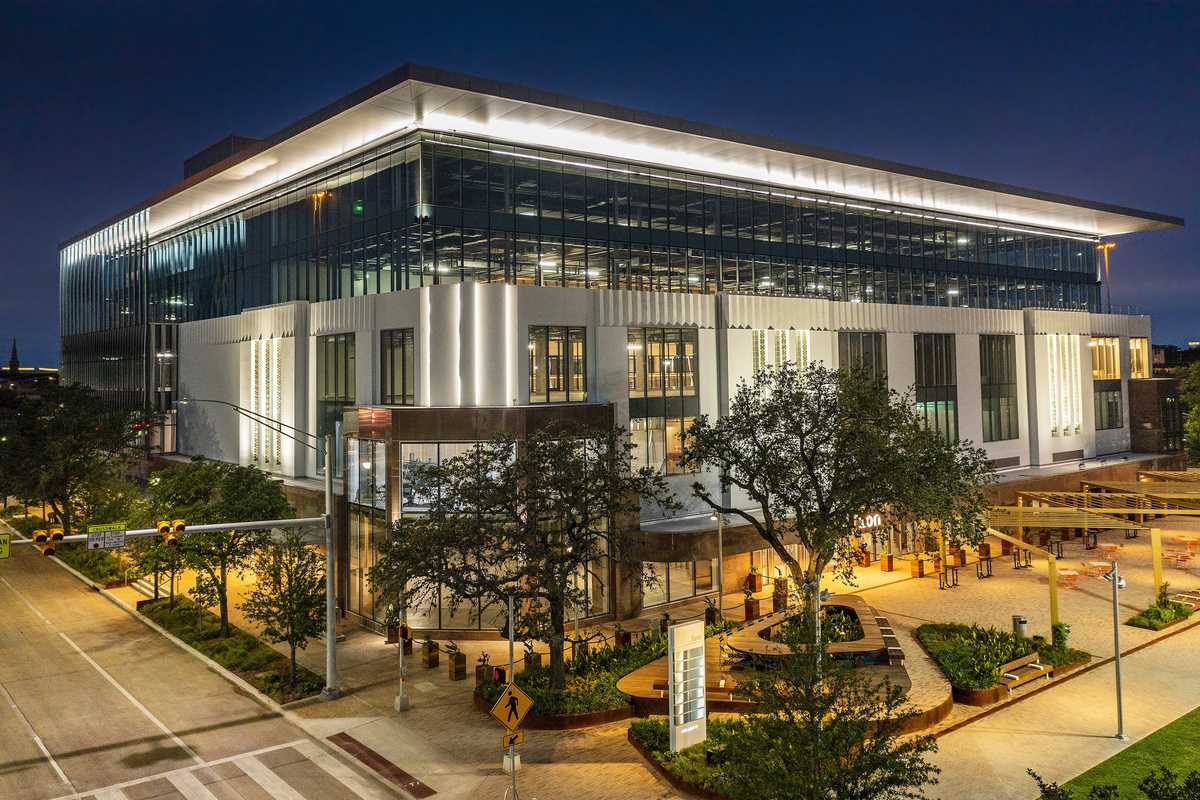
Houston-based Memorial Hermann could soon be part of one of the largest health care networks in Texas. Photo via memorialhermann.org

Two powerhouse medical centers have decided to team up to become one of the largest health care systems in Texas.

Houston-based Memorial Hermann Health System and Dallas-based Baylor Scott & White Health's board members signed a letter of intent to merge and create a combined system, according to an October 1 press release. A definitive agreement is expected to be complete in 2019.

"Together, we believe we will be able to accelerate our commitments to make care more consumer centric; grow our capabilities to manage the health of populations; and bend the unsustainable healthcare cost curve in the state," says Chuck Stokes, president and CEO of Memorial Hermann, in the release. "Through this combined system, we have a unique opportunity to reinvent healthcare and make a profound difference in the lives of millions of Texans."

The two systems together have over 68 hospital campuses, 1,100 care delivery sites, almost 14,000 physicians, and serve almost 10 million patients each year, according to the release.

The combined organization will operate under a unified board, led by Ross McKnight, the current chair of the Baylor Scott & White Holdings Board of Trustees. A vice chair will be selected by Memorial Hermann and will serve as the chair after McKnight's two-year term.

Jim Hinton, current CEO of Baylor Scott & White, will be the CEO. Stokes will serve in the proposed office of the CEO, along with current Baylor Scott & White president, Pete McCanna.

"Baylor Scott & White was founded as a Christian ministry more than 100 years ago; ever since, it has advanced health and driven change in North and Central Texas," McKnight says in the release. "This proposed combination starts the next chapter in the legacies of service and innovation for both systems. It will not only make a positive difference in the lives of millions here, it will become a national model."

Both organizations will maintain their brands and names locally. Executive and support staff will be based in the cities where the two entities currently have operations: Austin, Dallas, Houston, and Temple.

"This is about two mission-driven organizations — both committed to making safe, high-quality healthcare more convenient and affordable — building something transformative together," Hinton says in the release. "We must lead the change in our industry, while insisting we continue to fulfill our unwavering commitments to meeting the needs of all Texans."


Ad Placement 300x100
Ad Placement 300x600

CultureMap Emails are Awesome

Fast-growing Houston real estate startup surges to No. 7 on Inc. 5000

growth report

Houston-based Epique Realty has ridden the AI wave to rank among the Inc. 5000’s 10 fastest-growing private companies.

With three-year revenue growth of 23,210 percent, the AI-powered real estate brokerage appears at No. 7 on this year’s Inc. 5000 list. The 2026 list ranks private companies based on percentage revenue growth from 2022 to 2025.

Epique, founded in 2021, also ranks as the No. 1 fastest-growing company in Houston, No. 1 fastest-growing real estate company in the U.S., and No. 2 fastest-growing company in Texas.

Epique’s annual revenue surpasses $91 million

Between 2022 and 2025, the company’s annual revenue skyrocketed from $391,654 to more than $91.2 million. In 2025, the brokerage closed more than 23,000 deals and surpassed $7 billion in total sales, elevating Epique to the country’s 14th-largest real estate brokerage as measured by volume.

Epique’s network has more than 4,000 agents.

“To debut in the top 10 of the Inc. 5000 is absolute proof that when you relentlessly put agents first, exponential growth takes care of itself,” co-founder and CEO Joshua Miller said in a news release.

“We didn’t achieve this by following the industry playbook; we achieved this by burning it,” Miller added. “By fully funding our agents’ success through free health care, proprietary AI, and world-class leads, we’ve built a company where agents can finally thrive.”

The company’s other co-founders are Chris Miller, chief operating officer and vice president of expansion, and Janice Delci, chief financial officer.

Epique expands business to Canada, Mexico, Australia

The Millers and Delci have guided the company’s rapid expansion.

“Scaling our corporate support team to match [our] hyper-growth while seamlessly expanding across all 50 states and internationally to Canada, Australia, and Mexico takes an incomparable operational infrastructure,” Miller said.

“We have built an enterprise-grade technology ecosystem that allows us to absorb overhead and empower our agents at lightning speed,” he added. “This ranking validates that our disruptive model is working, and it is completely redefining the global industry standard.”

Epique launched its platform in 2023, touting itself as the industry’s first AI-powered brokerage. The startup’s platform provides AI tools for real estate agents to improve their marketing, streamline content creation, and boost engagement with clients and prospects.

Among Epique’s AI tools are:

  • ChatGPT for generation of property descriptions
  • AI-assisted creation of blog posts and agents’ bios
  • Production of Instagram quotes for social media marketing

“When we started Epique, we wanted to build a company that genuinely cared for its agents’ financial and physical well-being,” Delci says. “To see that vision translate into this level of historic record-breaking growth is a beautiful testament to the true power of radical generosity.”

Epique and fellow honorees will be recognized Oct. 14-16 at the 2026 Inc. 5000 Conference & Gala in Dallas.

Six other Houston-area companies land in top 250

Here are the six other Houston-area companies that claimed spots in the top 250 on the Inc. 5000 list. Each company name is followed by its ranking, headquarters city, and three-year growth rate.

  • No. 27 Empact Technologies, 8,275 percent
  • No. 60 Action1, 4,512 percent
  • No 75 Signs By G, 3,684 percent
  • No. 79 The ’Pause Life, 3,469 percent (Galveston)
  • No. 110 Turtlebox Audio, 2,576 percent
  • No. 178 Dahnani Private Equity Group, 1,904 percent (Stafford)

How did companies in Texas’ other major metros fare?

Here’s a breakdown of companies in the Austin, Dallas-Fort Worth, and San Antonio areas that made the top 250 on the Inc. 5000. Again, each company name is followed by its ranking, headquarters city, and three-year growth rate.

Austin (10 companies)

  • No. 9 Investment Watches, 15,741 percent
  • No. 72 Razor Metrics, 3,856 percent
  • No. 91 Autonomize AI, 2,921 percent
  • No. 102 Choose Your Horizon, 2,719 percent
  • No. 132 Wander Staffing, 2,296 percent
  • No. 144 Everyday Dose, 2,179 percent
  • No. 148 NetRise, 2,118 percent
  • No. 163 Nutrabound Labs, 1,999 percent (Bastrop)
  • No. 179 Steadily, 1,890 percent
  • No. 208 Tiny Health, 1,624 percent

Dallas-Fort Worth (11 companies)

  • No. 3 Yantran, 258,740 percent (Allen)
  • No. 12 Paek Management Group, 12,520 percent (Irving)
  • No. 82 Elite Robotics and Automation, 3,334 percent (Fort Worth)
  • No. 133 Outamation, 2,291 percent (Southlake)
  • No. 147 Red Creek Solutions, 2,119 percent (Frisco)
  • No. 155 JobTread Software, 2,071 percent (Dallas)
  • No. 164 DAX Eyewear, 1,977 percent (Nevada)
  • No. 186 Optimized Waste Removal, 1,830 percent (Fort Worth)
  • No. 204 Freight Flex, 1,642 percent (Denton)
  • No. 212 Maverick Power, 1,591 percent (McKinney)
  • No. 229 Innovative Life Sciences, 1,494 percent (McKinney)

San Antonio (one company)

  • No. 118 Hire With Near, 2,421 percent

Amazon to expand Prime Air drone delivery to almost 500 U.S. cities

In the air

https://sanantonio.culturemap.com/news/city-life/prime-air-expands-service-texas/By the end of the year, more Texans may be able to get ultrafast deliveries through Amazon’s Prime Air drone delivery service. On Wednesday, August 19, the company announced plans to majorly expand drone delivery to nearly 500 cities in the U.S., a sixfold increase from its current footprint.

Although Amazon did not reveal the cities it is targeting for the expansion, it almost certainly will include Texas. The state, which ranks among the biggest states for ecommerce activity, is currently home to four of the nation’s 11 Prime Air sites, including the Houston suburb of Richmond, as well as San Antonio, Waco, and Richardson (near Dallas).

For drone deliveries, the company tends to target areas unencumbered by skyscrapers and major airports. Each facility covers a delivery area of approximately 175 square miles.

Prime Air deliveries must be five pounds or less and fit into a large shoebox. Still, Amazon says more than 60 percent of its most ordered items are eligible. The list includes groceries, cosmetics, medications, clothing, and small electronics like Apple AirPods and Ring doorbells. More fragile items — like eggs — are not available through the service.

Orders arrive as quickly as 30 minutes, with most packages dropped around 60 minutes after checkout. Prime members will enjoy free delivery on orders $50 or more and a $2.99 fee for orders under $50. Non-members pay $4.99.

Amazon drone delivery Photo courtesy of Amazon

According to Amazon, customers should have little worries about orders being damaged or drones being entangled in trees. Shoppers see and confirm their delivery point when placing their first drone delivery order and can select a new area at any time.

Amazon also sends a notification to customers if there is no safe delivery space and does not fly at night or under severe weather conditions. The retail giant says noise is minimal with sound levels similar to idling delivery trucks.

Georgia, Ohio, Illinois, Idaho, and New York are the first states on the expansion plan. All future sites will be subject to regulatory hurdles like zoning changes, but the company is confident it will be serving tens of millions of new customers by year-end.

---

This article originally appeared on CultureMap.com.

Telsa targets Houston area for new $10 billion manufacturing plant

Project Sun City

Electric vehicle and clean energy company Tesla is considering building a new $10.1 billion solar cell manufacturing facility in Fort Bend County, according to documents filed with the Texas Comptroller’s Office.

If approved, the plant, called Project Sun City, would be located on a 3,050-acre site off FM 762 and FM 1994 in Richmond, Texas. Tesla aims to finish construction in 2028, with the plant being operational by early 2029.

The plant will manufacture photovoltaic (PV) solar cells and modules that can convert sunlight into electricity. PV Magazine reports that the facility is "the largest single manufacturing investment Tesla has proposed on paper."

Advisory and consulting firm Kroll submitted the documents to the Texas Comptroller of Public Accounts and noted if an agreement regarding tax incentives isn't reached, the project will exit Texas.

Tesla has requested credits under the Jobs, Energy, Technology, and Innovation (JETI) Act. The incentive program aims to attract large, capital-intensive economic development projects by lowering the property taxes an entity must pay over 10 years if it meets requirements related to job creation and investment. For example, pharmaceutical giant Bristol Myers Squibb Co. recently announced that its forthcoming $2.3 billion Houston-area manufacturing site is a qualified project under the JETI program.

Kroll predicts that the facility would create 9,712 new full-time jobs, over 1,100 construction jobs and billions of dollars in future property tax revenue, the documents show. Additionally, it says the project will spur $1.1 billion in local business expenditures and that Texas would increase its GDP by approximately $107 billion as a result of the project activities.

Tesla opened its $200 million Megafactory in Brookshire, Texas, last year. The company is continuing its goal to deploy 100 gigawatts of solar manufacturing in the U.S before the end of 2028. According to the U.S. Energy Information Administration, 100 gigawatts is equal to about 8 percent of the country's power grid capacity.

---

This article originally appeared on EnergyCapitalHTX.com.